
Advanced or not Advanced
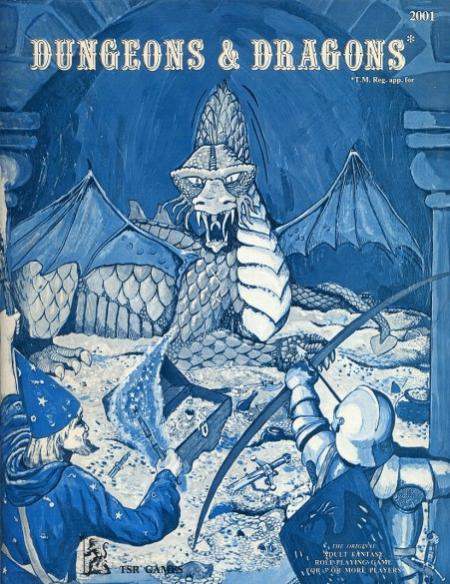 Returning to the long line of D&D editions, a successor appeared in 1977, now in two forms. The first was the "Blue Box", full of "every good thing", also called the Basic Set. But if there is a Basic Set, there must be another set too, at least in the plans. The AD&D brand, Advanced D&D, appears at this point—at least in theory. Practice is a little different. More than a little, in fact. In any case, the Blue Box also had many printings, with slightly altered rulebooks running to a hefty forty-eight pages at the time. That may not seem much today, but remember that games of barely a few pages published in magazines had been common until then. Three booklets, each thicker than a magazine, together with supplements and modules, made for a very extensive, complex game by the standards of the day. Until AD&D appeared.
Each such set included an adventure module, and which one depended on the printing, so a new version could sometimes be worth buying. Such extras in a reprint or revised edition offered value even to owners of the previous version. The Basic Set was assembled with "outside help", focusing primarily on beginners. It is also true that, according to some rumours, one reason for pushing the Basic Set was to make it D&D's successor, thereby keeping Dave Arneson—who died in 2009—out of AD&D. "Cleverly squeezing him out" may have been the first major scandal, but it was not really about fans and did not affect them. Still, removing him effectively removed Blackmoor from D&D's mainstream.
"Squeezing out former co-creators" and manipulating a world or system to do it is therefore not a uniquely Hungarian practice, nor does it make life difficult only for M.A.G.U.S. fans. D&D fans were fortunate that several different worlds were involved. Unfortunately, changes of concept and many other little things often affected more than a single world. At the same time, AD&D and D&D were then two different games, partly aimed at different audiences. In that respect, the solution was more elegant than the Summarium-style renewal offered for M.A.G.U.S.
B1, In Search of the Unknown, was Mike Carr's adventure module, included in early Blue Boxes. It had few successors, unlike Gary Gygax's B2, The Keep on the Borderlands, which later had a successor of sorts in Return to the Keep on the Borderlands for AD&D second edition. Their letter codes also indicated that they belonged to a series. Many more adventure series marked with different letter codes followed. We will have to return to these in greater detail, since it is often not so simple. The point is that some of these adventure modules are iconic products.
For now, it is worth remembering that the B-series comprised several parts. Alongside conventional adventures played with a party and DM, it included a "BSOLO" adventure allowing single-player play. Later D&D and AD&D history also featured adventures for one player. Some required a DM's participation, while others were truly "single-player" games anyone could play independently.
This seems a little odd today, but is almost perfectly understandable for a dungeon-focused adventure with little social interaction or roleplaying. In dungeon crawls at the time, how a DM controlled monsters mattered less, so playing solo—even without a DM—did not take much away from tactical combat either. Although a solo adventure offers more, it does not differ greatly from the Fighting Fantasy gamebooks familiar in Hungary. Here, however, the character can readily continue into another adventure.
All nine adventure modules were made for the Blue Box, and therefore for characters from first to fourth level. It is also worth noting that the Blue Box's rule booklets were thinner partly because a book for beginners did not need high-level spells, powerful magic items or stronger monsters.
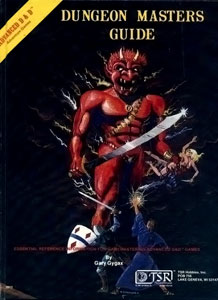 As mentioned, AD&D's release was also on the agenda, but only the Monster Manual appeared in 1977. The Player's Handbook followed in 1978, and the Dungeon Master's Guide in 1979. So far, the Advanced books seem to offer a clear next step beyond the Basic Set. The three books really were hefty: compared with earlier forty-eight-page rulebooks, a volume running to hundreds of pages certainly seemed so. With books so much thicker, I hardly need mention that the game contained many new rules and brought many new possibilities. We could say that AD&D's product line perfectly complemented D&D's existing line and covered the market. D&D was there for beginners, and AD&D perhaps offered a direct path onwards.
Reality, however, was slightly different, as we must realise in 1981. The Magenta Box appeared, accompanied by the Light Blue Box. One was the D&D Basic Set, the other its Expert Set, with rules for play from fourth to fourteenth level. The Basic Set contained the rules' "second revision", though the edition number varies. Naturally, the Expert Set also included an adventure module: X1, The Isle of Dread. How do we advance beyond fourteenth level? A good question. The intention was for several other boxes to help with this, but this Light Blue Box had no higher-level sibling. For now, the plan remained only a plan. D&D rulebooks could therefore be thinner partly because they did not need higher-level monsters, spells and items... And the existing selection was divided among books intended for different levels.
In any case, for players less fond of reading, a few "rule booklets" resembling those supplied with board games and wargames surely looked less frightening than a pile of three thick core rulebooks and their supplements. This partly affected the game's marketability, even if all the booklets in several boxes added up to more reading. Oddly, D&D Essentials later returned to this boxed, booklet-based format, at least for the starter box, which covers only first and second level. For later levels, however, it offers a single core book—so many people again see a thick book at the table—and has quite a few supplements.