
Clubs and organisations
Today, most demonstration games, events and so on are associated with shops, for two simple, logical reasons. Events and regular opportunities to play attract players. If they visit a shop to play, the staff, who also know their game, can persuade them to buy things more easily than if they first have to reach everyone with advertising leaflets, for instance, and encourage them to come in. Local shops have an interest in supporting players and events to expand their customer base, because the enlarged market is what they live on. It is no accident that Tuan's shop hosts regular M.A.G.U.S. events either.
At that time, however, very few shops seem to have been involved in wargames deeply enough to offer serious opportunities to play, leaving clubs in basements and garages. Oddly, here in Hungary most clubs have operated from the outset in cultural centres, schools or separately rented premises; garages and basements escaped conversion into clubs. Hungarian shops, meanwhile, mostly hold official events only for card games. These differences mean fewer clubs, and the absence of small clubs forming closed communities makes it hard for many people to understand how club life leads to the structure and design of adventure modules, and how this affects particular D&D editions. This is another reason learning D&D's history and these small details can be useful.
A game can succeed only if there is somewhere to play it. That requires clubs. Clubs, in turn, need many new things to help retain players. Many clubs naturally also offer comics and similar things, and places like these had room for a club in the basement too. There is nothing unusual about this arrangement. It is such a characteristic stereotype that films and games depict it. Many geek hobbies moved into basements, garages and similar places. We may be very familiar with this aspect of geek culture...
Another interesting point is that the IFW could effectively be a "precursor" to the RPGA Network from Gygax's wargaming period. The RPGA Network and the idea of international networks return later with Living Greyhawk and Living Forgotten Realms, where many game masters in many countries play the same game. Centrally coordinated events have a tradition in other areas too; it is interesting to remember this in connection with D&D Encounters for fourth edition. Fifth edition's Organized Play represents the same direction.
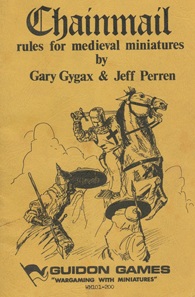 In other respects, life was not so different then: many clubs and groups made homebrew systems around particular ideas. Today it would be hard to say who was first at what or who invented what, unless we restrict ourselves to commercially released products. Were publishers or individual hobby shops behind them? A good question. But here we are already talking about the team behind Chainmail, one of D&D's direct precursors.
Around this time, local hobby-shop owner Jeff Perren is said to have developed his own medieval system, inspired by Siege of Bodenburg, and brought Gygax's group into the project. The original six pages of rules became sixteen and also appeared in The Doomsday Book, published by the Castle and Crusade Society. It was part fanzine, part society newsletter. The system and its supplements expanded, and by the first edition's publication in 1971, the book included a fantasy supplement. It was one of the first three fantasy wargames, but not the first. As far as I know, two preceded it. At least one deserves a short digression.