
The Early Williams Years
 It is 1987, the beginning of the Williams era, and quietly the story of the H adventure series, previously distinguished by battles designed for Battlesystem, is already being placed in a new world: perhaps this is where Forgotten Realms is born. Perhaps for good reason, too. Just as Blackmoor disappeared when its principal creator departed, Greyhawk could no longer remain the main direction, while Dragonlance was too restrictive. Many readers may know that in the Hungarian market, whenever a developer leaves M.A.G.U.S., the resulting rapid rewrites of the world produce retroactive changes, new contradictions and countless small problems. With D&D and AD&D, the usual solution was instead to close the old world or campaign and launch a new one. Players noticed the ruptures less, which I actually consider a good thing.
At the same time, this led to a slightly strange situation. Blackmoor soon dropped out of the picture, so little information appeared for it, while Dragonlance and Dark Sun made many changes to races and classes. But in the "mainstream" AD&D worlds, it was rather odd that the basic races and classes were identical. Is this what a knight is taught everywhere? Do priests everywhere know these spells? Do wizards cast spells the same way everywhere? Countless questions arose, primarily because D&D and AD&D were partly independent of any particular setting. In this respect it would be better if the system followed the world a little, but often that could hardly be the aim, since another aim of D&D and AD&D was to make it easy for the game master to create a world. Of course, this also left the worlds with roughly identical economies, and magic items had market prices that, strangely enough, were identical across worlds.
Suspension of disbelief. This, too, underpins our ability to immerse ourselves in our characters. But disbelief becomes harder to suspend the more fragmented and strange the world around the character becomes, the less alive the characters feel, and the more alien the system is to the world. How much did D&D aim to remain faithful to its setting? Good question. A good wargame simulates realistic battles, or battles faithful to its setting, and the S in TSR's name refers to simulation. Yet the pursuit of game balance and the possibility of competitive play—another wargaming inheritance—is fundamentally alien to a living world. The Dungeon Master's creative freedom in preparing an adventure would work against realism, since he is "allowed" to violate it; yet a world alien to its characters makes those characters harder to inhabit... Of course, nobody was engaging in theoretical discussions like these at the time. A world simply appeared around an adventure that had previously been "hanging in the air". Whatever our theoretical arguments, we have to regard that as progress.
Even if we know perfectly well that the characters were still surrounded by the unknown: the adventure merely mentions the world, nothing else had yet appeared for it, and the accessible world consists of a single tiny domain. Where do the characters' backgrounds connect them to? Fortunately, development soon gets underway, and before long a novel arrives too: Darkwalker on Moonshae. Originally intended as a standalone novel, it later became a trilogy. This epic fantasy takes place in a small area with its own mythology, which might have justified a separate world. But it worked just as well as a book belonging to TSR's new world, heralding the arrival of the new setting book. How deliberate a choice was this novel? How did they manage to publish it before the setting book? Interesting questions.
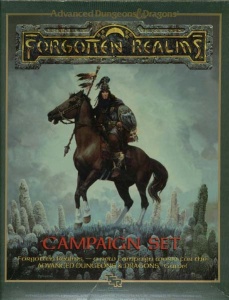 Of course, Forgotten Realms did have a history. In fact, the world's birth predates D&D itself: Ed Greenwood was already writing stories set in it as a child in 1967. That was seven years before D&D appeared, six before TSR was founded, four before Chainmail's official release... Forgotten Realms was born around the time Gygax first encountered the idea of Chainmail. Chainmail did not yet have a fantasy supplement, so there were probably no real antecedents to either Greyhawk or Blackmoor at that point. AD&D's new world was therefore also the AD&D world with the longest history.
Ed Greenwood had been involved with D&D since 1975, but it was AD&D's first edition that drew him deeply into the system. Since The Dragon published plenty of material by outside contributors, it was hardly surprising that Greenwood's articles appeared there too. He placed his writings about monsters and magic items within a single world. The world's concept already existed, and Greenwood's own group's adventures took place there. But it is very unlikely that anyone outside his small circle of friends knew it as a world before 1986, or that anyone would have written a novel specifically for it. It is far more likely that the world's openness made it easy to fit all sorts of things into it. Although its foundations existed, Greenwood invented many things as needed, leaving enough blank spaces for everything. At least, that was what Jeff Grubb learned from Mr Greenwood when he approached him in search of a new AD&D world. An open world looked ideal for the AD&D second-edition project that had meanwhile begun, and could easily become AD&D's new default setting. It seemed more promising than the somewhat closed Dragonlance. That is how Forgotten Realms became an AD&D success story.
Which brings us to the release of the setting book, an immediate enormous success. The review in The Dragon said this was genuinely a world made for gaming, rather than a setting created as the background to literary works, like Middle-earth or, among AD&D worlds, Dragonlance. Compatible with plenty of previously published material, colourful characters, diverse peoples: everything good that could be said at the time. TSR's magazine was reviewing TSR's flagship, so alongside a few insignificant objections to establish credibility, its pages could repeat all the virtues the marketing team had devised. Wasn't it wonderful that most magazines were still tied to publishers back then, and there was no Internet, for example?
I am not asking that as a joke. A roleplaying world dies without players. Other people may be interested, but they do not buy it because they cannot see any players for it, so you cannot see them as players either. Having this effective mouthpiece still operating made Forgotten Realms much easier to sell than the probably equally imaginative Eberron would be later. Of course, marketing by mouthpiece and somewhat one-sided magazines had their drawbacks too. But it is better to remember the good things about the past, and Forgotten Realms was a fine success. There was reason to celebrate it, even if some strange releases soon followed. The H4 adventure, for example.
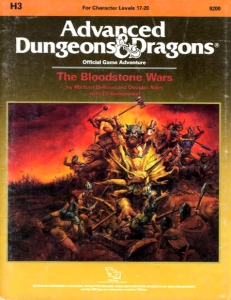
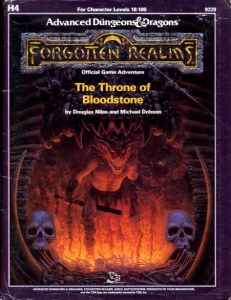 Remember H3, mentioned not so long ago? It was an interesting story. H1 began as a standalone adventure, primarily intended for Battlesystem fans, packed with large battles... But I do not want to repeat everything. Nor repeat that many people think the adventure series certainly was not originally written for Forgotten Realms. Although The Throne of Bloodstone carries the Forgotten Realms logo on its box, it is connected not to the world's own mythology but to Orcus and Vecna, familiar from Greyhawk, where their roots lay. TSR quite clearly believed its beautiful new world's openness could accommodate anything.
That mindset persisted for quite some time. In any case, this adventure for levels 18–100 went a little over the top in many respects—more than a little—yet it is perhaps one of the better-known entries. Perhaps precisely because it was considered suitable up to level 100. I do not imagine there were many level-100 AD&D characters at the time, though there were surely clubs that went a little wild with XP awards. Still, it is an interesting fact that the first adventure released under the Forgotten Realms logo was written for levels 18–100. Of course, many would say the setting is sufficiently over the top to suit it.