
TSR enters the scene
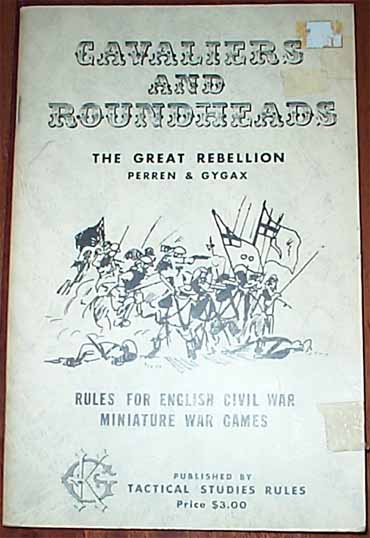 Cavaliers and Roundheads was TSR's first game. I would even call it their first roleplaying game, because it already contained many roleplaying elements. Or say that "this was what they had instead of Kickstarter", the available form of crowdfunding. At least for a new, independent publisher, this was "the opportunity". Published in 1973 after TSR's founding, this little booklet of barely a few pages primarily aimed to raise the money needed for D&D's first edition. The thirty-six-page booklet cost three dollars at the time.
History remembers Chainmail, previously published in partnership with someone else, as Gygax's first commercially released game. Fewer people remember this one. Yet it matters. This is not a little item that fits in a magazine, but a standalone rule booklet. Oddly, Hungarian roleplaying publishing also began with rule booklets: the system Harc és Varázslat (Harc és Varázslat: Harc és Varázslat appeared years before M.A.G.U.S., in two forty-eight-page booklets. It can still be bought at Silverland) was published in two booklets. But to return to Cavaliers and Roundheads:
The game covered the English Civil War and its characteristic soldiers. Little was made for the core rules, naturally, since it was intended from the outset as only a "temporary" product. Accordingly, neither "campaign" nor "module" appeared here yet. Competitors used both terms, though, and they probably came up quite often in Gygax's club too. We need not look far for the reasons.
As we can see, many contemporary games covered wars and military campaigns. Individual battles suitable for a single session combined into a campaign, the consequences of each victory mattered, and the true, final victory in the shared play of many club members came at the end of the "war", the "campaign". The word campaign thus refers to a military operation, not a character's life story. An interesting little historical detail in roleplaying's history. An interesting word that explains much. It also reveals that the question "Is fourth edition still D&D?" is flawed from the outset: with fourth edition, D&D effectively returned to its roots and tried to revive its traditions. Is that good? A good question. I promise we will return to it.
If a game sometimes covered a preplanned campaign, events that fitted into many campaigns because of the game's more "modular" structure could rightly be called modules. That is why prewritten adventures are still generally known as adventure modules. This term's origins also lie primarily in this period and in clubs formed around tabletop strategy games. Why were these needed? Because a campaign could contain many forest ambushes and similar events that could be inserted at numerous points. This made assembling a wargame campaign easier. The modular structure of wargame campaigns was easy to inherit.
A module generally contained all the information needed to play, including a map, making it easy to insert at many points in a longer campaign. Perhaps this also explains why early D&D publications tended towards shorter adventures, with the aim that whoever happened to gather at the club could play. The connection between roleplaying, club life and existing geek culture is thus related too. Even then, however, a serious question was which results from one adventure carried over to the next. We can leave that until we discuss the first adventure modules and module series, because a roleplaying campaign is a slightly different story.
Why is the term absent here? Because most of D&D was already finished. That was the longer-term product, and highlighting the temporary solution's expandability would not have been worthwhile. But the fact remains that we have reached D&D's direct predecessor, after which the first D&D will no longer be such a great novelty.