
Famous attempts: Hyboria and Chainmail
English wargamer Tony Bath played within his own circles and, like so many people at the time, "published" his own rules and campaign in some form. His Hyboria campaign was the first fantasy wargame, included roleplaying elements, and was based on the Conan the Barbarian stories. It still lacked magic, among other things. Nevertheless, Gygax's group had been beaten to the first fantasy wargame. It had a substantial story and a "newspaper", and we must also accept that "roleplaying elements" first appeared here. We could even associate the foundations of modern roleplaying with Bath. But fate chose otherwise.
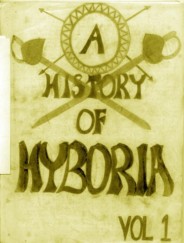 Primarily because the Hyboria campaign remained a wargame, and Tony Bath, born in 1926 and deceased in 2000, remained a wargamer. Although the game based on Conan's stories had few direct successors, we should not stop the story here. Conan's author maintained fairly close ties with Lovecraft's circle. The creation of worlds and mythologies that accompanies roleplaying can also be traced to this circle's work, alongside Tolkien's, of course. But the idea of multiple creators and sometimes shared worlds, as well as brands associated with many different worlds and visions of them, is interesting in this circle's work too. That trend continues to this day. Why did we not begin our story with this? Because D&D is more about the game than the story or the world, making those gaming roots more important. But let us return to those writers' work...
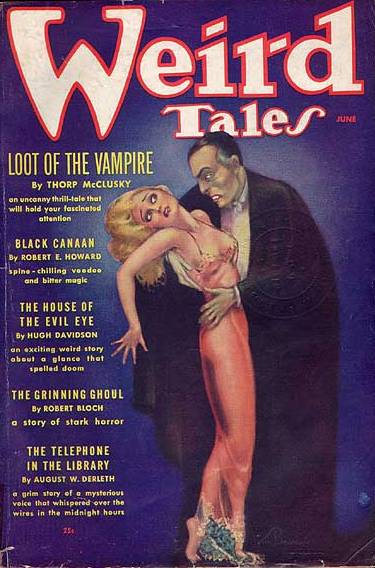 Alongside personal and working relationships, some character names are also said to move back and forth. An idea for a wizard in Robert E. Howard's work may become an important monster, high priest or other major figure elsewhere. Games previously drawing mainly on history now clearly gain another source. Why? I would point to Weird Tales. Customers of hobby shops also dealing in comics and fantasy and science-fiction magazines surely knew this celebrated author. Fantasy and many other things fell under "weird tales", which helped make them interesting.
This adaptation of Hyboria, however, did not become a product or a rapidly spreading innovation that changed the market. Anyone researching the subject a little will find it, but it is not what the world remembers. I think the reason is understandable. Yet the creators behind Weird Tales remain part of roleplaying's history as sources of inspiration. The fact that this particular game had no direct continuation then and there does not change that.
Chainmail did find a successor. That successor included many monsters, spells and other things Chainmail had already introduced, and this is precisely what made Gygax's role stand out. How widely the idea of roleplaying elements could have circulated around the world is a good question. Perhaps several people in different parts of the world thought of it at once; perhaps the idea travelled. Ultimately, it does not matter. Surprisingly enough, the story now turns to TSR's founding, followed shortly by D&D's publication. The road to D&D is now shorter.
But the Hyboria campaign raises another point. While many earlier wargames covered individual battles or depicted a war through campaigns, here we have a campaign built around particular characters and ten years of history. Longer-term goals and advantages make developing "units" important. If, because of the novels, a unit sometimes represents a specific person, character development follows naturally. Defining sides—alignment—and abilities and their use, also connected to personality, are part of the wargame toolkit too. Roleplaying elements therefore appear gradually.
If we do not assume these elements crossed the ocean from the Hyboria campaign, we must assume that this was not an innovation based on one unique idea, but the natural evolution of games also taking place in many other places. In that case, the same process could perfectly well have occurred in the now-forgotten games of many smaller groups; many people could have encountered these innovations in many places. Roleplaying's emergence therefore owes itself not to an "invention" or a unique idea, but to a natural evolution driven by the desire to convert the fights and battles of fantasy literature into wargame campaigns. That desire existed in many places.
Even today, nobody is surprised when a strategy game treats a hero as a unit, allows that hero to level up, and has us play similar campaigns on either square or hexagonal grids. Anyone calling this a precursor to numerous computer-game genres may well be right.