
d20 / Hasbro
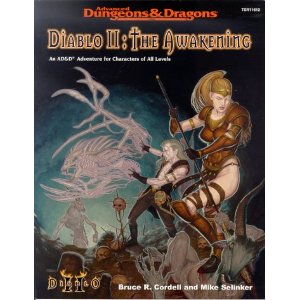 When ownership changes, AD&D's development takes a new direction, and some new considerations may come to define an era. We have become accustomed to this over the eras discussed so far. Let us look at an early Hasbro-era publication. In March 2000, AD&D / D&D adapts another new world. Isn't that cover on the left amusing? It is not nearly so funny, because the development team is also working on something else: D&D's third edition. They talk about the classic dungeon-crawl adventures of the good old days, when neither DM nor player needed much preparation, when there was little to invent about characters, their stories or the adventure, and AD&D / D&D was quick and easy to play. Well, the Diablo II adaptation fitted these aims and promises perfectly. Several books for it appeared from Wizards, now a Hasbro subsidiary.
But let us discuss something slightly different. We are still not at the third edition, just adding a little background to plans for a classic dungeon-crawl feel and a combat system based on maps and miniatures. By now Avalon Hill had been absorbed into Wizards, bringing a successful wargame and tabletop-game production team and all its infrastructure. Capital was now available to ramp up production again, and connecting it with D&D was no bad thing. Hasbro was traditionally strong in action figures: just think of G.I. Joe soldiers. And Hasbro operated on an entirely different scale from the companies we have encountered so far. Hasbro owned Monopoly, My Little Pony, NERF, Transformers, Nickelodeon and quite a few other familiar brands. Many branded shops, toy shops and hobby shops made an excellent living from its products. Meeting D&D's logistical requirements involved little significant extra work for it. It could also negotiate differently when booking printing capacity. As I said, a different scale. Accordingly, it viewed numerous things differently too, which would define the following years.
Yes, I mean the OGL, which the open-source community experienced as a triumph of its ideals. Reality was somewhat different. Hasbro did not want to take risks for small change, but knew D&D's success required many risky books that promised little money from the outset. The OGL therefore seemed a good solution. Especially when it knew it could not produce that many books itself: it wanted to adapt numerous worlds, from Diablo II through Call of Cthulhu and Star Wars to World of Warcraft. It simply lacked the resources for so many books, while licensing everything individually would have been difficult. It managed to pass the licence for Dragon, Dungeon and two other magazines to another publisher. For risky support with little prospect of profit, there was the OGL. This also potentially meant more worlds for its system, making switching between worlds even more natural. It strengthened ties with numerous publishers, AEG among them, and welcomed the arrival of small publishers producing PDF files.
The finished product, however, was not freely reusable or redistributable; the licence's aims and philosophy were far removed from open source. Few people cared at the time. Many eagerly awaited the third edition's release. No, not because of the still newer D&D-based Diablo II adaptation shown on the right. That certainly fitted the promised dungeon crawl, but less well the promised freedom. Players instead pounced on the new PHB, also shown on the left. It appeared in 2000. Some were delighted, since in many respects the freedom really was unlimited.
A character could have as many as twenty classes... Indeed, as eventually emerged with Savage Species, a character could have just as many mothers. The "unlimited combinability" of racial templates introduced us to the freedom of half-elemental, half-demon, half-golem, half-red-dragon, half-celestial, half-orc characters. The freedom of unlimited powergaming, ideal for dungeon crawls; booming character-optimisation forums; the period when almost everyone heard of builds called Pun-Pun and CoDzilla. Only a few grumblers remained dissatisfied, fantasising about creating characters that fitted the world and had good backgrounds. Hadn't they heard the system's lead designers promise efficient, classic dungeon crawling, without all the agony of creating stories and characters appropriate to them? A game with backgrounds like that, characters that fit their world and numerous personality traits must surely be some other game. Many celebrated D&D's third edition, and at least as many quietly thought: I can get this sort of dungeon crawl at my computer, and went off to play Diablo. Once again, I do not mean the D&D-based version shown here.
Many of us would have welcomed more realistic character creation following the character's story, where learning takes time and a character must make do with two parents; where the world's limitations are sacred; where spell descriptions explain not merely what to roll and how their areas cover miniatures standing in different squares—discussed under combat, for example—but how they actually work in that world. Hasbro, however, wanted to sell miniatures, battlemats and "collectible" rulebooks that aided powergaming for a setting conducive to brisk club play, rather than descriptions for people interested in details. Descriptions already existed: select the details from those, and a setting no longer needs a large box, just one book... Plenty of publishers could have produced suitable books, of course, and Hungarian publishers could target the PDF market too. But this audience meant lots of work, little profit and measurable risk. Publishers targeting it generally did not switch to the d20 System. Or made a terrible mess of the switch.
And to keep the amount of text from looking meagre, it was easy to fill the pages with attractive design. Nobody would write notes on them anyway; players pondering connections were hardly the aim. Star Wars d20 soon appeared, as did Call of Cthulhu d20 and the World of Warcraft RPG. The aim was to get plenty of people buying Hasbro products. This worked only partly. Nevertheless, D&D's third edition was a successful game, and had I wanted dungeon crawling then, I would certainly have chosen it too. But remember: promising to bring back the simple dungeon-crawl experience of old necessarily signalled a change of direction. Development reversed course. Of course, tastes differ. Some welcomed unlimited powergaming, dungeon crawling, collecting treasure and many other things. Others thought they did not care about the philosophy behind the system: they would handle its flaws and try roleplaying under D&D 3 too.