
D&D Miniatures
Anyone who doubts that this period saw a shift towards miniature combat games should certainly look at the Miniatures Handbook and D&D Miniatures. Yes, these packs of figures revived a phrase familiar from the early card-game boom: "Two displays of that as well, please." Many people bought entire cartons. A secondary market developed for the figures, cheaper ones were bought on impulse, and revenue grew... Small wonder, then, that Hasbro did not want to sideline miniatures. Especially when a very vocal part of the community said it welcomed more tactical combat, all those lovely figures and dungeon crawling. It was not a bad game, just different from what many of us expected.
Naturally, it also exploited players' urge to collect. Some of this is simple biology. Yes, it had already been one of Magic's secrets. When you buy without knowing whether you will get something good or bad, a lucky purchase makes you happy. Your brain then associates that pleasure with opening and buying the little packs. Feeling down? Need endorphins? Pleasure releases them... What gave me that feeling last time? Oh yes, opening boosters. Off to the usual shop, then, to buy D&D Miniatures or Magic. This kind of addiction is good business, whether it involves illegal drugs or the excitement of opening a booster and the pleasure of seeing a good card, die or miniature. Yes, the excitement of opening packs releases a hormone that helps you become addicted. Do you think marketing professionals working with professional psychologists fail to factor this in? You are mistaken.
Copying Diablo II and WOW may likewise have primarily aimed to reproduce their correctly paced sense of achievement. You know from that logo that the game will be exciting—PVP releases adrenaline—and that you will experience success. If your body craves this, the resulting addiction will make you seek that logo just as extreme downhill enthusiasts seek their bicycles when they need adrenaline. The same feeling lies behind miniature collections that are hardly ever used. It is also the secret of dungeon crawling: it is bloody reliable. At predictable intervals an encounter arrives; with a little excitement and effort, you beat the monster, and receive the satisfaction and reward. Your body responds with hormones, whose arrival at the right intervals can become addictive. Someone addicted to playing for their daily loot will not go looking for a different, riskier, deeper game.
D&D delivers this perfectly. That sense of achievement relieves stress, and it is much better to see a happier person remembering it than someone made grim by their own failures, who sees only the pub as a solution amid worries about work and the mortgage, and takes their aggression out on their wife rather than beholders and dragons. It is a simple, functional game for a shrinking market. A substance with which getting people hooked becomes increasingly difficult, because many of roleplaying's advantages as a meaningful hobby have disappeared from it. Yet it can be produced and sold with bloody impressive efficiency. Of course, many things are different today: we have 3D printing and customisable 3D models.
To be fair, for a long time I too looked elsewhere for the defining merits of editions 3 and 3.5 and Miniatures. The average player does not analyse the game's effects and their enjoyment through the hormonal system, neurology and biochemistry. They simply enjoy dungeon crawling, and remember the adventures, the game's momentum and the pleasure associated with a character they love and that character's successes. They are unlikely to analyse beyond that. They simply look forward to the next adventure, miss it if they do not get it, organise some of their days around the game and become an extremely reliable customer.
 Simply because the weekly adventures and familiar pleasure somehow also become intertwined with the sight of a particular logo.
Much of the history of editions 3 and 3.5 remained tied to previously established worlds, and unsurprisingly the default setting was Greyhawk. Dungeon-crawl adventures long characteristic of the first edition, in the world associated with that edition, and a newer, cleaner, even more overpowered experience that could again take you all the way to level 100, surely satisfied many people. Others remained enchanted by the hugely successful Forgotten Realms. For a long time, new settings meant licensed worlds such as Warcraft and Diablo II. But the history of edition 3.5 would not be complete without a beautiful new world faithful to D&D's new values.
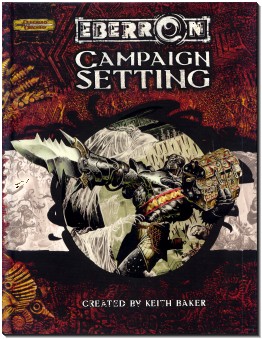
Yes, Eberron appeared. Unsurprisingly, it was somewhat freer in many respects, offered more possibilities in many areas—not just for powergamers—and helped make characters faithful to their world possible again. At least partly. New races were nothing new after Savage Species, but the world already pointed forward to the fourth edition. Who would have thought this beautiful new world would become the fourth edition's default setting? Although it appeared for edition 3.5 in 2004, it was no real breakthrough. It was developed from the ideas of the winner of a 2002 competition, with Wizards / Hasbro reportedly choosing from more than 11,000 entries. The story does not tell us which criteria they used: existing players' interests? Marketing considerations for attracting new players? In any case, it is a very interesting little world. But many people wanted to play in an already familiar world, their current favourite, while others associated the taste of success with familiar logos. For understandable reasons, the Eberron book lacked the logo of their familiar setting.
As I said, Hasbro operates on another scale. It is not pursuing a hobby but making money, and it is professional at that. The next page discusses events surrounding the fourth edition.