
The history of D&D does not begin with D&D, but with a long line of precursors. That was already true of the corresponding article on this site's previous incarnation. Since then, however, D&D's history has continued: fifth edition has appeared. The world and the market around D&D have changed too. So has this site, including the possibilities it offers. Four years have passed. In four years, D&D changes a great deal, the world changes, and so do we ourselves. D&D's latest attempt at renewal meant this article needed renewing too. But if the article is both long and revised, we must make sure returning readers get something new when they read it again.
Hassenfeld Brothers — The present publisher's past
Today, the multinational company Hasbro stands behind D&D. In 1923, the company began under the name Hassenfeld Brothers (Hassenfeld Brothers: The three Hassenfeld brothers, Hillel, Herman and Henry, started out as a small family company. Trading in textiles, from textiles). It was founded by three brothers and dealt in textiles. Like so many businesses in the English-speaking market, it did not have a separate legal personality until 1926. Pencil cases and other school supplies were followed by pencil manufacturing. Money earned from this let them enter the toy industry in the 1940s with a "play doctor" toy. Modelling clay and a doctor set were unremarkable, run-of-the-mill products, but 1952 brought Hasbro its first success: Mr. Potato Head, a set with which "children could make funny faces out of any vegetable". For us, though, 1952 is interesting for another reason. Even at this point, the company's story would still tell us little about the history of roleplaying.
The ABC of Wargames: Avalon Hill
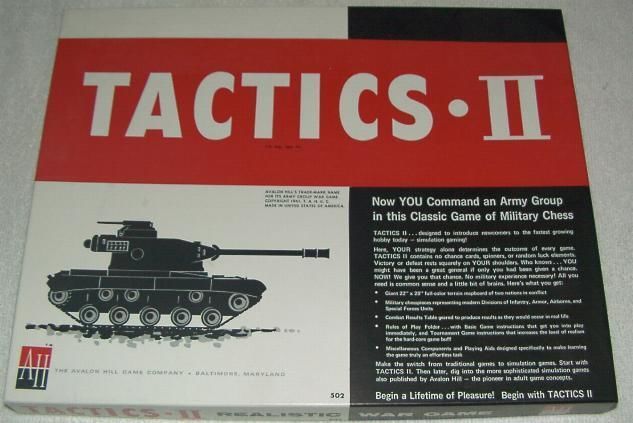 1952 really matters to us for a different reason: a certain Charles Swann Roberts publishes his strategy game Tactics, the first tabletop strategy game of its kind. To publish his own game, he establishes The Avalon Game Company, later known as Avalon Hill. The second edition of Tactics appears under the company's new name. America takes to tabletop strategy games relatively quickly, and Avalon Hill soon publishes more: Gettysburg, U-boot, D-Day, Civil War and Stalingrad. All military themes drawn from Earth's history.
Since Avalon Hill's name will recur in the history of roleplaying, it is worth remembering, even though the company is primarily a heavyweight in strategy games. One event crucial to D&D's history is the 1964 launch of its magazine The General, with just six issues a year. It lasted until 1998, when Hasbro—the company now also associated with D&D—bought Avalon Hill and discontinued it. Yes, this was the first official magazine from the world's first wargame publisher. A shame to lose it.
In the United States, games like these began gaining ground immediately after their appearance. Clubs formed around them, in a process that continued for decades. People chose the latest wargame session over rock and roll or sport on a Friday evening. Let us say that these communities gave birth to the first roleplaying game and many of its precursors. Such tabletop strategy games were considerably more complex than many familiar board games of the era. A hobby had begun. Unlike the roleplaying games that followed, individual players here played against one another.
Chancellorsville, appearing alongside Gettysburg, used the same game system, making a change of "board" and setting an interesting option. Naturally, games simulating one particular situation continued for a long time too. This way of operating was good for business. But games using the same rules, followed by homemade boards for them, naturally led to games where players could create the battlefield themselves. That provides the basis for substantial campaigns and in-house tournaments.
Such campaigns felt natural in a game about war. Today's computer strategy games likewise present their stories as campaigns built on similar foundations. But this has a small consequence: more and more stories began to appear, sometimes adapting novels or cycles of novels with only a few miniatures.
SPI enters the scene
In 1966, Chris Wagner's fanzine Strategy & Tactics appeared as an "independent competitor" to The General, later becoming a substantial magazine. Its first few issues were published in Japan, where Wagner was stationed as a master sergeant in the US Air Force. When its founder was later posted home, the magazine began appearing in America too. Jim Dunningan took over and founded the publisher SPI (SPI: Simulations Publications, Inc. was an American strategy-game publisher that went bankrupt in 1982. TSR bought its brands and rights in 1983) for it. An interesting tradition began with issue eighteen: every issue included a complete game. And yes, SPI's name will return in our story too.
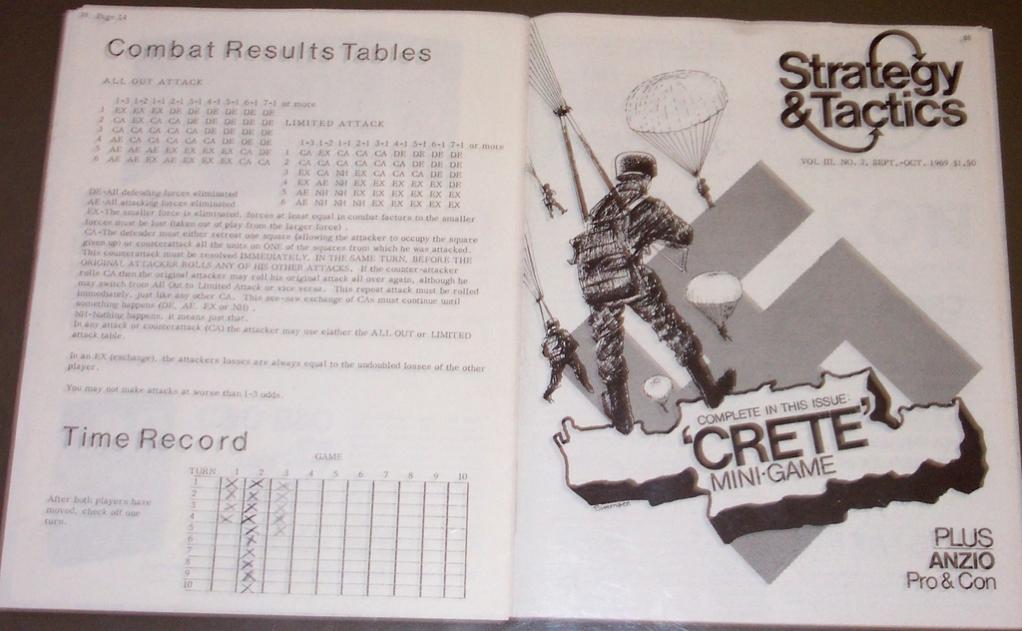
Although regular game publication alongside the magazine began with Crete in 1969, shown on the left, it did not come out of nowhere. Individual games had appeared in the magazine before. Among them was a little game from 1967 of particular interest to D&D's history. Publication in a magazine naturally affected its length and complexity, as well as requiring it to use miniatures and dice that were already available.
That 1967 game was Henry Bodenstedt's Siege of Bodenburg. It too had precursors, of course, including the 40 mm Elastolin figures and the castles made for them around which the game was built. O&M Haußer, the company making Elastolin figures, was founded in 1904 and was already producing them by 1910. Production of composite Elastolin figures ended in 1969, and of plastic figures in 1982. The company went bankrupt in 1983. It seems this period proved fatal both to SPI and to this miniature manufacturer.
We did not begin our story with them, though, because they were not seriously involved in either roleplaying or tactical games; apart from Siege of Bodenburg, their role would seem incidental. Gary Gygax's group almost certainly encountered that game. It was the first wargame played with medieval miniatures, bringing a major change after tanks and SS officers. But the credit belongs to Henry Bodenstedt and Strategy & Tactics; O&M Haußer was only a passive supporting player in the story.
Nevertheless, this game brings us much closer to D&D. Understanding that turning point required telling the story from Avalon Hill through Strategy & Tactics. But we must also glance back in time a little to understand where Gary Gygax and his group were when Siege of Bodenburg appeared in 1967. Not very far back: according to Wizards' website, he founded the International Federation of Wargamers—originally called the United States Continental Army Command—in 1966, while an interview on WomanGamers dates it to 1963.
According to Wizards' website, TSR's history begins with precisely this event. Gygax had encountered tactical games by buying Avalon Hill's Gettysburg in 1963—I promised we would return to Avalon Hill—which makes a 1966 founding seem more likely. It will therefore surprise nobody that he read the major magazines available at the time and encountered Siege of Bodenburg. The more familiar names are beginning to appear.
A year later, in 1968, the Castle and Crusade Society, supporting medieval tactical games or wargames, was established within the IFW, again founded by Gygax. The medieval direction now comes into view too. This year also saw the first Gen Con, then likewise associated with the IFW, which would grow into one of D&D's most important regular events. Gygax's local club was then called the Lake Geneva Tactical Studies Association, LGTSA. The phrase "tactical studies" in the company name Tactical Studies Rules also comes from here. This club operated mainly in Gygax's basement.
Clubs and organisations
Today, most demonstration games, events and so on are associated with shops, for two simple, logical reasons. Events and regular opportunities to play attract players. If they visit a shop to play, the staff, who also know their game, can persuade them to buy things more easily than if they first have to reach everyone with advertising leaflets, for instance, and encourage them to come in. Local shops have an interest in supporting players and events to expand their customer base, because the enlarged market is what they live on. It is no accident that Tuan's shop hosts regular M.A.G.U.S. events either.
At that time, however, very few shops seem to have been involved in wargames deeply enough to offer serious opportunities to play, leaving clubs in basements and garages. Oddly, here in Hungary most clubs have operated from the outset in cultural centres, schools or separately rented premises; garages and basements escaped conversion into clubs. Hungarian shops, meanwhile, mostly hold official events only for card games. These differences mean fewer clubs, and the absence of small clubs forming closed communities makes it hard for many people to understand how club life leads to the structure and design of adventure modules, and how this affects particular D&D editions. This is another reason learning D&D's history and these small details can be useful.
A game can succeed only if there is somewhere to play it. That requires clubs. Clubs, in turn, need many new things to help retain players. Many clubs naturally also offer comics and similar things, and places like these had room for a club in the basement too. There is nothing unusual about this arrangement. It is such a characteristic stereotype that films and games depict it. Many geek hobbies moved into basements, garages and similar places. We may be very familiar with this aspect of geek culture...
Another interesting point is that the IFW could effectively be a "precursor" to the RPGA Network from Gygax's wargaming period. The RPGA Network and the idea of international networks return later with Living Greyhawk and Living Forgotten Realms, where many game masters in many countries play the same game. Centrally coordinated events have a tradition in other areas too; it is interesting to remember this in connection with D&D Encounters for fourth edition. Fifth edition's Organized Play represents the same direction.
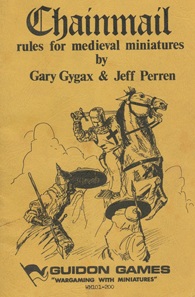 In other respects, life was not so different then: many clubs and groups made homebrew systems around particular ideas. Today it would be hard to say who was first at what or who invented what, unless we restrict ourselves to commercially released products. Were publishers or individual hobby shops behind them? A good question. But here we are already talking about the team behind Chainmail, one of D&D's direct precursors.
Around this time, local hobby-shop owner Jeff Perren is said to have developed his own medieval system, inspired by Siege of Bodenburg, and brought Gygax's group into the project. The original six pages of rules became sixteen and also appeared in The Doomsday Book, published by the Castle and Crusade Society. It was part fanzine, part society newsletter. The system and its supplements expanded, and by the first edition's publication in 1971, the book included a fantasy supplement. It was one of the first three fantasy wargames, but not the first. As far as I know, two preceded it. At least one deserves a short digression.
Famous attempts: Hyboria and Chainmail
English wargamer Tony Bath played within his own circles and, like so many people at the time, "published" his own rules and campaign in some form. His Hyboria campaign was the first fantasy wargame, included roleplaying elements, and was based on the Conan the Barbarian stories. It still lacked magic, among other things. Nevertheless, Gygax's group had been beaten to the first fantasy wargame. It had a substantial story and a "newspaper", and we must also accept that "roleplaying elements" first appeared here. We could even associate the foundations of modern roleplaying with Bath. But fate chose otherwise.
 Primarily because the Hyboria campaign remained a wargame, and Tony Bath, born in 1926 and deceased in 2000, remained a wargamer. Although the game based on Conan's stories had few direct successors, we should not stop the story here. Conan's author maintained fairly close ties with Lovecraft's circle. The creation of worlds and mythologies that accompanies roleplaying can also be traced to this circle's work, alongside Tolkien's, of course. But the idea of multiple creators and sometimes shared worlds, as well as brands associated with many different worlds and visions of them, is interesting in this circle's work too. That trend continues to this day. Why did we not begin our story with this? Because D&D is more about the game than the story or the world, making those gaming roots more important. But let us return to those writers' work...
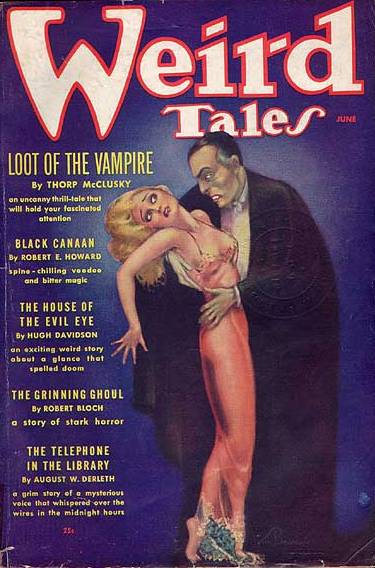 Alongside personal and working relationships, some character names are also said to move back and forth. An idea for a wizard in Robert E. Howard's work may become an important monster, high priest or other major figure elsewhere. Games previously drawing mainly on history now clearly gain another source. Why? I would point to Weird Tales. Customers of hobby shops also dealing in comics and fantasy and science-fiction magazines surely knew this celebrated author. Fantasy and many other things fell under "weird tales", which helped make them interesting.
This adaptation of Hyboria, however, did not become a product or a rapidly spreading innovation that changed the market. Anyone researching the subject a little will find it, but it is not what the world remembers. I think the reason is understandable. Yet the creators behind Weird Tales remain part of roleplaying's history as sources of inspiration. The fact that this particular game had no direct continuation then and there does not change that.
Chainmail did find a successor. That successor included many monsters, spells and other things Chainmail had already introduced, and this is precisely what made Gygax's role stand out. How widely the idea of roleplaying elements could have circulated around the world is a good question. Perhaps several people in different parts of the world thought of it at once; perhaps the idea travelled. Ultimately, it does not matter. Surprisingly enough, the story now turns to TSR's founding, followed shortly by D&D's publication. The road to D&D is now shorter.
But the Hyboria campaign raises another point. While many earlier wargames covered individual battles or depicted a war through campaigns, here we have a campaign built around particular characters and ten years of history. Longer-term goals and advantages make developing "units" important. If, because of the novels, a unit sometimes represents a specific person, character development follows naturally. Defining sides—alignment—and abilities and their use, also connected to personality, are part of the wargame toolkit too. Roleplaying elements therefore appear gradually.
If we do not assume these elements crossed the ocean from the Hyboria campaign, we must assume that this was not an innovation based on one unique idea, but the natural evolution of games also taking place in many other places. In that case, the same process could perfectly well have occurred in the now-forgotten games of many smaller groups; many people could have encountered these innovations in many places. Roleplaying's emergence therefore owes itself not to an "invention" or a unique idea, but to a natural evolution driven by the desire to convert the fights and battles of fantasy literature into wargame campaigns. That desire existed in many places.
Even today, nobody is surprised when a strategy game treats a hero as a unit, allows that hero to level up, and has us play similar campaigns on either square or hexagonal grids. Anyone calling this a precursor to numerous computer-game genres may well be right.
TSR enters the scene
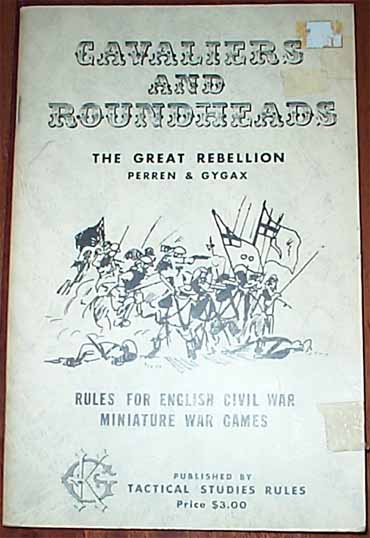 Cavaliers and Roundheads was TSR's first game. I would even call it their first roleplaying game, because it already contained many roleplaying elements. Or say that "this was what they had instead of Kickstarter", the available form of crowdfunding. At least for a new, independent publisher, this was "the opportunity". Published in 1973 after TSR's founding, this little booklet of barely a few pages primarily aimed to raise the money needed for D&D's first edition. The thirty-six-page booklet cost three dollars at the time.
History remembers Chainmail, previously published in partnership with someone else, as Gygax's first commercially released game. Fewer people remember this one. Yet it matters. This is not a little item that fits in a magazine, but a standalone rule booklet. Oddly, Hungarian roleplaying publishing also began with rule booklets: the system Harc és Varázslat (Harc és Varázslat: Harc és Varázslat appeared years before M.A.G.U.S., in two forty-eight-page booklets. It can still be bought at Silverland) was published in two booklets. But to return to Cavaliers and Roundheads:
The game covered the English Civil War and its characteristic soldiers. Little was made for the core rules, naturally, since it was intended from the outset as only a "temporary" product. Accordingly, neither "campaign" nor "module" appeared here yet. Competitors used both terms, though, and they probably came up quite often in Gygax's club too. We need not look far for the reasons.
As we can see, many contemporary games covered wars and military campaigns. Individual battles suitable for a single session combined into a campaign, the consequences of each victory mattered, and the true, final victory in the shared play of many club members came at the end of the "war", the "campaign". The word campaign thus refers to a military operation, not a character's life story. An interesting little historical detail in roleplaying's history. An interesting word that explains much. It also reveals that the question "Is fourth edition still D&D?" is flawed from the outset: with fourth edition, D&D effectively returned to its roots and tried to revive its traditions. Is that good? A good question. I promise we will return to it.
If a game sometimes covered a preplanned campaign, events that fitted into many campaigns because of the game's more "modular" structure could rightly be called modules. That is why prewritten adventures are still generally known as adventure modules. This term's origins also lie primarily in this period and in clubs formed around tabletop strategy games. Why were these needed? Because a campaign could contain many forest ambushes and similar events that could be inserted at numerous points. This made assembling a wargame campaign easier. The modular structure of wargame campaigns was easy to inherit.
A module generally contained all the information needed to play, including a map, making it easy to insert at many points in a longer campaign. Perhaps this also explains why early D&D publications tended towards shorter adventures, with the aim that whoever happened to gather at the club could play. The connection between roleplaying, club life and existing geek culture is thus related too. Even then, however, a serious question was which results from one adventure carried over to the next. We can leave that until we discuss the first adventure modules and module series, because a roleplaying campaign is a slightly different story.
Why is the term absent here? Because most of D&D was already finished. That was the longer-term product, and highlighting the temporary solution's expandability would not have been worthwhile. But the fact remains that we have reached D&D's direct predecessor, after which the first D&D will no longer be such a great novelty.
Early editions
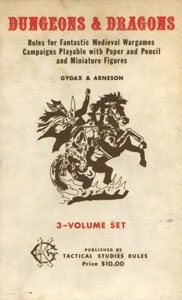 D&D's very first edition, the legendary "White Box" published in 1974, immediately offers a huge surprise. According to the box, it is not a roleplaying game: the word wargame appears again, the term for tabletop strategy or tactical games. Rules, in other words, for fantastic medieval tactical-game campaigns played with paper, pencil and miniature figures. Dice are not even mentioned. Nor is roleplaying. Interesting, isn't it? According to its developer, D&D's original edition was still very much a wargame, not the first roleplaying game. At least if we believe the wording on the box, the development team's affiliations and many other things. Simplifying D&D and giving it a somewhat "wargame" feel is therefore not a change alien to D&D, but a little nostalgia—and, as we see, not without foundation.
Is that good or bad? A good question. Many enjoy a heritage train, whether hauled by an M61 NOHAB or the "424 battleship", a legendary steam locomotive, yet dislike the "everyday heritage operation" on Budapest's BKV network. Fourth-edition D&D offers an excellent opportunity for nostalgia, though not through the original system. Even its harshest critics say it became what original D&D had been: a miniatures-based wargame. The question is whether it is also good for everyday use as a modern, forward-looking system. You can debate it, see it as a "reboot" and debate whether a reboot was needed. Or accept that this is what we have, and anyone who dislikes it can play another edition. That option is open to almost everyone.
In any case, it is worth looking at one important aspect of the game: players did not play against one another, but fulfilled different roles within a party. In this respect, "PvE" (Player vs Environment: A game where the player's opponent is not another player, but the environment, also managed by the game master. It can be single-player or cooperative.) was one of the innovations. If you are no longer "the winner", though, earning admiring looks from friends through victory becomes harder. In many places, defeated opponents, loot and levels brought recognition and a sense of achievement. Elsewhere, what mattered was who made the shared entertainment more interesting. Everything from jokes through an interesting character to roleplaying could begin to provide a sense of success.
Anything that provides a sense of success also becomes a goal, and many people will strive for it. Roleplaying thus becomes a concept that emerges naturally. This process happens wherever slain enemies suddenly cease to be the main source of satisfaction. Many such processes exist in the Hungarian market too. There is nothing surprising about D&D becoming a roleplaying game in today's sense this way. And with that, the development of roleplaying games began.
But let us return briefly to the first, original edition. The Blackmoor and Greyhawk campaign settings appeared for it. Here too, the world was primarily the "site of the military campaign", a rather pleasing connection to roots reaching back to tactical games. Additions appeared in fanzines and magazines, and a life grew around the game. The vast American market, the subculture and links with international organisations produced figures of one thousand copies sold in the first year, five thousand the next, and continuing growth. But 1975 also brought the death of TSR co-founder Don Kaye. The company TSR Hobbies, Inc. replaced the earlier partnership at this point. The first "full-time employee" had arrived shortly before. Board games and many other little things followed too.
We could say much about TSR's history, interesting well beyond this period, and about its other games. But learning about them would not help us understand D&D's history and development. Knowing a board game does little to help place the current D&D edition in the history of editions and decide whether it represents progress or regression. Nor would it tell us where D&D stood relative to the market. It would not help decide which game and version to choose either; a sentence on every "ancient", now-unobtainable board game would add little. Let us turn instead to magazines close to D&D.
Dragon launches
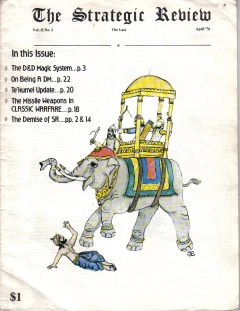 1975 brought the first issue of Strategic Review. In this form, however, the magazine lasted only seven issues. Clearly, despite D&D's appearance, TSR's founding team remained captivated by strategy and tactical games, naturally including D&D among them. Seven issues is not much for a magazine: barely more than half a year's run for a monthly. Nevertheless, the magazine, sold for one dollar, was not unsuccessful. It did not close; it simply split in two. One half continued as The Dragon, dealing with roleplaying. The other remained on the wargame track as Little Wars, but lasted only thirteen issues before being absorbed into The Dragon.
The split was therefore neither long-lived nor successful. The situation suggests that The Dragon was the more successful title. Why? We can consider the reasons. One is obviously that the roleplaying side had a magazine tied to the product that created the genre, while the wargame side had an amateur magazine from a simple fan association. But we can also discuss how D&D's appearance had consequences.
The Dragon eventually became Dragon Magazine, then simply Dragon. Part of its success was appearing in several languages. French and German markets are unsurprising, but it even had a Hungarian edition for a short while. After issue 359, Dragon became an online magazine tied to the D&D Insider subscription. The year 2014 and D&D's fifth edition brought the end of D&D Insider and its associated online magazine. Sadly, this is not the first legendary magazine whose demise we have described here. And because so many magazines and services had merged into it, this also affected the later but equally legendary Dungeon magazine.
The Dragon's appearance in 1976 is also interesting because this is where roleplaying first separates from the various tactical and strategy games. The emergence of roleplaying as a distinct genre may be tied to this change. At this point, people recognised that the roleplaying market differed from the wargame and related board-game market: different needs, different aims, different development priorities. Little Wars being absorbed may also indicate a shrinking wargame market, making it clear to many that TSR's future from here lay in roleplaying games.
Interestingly, theories helping explain and categorise roleplaying appeared much later. Analysing those does not belong to D&D's history, so it is enough to know that the publisher's team, developers and market became conscious of roleplaying as a genre in 1976. Understandably, many roleplayers consider The Dragon central to D&D's history. Many regard its online-magazine format, folded into D&D Insider, as spitting in loyal fans' faces, abandoning valuable traditions and effectively the surest sign of D&D's decline. But we will see that strange things had happened earlier too.
The point is that, by 1976, the two genres had separated. Even if roleplaying took only part of the market wargames had reached, that still meant a decline for that market. Tabletop roleplaying likewise experienced declines when computer RPGs, MMORPGs and card games entered the market.
Despite the split, the wargame heritage remained: a campaign remained a campaign, a module a module, and naturally a character a character. D&D is still haunted by the problem that "character" means disposition, the "character" of a wargame figure. Can a character have a character? We have written about that already. Attachment to using miniatures and many other common features naturally remained for a long time, but roleplaying's development had now diverged from tactical games. Consciously articulating the difference was still difficult, especially without mentioning immersion. Since then, of course, many people have sought not only to define roleplaying, but also to establish plenty of categories.
Advanced or not Advanced
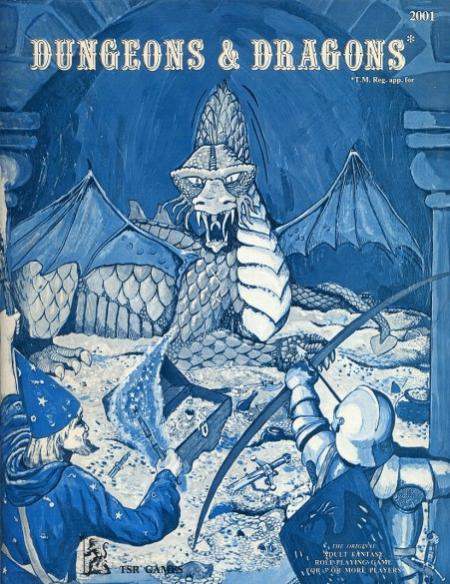 Returning to the long line of D&D editions, a successor appeared in 1977, now in two forms. The first was the "Blue Box", full of "every good thing", also called the Basic Set. But if there is a Basic Set, there must be another set too, at least in the plans. The AD&D brand, Advanced D&D, appears at this point—at least in theory. Practice is a little different. More than a little, in fact. In any case, the Blue Box also had many printings, with slightly altered rulebooks running to a hefty forty-eight pages at the time. That may not seem much today, but remember that games of barely a few pages published in magazines had been common until then. Three booklets, each thicker than a magazine, together with supplements and modules, made for a very extensive, complex game by the standards of the day. Until AD&D appeared.
Each such set included an adventure module, and which one depended on the printing, so a new version could sometimes be worth buying. Such extras in a reprint or revised edition offered value even to owners of the previous version. The Basic Set was assembled with "outside help", focusing primarily on beginners. It is also true that, according to some rumours, one reason for pushing the Basic Set was to make it D&D's successor, thereby keeping Dave Arneson—who died in 2009—out of AD&D. "Cleverly squeezing him out" may have been the first major scandal, but it was not really about fans and did not affect them. Still, removing him effectively removed Blackmoor from D&D's mainstream.
"Squeezing out former co-creators" and manipulating a world or system to do it is therefore not a uniquely Hungarian practice, nor does it make life difficult only for M.A.G.U.S. fans. D&D fans were fortunate that several different worlds were involved. Unfortunately, changes of concept and many other little things often affected more than a single world. At the same time, AD&D and D&D were then two different games, partly aimed at different audiences. In that respect, the solution was more elegant than the Summarium-style renewal offered for M.A.G.U.S.
B1, In Search of the Unknown, was Mike Carr's adventure module, included in early Blue Boxes. It had few successors, unlike Gary Gygax's B2, The Keep on the Borderlands, which later had a successor of sorts in Return to the Keep on the Borderlands for AD&D second edition. Their letter codes also indicated that they belonged to a series. Many more adventure series marked with different letter codes followed. We will have to return to these in greater detail, since it is often not so simple. The point is that some of these adventure modules are iconic products.
For now, it is worth remembering that the B-series comprised several parts. Alongside conventional adventures played with a party and DM, it included a "BSOLO" adventure allowing single-player play. Later D&D and AD&D history also featured adventures for one player. Some required a DM's participation, while others were truly "single-player" games anyone could play independently.
This seems a little odd today, but is almost perfectly understandable for a dungeon-focused adventure with little social interaction or roleplaying. In dungeon crawls at the time, how a DM controlled monsters mattered less, so playing solo—even without a DM—did not take much away from tactical combat either. Although a solo adventure offers more, it does not differ greatly from the Fighting Fantasy gamebooks familiar in Hungary. Here, however, the character can readily continue into another adventure.
All nine adventure modules were made for the Blue Box, and therefore for characters from first to fourth level. It is also worth noting that the Blue Box's rule booklets were thinner partly because a book for beginners did not need high-level spells, powerful magic items or stronger monsters.
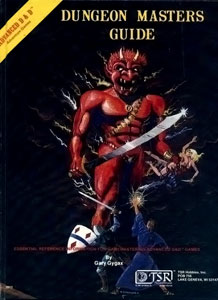 As mentioned, AD&D's release was also on the agenda, but only the Monster Manual appeared in 1977. The Player's Handbook followed in 1978, and the Dungeon Master's Guide in 1979. So far, the Advanced books seem to offer a clear next step beyond the Basic Set. The three books really were hefty: compared with earlier forty-eight-page rulebooks, a volume running to hundreds of pages certainly seemed so. With books so much thicker, I hardly need mention that the game contained many new rules and brought many new possibilities. We could say that AD&D's product line perfectly complemented D&D's existing line and covered the market. D&D was there for beginners, and AD&D perhaps offered a direct path onwards.
Reality, however, was slightly different, as we must realise in 1981. The Magenta Box appeared, accompanied by the Light Blue Box. One was the D&D Basic Set, the other its Expert Set, with rules for play from fourth to fourteenth level. The Basic Set contained the rules' "second revision", though the edition number varies. Naturally, the Expert Set also included an adventure module: X1, The Isle of Dread. How do we advance beyond fourteenth level? A good question. The intention was for several other boxes to help with this, but this Light Blue Box had no higher-level sibling. For now, the plan remained only a plan. D&D rulebooks could therefore be thinner partly because they did not need higher-level monsters, spells and items... And the existing selection was divided among books intended for different levels.
In any case, for players less fond of reading, a few "rule booklets" resembling those supplied with board games and wargames surely looked less frightening than a pile of three thick core rulebooks and their supplements. This partly affected the game's marketability, even if all the booklets in several boxes added up to more reading. Oddly, D&D Essentials later returned to this boxed, booklet-based format, at least for the starter box, which covers only first and second level. For later levels, however, it offers a single core book—so many people again see a thick book at the table—and has quite a few supplements.
The SPI story
In 1982, an awkward interlude interrupted development. Strategy & Tactics' publisher went bankrupt, and the rights passed to TSR. This may have been the worst investment in TSR's history, not because what it bought was worthless. Avalon Hill had been interested in SPI too, seeing potential in its brands and intellectual property. In the end, however, TSR acquired the company, which had few financially valuable assets besides its distinguished names. A few things might have helped offset the financial mistakes. One was a database produced by machine-processing reply postcards, which said far more than a conventional "marketing database". Responses collected from players could indicate what the market wanted, providing a basis for predicting an individual game's success or failure. The frequent absence of visible market research behind products remains a problem, even though reaching fans is considerably cheaper today.
There were also plenty of steady subscribers who bought enormous numbers of games. They were partly creditors too, having preordered numerous games, and many had previously bought "lifetime subscriptions" to Strategy & Tactics. TSR thought that, since it received none of that money and had acquired only assets, not obligations, it could simply announce that the preorders and lifetime subscriptions were lost. Players received neither money, magazines nor games. Ordinary annual subscriptions suffered the same fate as lifetime ones. On paper, TSR saved money, even though these players' claims did not amount to much, and retaining the customer base would surely have been worth far more over the long term and brought in much more revenue even in the first year. It was a bad decision.
The value of what it bought was thus lost. Money thrown away merely so "nobody else can have it" produces no return. It is true that SPI's lifetime subscriptions were problematic: without new entrants, only advertising revenue remained, and competitors were reluctant to advertise. But TSR could readily have attracted new subscribers and sold many of its own games to these customers. Before the purchase, it should have assessed what would happen to this community and how the company could operate after acquisition. Thorough consideration and assessment never happened, however, and TSR decided not to honour obligations to the players.
The result was predictable: fans who were among the biggest customers in the roleplaying and wargame markets came to hate TSR. That cost far more than TSR gained from the arrangement. TSR could not recover its earlier claims—the money SPI owed it—either. It emerged owning a few venerable names but probably without any real profit. A true lose–lose situation; even from its own perspective, one of the worst solutions. Why mention big customers? Because a "lifetime subscription" is obviously a more expensive product. Anyone who could readily find the money for it could also have bought other costly products more easily, making these people an important market. By preordering, they were also early adopters who later recommended products within their circles and clubs. In their eyes, TSR became something of a "rotten company" here...
Naturally, SPI's developers had little reason to stay either. They went to Avalon Hill and published products competing with many TSR games. If many people were angry with TSR and heard about this, choosing a side and a new favourite product was easy. One more thing worth knowing about the Avalon Hill thread is that, in 1980, the "big three" RPGs were D&D from TSR, Traveller from Game Designers' Workshop, and RuneQuest. Traveller is a science-fiction game with successors still appearing today. This article is about D&D, and we will return to RuneQuest shortly. You will not have to wait long: the very next page continues with a RuneQuest-related story.
Scandals and rivals
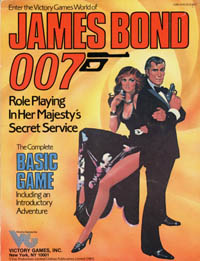
1982 was interesting not only for the situation—the scandal—around SPI's acquisition, but also for the appearance of D&D in French. Gygax saw an opportunity to exploit the franchise and headed to Hollywood to sell film and television rights, resulting in an animated series. 1983 was important in many respects. This was when TSR's roleplaying range truly became complete. The full set of AD&D first-edition books appeared in a uniform presentation, recognisable by their orange spines. Another Basic Set, the Red Box, also appeared, alongside another Expert Set, the Blue Box, and the Companion Set, the Teal Box, for levels fifteen to twenty-five. A few other things happened that year too. Several Avalon Hill RPGs appeared: James Bond 007, Lords of Creation, Powers and Perils, and RuneQuest's third edition.
 RuneQuest's original developer, however, was not Avalon Hill but Chaosium. Its system's successor was BRP, on which Call of Cthulhu was based, among others. That still lies ahead, and we will return to it a little later. The point is that the RuneQuest rights were sold and went to Avalon Hill. This let the company expand its player base from two directions, including in roleplaying, while also strengthening its traditional wargame line. The essential point is that the now-legendary Red Box, whose visual identity D&D Essentials inherited, for example, had RuneQuest as its principal rival. RuneQuest landed precisely where the SPI developers fleeing TSR had gone, very likely accompanied by many Strategy & Tactics readers, among the wargame community's best customers. Although D&D remained the roleplaying market leader, TSR surely lost many wargame customers and was therefore forced to focus primarily on roleplaying.
The publicity generated by the row strengthened more than Avalon Hill. RuneQuest remained strong, while James Bond 007 remained the leading espionage RPG until its licence expired, far outstripping TSR's Top Secret. Chaosium also grew stronger, establishing another powerful brand in the roleplaying market. Yes: players considered RuneQuest competitive, saw BRP as the successor to its system, and could clearly see that this system could be applied to many settings and separate games. Many have experimented with that since, including TSR with the d20 System. Unsurprisingly, some players alienated at this point became Chaosium customers, and they were not particularly inclined to buy the d20 version of Call of Cthulhu. The traditional BRP game's thirtieth-anniversary edition is appearing this very year, in thick, sturdy leather binding, sewn, with gold foil and paper reminiscent of art books.
Competition was therefore intensifying, but TSR responded partly by expanding its range and partly by moving in many other directions. Tournaments and events kept the C-series tournament modules busy, and scoring systems for many competitions developed. By then, however, D&D was visible enough that the group "Bothered About Dungeons and Dragons" was founded in 1982 by an anti-occult activist. The organisation's claims have since been disproved, but its founder tried to connect fantasy games with both Satanism and suicide. By gaining publicity for years, sometimes disregarding the law, she shaped D&D and AD&D. Many recommendations about player-character alignments and the renaming of certain creatures can be traced to this.
This spokesperson against roleplaying published until her death, and many people cited her. Even when rebuttals appeared, many continued taking their information from her successive articles. It is true that Patricia A. Pulling's son shot himself. It is unlikely, however, that this was connected with his D&D character being cursed: that was probably far from a one-off event and occurred in many adventures... Removing a curse placed on a character was also the basis of many adventures. In any case, her lawsuits against the school and TSR alleging a connection between the D&D curse and the suicide were dismissed.
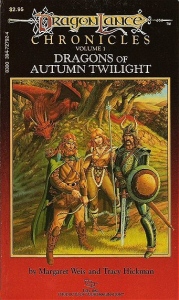 What TSR gained from its fuller range, it lost through competitors appearing and growing stronger. That was hardly a good position. The BADD controversy worsened matters by targeting the company's reputation too. A company whose reputation was disputed even among players, and which faced many attacks, did not become especially popular. Parents also knew less about many other books or preferred seeing them in their children's hands. Expansion continued, however. Dragonlance Chronicles appeared in 1984, accompanied by the DL module series, a model of roleplaying more closely connected to literature. The book became a bestseller, making TSR the world's largest and strongest fantasy and science-fiction publisher and consolidating D&D's market position. Interestingly, the book's Hungarian publication in 1992 also strongly influenced Hungary's roleplaying market. There has since been another Hungarian edition, published by Delta Vision in 2009.
1984 also saw the Master Set, the Black Box, with rules for adventures at levels twenty-six to thirty-six, making this revised D&D edition nearly complete. The system developed in many respects. The SPI scandal had been survived, along with several other disputes. Success seemed complete, the road towards the system's later fame uninterrupted. Two roughly complete systems with many supplements, a relatively large market, two strong settings—Greyhawk and Dragonlance—and a market-leading position in novels. What more could one want? But there was bad news: TSR's business footing was growing weak, soon leading to another scandal. Suffice it to say that Gygax learned at this point that the company was one and a half million dollars in debt and that Blumes, entrusted with management, was seeking an investor.
Remember that separating AD&D from D&D had also mattered partly because of rights, and that worlds had changed. A debt like this is not necessarily good news, and whose investor or ally resolves the crisis matters too. Who brings the rescuer to the company, and to whom that rescuer will be loyal, are important.
Gygax turned to business associate Flint Dille, with whom he had written a few Fighting Fantasy-style gamebooks and a screenplay for an unmade D&D film, hoping Dille's sister, a certain Lorraine Williams, would invest in TSR. That did not happen, but Gygax hired her, trusting her business-management experience. How serious the debt was in this situation is a good question, but it was almost certainly enough to frighten both Gygax and Blumes. This was no small sum. Frightened or not, though, they really did need an investor.
Fleeing towards the precipice
Was the growth sustainable, or an uncontrolled rush towards the edge of a precipice? We do not know, but the peak was already in sight. Revenue grew rapidly, yet costs grew faster. The chance to break out of geek subculture, brought by hugely successful fantasy novels, generated rapid growth, but nobody was there to finance it. Until Lorraine arrived, the team lacked a real businessperson able to manage growth, opportunities, the situation, customer relations and many other things. Without these, even steady growth became a suicidal charge. And an appointed manager with a clearer view of the company and an opportunity to buy it could easily become a Trojan horse.
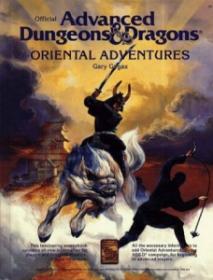 1985 was another strange year for TSR, with further expansion of the range. Oriental Adventures was a huge success, giving reasons to pursue new games and publications; enthusiasm and momentum lasted a while longer. Its success substantially expanded the range, offering a new world and a new kind of play. Management, however, still could not keep pace with rapid growth. Alongside lingering echoes of earlier problems, new conflicts arising from accumulated debt poisoned the atmosphere. To an outsider, of course, this was TSR's golden age, the period when AD&D first edition was truly successful, remembered by many players as the golden age. Perhaps not without reason. Nor was it perhaps accidental that this golden age could not last. Excessively rapid growth cannot continue forever. Escaping conflicts by charging forwards eventually runs out of steam, and a company sized for growth struggles with the new situation. The peak approached, while TSR's roller coaster raced towards it at breakneck speed...
Another interesting book belongs to 1985: Unearthed Arcana. Many regard it as legendary, and Hungarian players loved many rules appearing in it. But much of the material was not new: supplements, ideas and rules previously published in The Dragon had been compiled together. A book with everything in one place is naturally far more convenient than carrying many magazines around, but we can see that reusing existing content was already fashionable. Whether that was good is hard to say. What is certain is that Oriental Adventures and Unearthed Arcana brought substantial revenue into TSR's coffers, making the debt look easily like an investment in the future. Investing in the future, though, requires money and an investor, and here the situation was largely unchanged. I know everyone is wise after the event, but TSR had plenty of opportunities. Its management did not see them that way, so solving the financial crisis probably really did require a leadership change. Most displaced leaders were naturally unhappy about that.
Still in that year, though attracting much less interest, D&D's Immortals Set, the Gold Box, appeared. It concerned characters of demigod-like power who had joined the ranks of the "immortals". For anyone uninterested in Advanced but fond of these higher levels, it was surely good. It was not a mass-market product, however. A core book or starter box targets the "masses" trying the game, while most supplements can count only on the established player base, often a narrow portion of it. The Immortals box targeted only players who reached very high levels, remained with classic D&D and were receptive to its new features. It was therefore not among the year's great successes.
One more little thing must be mentioned for 1985. Battlesystem appeared, intended as Chainmail's successor: partly a battle system for AD&D and D&D, partly a wargame based on them. There was a small return to wargaming roots. This was all well and good, and surely pleased many fans, though Battlesystem was less popular here. Hungary had not experienced a prior wargame craze, and importing lead miniatures would have been very difficult then; later, other wargames gained ground. Remember that our little country faced "multiple disadvantages" at the time: foreign-currency allowances were small and tied to travel. The country itself also had little foreign currency, and the average Hungarian had no need for the declining West's money; a passport valid worldwide was still only a distant dream. Yes, that document will matter in Hungarian roleplaying history, and when considering D&D's domestic market it will be worth discussing too. But, as I said, that is still some way off. Battle simulation with lead figures was not far from D&D or AD&D even then...
Having mentioned Battlesystem, we should also mention adventure module H1, originally intended as a standalone adventure but later becoming the opening instalment of a four-part series. It was initially setting-independent and intended to support Battlesystem, but H3 retroactively placed the entire series in the Forgotten Realms. Naturally, nobody knew that when the first module appeared. Indeed, most people were almost certain that its many battles were intended to fit, to some extent, the then-default worlds of AD&D and D&D. Battlesystem was mandatory at the start of the series; H2 did not use it; H3 recommended it; and H4 made it optional. Everyone can decide where to place the series. Its Battlesystem connection, however, is a fact.
Speaking of adventure modules... TSR launched another magazine in 1986: Dungeon Adventures. At this point it contained adventures for TSR's games. It later reached issue 150 in print before becoming an online magazine alongside Dragon, folded into the D&D Insider subscription. We will return to that affair and its surrounding controversy. It will be an interesting story too, but for now it is worth looking at Dungeon from another angle. Alongside separately published adventures, there was a bimonthly magazine with four or five adventure modules in every issue. This gave the community running written adventures in clubs a formidable resource. A game always available to try in clubs intertwined with shops could even underpin growth.
It was not a bad tactic. Dungeon's name is almost as venerable as Dragon's, and "losing" it is just as painful. Remember: online Dungeon no longer offers masses of selected adventures, and simple website support articles do not replace them. It looks more as though the publisher is money-hungry, charging even for what it should provide free and using a famous magazine's past as its shop sign. Yet its absence today is the clearest sign of what an enormous step forward Dungeon's launch was. Of course, the absence is debatable: Dungeon's adventures were not written by the system's creators, and the Internet is full of modules by outside writers. We can say all we like that holding the magazine, browsing new, selected ideas and running them without a computer at the table or a wish to print anything is different... We are left selecting and printing adventures hunted down online instead of buying good old Dungeon. It is true, though, that in an era of many freely available adventures, selling Dungeon in good numbers would surely be harder.
Many nevertheless say Dungeon's value was debatable. Undoubtedly useful and loved, it gave TSR stable subscription revenue and surely helped stabilise the company's finances. Yet it may have been a double-edged sword. Players no longer dropped into the local hobby shop "just for an adventure", browsed new stock and let a salesperson familiar with their group persuade them to buy more books. Their subscription delivered the adventure straight to their letterbox instead.
Management, rights and misguided behaviour
Given the company's earlier losses and conflicts, however, guessing where Dungeon's and the clubs' apparent success alone might have led is merely a "what if" exercise. As expected, the next scandal arrived at the publisher. Anyone who thought M.A.G.U.S. was alone in this, that only its system and world changed through such affairs, was badly mistaken. The SPI affair and the attempt to squeeze out a co-founder through Basic D&D were just as natural as the current search for scapegoats. Remember, though: Gygax was the one who stepped back to pursue film rights and let the company rush towards debt without paying attention. New ideas and product lines could have succeeded, and, as we see, a successful strategy could even have repaid the debt. That is good news in many respects.
But we can also say that everyone is wise after the event. At the time, many people did not know which way to turn or how to make this a successful company. That leads to conflicts whose appearance had been foreseeable for a while. It is no surprise to say TSR was not a particularly successful company either. Comparing Mr Gygax with so many other creators who encounter and create conflicts may not be far from reality. This pattern too is hardly unique. Large though these sums were, they could easily have become small change. But that required understanding a few changes.
By the mid-eighties, geeks were fascinated by much more than D&D and wargames. D&D-based games had existed earlier on mainframes and early consoles, and an independent development based on it later appeared under an unrelated brand. But the eighties were also about accessible computing. The Commodore 64 was present in so many geeks' homes that computers suddenly became mainstream. What did this mean? Partly that the average geek had less time and money for roleplaying. Partly that AD&D-based software could also be sold to them. Unfortunately, that still had to wait a little. Selling licences could, however, be an interesting source of revenue. There were directions in which to escape and places to cut costs. Few people recognised that there and then.
Yes, market research was precisely what we had to emphasise among the lost opportunities in the SPI story. Instead, many people saw the solution in scapegoating, hostility and personnel changes.
During the financial crisis, Gygax moved to remove Blumes, who then sold his stake to Williams—out of revenge, according to many. She was now not only an experienced manager who knew the company from within, but also a controlling owner. Remember what I said about the Trojan horse? A professional business manager knows exactly when growth will cover a temporary shortfall. Instead of the picture presented in the initial "investment offer"—debt, an uninteresting game, an investor wanted—she now knew from inside a company with substantial growth potential and had an opportunity to acquire it. Gygax tried to stop the sale, lost the legal battle and decided to leave, selling his own share in TSR. Another era began in TSR's and D&D/AD&D's history. Lorraine Williams, a businesswoman unfamiliar with the gaming world, became not a new investor in the company but its new owner, buying only existing shares. What would TSR achieve during the Williams era? What would become of D&D under an investor unfamiliar with both the game and the battles surrounding it?
This era is no longer such a distant past, and many of its stories may be familiar to many readers. It took place after Dragonlance appeared, and by then people could travel to Vienna, from where a few imported rulebooks reached Hungary and pirate translations began appearing. Alongside international expansion now reaching behind the Iron Curtain, there were many other positives in this period, initially still dominated by the spread of roleplaying. Those who discovered roleplaying very early in Hungary may have known this era. The beginning of the Williams era will therefore include Hungarian connections too. I reveal no great secret by saying that much of it was successful for TSR, though later it also brought the company's fall and loss of independence, thanks to roleplaying's retreat, the spread of card games and plummeting quality. The next page is worth reading for these developments and many other events shaping D&D and AD&D, including TSR's "bankruptcy" and absorption by Wizards.
The Early Williams Years
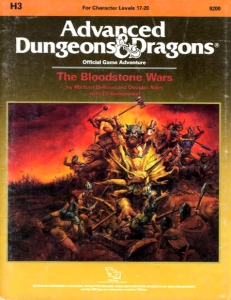 It is 1987, the beginning of the Williams era, and quietly the story of the H adventure series, previously distinguished by battles designed for Battlesystem, is already being placed in a new world: perhaps this is where Forgotten Realms is born. Perhaps for good reason, too. Just as Blackmoor disappeared when its principal creator departed, Greyhawk could no longer remain the main direction, while Dragonlance was too restrictive. Many readers may know that in the Hungarian market, whenever a developer leaves M.A.G.U.S., the resulting rapid rewrites of the world produce retroactive changes, new contradictions and countless small problems. With D&D and AD&D, the usual solution was instead to close the old world or campaign and launch a new one. Players noticed the ruptures less, which I actually consider a good thing.
At the same time, this led to a slightly strange situation. Blackmoor soon dropped out of the picture, so little information appeared for it, while Dragonlance and Dark Sun made many changes to races and classes. But in the "mainstream" AD&D worlds, it was rather odd that the basic races and classes were identical. Is this what a knight is taught everywhere? Do priests everywhere know these spells? Do wizards cast spells the same way everywhere? Countless questions arose, primarily because D&D and AD&D were partly independent of any particular setting. In this respect it would be better if the system followed the world a little, but often that could hardly be the aim, since another aim of D&D and AD&D was to make it easy for the game master to create a world. Of course, this also left the worlds with roughly identical economies, and magic items had market prices that, strangely enough, were identical across worlds.
Suspension of disbelief. This, too, underpins our ability to immerse ourselves in our characters. But disbelief becomes harder to suspend the more fragmented and strange the world around the character becomes, the less alive the characters feel, and the more alien the system is to the world. How much did D&D aim to remain faithful to its setting? Good question. A good wargame simulates realistic battles, or battles faithful to its setting, and the S in TSR's name refers to simulation. Yet the pursuit of game balance and the possibility of competitive play—another wargaming inheritance—is fundamentally alien to a living world. The Dungeon Master's creative freedom in preparing an adventure would work against realism, since he is "allowed" to violate it; yet a world alien to its characters makes those characters harder to inhabit... Of course, nobody was engaging in theoretical discussions like these at the time. A world simply appeared around an adventure that had previously been "hanging in the air". Whatever our theoretical arguments, we have to regard that as progress.
Even if we know perfectly well that the characters were still surrounded by the unknown: the adventure merely mentions the world, nothing else had yet appeared for it, and the accessible world consists of a single tiny domain. Where do the characters' backgrounds connect them to? Fortunately, development soon gets underway, and before long a novel arrives too: Darkwalker on Moonshae. Originally intended as a standalone novel, it later became a trilogy. This epic fantasy takes place in a small area with its own mythology, which might have justified a separate world. But it worked just as well as a book belonging to TSR's new world, heralding the arrival of the new setting book. How deliberate a choice was this novel? How did they manage to publish it before the setting book? Interesting questions.
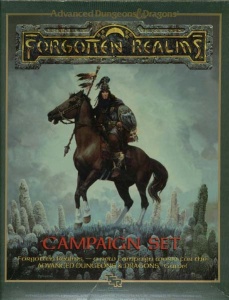 Of course, Forgotten Realms did have a history. In fact, the world's birth predates D&D itself: Ed Greenwood was already writing stories set in it as a child in 1967. That was seven years before D&D appeared, six before TSR was founded, four before Chainmail's official release... Forgotten Realms was born around the time Gygax first encountered the idea of Chainmail. Chainmail did not yet have a fantasy supplement, so there were probably no real antecedents to either Greyhawk or Blackmoor at that point. AD&D's new world was therefore also the AD&D world with the longest history.
Ed Greenwood had been involved with D&D since 1975, but it was AD&D's first edition that drew him deeply into the system. Since The Dragon published plenty of material by outside contributors, it was hardly surprising that Greenwood's articles appeared there too. He placed his writings about monsters and magic items within a single world. The world's concept already existed, and Greenwood's own group's adventures took place there. But it is very unlikely that anyone outside his small circle of friends knew it as a world before 1986, or that anyone would have written a novel specifically for it. It is far more likely that the world's openness made it easy to fit all sorts of things into it. Although its foundations existed, Greenwood invented many things as needed, leaving enough blank spaces for everything. At least, that was what Jeff Grubb learned from Mr Greenwood when he approached him in search of a new AD&D world. An open world looked ideal for the AD&D second-edition project that had meanwhile begun, and could easily become AD&D's new default setting. It seemed more promising than the somewhat closed Dragonlance. That is how Forgotten Realms became an AD&D success story.
Which brings us to the release of the setting book, an immediate enormous success. The review in The Dragon said this was genuinely a world made for gaming, rather than a setting created as the background to literary works, like Middle-earth or, among AD&D worlds, Dragonlance. Compatible with plenty of previously published material, colourful characters, diverse peoples: everything good that could be said at the time. TSR's magazine was reviewing TSR's flagship, so alongside a few insignificant objections to establish credibility, its pages could repeat all the virtues the marketing team had devised. Wasn't it wonderful that most magazines were still tied to publishers back then, and there was no Internet, for example?
I am not asking that as a joke. A roleplaying world dies without players. Other people may be interested, but they do not buy it because they cannot see any players for it, so you cannot see them as players either. Having this effective mouthpiece still operating made Forgotten Realms much easier to sell than the probably equally imaginative Eberron would be later. Of course, marketing by mouthpiece and somewhat one-sided magazines had their drawbacks too. But it is better to remember the good things about the past, and Forgotten Realms was a fine success. There was reason to celebrate it, even if some strange releases soon followed. The H4 adventure, for example.
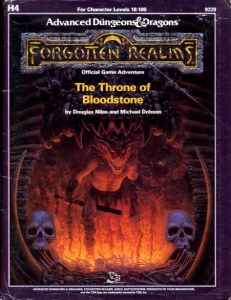 Remember H3, mentioned not so long ago? It was an interesting story. H1 began as a standalone adventure, primarily intended for Battlesystem fans, packed with large battles... But I do not want to repeat everything. Nor repeat that many people think the adventure series certainly was not originally written for Forgotten Realms. Although The Throne of Bloodstone carries the Forgotten Realms logo on its box, it is connected not to the world's own mythology but to Orcus and Vecna, familiar from Greyhawk, where their roots lay. TSR quite clearly believed its beautiful new world's openness could accommodate anything.
That mindset persisted for quite some time. In any case, this adventure for levels 18–100 went a little over the top in many respects—more than a little—yet it is perhaps one of the better-known entries. Perhaps precisely because it was considered suitable up to level 100. I do not imagine there were many level-100 AD&D characters at the time, though there were surely clubs that went a little wild with XP awards. Still, it is an interesting fact that the first adventure released under the Forgotten Realms logo was written for levels 18–100. Of course, many would say the setting is sufficiently over the top to suit it.
The Era Behind the Iron Curtain
It was not only AD&D's worlds that changed, but the world around us too. The preceding pages cover the end of the first edition; the next will discuss the beginning of the second. I have already mentioned that rulebooks were reaching Hungary by then, and hinted at later developments. But why does the situation behind the Iron Curtain matter? I could say because it determines how D&D is perceived in Hungary. More importantly, however, we need to understand that the Hungarian situation is our point of reference. Once we recognise how it differs from the international situation, how this connects to perceptions of individual worlds and many other small details, we can understand the international situation and other eras more easily too. Between 1985 and 1995, things changed considerably around here.
We have covered this period from another angle ourselves, but Call of Cthulhu is not the point now... György Moldova's book A pénz szaga, published in 1986, described how the truck traffic of the time brought numerous drivers who would import practically anything. They might choose particular products deliberately or by chance. Alongside this, more and more people obtained passports valid for the West, followed a little later, in 1987, by the worldwide passport, foreign-currency allowances and so on. At the time, a roleplaying game was "some game from the West" that might make your child cooler than their classmates and help them learn languages, but was as rare as hen's teeth. Yet as increasing numbers travelled abroad, including people who had heard of it, roleplaying began to spread. Foreign-currency allowances, however, remained limited for a long time.
Naturally, that meant many supplements never made it into the country. Expanding the mythology ourselves made more sense. With no other model to follow, most people played to win, so munchkin play was the norm rather than a conspicuous problem. It remained that way for quite some time. One important detail is that a little later, a pirate translation of AD&D circulated in Hungary under the title Rubin Kódex. This made AD&D playable in Hungarian, allowing it to spread more widely than in the days of English rulebooks brought back from Vienna. Another is that the Hungarian translation of Dragonlance Chronicles appeared during this period, in 1992, while Hungarian fantasy writers who played AD&D began publishing novels based on it. The year 1990 also brought a Hungarian-language D&D lookalike: the first Hungarian roleplaying game, Harc és Varázslat. Strangely enough, the back covers of its booklets also showed the cover of a "similar American game"—D&D itself.
Hungary already had well-functioning clubs during this period. Bíborhold had long since appeared, and legends circulated about the powergaming at the PeCsa club, even though we know these clubs also brought together the people who would create M.A.G.U.S., for example. GURU acquired a few pages on roleplaying, followed by the small-format Rúna and Hungary's second roleplaying game, M.A.G.U.S. Since the "competition" was already planning a Hungarian release too, in the form of MERP, serious warfare broke out in Hungary's roleplaying scene. The Beholder–VP hostilities were perhaps settled at one of the Rúna Camps. By then, roleplaying had become a mass hobby in Hungary as well. And many things changed.
One explanation for the early spread of munchkin play is that winning a game provides a sense of achievement and creates addiction. But it is also certain that someone who regularly acts as game master and has to do a little research eventually finds their pleasure not in defeated monsters but in discovery, and in the joy and pride of a good idea successfully applied. Thus even the notorious groups at Petőfi Csarnok produced the creator of CODEX. And when success has for some time meant not beating a monster from the Monster Compendium but understanding the world and piecing together details, something the character can do too, the player and GM change. The same happens when recognition of good roleplaying by one's companions provides that sense of achievement.
Meanwhile, AD&D slowly but surely slipped into second place behind M.A.G.U.S. in Hungary. This was largely because the spirit of the age clearly favoured games focused on story, and M.A.G.U.S. had been written with that in mind from the outset. It had no traditions that were difficult to explain in terms of the world or story. D&D, however, kept developing and had supplements. M.A.G.U.S. was less able to develop... Which could shift the balance of power again. But to understand that, we should look at international events from 1989 onwards.
The Second Edition Arrives
The next major step is 1989—no, not because Hungary changed political systems. Remember that work on AD&D's second edition began back in 1987? And that Forgotten Realms became the default setting in connection with it? Well, 1989 was the year the second edition appeared. What made it different? Many things. They tried to rename demons and devils quickly, for example, while assassins and half-orcs disappeared. If that were not enough, dragons became stronger. If they are the monsters the game is named after, they should not be weak. At least, that was one of the stated motivations. The Monstrous Compendium consisted of a binder and loose-leaf pages, but the advantages of this arrangement were soon undermined by putting several monsters on one sheet, or spreading a single monster's description across several sheets. Moreover, the paper's quality meant it wore out quickly. In practice, the solution borrowed from Avalon Hill did not work, and a few years later the Monstrous Manual returned to book form.
 AD&D's second edition is the one most people know. Thanks to the growing number of computer games based on AD&D's system and worlds, even people playing other roleplaying games around a table came to know this edition. Fewer computer games used later editions. Why did computer game developers subsequently abandon the system? Good question. But AD&D's strengths certainly included interesting worlds and a somewhat story-centred game. And on computers too, this direction was the truly successful one, rather than the simple dungeon crawl. Although I do remember a game called Dungeon Hack, for example, which offered unlimited replayability.
We will discuss changes to the system separately on a later page, returning then to the second edition's innovations.
AD&D's second edition did not remain alone for long. D&D was renewed too, with a new edition comprising a single rulebook, published as the Rules Cyclopedia in 1991. Needless to say, it was not particularly successful and made few waves alongside AD&D's second edition, but that was not much of a problem. TSR was clearly the market leader at the time, and released many other successful games during this period. It looked like a new golden age. Numerous computer games adapted AD&D's second edition. Forgotten Realms novels were successful too; TSR seemed invincible. There is plenty of good news I could mention, yet what comes to mind is a quiet, uneventful period: AD&D was a well-functioning product from a well-functioning company.
It would be easy to end the successful part of the Williams era there, but I will not. This was when Drizzt was born, fortunately still without a publicly available character sheet. And the Dark Elf Trilogy was not written first: Salvatore tacked it on before the Icewind Dale Trilogy as a prequel. As so often happens, the original trilogy may be the series' high point, which certainly helped explain Drizzt's success. But once they had grown fond of the character, many readers failed to ask: why did he stubbornly send his family, including his father, to certain death? What they did to him when he defied them might not have seemed strange to Drizzt; these were accepted practices. And if the question did not arise then, few people would later raise an eyebrow at broken oaths or strangely interpreted opportunities. Drizzt established the archetype of the oath-breaking hero who sometimes kills indiscriminately in the name of good, without even considering other possibilities.
Here, alignment once again becomes little more than "which side's forces would he ally with", without really determining the character's personality. In many respects, that makes him a less than ideal example of roleplaying. And when roleplaying recedes into the background and we start looking for qualities that are not primarily tabletop roleplaying's strengths, we can reasonably ask: why choose tabletop roleplaying in pursuit of that quality? Once other kinds of games become competitors too, because "easy victories also draw the crowds", this can eventually backfire badly. For a long time AD&D tried to offer something wargames could not. Giving up some of its roleplaying soon put it in the same league as several older or newer types of games.
Internationally, however, the turning point came quickly. The arrival of Magic: The Gathering ushered in the period of decline. The following pages cover the Beginning of the End; I promise it will be instructive. And if that is not enough, the d20 era and modern history follow, then an overview of the major changes to the system... Along with a short detour concerning the frequently mentioned Avalon Hill.
The Beginning of the End
I have often said that rapid growth, a golden age, cannot really last forever. A combination of factors brought this golden age to an end. Many people include mass production among the causes, but part of the real explanation lies further afield. As TSR increasingly focused on roleplaying, while also selling mostly complete games in the wargaming market, it had to face a fact: the revenue available from this was finite, and it lacked products people would buy for themselves "just because". Someone who felt they "deserved something for all that hard work" might easily buy a Warhammer miniature instead of a cake or an ice cream. Buying an AD&D rulebook or boxed set that way was unlikely. It was too expensive for that sort of emotional decision, and choosing required too much thought. Roleplaying was not such a profitable business after all. And despite Battlesystem, players hardly bought miniatures. Somehow a paper token was enough.
There was a reason: one miniature could perfectly well represent a dozen soldiers, but finding one that truly suited a character might take years. And if you had no miniature for your own character, why have them for "nameless" armies? The inexpensive little impulse purchases—a miniature, a pot of paint and similar accessories familiar from wargames—were simply missing from the AD&D market. Yet together they would have brought in considerable money, as well as a fairly steady base income: even if a major publication failed to sell well, people would still buy these things. The collectible AD&D cards, also available as a complete set, were not remotely appealing. In other words, TSR's product range was wrong. And things would soon get much worse.
Although Warhammer and its publisher Games Workshop were the strongest "wargame" publisher, many others also benefited from the genre's renaissance. Even if, as we know, Avalon Hill could enjoy it only in the short term.
Soon it was not just Games Workshop that became stronger commercially, but Wizards of the Coast too, thanks to the success of Magic: The Gathering. All you need to know about the new game is that its entire first year's planned stock sold out within days, shattering every expectation for revenue and profit. The year 1993 clearly belonged to Wizards of the Coast, and the company won numerous awards in 1994 too. The card-game craze was raging, dealing a severe blow to TSR's position. As TSR lost its market leadership, the vulnerable dwarf gradually became a giant. TSR was still far from worthless and remained the market leader in many areas, but management decided to fight the rising titans. It would be no easy struggle: with D&D and AD&D, TSR had become accustomed to fighting from a market-leading position, with the law as a powerful weapon. That no longer worked. TSR had also traditionally handled its community badly, and this now backfired spectacularly.
The first substantial response arrived in 1994 in the form of the Spellfire card game, but it did not deliver a real breakthrough. AD&D acquired an even newer, freer, more open setting: Planescape. Then came Blood Wars, a card game based on it, in 1995. The game was interesting and would have been an excellent advertisement for Planescape. The pictures were beautiful and would have made wonderful illustrations for AD&D adventures too. There was just one snag. While Wizards of the Coast welcomed fair use of its pictures on fan sites, TSR attacked anything and anyone who wanted to use its images. This quickly wrecked the game's popularity. Incidentally, it also ensured that AD&D players did not do much collecting either.
Even worse was the mass production that had become necessary. The beautiful, new, successful world that genuinely offered something different, and the still-successful Forgotten Realms, seemingly could accommodate anything. But releases arrived that undermined the worlds' coherence. Some were commercially successful and occasionally even created new legends, yet they still contributed to TSR's problems. Things deteriorated year after year, despite the potential in many publications and the plans to renew AD&D itself. A great many things simply did not turn out well.
The Second Edition Is Revamped
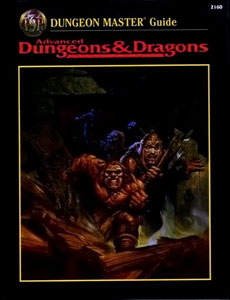 A revised version of AD&D's second edition appeared in 1995, and it was both attractive and good. Alongside it, the Player's Option series was supposed to begin modernising the system. The system really was promising, but there was one small snag. TSR at the time was busy trying to stabilise its position by racing forward at breakneck speed. Being the market leader in roleplaying guaranteed very little, since roleplaying games were retreating from American club life. The reasons are not difficult to guess: someone dropping into a club could quickly start playing cards, whereas assembling an AD&D group took time. If card games already in progress delayed that further, the situation became harder.
You could say the card games launched to repair the product range—Spellfire and Blood Wars—also slightly damaged AD&D's prospects. It was beginning to look like a situation in which almost every answer available to TSR's team was a bad one. And remember: 1995 made this a little worse. Yes, partly because of Windows 95. This was when computers became genuine competitors to tabletop games, since they could now spread faster than ever. Partly because of CD-ROM and CD-R, too. The Core Rules CD-ROM could still provide a response to that. But the spread of the Internet naturally made things worse. This was the period when many other games, many other book publishers and most print magazines all found themselves in trouble at once. That online bookshops later also undermined small shops and the clubs still supporting AD&D is merely an additional detail. But this was a major change.
In this struggle for the revenue sustaining the publisher and retailers, publications could not be tested thoroughly, slowly and expensively. That was no problem when revising the core books, but the Player's Option series, intended to renew the system, appeared untested, with books that sometimes contradicted one another. A good DM could easily fix these mistakes, allowing AD&D to promise and deliver a great deal, but there was one small snag: every DM fixed them differently, and the entire series was optional. A fragmented player base did nothing for the prospects of people seeking games at clubs. Bad luck. Considerable bad luck. Moreover, the visible problems accompanying mass publication soon undermined the authors' credibility. Anyone who checked a book's calculations and quickly discovered fundamental mistakes would thereafter have less faith in that author, the testers and the publisher's quality control. Sales figures reflected this.
The renewal of AD&D also included the two Core Rules CD-ROMs and the expansion for the second. Strangely, features demonstrated in the first CD's map editor were then absent from the second. And although the Player's Option rules were included in the Core Rules 2.0 expansion, its character generator was not prepared to handle a system riddled with contradictions. Yet we can see that AD&D needed renewal: by then it looked terribly outdated. While many systems were almost entirely skill-based, here the skill system was one optional rules variant among several contradictory ones. The idea that a character knows whatever the player knows seeped into Hungarian roleplaying too, promptly producing questions about how a wizard could make an atomic bomb in one system or another.
And that was only the beginning of the problems. The combat system barely distinguished between weapons. These supplements also shortened the combat round, originally one minute long. Of course, many GMs struggled even with that. The question was which direction to take. What is certain is that this edition still tried many ways of making characters more varied, while retaining the world's limitations; despite its tactical combat system, the game would have been more story-based. Several other boxed sets experimented with renewing the system too. Consider Requiem, for example: its treatment of AD&D's classic undead races as classes was interesting. But these early attempts were unsuccessful. Without success, the later efforts to return to the successful period were understandable.
Many things in the world had changed, however, fundamentally transforming competition between roleplaying systems.
The International Situation
Naturally, the situation steadily worsened in countries where they had previously refused permission to translate AD&D. Just consider that AD&D was no longer the market leader even in our region: people mostly played local games, and we were already hearing about pirate Polish translations of M.A.G.U.S. and their possible legalisation. TSR had gradually lost most of a market. In our region alone this certainly meant several thousand players; a figure around 10,000 would not be surprising either. All right: that means roughly half a million dollars, 1% of the 1996 revenue. But if we also consider that Sweden had adopted its own system, as had several other smaller or larger markets, the loss was much greater. Or should I mention German systems too?
A revenue difference of a few per cent can strain a company all by itself. But that was not the real problem. The world had become more international: more people could read about which games were popular where, pirate translations could circulate, and numerous other systems could spread. TSR handled this situation particularly badly. At a time when every cent counted, these cents counted too. The outlook grew darker, though occasional products still seemed to offer a way out of this hopeless situation.
Dragon Dice arrived as a lifeline in 1996, initially looking successful. TSR also decided that if its more expensive hardcover novels had sold well so far, it would now try twelve novels a year. With the failure of the Dragon Dice expansions, the company's revenues began to shrink relatively quickly. Revenue of forty million dollars did not look particularly good, mainly because the till was almost empty. Every cent lost in smaller markets or through justly unpopular decisions was sorely missed. The novels were not selling either, and returns of unsaleable books brought unexpected and ultimately unmanageable costs. When Random House returned a large shipment of unsold and unsaleable novels, TSR had to pay for the returns too, and became insolvent almost immediately. That left it no prospect of releasing new products either. The options looked anything but bright.
Bankruptcy and debt restructuring appeared possible, as did selling certain rights or finding an investor willing to invest in the company, perhaps buy it outright. I doubt it will surprise anyone to hear that Wizards of the Coast, rapidly fattened by Magic's success, bought the publisher in 1997. TSR would not live to see Baldur's Gate released as an independent company, nor have to fight WOW: it had merged into a much younger company enriched by the card-game market. The Williams era was over. It would be easy to say that the much weaker than expected performance of Dragon Dice and the novels directly caused the collapse, but that would hardly be fair to those products. Dragon Dice began with unexpected success, and most of the novels started strongly too. The unrealistic expectation of infinite growth from a finite market, and the problems behind those expectations, had already existed for years, in several areas.
TSR took too many risks and did not even try to place its riskier ventures in separate companies so their failure would not destroy the parent. That alone is a serious mistake for a company trying to escape its problems through a succession of risky manoeuvres. It was equally serious that numerous risky product lines, generally made unprofitable by mass production, were neither sold nor entrusted to outside developers nor opened to independent developers. A substantial proportion of these risky products produced losses, worsening TSR's position still further.
And spending money on legal action against fans, shutting down fan sites because they featured graphics and brand names connected to TSR products, was bad in several ways. The direct effect was that these legal battles cost money, often considerable money. Money spent on lawyers did not and could not pay for itself. I am not saying it would have covered Random House's returns bill, but it would have given the company more room to manoeuvre. Furthermore, the people behind those fan sites and fanzines were TSR's biggest customers. After the lawsuits, they had to face the fact that other games and publishers offered a friendlier environment. The third serious problem was that TSR turned much of its community against itself while reducing its products' value for money, partly through fewer players and partly through less freely available support.
And some players remembered earlier affairs and said it might be worth supporting D&D's competitors too. In many people's eyes TSR was a more hated company than even Microsoft.
New Competitors
By this time TSR already had numerous competitors to contend with. Many larger, better-known roleplaying games were on the market, taking sizeable slices of the pie. Without attempting a complete list, we can mention Vampire, Shadowrun, Call of Cthulhu and Cyberpunk; GURPS, very successful in America, is another interesting example. Oddly, however, I would single out Call of Cthulhu and James Bond 007, already part of history by then. Neither for its quality nor its market strength, but rather with reference to the scandal following SPI's absorption and its longer-term consequences. James Bond 007 showed that a later competitor could readily beat TSR. And yes, Avalon Hill was behind it. Chaosium, meanwhile, had sold RuneQuest to Avalon Hill. Amid the scandal, many people encountered it as one of the three major games of the time. This publicity came "free" to both Avalon Hill and Chaosium. It did not cost either a penny. The mass of people discovering BRP, and the system's at least relative success, also showed that one system—and the BRP brand appearing in many places—could sustain several games. In both cases, roleplaying in modern settings gained real public recognition too.
Many people found it easier to inhabit an easily imagined character in a familiar world, making roleplaying a little more about immersion, stories and so forth, and less about combat. Many publishers could respond to these market changes. This fine new direction characterised games based on Storyteller, such as Vampire, just as much as Cyberpunk and Shadowrun, set on the Earth of the near future. The triumph of immersion reshaped the market somewhat. Precisely for this reason, system flaws that broke immersion became a sensitive issue, and this process also contributed to TSR's declining sales. BRP's success made GURPS's success predictable too.
By a strange twist of fate, Avalon Hill also found itself in serious trouble at this time. Its story was less straightforwardly a case of self-inflicted damage. Of course, Avalon Hill was responsible for losing ground to Games Workshop, but it had numerous good ideas for computer adaptations of its games. In this area, however, it was helpless against a thief, for example. I will say more about that on the final page, an appendix to this article. It is an interesting little piracy story. But I will let you in on something: Avalon Hill still has a part to play in D&D. Perhaps quite a significant one.
Back to TSR. Wizards of the Coast bought the company, and many people would immediately mention the third edition, but much water flowed under the bridge before that. Among other things, Hasbro acquired Wizards of the Coast before the third edition's 2000 release. D&D 3 therefore appeared as a Hasbro game, backed by a multinational and its own ways of doing things. That belongs on a separate page. Wizards pursued an interesting policy. It liked fan-created material, so it quickly entrusted settings that seemed too risky, had reputations battered by mass production and generated less revenue—Dark Sun, Spelljammer and Planescape—to the fans. This is one way to discontinue risky product lines. It is good because fans do not face their world's complete closure or abolition, and gain a substantial say in developing it. If it grows stronger, the project can easily be revived.
It is bad because it clearly signalled that none of the AD&D worlds was Wizards' own child. It would not nurture them; it would focus on strong product lines bringing reliable profits, using them to supplement its own range. The brands attached to the worlds offered excellent opportunities to sell novels or earn money by licensing computer adaptations. Yes, Planescape: Torment may have brought in a tidy sum too. In the competition between successful projects hungry for funding, they also had to compete with games such as Pokémon, released in 1999. By then, however, Wizards was no longer an independent company.
One success story does belong to the Wizards era, right at its end... Baldur's Gate appeared in 1998, along with its Tales of the Sword Coast expansion. For many people, the collaboration between BioWare and Black Isle is an important milestone, perhaps a significant advance over earlier AD&D- and D&D-based roleplaying games. In many respects that is surely true. It certainly reached a wider audience, introducing many people to Forgotten Realms. Discovering the world plays an important role in the game, assisted by numerous books you can find, giving the computer game depth. In many places the story and our decisions matter more than monsters defeated in dungeons, which is no bad thing.
Baldur's Gate also marked the start of a successful, longer-term collaboration that would lead to Neverwinter Nights, another important milestone in D&D and AD&D history. Computer roleplaying games grew stronger in many respects as a result. But 1998 brought another change in D&D's history. While everyone was watching or waiting for Baldur's Gate, Hasbro acquired Wizards of the Coast in the summer of 1998 after four years of trying and waiting. It will be interesting to examine the AD&D and D&D supplements released at the beginning of the Hasbro era. And yes, I will now try to discuss the third edition, its values and aims too. For players who discovered D&D through the third edition, this period holds many interesting details, and it also shows why comparing D&D's fourth edition to World of Warcraft is unfair.
The next period is truly defined by Hasbro and the d20 System; you can read more after the break. And if your perseverance lasts beyond the next page, the recent past is coming soon, followed by many other interesting and important details.
d20 / Hasbro
 When ownership changes, AD&D's development takes a new direction, and some new considerations may come to define an era. We have become accustomed to this over the eras discussed so far. Let us look at an early Hasbro-era publication. In March 2000, AD&D / D&D adapts another new world. Isn't that cover on the left amusing? It is not nearly so funny, because the development team is also working on something else: D&D's third edition. They talk about the classic dungeon-crawl adventures of the good old days, when neither DM nor player needed much preparation, when there was little to invent about characters, their stories or the adventure, and AD&D / D&D was quick and easy to play. Well, the Diablo II adaptation fitted these aims and promises perfectly. Several books for it appeared from Wizards, now a Hasbro subsidiary.
But let us discuss something slightly different. We are still not at the third edition, just adding a little background to plans for a classic dungeon-crawl feel and a combat system based on maps and miniatures. By now Avalon Hill had been absorbed into Wizards, bringing a successful wargame and tabletop-game production team and all its infrastructure. Capital was now available to ramp up production again, and connecting it with D&D was no bad thing. Hasbro was traditionally strong in action figures: just think of G.I. Joe soldiers. And Hasbro operated on an entirely different scale from the companies we have encountered so far. Hasbro owned Monopoly, My Little Pony, NERF, Transformers, Nickelodeon and quite a few other familiar brands. Many branded shops, toy shops and hobby shops made an excellent living from its products. Meeting D&D's logistical requirements involved little significant extra work for it. It could also negotiate differently when booking printing capacity. As I said, a different scale. Accordingly, it viewed numerous things differently too, which would define the following years.
Yes, I mean the OGL, which the open-source community experienced as a triumph of its ideals. Reality was somewhat different. Hasbro did not want to take risks for small change, but knew D&D's success required many risky books that promised little money from the outset. The OGL therefore seemed a good solution. Especially when it knew it could not produce that many books itself: it wanted to adapt numerous worlds, from Diablo II through Call of Cthulhu and Star Wars to World of Warcraft. It simply lacked the resources for so many books, while licensing everything individually would have been difficult. It managed to pass the licence for Dragon, Dungeon and two other magazines to another publisher. For risky support with little prospect of profit, there was the OGL. This also potentially meant more worlds for its system, making switching between worlds even more natural. It strengthened ties with numerous publishers, AEG among them, and welcomed the arrival of small publishers producing PDF files.
The finished product, however, was not freely reusable or redistributable; the licence's aims and philosophy were far removed from open source. Few people cared at the time. Many eagerly awaited the third edition's release. No, not because of the still newer D&D-based Diablo II adaptation shown on the right. That certainly fitted the promised dungeon crawl, but less well the promised freedom. Players instead pounced on the new PHB, also shown on the left. It appeared in 2000. Some were delighted, since in many respects the freedom really was unlimited.
A character could have as many as twenty classes... Indeed, as eventually emerged with Savage Species, a character could have just as many mothers. The "unlimited combinability" of racial templates introduced us to the freedom of half-elemental, half-demon, half-golem, half-red-dragon, half-celestial, half-orc characters. The freedom of unlimited powergaming, ideal for dungeon crawls; booming character-optimisation forums; the period when almost everyone heard of builds called Pun-Pun and CoDzilla. Only a few grumblers remained dissatisfied, fantasising about creating characters that fitted the world and had good backgrounds. Hadn't they heard the system's lead designers promise efficient, classic dungeon crawling, without all the agony of creating stories and characters appropriate to them? A game with backgrounds like that, characters that fit their world and numerous personality traits must surely be some other game. Many celebrated D&D's third edition, and at least as many quietly thought: I can get this sort of dungeon crawl at my computer, and went off to play Diablo. Once again, I do not mean the D&D-based version shown here.
Many of us would have welcomed more realistic character creation following the character's story, where learning takes time and a character must make do with two parents; where the world's limitations are sacred; where spell descriptions explain not merely what to roll and how their areas cover miniatures standing in different squares—discussed under combat, for example—but how they actually work in that world. Hasbro, however, wanted to sell miniatures, battlemats and "collectible" rulebooks that aided powergaming for a setting conducive to brisk club play, rather than descriptions for people interested in details. Descriptions already existed: select the details from those, and a setting no longer needs a large box, just one book... Plenty of publishers could have produced suitable books, of course, and Hungarian publishers could target the PDF market too. But this audience meant lots of work, little profit and measurable risk. Publishers targeting it generally did not switch to the d20 System. Or made a terrible mess of the switch.
And to keep the amount of text from looking meagre, it was easy to fill the pages with attractive design. Nobody would write notes on them anyway; players pondering connections were hardly the aim. Star Wars d20 soon appeared, as did Call of Cthulhu d20 and the World of Warcraft RPG. The aim was to get plenty of people buying Hasbro products. This worked only partly. Nevertheless, D&D's third edition was a successful game, and had I wanted dungeon crawling then, I would certainly have chosen it too. But remember: promising to bring back the simple dungeon-crawl experience of old necessarily signalled a change of direction. Development reversed course. Of course, tastes differ. Some welcomed unlimited powergaming, dungeon crawling, collecting treasure and many other things. Others thought they did not care about the philosophy behind the system: they would handle its flaws and try roleplaying under D&D 3 too.
Why Was 3.5 Needed?
The system was, of course, terribly unbalanced. One of its developers, Monte Cook, soon offered some fixes through his own company. Nice, isn't it? But the wait was short, and edition 3.5 arrived in July 2003. According to malicious tongues, releasing a new edition instead of errata and PDF updates was useful because lots of people buy core books. This is not far from the truth, even if the Epic Level Handbook, Savage Species and the third-edition Unearthed Arcana—with still more rules to facilitate powergaming—were similarly successful. These were essential accessories for the average player thinking in overpowered builds. In any case, edition 3.5 was an excellent opportunity to publish core books again, charging good money for bug fixes.
Hasbro operates on another scale, and many of its decision-makers have no direct connection to roleplaying. Its marketing department also has considerable influence on product development, but unfortunately very few of those people see roleplaying's unique possibilities. Even if they struggle to understand why anyone reads so many books for a game, they simply settle the matter by deciding that the target audience is "bookworm board-game addicts who never grow up". Then production can begin. Could this instead be a more meaningful hobby than getting drunk for a more adult age group? As it was for many people at one time, at least? It does not matter.
Do many people familiar with computer roleplaying games want immersion, lore and depth instead, even if that requires reading, although many are not bookworms? They are not the target audience identified above. The game is now more tactical, simpler and faster than ever: go to a club, play a quick encounter and pack up, ready to play again next week. A simple concept, but it says nothing about why D&D would be better than Diablo II or WOW, why anyone should read those damned books for it, or how reading, complexity and the opportunity to understand connections might be traditional roleplaying's greatest strengths rather than disadvantages. In the name of streamlining, these things were gradually pushed into the background.
Complexity? Lore? Story? Think about it: the CD-ROM had already appeared as a medium during the renewal of AD&D's second edition. We know Baldur's Gate, Icewind Dale, Planescape: Torment and countless other games offered enormous amounts of content and interesting stories. Not dungeon crawling, nor early adventures based on it. And they certainly did not claim D&D was about killing terrible monsters and taking their treasure. Yet that concept dates from the development of the third edition.
D&D, however, is not M.A.G.U.S. The international market had plenty of competitors. Anyone who disliked the direction represented by the d20 System could easily find many other games, increasingly easily as the e-book market emerged. Hasbro partly blamed system bugs for lost players, making 3.5E predictable. When feedback about balance problems persisted, it understandably concluded that balance was needed, requiring stricter quality control. The latter was impossible with freely published third-party supplements.
There was no solution, while collectible miniatures, promising substantial revenue, somehow moved increasingly into the foreground.
D&D Miniatures
Anyone who doubts that this period saw a shift towards miniature combat games should certainly look at the Miniatures Handbook and D&D Miniatures. Yes, these packs of figures revived a phrase familiar from the early card-game boom: "Two displays of that as well, please." Many people bought entire cartons. A secondary market developed for the figures, cheaper ones were bought on impulse, and revenue grew... Small wonder, then, that Hasbro did not want to sideline miniatures. Especially when a very vocal part of the community said it welcomed more tactical combat, all those lovely figures and dungeon crawling. It was not a bad game, just different from what many of us expected.
Naturally, it also exploited players' urge to collect. Some of this is simple biology. Yes, it had already been one of Magic's secrets. When you buy without knowing whether you will get something good or bad, a lucky purchase makes you happy. Your brain then associates that pleasure with opening and buying the little packs. Feeling down? Need endorphins? Pleasure releases them... What gave me that feeling last time? Oh yes, opening boosters. Off to the usual shop, then, to buy D&D Miniatures or Magic. This kind of addiction is good business, whether it involves illegal drugs or the excitement of opening a booster and the pleasure of seeing a good card, die or miniature. Yes, the excitement of opening packs releases a hormone that helps you become addicted. Do you think marketing professionals working with professional psychologists fail to factor this in? You are mistaken.
Copying Diablo II and WOW may likewise have primarily aimed to reproduce their correctly paced sense of achievement. You know from that logo that the game will be exciting—PVP releases adrenaline—and that you will experience success. If your body craves this, the resulting addiction will make you seek that logo just as extreme downhill enthusiasts seek their bicycles when they need adrenaline. The same feeling lies behind miniature collections that are hardly ever used. It is also the secret of dungeon crawling: it is bloody reliable. At predictable intervals an encounter arrives; with a little excitement and effort, you beat the monster, and receive the satisfaction and reward. Your body responds with hormones, whose arrival at the right intervals can become addictive. Someone addicted to playing for their daily loot will not go looking for a different, riskier, deeper game.
D&D delivers this perfectly. That sense of achievement relieves stress, and it is much better to see a happier person remembering it than someone made grim by their own failures, who sees only the pub as a solution amid worries about work and the mortgage, and takes their aggression out on their wife rather than beholders and dragons. It is a simple, functional game for a shrinking market. A substance with which getting people hooked becomes increasingly difficult, because many of roleplaying's advantages as a meaningful hobby have disappeared from it. Yet it can be produced and sold with bloody impressive efficiency. Of course, many things are different today: we have 3D printing and customisable 3D models.
To be fair, for a long time I too looked elsewhere for the defining merits of editions 3 and 3.5 and Miniatures. The average player does not analyse the game's effects and their enjoyment through the hormonal system, neurology and biochemistry. They simply enjoy dungeon crawling, and remember the adventures, the game's momentum and the pleasure associated with a character they love and that character's successes. They are unlikely to analyse beyond that. They simply look forward to the next adventure, miss it if they do not get it, organise some of their days around the game and become an extremely reliable customer.
 Simply because the weekly adventures and familiar pleasure somehow also become intertwined with the sight of a particular logo.
Much of the history of editions 3 and 3.5 remained tied to previously established worlds, and unsurprisingly the default setting was Greyhawk. Dungeon-crawl adventures long characteristic of the first edition, in the world associated with that edition, and a newer, cleaner, even more overpowered experience that could again take you all the way to level 100, surely satisfied many people. Others remained enchanted by the hugely successful Forgotten Realms. For a long time, new settings meant licensed worlds such as Warcraft and Diablo II. But the history of edition 3.5 would not be complete without a beautiful new world faithful to D&D's new values.
Yes, Eberron appeared. Unsurprisingly, it was somewhat freer in many respects, offered more possibilities in many areas—not just for powergamers—and helped make characters faithful to their world possible again. At least partly. New races were nothing new after Savage Species, but the world already pointed forward to the fourth edition. Who would have thought this beautiful new world would become the fourth edition's default setting? Although it appeared for edition 3.5 in 2004, it was no real breakthrough. It was developed from the ideas of the winner of a 2002 competition, with Wizards / Hasbro reportedly choosing from more than 11,000 entries. The story does not tell us which criteria they used: existing players' interests? Marketing considerations for attracting new players? In any case, it is a very interesting little world. But many people wanted to play in an already familiar world, their current favourite, while others associated the taste of success with familiar logos. For understandable reasons, the Eberron book lacked the logo of their familiar setting.
As I said, Hasbro operates on another scale. It is not pursuing a hobby but making money, and it is professional at that. The next page discusses events surrounding the fourth edition.
The Fourth Edition
 Since in 2011 I associated the recent past with the fourth edition's arrival, I should begin there immediately. The fourth edition appeared in 2007. If the marketing department regarded balance-breaking munchkin builds as the problem, it is unsurprising that they tried to address them: unlimited powergaming and the overpowered builds that annoyed so many people disappeared. For many players, however, the sense of achievement then stopped arriving so reliably. Poor things. In return, character creation became simpler, with fewer combinations to consider. That is good: it saves time and curbs "the practice of accumulating parents by taking lots of half-races", potentially making the game feel lifelike. Were it not for one tiny snag. Let me begin with a legendary quotation: "D&D is still about going into dungeons, killing monsters, and taking their treasure." D&D is about going down into dungeons, killing monsters and taking their treasure. The quotation is attributed to one of the fourth edition's authors. In fact, the statement originally came during third-edition playtesting, about that edition, from Ryan Dancey, one of the leaders of the team entrusted with designing it. He had already been Wizards' vice-president responsible for tabletop roleplaying before Hasbro's acquisition. Specifically, it arose in a discussion about the Charisma ability being undervalued. So this was not a goal the creative team first set itself for the fourth edition.
Indeed, an article in Dungeon Online during the fourth-edition era approaches the problem interestingly. It says many D&D players welcome the simplicity of everyone in the dungeon being evil and allies being in town, but that DMs should still occasionally introduce a moral dilemma and let characters think, decide and so on. The application of the Points of Light concept is therefore an observed practice rather than an aim, characteristic of adventures at clubs and events, to which perceived or actual customer demand is accommodated. Consider what this means. For example, among many people nostalgic for the first edition's classic dungeon crawls, points of light were already common, exploring moral questions was rare, Charisma was undervalued, and almost every encounter was reduced to combat, despite encounter reactions still existing in the second edition. Their wargaming roots also made miniatures familiar.
We are the odd ones here in Central Europe. Thanks to formerly closed borders, we first encountered the novels, then saw roleplaying as a game connected with them. In imaginary games of "what if...", "what would we have done differently in the hero's place if..." and similar questions, characters' personalities and ways of thinking, moral issues, decisions and social interaction play prominent roles. Many Hungarian players did not want dungeon crawling or a return to the first edition's often one-dimensional adventures, hanging in the air without a world. In the USA, however, plenty of people wanted precisely that. Those classic AD&D adventures, hanging in the air without a world, really do exemplify the Points of Light concept.
Without mindless powergaming, the fourth edition really is more tactical and often offers better opportunities for storytelling. It is simply missing one thing: roleplaying. Not because anyone deliberately eradicated it, or because the fourth edition wanted to change things, but because its writers knew the wargaming roots, had themselves seen that environment as their model, and could not even imagine that roleplaying is largely about a character's decisions: moral decisions, love, friendship, different interests, a thousand and one other things, but chiefly decisions. That for us it is not natural for a good drow to cut down his sister when he has a chance to redeem her, because he has a choice... We do not treat her as a monster to be killed merely because we encounter her as an "enemy" amid an adventure's battles.
I must admit that recognising this difference shocked me too, and recognising this characteristic was partly what persuaded me to write this article. Of course, beforehand I tried a little roleplaying myself, attempting to work out how an American might view GNS theory. Wizards' developers surely paid attention to this theory, and I have to say I could see a reading of it that applied to the wargaming market and combat games too, leaving out precisely decisions, the character's perspective and a truly living world. Simulation matters in combat systems and battles as well, where it likewise conflicts with gamism's demand for balance and narrativism's demand for an interesting outcome. Simple physical simulation. There is no depth involved—why would there be? If I can interpret it that way, so can someone who sees the market that way!
I went through the core books of several editions. Few discussed decisions, their consequences, freedom, possibilities or individual goals. Little was said about characters' families; somehow these things were not considered particularly important. There were plenty of logistical problems in the name of simulation: food has weight, treasure has weight, even potions have weight. The question is what you can carry and how. But beyond logistics, might food also have a flavour? That no longer mattered. Should there be a central story underlying the dungeon, or was the sole aim a varied challenge of appropriate difficulty? Which considerations contributed to entertaining battles, and which were extra simulation that slowed the game down?
Streamlining—removing unnecessary elements that slow play and optimising the game for classic dungeon crawling, an aim since the third edition—points in this direction. Who cares what dwarven culture is like? There should be dwarf wizards regardless, because those extra HP are needed; the other restrictions are merely frills slowing down play. It was like this in the days of Basic D&D, and it is like this today. Anything offering a little more looked like a sidetrack, disliked by the crowds seeking quick games at clubs. Yet once they were not the only people playing D&D and AD&D. Fortunately. It is no accident that BioWare games give lore more importance and have greater depth, sometimes running rings around many D&D publications precisely where roleplaying should be stronger.
Sandbox, Safety Rails and the Game Master's Work
For D&D, however, this entire direction concerns the problem known as "sandbox vs safety rails". A player who is free, during play or character creation, can easily upset the game master's plans. If a character has personal goals, there is no guarantee they will follow the adventure's direction. The aim is for the characters to form an effective party at any time and make it through the adventure, avoiding trouble at the club. The system's task is precisely not to support unlimited imagination or handle living, feeling, thinking characters with histories and backgrounds. It is to erect the necessary safety rails so unlimited imagination cannot upset the DM's plans. Game balance, which players so often interpret as balance between characters, actually means "balance between parties". If you have an adventure written for level ten, it should generally work well for a tenth-level party. It is that simple. Decisions do not fit easily into this.
Remember: BioWare's games, and generally most story-centred games in which decisions have important later consequences and we can shape our character's personality, behaviour and choices more freely, are strictly single-player. D&D, however, began as a shared game for people sometimes unknown to one another, where it could hardly be obvious at the table which character's interests should prevail. The design decisions stem from this target audience's needs, and D&D's history explains why precisely this audience stood at the centre of development. Many people wanting something different ended up among other games' fans, making it difficult to head in another direction even when building on the available fan base.
In this respect, the fourth edition recognises a predicament from which the fifth edition has since tried to break free, mostly unsuccessfully in my view. I would venture that "sandbox vs safety rails" is, in many respects, tabletop roleplaying's greatest problem. If players can act freely, they can easily surprise the game master, and the game as originally conceived no longer works. If they cannot act freely, however, the game offers little more freedom than a computer roleplaying game. Indeed, the latter does not even require you to "make decisions that keep the party from falling apart"; there is less accommodation of others.
If we count freedom among tabletop roleplaying's virtues, neither dungeon crawling nor safety rails fits, and the game master must primarily portray the world. Many people cannot do that and do not want to be able to. More than one player and game master was surprised when I advised players to discuss their party concept and plans even if that meant contradicting the GM. Freedom disappears from the game's virtues if the party can only go where the GM planned before even knowing the characters. But if the party can go anywhere, the GM must prepare to portray the whole environment, and every group member puts work into the shared game, then the GM's word is only one vote too. And remember: if it remains unacceptable to play out characters' personalities or various emerging concepts because they would take things off the GM's planned storyline, roleplaying itself would be what was missing. We therefore have to reject the inviolability of the planned story and the GM's privileged position in such a situation.
I reread numerous reviews of the fourth edition, and in so many I felt the author struggled to explain what they disliked. Something was missing, something was not as expected, something was not quite D&D. But they could not or would not say what. There was no longer that cleaner, drier, even more overpowered feeling. The fourth edition is less over the top than the third, and players fond of the latter's many outrageous builds miss the familiar sensation. Otherwise, judged by the aim of simplification, the fourth edition really does look like progress in every respect. But in sandbox versus safety rails, balance and the adventure's security mattered; freedom and roleplaying did not. Of course, the situation is nowhere near this ideal.
The PDF Story
Yes, Ryan Dancey's name comes up again. Third-edition fans often like the OGL too, but it also meant untested, frequently incompatible supplements could appear. Powergaming was unrestricted. Many people have explained why the OGL was unsustainable, even if it offered Hasbro many short-term advantages. The best example is how quickly Pathfinder RPG emerged as a competitor to the fourth edition: anyone unhappy with the change received a new system. Of course, there were many other problems with the OGL, but hearing the word "open", many praise it regardless of anything else. Let us simply start with an interpretation based on American clubs' priorities.
One important aim of the third edition was to serve this market with a game anyone could quickly play or run after dropping into a club. Players' characters would suit the adventure, and nobody would need special preparation for each occasion. But allowing many people to develop mutually incompatible supplements, then having many people use them, backfired. Other games borrowed a great deal from D&D's rules, which did not really fit their own worlds. Moreover, in many respects—which rule could be reused where—the OGL was as problematic as the American patent system. Its restrictions kept many good rules out of other games where they would have made sense. With your own system it is easy to create a similar rule; here the options were a missing rule, a cross-reference to another game or complete incompatibility.
What bothered Wizards, however, was that OGL continuations of its third edition were competing with the fourth, and their PDFs often appeared in the same shops as PDF versions of its own books. Somehow the situation had to be resolved. Many contracts needed extraordinary termination, and ties with many companies had to be cut, including the former publisher of Dragon and Dungeon, since it published Pathfinder. This required finding fault with all PDF sales. The fault was found: insufficient protection. Pirate versions appeared too quickly. Perhaps that was true. Finding the new protection, the watermark, waiting until a PDF had enough buyers that an early customer could not be identified from a few purchases, and similar delays took only a few days longer than a 300 DPI scan plus OCR. Many PDFs were only slightly better protected than necessary. Stronger protection would merely have brought back scanning and home OCR. Scans of the fourth edition are hardly difficult to find either.
But now the recommendation "customers who buy Wizards products often buy Pathfinder" no longer appeared beside its PDFs, and the PDF offering no longer strengthened a competitor continuing 3.5E. Incidentally, the rules database on its own D&D Insider platform also gained value as the only official electronically readable rules collection. Hasbro seemingly gained on many fronts, but the move was anything but friendly. In the long run, then, Hasbro lost out through the OGL story, and the former vice-president who had set this process in motion—yes, Ryan Dancey—spoke of a death spiral. It is also a fact that this process spelled the end of printed D&D magazines. Another scandal certainly did nothing for Wizards' reputation.
Meanwhile, neither the earlier PDFs, with their colourful designs, nor the new electronic format read well on an e-reader. You could not say your D&D collection was with you and available for comfortable reading at any time. Comfortable reading of electronic documents soon became an important consideration. In many respects, players could once again feel neglected. This surely had a measurable negative impact on D&D's fan base, and if we see the negative effect we would expect from that, we should not seek scapegoats elsewhere.
D&D Essentials: It Was Not Needed
The arrival of D&D Essentials offers no escape from the predicted death spiral either, since it addresses the same target audience, leaving the shrinking market unchanged. But why is the market shrinking? There are chiefly four or five reasons. One typical reason is the contraction of the wargaming market, mainly because of computer games' growing popularity. A turn-based strategy game can be just as complex on a computer as on a table, and with a suitable scenario editor, no less free. So fewer people go to these clubs in the first place. Fewer shops can afford to maintain clubs. RPGNow, D&D Insider and Amazon all compete with them. There would also be plenty to say about the effects of a market shrinking because of computer games.
As a third main reason, I can mention that card games and other collecting games had already squeezed the roleplaying market. D&D is now far from dominant in clubs. We see it in Hungarian shops' clubs too: there are official Magic events, but no D&D events. If roleplaying differs from wargaming in that different players control "units", or heroes, with different tactical roles, and those units themselves develop over a campaign rather than the army growing in size, FPS games and other computer games can provide that approach too. You do not go to a club for that, perhaps a LAN party at most. Like it or not, D&D simply cannot offer more in this area.
The fifth main reason is streamlining. D&D was successfully stripped of many things unnecessary for this market and community but valuable to many other players. That led to the loss of a substantial part of the player base. This concept was already present in the third edition, and the attrition is nothing new. Naturally, the fourth edition intensified it: people who enjoyed going wild with powergaming there did not get what they valued from the fourth edition. The existing base shrank further. Negative criticism circulated widely, among players and potential players alike. Because the transition between editions three and four is so sharp in this respect, the current attrition is conspicuous. With good reason.
But the game did not only just become WOW-like; it could already do that in the d20 System era. Nor did dumbing it down begin now: "streamlining" in this direction was already the third edition's most prominent slogan. What has happened now is that an inherently dangerous concept has finally been executed well. Strangely, this may also have brought us closer to creating lifelike characters. Yet the game remains largely tactical, which is hardly good news. In individual scenes the question is still not how the character would like to resolve things, but which tactics can resolve them. Choices must follow efficiency rather than the character's thoughts. Streamlining, support for clubs and so forth remain.
Simplification and catering to people who dislike reading and thinking much are just as much a dead end as focusing on a market where roleplaying games are weak. The next edition of D&D will succeed when it focuses on roleplaying's strengths. Much water will flow under the bridge before then. Anyone who thinks the current game is "not D&D" should reread the original D&D box and consider what the T stood for in TSR, the company created to publish it. Where are D&D's roots? Why did TSR's and Wizards' explanations approach roleplaying as they did? Why was there never any discussion of unlimited, free imagination, living characters, dilemmas and decisions? Over roughly four decades, since Chainmail's 1971 release, they have scarcely reached the point of seeing that roleplaying can be something else, perhaps something more.
D&D Essentials was an interesting response to the fourth edition's problems. In many respects, however, it was the wrong response. And that is precisely why the fifth edition cannot quite get it right either. The fundamental question has never merely been that D&D competes with GURPS, Call of Cthulhu and many other roleplaying systems. It is also that roleplaying competes with tabletop strategy games, card games and computer games. Tabletop strategy games and board games have been there from the beginning. Leaving them out of competitor analysis is a problem.
D&D Compared with Other Roleplaying Games
D&D 4
- Better game balance, more tactical challenges
- "Sweeter victories"
- "Classic dungeon crawling"
- The DM's work is not wasted (safety rails)
- Freedom to reflavour
- Simplification makes it easy to learn
- But less detailed than its competitors
- Less faithful to its world than its competitors
- Attractive design
- Established brand name
- Regular, predictable opportunities to play
D&D 3.5
- Classic dungeon crawling
- Tactical combat in principle
- The DM's work is not wasted (safety rails)
- Free character creation
- The basics are easy to learn; all the options are not
- Less faithful to its world than many competitors
- Less detail about the world, more options instead
- Attractive design
- Established brand name
Storyteller
- Story-centred
- Familiar system, established brand name
- Atmospheric world
- Atmospheric design
- We know the world of Earth
- Terrible editing
- The system has low granularity
- Many things have not been checked mathematically
GURPS
- Detailed
- Complex
- Good rulebooks
- Slower, harder to learn
- Universal system
- Many worlds, a substantial proportion familiar
- Few supplements tied to particular worlds
D&D in the Overall Market
D&D
- Many rules to learn
- Requires a group
- Difficult for the game master to prepare
- Predictable sense of achievement
- "The game where a five-hour journey takes five minutes, and a five-minute fight takes five hours"
- Dungeon crawling gives lore increasingly less emphasis
- Freedom limited by "safety rails"
- Little visual stimulation
- Familiar brand
- All those books are expensive
Warhammer
- Many rules to learn
- Expensive miniatures
- Simpler preparation
- "A five-minute fight takes five hours"
- Tactics, strategy
- Less free than computer strategy games
- Familiar brand
- Lore explored by many people
- Requires one other player
- Many tournaments with prizes; made for competition
Magic: The Gathering
- Quick to learn
- Many cards are bloody expensive
- You may need to buy enormous numbers of packs
- Fast
- Requires one other player
- Well-known, large tournaments
- Made for competition
- Minimal preparation
- The role of chance
- A "pay to win" feel
Diablo II
- Playable at any time
- Zero preparation required
- Quick to learn
- Reliable, predictable sense of achievement
- A large community to show off your loot to
- A visual medium
- Fast, lively combat and adrenaline
- Some story behind it
- Familiar brand
World of Warcraft
- Quick to learn
- Tactical raids and arenas
- Fast, lively but "chaotic" combat
- A visual medium
- Large community
- Playable at any time
- A sense of achievement is reliably available
- Even roleplaying on RP servers
- More complex game with many abilities
- Continuously expanding lore
The situation is interesting in many respects. D&D outperforms other roleplaying games in areas where computer games, card games and many other products may do still better. Freedom is among tabletop roleplaying's traditional virtues, allowing players to leave a written adventure behind and potentially waste the GM's work. If that possibility disappears, players might as well choose Diablo or Baldur's Gate instead. But if freedom remains, it is easy to leave a prepared adventure, and the GM's work can be wasted. In a similarly freer game, the ability to "improvise" at such moments matters.
For improvisation to work without problems, however, solid foundations help: a setting description written to meet this need and a consistently designed vision of the world. This was not, and has not become, D&D's strength.
We followed the birth of D&D's fifth edition closely. Doubts about the system arose from the very beginning. Those best able to fix a problem are those capable of recognising it. Yet many core members of the development team were thinking too exclusively in terms of dungeon crawling. At the same time, we had reached the point where players who liked that direction formed an overwhelming majority of D&D players. The others had found numerous other games. It is true that with fewer munchkin builds, D&D 4 could even be a little more conducive to roleplaying than previous editions, but it still was not quite right. Precisely calibrated tactical challenges leave little room for players to portray their characters' flaws or inexperience. Efficiency is supposed to be the aim.
Here too, character creation is largely about competitive builds; a character a little weaker because of its concept... It immediately became clear that in the fifth edition too, perceived or actual balance mattered more than a game that accurately represented the world, or freedom, or diversity in many respects. So I have serious doubts. It is easy to notice a fundamental feature of racial modifiers: every race is weaker than humans, even in its own area of strength. That is hardly good news for fidelity to the world.
A much greater problem is that the people D&D wants to win back are already playing other games. Why would they start playing D&D again if its main message is that the fifth edition is a compromise intended to suit everyone? Those lost players have already found games that are not compromises. The munchkin will not return, because powergaming cannot go as far as in Pathfinder, for example. Another group prefers play faithful to the world. For them, supposedly exceptionally agile creatures having worse Dexterity than humans will send them towards another familiar system. Those who decided computer games were perfectly good for dungeon crawling and did not want to learn lots of things again see hefty books.
It is easy to imagine people in these groups refusing to switch back to D&D. Its fifth edition will therefore fail to win many people back. When D&D lost many players, serious faults and shortcomings were needed to make them switch. The game they switched to had to be substantially better than the D&D they knew. Switching games means all that previously invested work and money... For them to switch from their current favourite to D&D's fifth edition, a similarly substantial difference would have to emerge in D&D's favour. And however much we say that adventures playable anywhere and the succession of Organized Play events are valuable, these are really tools for retaining existing players rather than reaching new ones or winning back those previously lost.
Think of a player who turned towards MMORPGs because they promised play at any time. Numerous opportunities available at fixed times are a step backwards for them. Even raid schedules may be less restrictive. D&D offers no more in terms of achievement, freedom or roleplaying in this situation. Why switch back? All right: if D&D Organized Play suits someone and lets them play a lot, they will be less likely to switch to computer games. Had this direction appeared in 1995, it would have effectively slowed the advance of card games and computer games. But it remains very late compared with that, and even if current Organized Play is better than the earlier Encounters approach, unfortunately it still does not quite deliver in terms of story either.
The last few D&D editions have been accompanied by the claim that five hours of walking take five minutes, while five minutes of combat take five hours. Combat consequently feels anything but lively, making it far from ideal for a combat-oriented game. Meanwhile, it deliberately distances itself from more roleplaying-oriented play. D&D is in a difficult position precisely because it has traditionally always been this kind of game. We can talk about now having rules "to simulate a two-minute battle over two days", just as we can dispose of an army's two-day march in two minutes, but that has no real value.
Major System Changes in a Nutshell
As we have seen, D&D's and AD&D's creators regard roleplaying not as unlimited imagination, immersion, characters' decisions and lives, but as a series of simple challenges. Every encounter, puzzle and skill challenge is one of these. They form adventures, which form campaigns. A play style based on immersion was mentioned occasionally, but most editions paid it little attention. We learned that a world offering novel-like stories, with many creators, was more a literary background than a setting for play. The most important feature of gaming worlds was that incompatible things could be mixed freely. Does that destroy immersion and believable characters? Who cares? Damage, kills, XP, treasure... We have the more prominent watchwords. Bad luck. The system, however, did change.
Where a wargame player commands armies, here they have a particular role within a party. The party's and characters' affiliations were determined by alignment, referred to in Hungarian as "jellem"... But the English word for jellem is character. Various abilities and skills determining the character's capabilities, behaviour and so on were attached to this: everything on the character sheet. Including a "character class", specifying "what sort of figure we control on the battlefield". When individual heroes engage in cooperative play over a campaign, that is important information.
Initially, this character class included the character's race. With little scope for independent skills, it specified quite precisely what sort of figure someone brought into the game. It was simple. With only three "alignments", designing a party of different figures sharing one alignment was easy. It was just a little strange that "all elves were alike". Well, not quite. An elven woman deserved a different beautifully painted miniature from her husband. Besides, she had a level, alignment and nicely rolled abilities too. And the player invented the physical description, ideally applying those ideas when painting the appropriate miniature.
AD&D separated class and race, a welcome development. We were told which classes were compatible with each race. Echoing the earlier mixed abilities, nonhuman races typically had multiclassing, while humans could change classes. To balance multiclassing and racial abilities, maximum attainable levels differed between races. Naturally, this caused considerable argument: it was no disadvantage in a low-level party, everyone brought a different character for high-level play, and it was alien to the world besides. But it was the simple solution replacing earlier racial classes with mixed abilities. That was one thing. Characters now chose from nine alignments defined along two axes rather than three, a new combat system no longer resembled Chainmail, and the game expanded in countless areas.
The second edition brought enormous change. At least humans could now advance to level twenty regardless of class, initially at any rate; supplements mentioning higher levels appeared later. Quite a few classes disappeared, along with the half-orc race. Demons and devils were renamed, and more people used the optional skill system. The illusionist became a specialist wizard, with many other specialists appearing. The range of specialist wizards and priests continued to grow. Four broad class groups emerged: warriors, rogues, priests and, finally, magic-users. Mages found magic resistance harder to overcome, currency exchange ratios changed, and numerous other small changes appeared. THAC0 replaced the assortment of combat-value tables; segments disappeared, replaced by initiative modifiers. Weapon speeds, surprise and a few other details changed. Oh, and priestly spheres appeared, depending on the priest's deity and class.
The Player's Option series introduced numerous innovations, perhaps more than an average edition. Classes and races could be customised with character points, though the ability lists were class- and race-specific. Customisation required the DM's consent, of course... Nor was the idea to discard mandatory basic training for a few overpowered abilities. There were advantages, disadvantages, multiple specialisations, critical injuries and a more complex combat system. It explained roughly how rare higher-level characters were—there was a rule, but the calculations were wrong. In short, there was a reason so many mockingly called it edition 2.5. It was not halfway towards the third edition, however.
With the third edition, malicious tongues said that alongside multiclassing came multi-mothering and multi-raciality, thanks to combinable "half-race" templates... Multiclassing became universal too: twenty or even more classes could be combined freely. The mixed training previously characteristic of races disappeared, as did level limits. Advancement was initially permitted to level twenty, but later became unlimited. New combat system, feats, mandatory skills, more important skills, new saving throws. Spell resistance replaced magic resistance on an entirely different basis. Virtually everything changed. Most specialist priests disappeared, as did class groups. Like its first-edition counterpart, the monk lacked priestly magic; in the second edition it had been a specialist priest. Domains replaced spheres... The list could continue, but almost everything changed. And one exceptionally important innovation arrived: unlike before, placing monsters was no longer primarily about the world, but about appropriate difficulty for the party's level.
The aim was to provide an appropriate challenge; from then on, in most encounters "how can this be solved?" became more important than "which solution does my character choose?", and the world's role diminished. In return, the DM faced far fewer surprises and could run prewritten adventures much more easily. This created a new situation. Establishing streamlining as an important direction also deserves mention: everything unnecessary to the intended vision could be weeded out, so the game would offer less and less rather than more and more. As eventually almost every monster became playable, with numerous prestige classes too, powergaming possibilities were unlimited. On the other hand, it was very easy to feed the market with "new, even more overpowered" supplements. Edition 3.5 merely added minor fixes.
The fourth edition completely reworked the system again. Multiclassing was entirely redesigned: nobody had several true classes. Separate races replaced most subraces. Skill points disappeared, leaving trained and untrained skills with different checks. Character advancement was new in many respects. Defences replaced the earlier saving throws, though a new kind of saving throw could end certain effects. Many noncombat spells became rituals independent of class. Recovery, healing and much of the combat system were reworked... The list could go on for pages. Once again, a wholly incompatible system appeared, different in many respects. Streamlining remained, however, reflected in the Points of Light concept and the simplification of alignment to five choices.
Is Essentials edition 4.5? Did it change things or supplement them? Perhaps it is a separate product line? Good questions; in any case, the differences here are small. Recently, at least, "half editions" have mostly meant minor fixes, while whole editions mean new systems. Gradual development of the system has disappeared as an approach.
The fifth edition would be a middle way in many respects. We can discuss every rule, the new, looser combat system and many other details, but it still is not perfect. There could be an advanced version alongside it for a "different concept", or many other directions to take. But when reforming D&D this way, it is difficult for developers to change enough without changing too much in many places.
Appendix: Interesting Details about the Relationship with Avalon Hill
How Avalon Hill ended up at Hasbro is an interesting question. How did the modern successor to Victory Games, Avalon Hill's development team formed by people fleeing TSR amid the scandal over SPI's absorption, end up at precisely the company where TSR's successor landed? How did a team making advanced strategy games and some roleplaying games become another Hasbro division? Oddly, Gettysburg comes to mind. Yes, I discussed that board game, but hearing the name probably also brings Sid Meier to many people's minds. Well, he too had something to do with Avalon Hill's fall and absorption into Hasbro.
Besides Gettysburg, Avalon Hill also had the Civilization board game, which invented the "tech tree", for example. Sid Meier initially claimed SimCity inspired him and that he did not even know this game. Several colleagues, however, said its related Advanced Civilization had been around the office. And citing SimCity as inspiration would hardly explain inventing the tech tree. Meier later admitted in an interview that he had played it. This did not save Avalon Hill's PC version of Advanced Civilization from losing to Sid Meier's Civilization II in the market. Meier, who stole the name and numerous mechanics and obstructed Avalon Hill, became comfortably wealthy from it... And he likes to denounce the nasty, evil pirates who steal other people's intellectual work by getting his games from torrent sites. This would not yet be particularly interesting, even if we remember a Gettysburg adaptation from Meier too, but there is another interesting detail.
This failure of Avalon Hill's Advanced Civilization PC game immediately preceded Hasbro's acquisition of Avalon Hill. By "stealing one of their last chances", Meier contributed substantially to Avalon Hill ending up exactly where TSR and Wizards did: inside Hasbro. Strangely, Hasbro also bought MicroProse from Spectrum HoloByte, and Meier himself left the company at that time. But the story would still not be particularly interesting. Another of Meier's successful games, Railroad Tycoon, bears an uncanny resemblance in numerous elements to the 18XX board games. Avalon Hill published those too, starting with the second game, 1830, and long planned PC adaptations, though only one appeared thanks to the Railroad Tycoon series. Meier, cleverly producing adaptations while talking around the subject, deprived them of this too.
Many of these games were praised for their "originality", despite their numerous flaws. Besides the discovery that they were not original at all, I mean. The square grid resulted from a simple engine that could be written quickly and cheaply, although hex-grid games already existed. Those openly cited wargames as inspiration, of course, without their developers trying to take credit for someone else's work. In any case, the flaws of square-grid maps accompanied Civilization for a long time. By the fifth instalment, Firaxis had finally reached the point of being able to use hexes, as Avalon Hill had much earlier.
Anyone who finds this combination of unscrupulous adaptation and antipiracy action strange is forgetting that Hungary offers plenty of examples too. Among rights defenders fighting for musicians are numerous people who became wealthy and famous, and worked for the state record company, through people transcribing songs from "Luxi", Radio Luxembourg, or Radio Free Europe broadcasts and adapting them without permission. Yes: they too appropriated and used other people's intellectual work without permission, except that they made money from it as well.
There is more; shall I go on? It is not difficult to discover what the White Wolf team played, where its ideas came from, or how so many errors entered the system as it was changed to "make it different". When the idea of a crossover with another world or game arose, White Wolf quickly decided it was better not to name the game that had inspired it, but a competitor instead. Today it may be the publisher taking the toughest action against piracy, sometimes trying to outdo even Hasbro's actions, which led to the closure of the printed Dragon, for example. And naturally, they are proud that their game is not a D&D clone, and is real roleplaying.
Everyone loves such original, honest children, don't they? And everyone is ready to respect their legal rights to the fullest?
To be fair, invoking pirates obviously has little to do with conviction. If something is not truly successful commercially and partners, investors and so on are unhappy, blaming pirates is easy. Sid Meier's Railroads was not commercially unsuccessful compared with other games because it was crap, but because people stole this one too. Right? Right? Successful games presumably are not stolen. Of course, a good game does have a lower proportion of pirate copies, simply because many evil pirates actually buy a good game after trying it. Disgusting.
And everyone still remembers the Pathfinder story. That was all about nasty pirates too, wasn't it?
I do believe, however, that the Avalon Hill story is interesting for other reasons too.