
Dragon launches
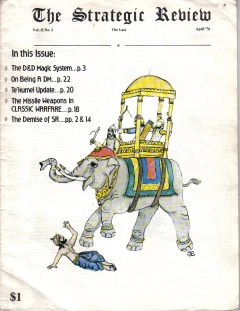 1975 brought the first issue of Strategic Review. In this form, however, the magazine lasted only seven issues. Clearly, despite D&D's appearance, TSR's founding team remained captivated by strategy and tactical games, naturally including D&D among them. Seven issues is not much for a magazine: barely more than half a year's run for a monthly. Nevertheless, the magazine, sold for one dollar, was not unsuccessful. It did not close; it simply split in two. One half continued as The Dragon, dealing with roleplaying. The other remained on the wargame track as Little Wars, but lasted only thirteen issues before being absorbed into The Dragon.
The split was therefore neither long-lived nor successful. The situation suggests that The Dragon was the more successful title. Why? We can consider the reasons. One is obviously that the roleplaying side had a magazine tied to the product that created the genre, while the wargame side had an amateur magazine from a simple fan association. But we can also discuss how D&D's appearance had consequences.
The Dragon eventually became Dragon Magazine, then simply Dragon. Part of its success was appearing in several languages. French and German markets are unsurprising, but it even had a Hungarian edition for a short while. After issue 359, Dragon became an online magazine tied to the D&D Insider subscription. The year 2014 and D&D's fifth edition brought the end of D&D Insider and its associated online magazine. Sadly, this is not the first legendary magazine whose demise we have described here. And because so many magazines and services had merged into it, this also affected the later but equally legendary Dungeon magazine.
The Dragon's appearance in 1976 is also interesting because this is where roleplaying first separates from the various tactical and strategy games. The emergence of roleplaying as a distinct genre may be tied to this change. At this point, people recognised that the roleplaying market differed from the wargame and related board-game market: different needs, different aims, different development priorities. Little Wars being absorbed may also indicate a shrinking wargame market, making it clear to many that TSR's future from here lay in roleplaying games.
Interestingly, theories helping explain and categorise roleplaying appeared much later. Analysing those does not belong to D&D's history, so it is enough to know that the publisher's team, developers and market became conscious of roleplaying as a genre in 1976. Understandably, many roleplayers consider The Dragon central to D&D's history. Many regard its online-magazine format, folded into D&D Insider, as spitting in loyal fans' faces, abandoning valuable traditions and effectively the surest sign of D&D's decline. But we will see that strange things had happened earlier too.
The point is that, by 1976, the two genres had separated. Even if roleplaying took only part of the market wargames had reached, that still meant a decline for that market. Tabletop roleplaying likewise experienced declines when computer RPGs, MMORPGs and card games entered the market.
Despite the split, the wargame heritage remained: a campaign remained a campaign, a module a module, and naturally a character a character. D&D is still haunted by the problem that "character" means disposition, the "character" of a wargame figure. Can a character have a character? We have written about that already. Attachment to using miniatures and many other common features naturally remained for a long time, but roleplaying's development had now diverged from tactical games. Consciously articulating the difference was still difficult, especially without mentioning immersion. Since then, of course, many people have sought not only to define roleplaying, but also to establish plenty of categories.