
Early editions
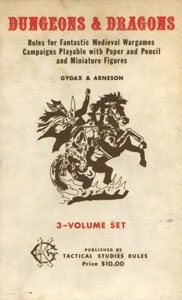 D&D's very first edition, the legendary "White Box" published in 1974, immediately offers a huge surprise. According to the box, it is not a roleplaying game: the word wargame appears again, the term for tabletop strategy or tactical games. Rules, in other words, for fantastic medieval tactical-game campaigns played with paper, pencil and miniature figures. Dice are not even mentioned. Nor is roleplaying. Interesting, isn't it? According to its developer, D&D's original edition was still very much a wargame, not the first roleplaying game. At least if we believe the wording on the box, the development team's affiliations and many other things. Simplifying D&D and giving it a somewhat "wargame" feel is therefore not a change alien to D&D, but a little nostalgia—and, as we see, not without foundation.
Is that good or bad? A good question. Many enjoy a heritage train, whether hauled by an M61 NOHAB or the "424 battleship", a legendary steam locomotive, yet dislike the "everyday heritage operation" on Budapest's BKV network. Fourth-edition D&D offers an excellent opportunity for nostalgia, though not through the original system. Even its harshest critics say it became what original D&D had been: a miniatures-based wargame. The question is whether it is also good for everyday use as a modern, forward-looking system. You can debate it, see it as a "reboot" and debate whether a reboot was needed. Or accept that this is what we have, and anyone who dislikes it can play another edition. That option is open to almost everyone.
In any case, it is worth looking at one important aspect of the game: players did not play against one another, but fulfilled different roles within a party. In this respect, "PvE" (Player vs Environment: A game where the player's opponent is not another player, but the environment, also managed by the game master. It can be single-player or cooperative.) was one of the innovations. If you are no longer "the winner", though, earning admiring looks from friends through victory becomes harder. In many places, defeated opponents, loot and levels brought recognition and a sense of achievement. Elsewhere, what mattered was who made the shared entertainment more interesting. Everything from jokes through an interesting character to roleplaying could begin to provide a sense of success.
Anything that provides a sense of success also becomes a goal, and many people will strive for it. Roleplaying thus becomes a concept that emerges naturally. This process happens wherever slain enemies suddenly cease to be the main source of satisfaction. Many such processes exist in the Hungarian market too. There is nothing surprising about D&D becoming a roleplaying game in today's sense this way. And with that, the development of roleplaying games began.
But let us return briefly to the first, original edition. The Blackmoor and Greyhawk campaign settings appeared for it. Here too, the world was primarily the "site of the military campaign", a rather pleasing connection to roots reaching back to tactical games. Additions appeared in fanzines and magazines, and a life grew around the game. The vast American market, the subculture and links with international organisations produced figures of one thousand copies sold in the first year, five thousand the next, and continuing growth. But 1975 also brought the death of TSR co-founder Don Kaye. The company TSR Hobbies, Inc. replaced the earlier partnership at this point. The first "full-time employee" had arrived shortly before. Board games and many other little things followed too.
We could say much about TSR's history, interesting well beyond this period, and about its other games. But learning about them would not help us understand D&D's history and development. Knowing a board game does little to help place the current D&D edition in the history of editions and decide whether it represents progress or regression. Nor would it tell us where D&D stood relative to the market. It would not help decide which game and version to choose either; a sentence on every "ancient", now-unobtainable board game would add little. Let us turn instead to magazines close to D&D.