
The history of D&D does not begin with D&D, but with a long line of precursors. That was already true of the corresponding article on this site's previous incarnation. Since then, however, D&D's history has continued: fifth edition has appeared. The world and the market around D&D have changed too. So has this site, including the possibilities it offers. Four years have passed. In four years, D&D changes a great deal, the world changes, and so do we ourselves. D&D's latest attempt at renewal meant this article needed renewing too. But if the article is both long and revised, we must make sure returning readers get something new when they read it again.
Hassenfeld Brothers — The present publisher's past
Today, the multinational company Hasbro stands behind D&D. In 1923, the company began under the name Hassenfeld Brothers (Hassenfeld Brothers: The three Hassenfeld brothers, Hillel, Herman and Henry, started out as a small family company. Trading in textiles, from textiles). It was founded by three brothers and dealt in textiles. Like so many businesses in the English-speaking market, it did not have a separate legal personality until 1926. Pencil cases and other school supplies were followed by pencil manufacturing. Money earned from this let them enter the toy industry in the 1940s with a "play doctor" toy. Modelling clay and a doctor set were unremarkable, run-of-the-mill products, but 1952 brought Hasbro its first success: Mr. Potato Head, a set with which "children could make funny faces out of any vegetable". For us, though, 1952 is interesting for another reason. Even at this point, the company's story would still tell us little about the history of roleplaying.
The ABC of Wargames: Avalon Hill
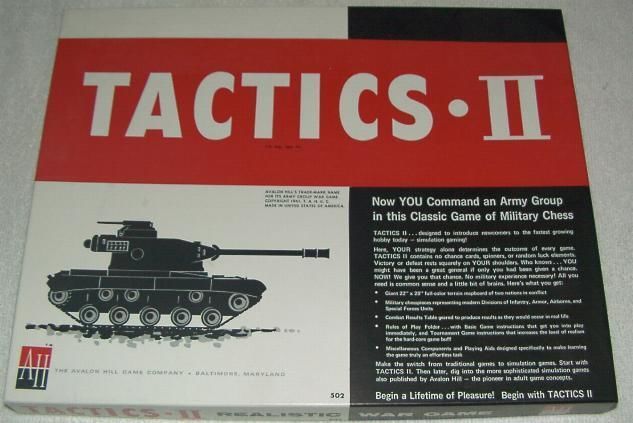 1952 really matters to us for a different reason: a certain Charles Swann Roberts publishes his strategy game Tactics, the first tabletop strategy game of its kind. To publish his own game, he establishes The Avalon Game Company, later known as Avalon Hill. The second edition of Tactics appears under the company's new name. America takes to tabletop strategy games relatively quickly, and Avalon Hill soon publishes more: Gettysburg, U-boot, D-Day, Civil War and Stalingrad. All military themes drawn from Earth's history.
Since Avalon Hill's name will recur in the history of roleplaying, it is worth remembering, even though the company is primarily a heavyweight in strategy games. One event crucial to D&D's history is the 1964 launch of its magazine The General, with just six issues a year. It lasted until 1998, when Hasbro—the company now also associated with D&D—bought Avalon Hill and discontinued it. Yes, this was the first official magazine from the world's first wargame publisher. A shame to lose it.
In the United States, games like these began gaining ground immediately after their appearance. Clubs formed around them, in a process that continued for decades. People chose the latest wargame session over rock and roll or sport on a Friday evening. Let us say that these communities gave birth to the first roleplaying game and many of its precursors. Such tabletop strategy games were considerably more complex than many familiar board games of the era. A hobby had begun. Unlike the roleplaying games that followed, individual players here played against one another.
Chancellorsville, appearing alongside Gettysburg, used the same game system, making a change of "board" and setting an interesting option. Naturally, games simulating one particular situation continued for a long time too. This way of operating was good for business. But games using the same rules, followed by homemade boards for them, naturally led to games where players could create the battlefield themselves. That provides the basis for substantial campaigns and in-house tournaments.
Such campaigns felt natural in a game about war. Today's computer strategy games likewise present their stories as campaigns built on similar foundations. But this has a small consequence: more and more stories began to appear, sometimes adapting novels or cycles of novels with only a few miniatures.