
SPI enters the scene
In 1966, Chris Wagner's fanzine Strategy & Tactics appeared as an "independent competitor" to The General, later becoming a substantial magazine. Its first few issues were published in Japan, where Wagner was stationed as a master sergeant in the US Air Force. When its founder was later posted home, the magazine began appearing in America too. Jim Dunningan took over and founded the publisher SPI (SPI: Simulations Publications, Inc. was an American strategy-game publisher that went bankrupt in 1982. TSR bought its brands and rights in 1983) for it. An interesting tradition began with issue eighteen: every issue included a complete game. And yes, SPI's name will return in our story too.
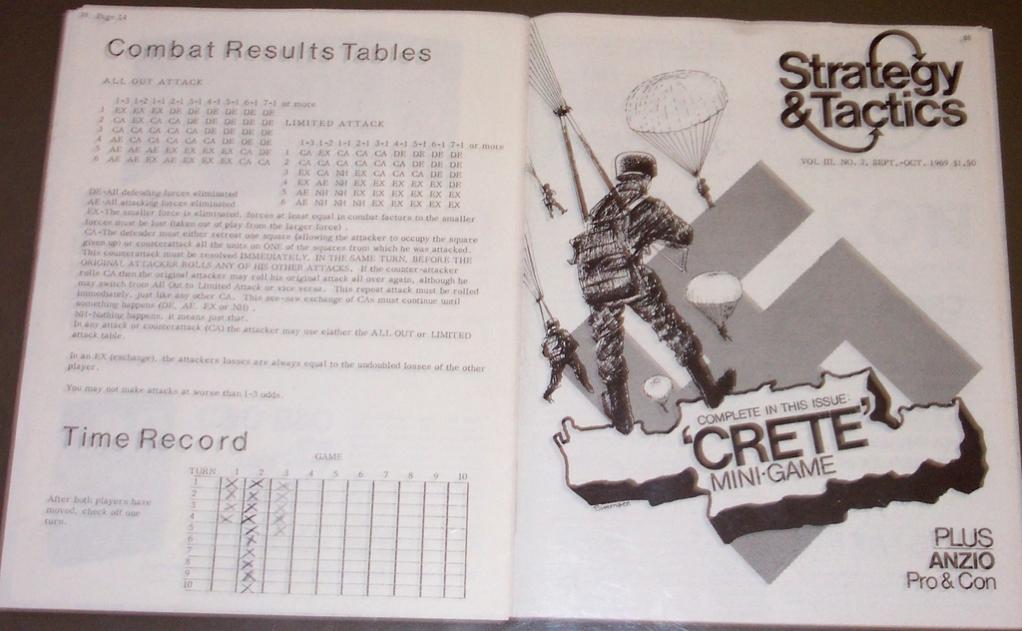
Although regular game publication alongside the magazine began with Crete in 1969, shown on the left, it did not come out of nowhere. Individual games had appeared in the magazine before. Among them was a little game from 1967 of particular interest to D&D's history. Publication in a magazine naturally affected its length and complexity, as well as requiring it to use miniatures and dice that were already available.
That 1967 game was Henry Bodenstedt's Siege of Bodenburg. It too had precursors, of course, including the 40 mm Elastolin figures and the castles made for them around which the game was built. O&M Haußer, the company making Elastolin figures, was founded in 1904 and was already producing them by 1910. Production of composite Elastolin figures ended in 1969, and of plastic figures in 1982. The company went bankrupt in 1983. It seems this period proved fatal both to SPI and to this miniature manufacturer.
We did not begin our story with them, though, because they were not seriously involved in either roleplaying or tactical games; apart from Siege of Bodenburg, their role would seem incidental. Gary Gygax's group almost certainly encountered that game. It was the first wargame played with medieval miniatures, bringing a major change after tanks and SS officers. But the credit belongs to Henry Bodenstedt and Strategy & Tactics; O&M Haußer was only a passive supporting player in the story.
Nevertheless, this game brings us much closer to D&D. Understanding that turning point required telling the story from Avalon Hill through Strategy & Tactics. But we must also glance back in time a little to understand where Gary Gygax and his group were when Siege of Bodenburg appeared in 1967. Not very far back: according to Wizards' website, he founded the International Federation of Wargamers—originally called the United States Continental Army Command—in 1966, while an interview on WomanGamers dates it to 1963.
According to Wizards' website, TSR's history begins with precisely this event. Gygax had encountered tactical games by buying Avalon Hill's Gettysburg in 1963—I promised we would return to Avalon Hill—which makes a 1966 founding seem more likely. It will therefore surprise nobody that he read the major magazines available at the time and encountered Siege of Bodenburg. The more familiar names are beginning to appear.
A year later, in 1968, the Castle and Crusade Society, supporting medieval tactical games or wargames, was established within the IFW, again founded by Gygax. The medieval direction now comes into view too. This year also saw the first Gen Con, then likewise associated with the IFW, which would grow into one of D&D's most important regular events. Gygax's local club was then called the Lake Geneva Tactical Studies Association, LGTSA. The phrase "tactical studies" in the company name Tactical Studies Rules also comes from here. This club operated mainly in Gygax's basement.