
Adventure structure
Whether we traverse a dungeon, the graph of events discussed in node-based adventure design, or arrange the evidence pyramid's elements on a traversable graph makes little difference. An adventure often involves traversing such a graph. Almost a dungeon, only with invisible walls, you might first say. But how we traverse it matters a great deal. We can easily establish the difficulty of individual elements. For a piece of indirect evidence, we might note that it can be obtained from eight sources and is easy at all of them. If rolls go well in many places, those impressive successes may even earn an improvement check at the adventure's end. The problem is that neither approach guarantees the group will traverse the whole graph, that we have not worked on particular parts in vain, or that the group will not try to go off the map and invent or start a new storyline.
Eliminating and expanding
The main task during an investigation is really eliminating false leads and suspects. If that produces no result—you have ruled everyone out, or cannot rule enough people out—you need to broaden the field with new evidence and possibilities. Eliminating false leads and suspects also requires obtaining and assessing new evidence. At the beginning of the adventure we can say everyone is a suspect, and the group obtains the obvious evidence relatively easily, then searches individual locations for perishable evidence available only for a limited time. This is the logical starting point. We can see that credibility already breaches the Three Clue Rule, or its reverse, here, because the group gains relatively large amounts of information. Contrary to those principles, however, investigation does not merely open new directions: some directions can be ruled out, while in other cases a suspect becomes a key witness.
In simpler, single-session investigative adventures, 90% of the relevant clues are available in the first two or three scenes. From there, the task is to narrow the suspects and eliminate false leads, perhaps without visiting additional locations. Let us examine the elimination-and-expansion process through a new example. In an adventure I ran recently, someone had been forced off the road: homicide using a vehicle. The group soon learned who might have traveled that road, and timing information, vehicle condition, and so on helped narrow the field. The false lead was simply that one group of suspects was being secretive because of smuggling. After ruling out the people involved, however, it emerged that agricultural machinery, a tractor for example, could have entered the road at many points. The culprit was soon found, although even the group still does not know the dark secret of what he was looking for at night and why. After the initial narrowing, the cycle needed one expansion and then another narrowing.
Running the adventure
Many adventures take their structure from a written story, so the chronological sequence of events determines it. In a good investigative adventure, whether the aim is a sandbox or a guided adventure, I would nevertheless say the primary structure is spatial. There are two main reasons. Many non-investigative adventures concern a present danger, while an investigative adventure concerns a past event. Whether yesterday's events are revealed before those of the day before is freely selectable. Moreover, as they explore the area, which information characters obtain, from which locations, and in what order depends heavily on the characters. The main temporal constraints concern information that builds on earlier information and events that react to one another.
I assume you too want to avoid working in vain, and want many of the locations and events you write to enter play, along with much of the evidence and its connections.
Guided adventure
For many adventures, you consider where the group can go from the starting point, how, and through which tasks. Here the trick is to work from the endpoint, the recognition of the facts, and from what the characters need to prove their case. You work backward, but traversal of the pyramid is ensured by the starting point probably being a particular location where indirect evidence links it to similar locations and specific people, creating the opportunity to gather relatively large amounts of evidence. Initially the characters move through the bottom two levels of the clue pyramid, then leads increasingly emerge from the evidence. You do not particularly want to let them wander all over the place.
The main guarantee of minimizing wasted work is that you actually guide them through the terrain.
Sandbox adventure
During the adventure, characters act freely within the playing area. There is no requirement for many pieces of indirect evidence to lead to direct evidence, then to a lead, then to proven facts that can catch the perpetrator. Some characters begin with an assumption corresponding to a provable fact, or perhaps to a lead. The latter may also be a false lead. They will therefore often move downward, or sideways in many directions, making the adventure's duration much less predictable. The environment and playing area react to them, and they react to it while also shaping the world. With many levels continuously accessible, the clue pyramid here takes the form more of a clue repository.
The main guarantee of minimizing wasted work is reusability of locations and surroundings. The murderer may have been found, making X's testimony unnecessary, but in the next adventure X will still talk about what they knew of this murder. Their house, personality, and so on remain too. You build on reusability and multiple available storylines. That is why subsequent adventures can typically begin at different points.
Physical structure
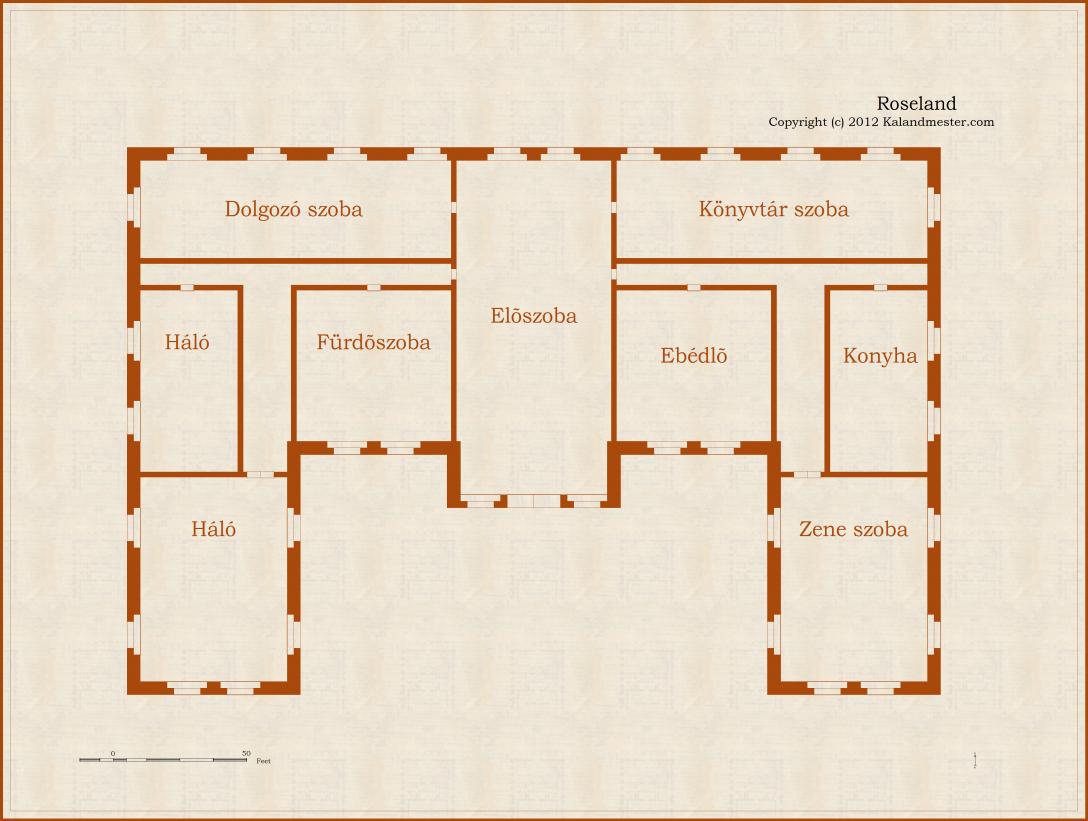 Alongside the details placed in the clue repository, the adventure has another important structure, provided by the map: the routes between places and which other locations they cross. This matters because roads too are places where characters can see or hear something. It can also justify an enemy ambush, help establish isolation where appropriate, or limit which events they can reach after others. It often creates connections between locations too. From location X, one may see what happens at Y, so evidence easily accessible at Y may also be noticeable from X, albeit at a different difficulty.
Many people looking at the map on the left would say, “There's the mistake: the Hungarian labels for study, library, and music room should be written as single compound words,” and perhaps point out other things too. True, but why was the map not made that way? The original had no copyright notice and was an adventure handout. Let us say the GM's version could, for example, include the stairs to the upper floor and much else. But even this bad old map shows that one bedroom window is visible from the music-room window. Going between kitchen and dining room takes you through a corridor also serving the music room. That affects who can see what. Just as importantly, it affects who could have seen what.
Timed events
The lab does not produce immediate results, and time can erase much evidence. Events occur at particular times—for example, the murderer may kill a witness—limiting the availability of some evidence while creating new clues and helping rule out suspects.