
 The introductory installment of our series was primarily a collection of ideas and advice that you either agreed with or did not, but you surely asked why the advice was not structured and where the connections between its points were. The thinking ran in one direction: someone asked a question, answers appeared, and I am not sure the beginner was any less lost by the end of a debate jumping among many viewpoints than at the beginning. So let’s put a consistent perspective in one place, roughly working through those lists. Someone working on this right now ideally needed it yesterday. In the longer term, however, that would not be the right solution. But approached from another direction, the argument also had a very simple outline:
- Reusable locations and NPCs
- A reason to return: clues that build on one another
- A second reason to return: checking a false lead
- Typical interaction at a location
- This is not enough for everyone: allow for other interactions
- The next level of balance: gathering information through abilities
- How to stock the “clue repository”
- Where and how to present clues
- Inaccuracy and accidental false leads
- Tools
- Debugging
Some people followed that thread, others did not. It was not particularly prominent. Someone did note, however, that Delta Green is not a perfect example of a combat-oriented adventure, because... Delta Green only removed the ultimate descent into madness from Call of Cthulhu, and many of its adventures are strongly investigative too, but some let the group raid the Deep Ones. In other words, raids and combat-oriented adventures are possible. They are not a general requirement. A general requirement usually does not arise. There was an extremely simple reason I began with the difference between combat-oriented and investigative adventures: You can generally kill a person only once, but usually observe them, question them, and so forth many times. That leads to a very important consideration. Although not every investigative adventure is a criminal investigation, this simple example will concern that kind of case, partly because of the question that was asked.
To prevent an adventure module from stalling, people developed the idea that the clues advancing it need some redundancy. This was the Three Clue Rule. If you miss one and misinterpret another, the third clue still works. Node-based adventure design reversed this principle, assuming that, with three clues pointing in different directions, the characters would follow one of them. Obviously not the one they never noticed. But that leaves the misinterpreted clue and the correct one. The misinterpreted clue can therefore send them in any wrong direction, and this approach does not plan a clue leading back from those directions. Misinterpretation adds a new false lead to the system. But there is another possibility: faced with two definitely contradictory clues, the group can choose two further ways of examining them. One is investigating the two locations simultaneously.
The other is investigating the two clues further to establish which way to go. With the Three Clue Rule, it is easy to see that attempts to resolve the contradiction can lead the group to interpret the misunderstood clue correctly. When the rule is reversed, however, the additional clue does not correct the misinterpretation. Although this article will not discuss it, trying to reconcile the two clues can readily produce further mistaken leads: clues pointing in different directions will have no correct harmony, but an incorrectly perceived harmony—a false lead—may still exist. False leads are an inevitable part of investigative adventures, and a false lead created by a player's misinterpretation is equivalent to one deliberately presented by the GM.
From point A, the player could therefore reach not only B, C, and D, but also, say, point C', created by a misinterpreted clue, and point A', representing deeper examination of A. While C' is a misinterpretation, A' is not: it is an option arising from the adventure's design. In a combat-oriented adventure, after exploring A and B, C, C', and D would seem good continuations, but the clue toward D has been confirmed in two places. Hang on, though: articles presenting node-based adventure design left out a point here. The conclusion. There is also a route from B to E, the conclusion. Or perhaps to E', and there may be one to D' too. Even to B'. And the feeling that we missed something may lead toward A' as well. You can generally kill a person only once, but usually observe them, question them, and so forth many times. A location becomes reusable because the player can hope to discover something new by returning to it. The problem of following a route in an endless loop therefore cannot easily be excluded, since the clue leading to A' and the newly arising B' points always remains. There is no guarantee the group reaches point E, the conclusion.
Visiting a location more than once does not mean planning several substantive scenes there. A dungeon is a good example. Corridor A has doors opening into rooms B, C, D, and E, and into corridor F leading onward. If the group explores in the order A→B→A→C→A→D→A→E→A→F, it effectively uses the dungeon in the order A→B→C→D→E→F if returning to corridor A produces no new encounter. Such as a relief patrol, a party searching for the missing guards, or something else that would create a new encounter in locations A', then A'', then A''', altered by the wreckage of earlier battles and the bodies lying there. The group proceeds with dwindling resources through increasingly difficult terrain. In node-based adventure design, the graph formed by planned scenes and the lines connecting them is almost a virtual dungeon. Although you can say that scene order influences the scenes and makes the adventure's arc unique, the conclusion often says otherwise.
In an investigative adventure, you allow for a player character armed with new information to ask many new questions. Checking further information will therefore very probably turn scene B into scenes B', B'', and even B''' as well. And people react to the characters' behavior at every location and in every scene.
Reusable locations
False leads are an inevitable part of investigative adventures, and a false lead created by a player's misinterpretation is equivalent to one deliberately presented by the GM. The clues above can apparently lead anywhere. How can we limit that effect? Primarily by limiting the environment available for exploration. If the adventure takes place on a ship or train, in a village or on a noble's estate, and we know nobody could have left, we have already defined the accessible locations. This also means that checking any clue or false lead must not take the characters outside the established playing area. Every clue and every false lead must be checkable within it, usually by comparison with other clues—for example, checking an alibi by questioning a witness. We have many clues but considerably fewer locations and NPCs, so we necessarily build on the same location or NPC at several points. Let us use a village cut off by flooding as the adventure's available playing area.
You cannot ask witness A whether B's alibi is true until you have heard the claim to be checked. It is therefore natural for characters to go from witness A to suspect B, then verify B's alibi by questioning A again. Ideally, checking the alibi might also establish that B arrived a little before C and left after C. We now have information about C's whereabouts that several other witnesses may confirm. If we know C was in the pub, we will not believe his claim to have seen his wife D at home the entire time. C's testimony is a planned false lead.
If nobody asked him to give false testimony and he is doing it only out of love and to protect his family, that does not in principle make it a particularly strong clue yet, especially before questioning his wife and the neighbors. The wife may have been home without witnesses, home according to the neighbors too, or perhaps in church before a hundred witnesses. Of course, she may have been at the murder scene, either as the perpetrator or as a witness terrified nobody would believe her against X. A conclusion drawn too early can be another false lead introduced by the players on top of a planned one. Half of investigation is not finding clues, but filtering out false information.
At C and D's home, one scene might involve the group secretly searching it, another questioning C there, another questioning D. Or questioning a neighbor at the fence. You can use the home's description, illustrations, and maps on any occasion. C's description also works whether he is at home or in the pub.
Designing adventures with reusable locations
When you intend to use a location only once, you roughly know what will happen there and when and where the adventure leads next. If you use it repeatedly, however, it will host a number of events unknown even to you. For every location, you need to know who is usually there and when. Those people's personalities must include how they react to events and repeated questions: you see NPCs change, and the location may develop alongside them. Normally, a location and the characters appearing there are presented together in an adventure module. In a good investigative adventure, however, people move around and their behavior changes. That means a separate NPC chapter, separate information on locations, separate information on events, and again separate information on clues.
At every location, indicate who and what events may appear and what clues may be present. NPC descriptions also include where they usually are and when, what events involve them, and what they know. This is therefore much less continuous prose than a database with many-to-many relationships, a “pile of case files.” Because of the many cross-references, I generally recommend the GM have at least a tablet or another electronic device. I often prepare adventure modules in OneNote with many cross-references. For the clues advancing the adventure, I also indicate where and how they can be obtained. The principal tool for this is the clue repository or clue pyramid.
Clue repository or clue pyramid
To be honest, I use a multilevel clue repository: a clue pyramid. In more extreme cases, I place proven or provable facts at the top, with leads below them, and below the leads, direct and indirect evidence. Solving an adventure might require proving three of five important provable facts. Each fact might have three good leads and one misleading false lead. I can assign, say, three useful and one useless piece of direct evidence to every lead. Three or four pieces of indirect evidence can help locate every piece of direct evidence. And each piece of evidence may have many sources. Many people can confirm that B really was in the pub, for example, or that two NPCs are probably secretly in love. Likewise, there may be several witness statements.
The five provable facts always include the “holy trinity” of motive, opportunity, and the murder weapon or instrument—or another object clearly linking the character to the murder. A confession belongs here too. The fifth “provable fact” is a story or scenario the prosecutor can present. Yes, if there is a recording of the incident, witnesses, and so forth, this means that recording. But it still has to be proved that the character is the person on the recording, so it is not a single “trump card” and solution either. A credible narrative may be built even on a few pieces of indirect evidence; player characters can easily skip levels.
The player characters find a bloodstain. They do not know when or how it got there. This is indirect evidence. If clues found at the scene and perhaps elsewhere establish that it is probably the murderer's blood, it immediately becomes direct evidence. Blood type and much else help identify people in a database, from which some legwork can lead to the right person. This is now a lead. If the lead points in the right direction, excellent. If the very person who committed the crime is the one with no records and whom you cannot find, it is a planned false lead. Even a lead pointing in the right direction is still not enough for a conviction. Despite a strong link to the incident, the person can readily say they were framed and the evidence is false. A narrative can easily be built around the story so far, but it would collapse at trial. At least one of motive, opportunity—the lack of an alibi, and so on—and a confession is needed.
But not all investigative adventures are created equal. One of the most highly rated crime series, The Wire, essentially follows an investigation of the same criminal group across five seasons. Programs on Investigation Discovery or ID Extra also concern investigations lasting months. If you want Columbo- or CSI-style investigations, one episode per case, you need to reduce the amount of required evidence and the number of false leads. With more than a hundred elements, and solutions played out for perhaps an hour or two per element and per source, exploring the four-level clue pyramid above works when investigation is central to an adventure played over an extended period. If direct evidence provides not merely a lead but an already usable fact, establishing motive, opportunity, or means, for example, the pyramid becomes smaller and the adventure shorter.
Designing locations
If you describe a vase as standing at the left end of a ledge on one occasion and at the right end on another, the characters may not necessarily notice. But if you build the same location as a map in Campaign Cartographer 3 or an image in DAZ Studio, and they have examined and interacted with many things so the image is fixed in their memories, they have a very good chance of noticing the change. Metagaming may not be nice, but if you want to help the characters with a little cheating, the players can become aware that you are using a different picture.
Perhaps the image is on different paper, you swap images printed on transparencies, or take it from another folder. They cannot directly bring that information in character, and they would look around anyway and might notice. The player who spots it will even be proud of themselves. They will think not of cheating, but of the neat hidden clue they noticed. When making images in DAZ Studio, I often change the visibility of certain objects and rerender only what changed. With Campaign Cartographer maps, putting the change on a separate layer can likewise help. Consistency matters here too, however. Do not move only the thing that is a clue; show the natural rearrangement of place settings, chairs, and many other small details as well. Let the group discuss which of the seven or eight differences they see might be clues and which are not.
So a single location can involve many scenes, many NPCs, and even more clues.
Adventure structure
Whether we traverse a dungeon, the graph of events discussed in node-based adventure design, or arrange the evidence pyramid's elements on a traversable graph makes little difference. An adventure often involves traversing such a graph. Almost a dungeon, only with invisible walls, you might first say. But how we traverse it matters a great deal. We can easily establish the difficulty of individual elements. For a piece of indirect evidence, we might note that it can be obtained from eight sources and is easy at all of them. If rolls go well in many places, those impressive successes may even earn an improvement check at the adventure's end. The problem is that neither approach guarantees the group will traverse the whole graph, that we have not worked on particular parts in vain, or that the group will not try to go off the map and invent or start a new storyline.
Eliminating and expanding
The main task during an investigation is really eliminating false leads and suspects. If that produces no result—you have ruled everyone out, or cannot rule enough people out—you need to broaden the field with new evidence and possibilities. Eliminating false leads and suspects also requires obtaining and assessing new evidence. At the beginning of the adventure we can say everyone is a suspect, and the group obtains the obvious evidence relatively easily, then searches individual locations for perishable evidence available only for a limited time. This is the logical starting point. We can see that credibility already breaches the Three Clue Rule, or its reverse, here, because the group gains relatively large amounts of information. Contrary to those principles, however, investigation does not merely open new directions: some directions can be ruled out, while in other cases a suspect becomes a key witness.
In simpler, single-session investigative adventures, 90% of the relevant clues are available in the first two or three scenes. From there, the task is to narrow the suspects and eliminate false leads, perhaps without visiting additional locations. Let us examine the elimination-and-expansion process through a new example. In an adventure I ran recently, someone had been forced off the road: homicide using a vehicle. The group soon learned who might have traveled that road, and timing information, vehicle condition, and so on helped narrow the field. The false lead was simply that one group of suspects was being secretive because of smuggling. After ruling out the people involved, however, it emerged that agricultural machinery, a tractor for example, could have entered the road at many points. The culprit was soon found, although even the group still does not know the dark secret of what he was looking for at night and why. After the initial narrowing, the cycle needed one expansion and then another narrowing.
Running the adventure
Many adventures take their structure from a written story, so the chronological sequence of events determines it. In a good investigative adventure, whether the aim is a sandbox or a guided adventure, I would nevertheless say the primary structure is spatial. There are two main reasons. Many non-investigative adventures concern a present danger, while an investigative adventure concerns a past event. Whether yesterday's events are revealed before those of the day before is freely selectable. Moreover, as they explore the area, which information characters obtain, from which locations, and in what order depends heavily on the characters. The main temporal constraints concern information that builds on earlier information and events that react to one another.
I assume you too want to avoid working in vain, and want many of the locations and events you write to enter play, along with much of the evidence and its connections.
Guided adventure
For many adventures, you consider where the group can go from the starting point, how, and through which tasks. Here the trick is to work from the endpoint, the recognition of the facts, and from what the characters need to prove their case. You work backward, but traversal of the pyramid is ensured by the starting point probably being a particular location where indirect evidence links it to similar locations and specific people, creating the opportunity to gather relatively large amounts of evidence. Initially the characters move through the bottom two levels of the clue pyramid, then leads increasingly emerge from the evidence. You do not particularly want to let them wander all over the place.
The main guarantee of minimizing wasted work is that you actually guide them through the terrain.
Sandbox adventure
During the adventure, characters act freely within the playing area. There is no requirement for many pieces of indirect evidence to lead to direct evidence, then to a lead, then to proven facts that can catch the perpetrator. Some characters begin with an assumption corresponding to a provable fact, or perhaps to a lead. The latter may also be a false lead. They will therefore often move downward, or sideways in many directions, making the adventure's duration much less predictable. The environment and playing area react to them, and they react to it while also shaping the world. With many levels continuously accessible, the clue pyramid here takes the form more of a clue repository.
The main guarantee of minimizing wasted work is reusability of locations and surroundings. The murderer may have been found, making X's testimony unnecessary, but in the next adventure X will still talk about what they knew of this murder. Their house, personality, and so on remain too. You build on reusability and multiple available storylines. That is why subsequent adventures can typically begin at different points.
Physical structure
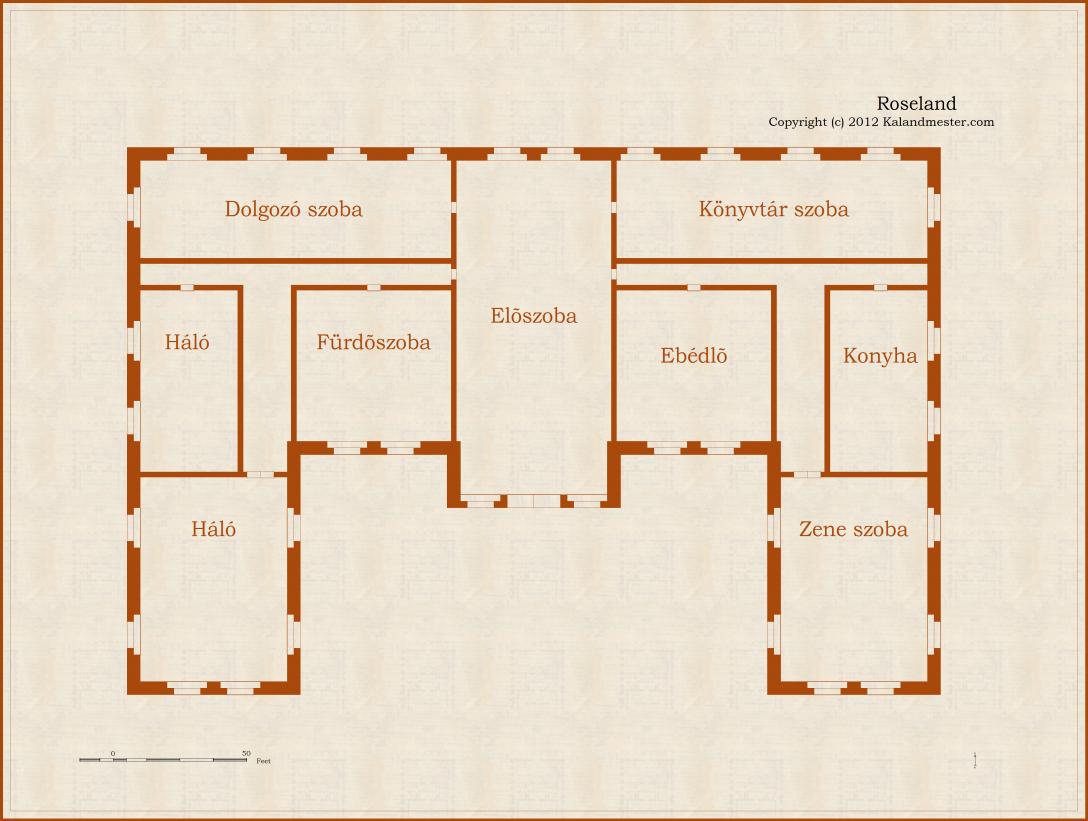 Alongside the details placed in the clue repository, the adventure has another important structure, provided by the map: the routes between places and which other locations they cross. This matters because roads too are places where characters can see or hear something. It can also justify an enemy ambush, help establish isolation where appropriate, or limit which events they can reach after others. It often creates connections between locations too. From location X, one may see what happens at Y, so evidence easily accessible at Y may also be noticeable from X, albeit at a different difficulty.
Many people looking at the map on the left would say, “There's the mistake: the Hungarian labels for study, library, and music room should be written as single compound words,” and perhaps point out other things too. True, but why was the map not made that way? The original had no copyright notice and was an adventure handout. Let us say the GM's version could, for example, include the stairs to the upper floor and much else. But even this bad old map shows that one bedroom window is visible from the music-room window. Going between kitchen and dining room takes you through a corridor also serving the music room. That affects who can see what. Just as importantly, it affects who could have seen what.
Timed events
The lab does not produce immediate results, and time can erase much evidence. Events occur at particular times—for example, the murderer may kill a witness—limiting the availability of some evidence while creating new clues and helping rule out suspects.
Simply returning
When characters return to an NPC or location, you generally need to consider four things. What specific aim brought them back, what new question do they want to ask, and is there reason for confrontation? How did the previous visit end? What additional information might they notice merely through visiting again? What new information does the living environment and the time of day provide? The answer to the first is entirely straightforward: the players have said what they want to check, and the clue pyramid tells you whether they can. In constructing the pyramid, this is a trivial detail. The fourth question is also settled by the clue pyramid and the adventure's physical and temporal structure. But two questions remain that we have not yet addressed: how the previous meeting ended, and new information arising naturally.
That was then; this is now
Someone who was irritable and very tired yesterday may apologize today. Or they may still be angry about being bothered at the wrong time. Consider the time elapsed, but also personality and psychology. How a character behaves in different situations can itself be a valuable clue. Repeated visits turn a snapshot into a moving picture, providing additional clues just through that. A repeat visit therefore gives the group new information beyond checking things they previously missed.
Consistent resolution and new information
 Obviously, you do not want to give players a clue merely by asking for a roll you would not normally request because a clue is present. Nor by describing something in greater detail than everything else. That is why consistent resolution matters. But characters also need to gain information and see many additional details when revisiting a location. Handling these two requirements together is one of the hardest tasks in investigative adventures.
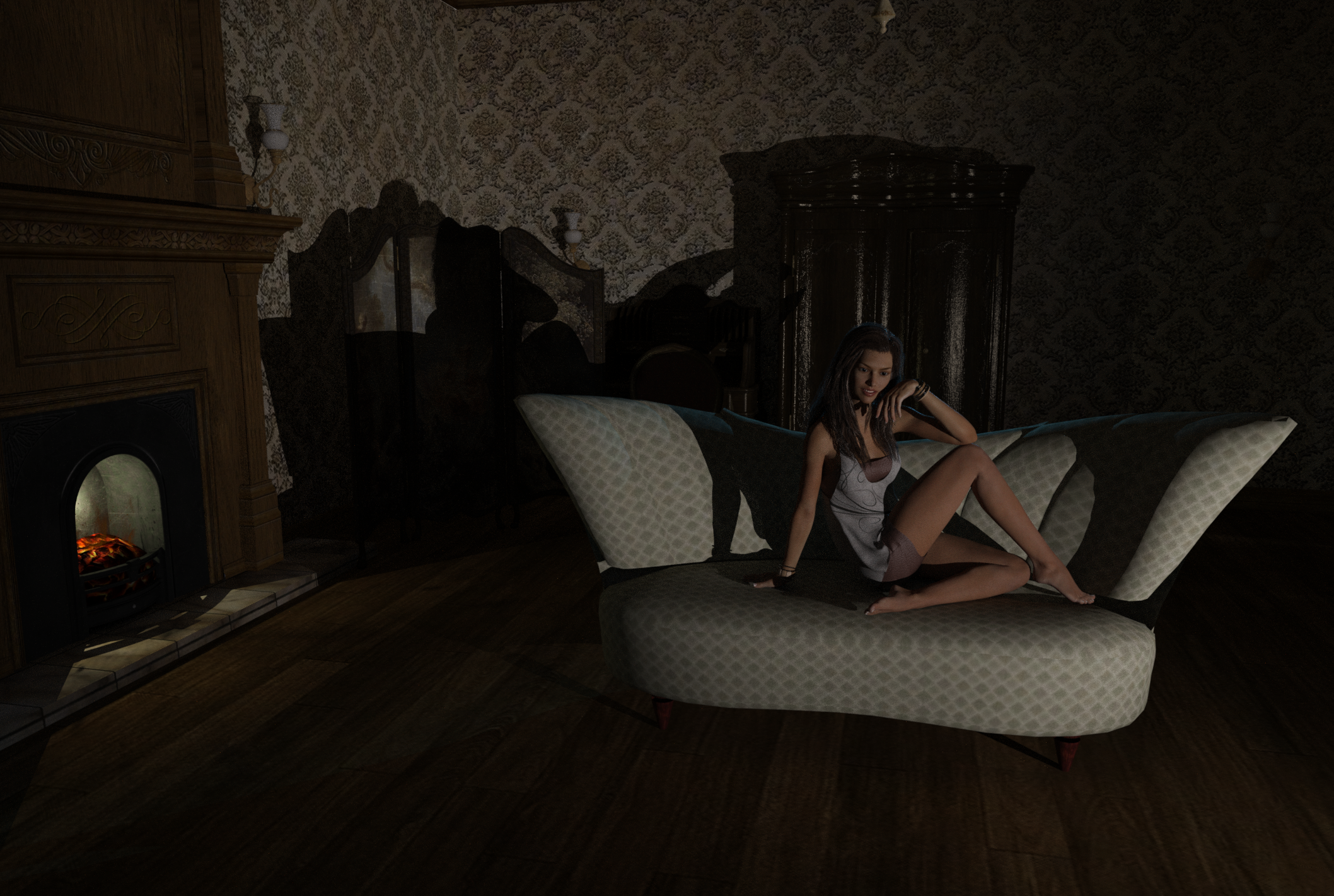
What consistent resolution looks like naturally varies from person to person. Suppose you start from the idea that a player character is human and can handle roughly seven pieces of information in parallel at once. As GM, you therefore give them six to eight. What happens when they first enter the room in the picture on the left? What are the six to eight important pieces of information? Darkness or dimness, the fire still flickering in the fireplace, the darker brownish colors, the screen in the corner, the cabinet, the sofa. And finally, the person on the sofa, because after their first impression of the room they will focus on her.
The information about her is that she is a woman, white, tall, attractive, brown-haired, wearing comfortable clothing primarily intended for home that nevertheless reveals quite a lot, and sitting comfortably on the sofa. The next information you provide under your consistent six-to-eight rule concerns her behavior and what she says. We can guess that, out of those twenty-one pieces of information, players will deal with at most seven.
But when they return because they want to know what she saw of something, you will certainly describe the elongated shadows, where the light comes from, and which way she could see out, because that is the information important to the players. They will certainly notice the three switched-off lamps too. And the seven details about the woman can, with consistent resolution, include three old and four new ones. The color of her stockings, for example, or her jewelry. You can convey a little of her style and that day's plans.
At another meeting, the adjective sleep-deprived may appear because of the nearby murder. Once that improves a little, you may remember that one PC will probably be looking at her breasts, while another notices that she now appears in prettier, more elegant clothing. If the characters survey the room, you can go from left to right, giving six to eight details about every object and waiting to see where they stop you.
Want to make the players work? If you suspect seven pieces of information are just manageable for them, the consistent amount in the adventure can be eleven, making the selection of the seven they will actually process an additional task. Want to make things easier? Give them only six pieces of information, or a picture.
Who sees what matters

Now look at the other picture. An extremely simplified sketch with no surroundings, making the arguments easier to follow. As GM, you may know the woman in the image is adjusting a device hidden in her stocking. Someone who sees only a silhouette, however, may readily describe her as naked. Naked and posing for someone, meaning somebody else may have been there, a man in their opinion. Only four of the seven things they perceived may remain, and imagination can readily expand those to eight or ten: recognizing the woman, thinking they know who is hiding in the shadows, and naming a particular man. Naturally, the identification is mistaken too, and the man imagined by the NPC was never there.
It is also natural for some witnesses to give very different descriptions of the same NPC. One will emphasize that “she had nice breasts,” while another considers her hair or eyes among the most important details. Several descriptions therefore reveal increasing information about a person, but may easily include false information too. That brings us to filtering out false information, another interesting subject.
False leads in your adventure
One of the characters' main tasks is filtering out false leads. They also want to eliminate innocent suspects. An investigative adventure's difficulty is affected by what proportion of the leads currently being examined are false, and when their falsity needs to be recognized. It is worth examining the types of false lead and how checking or recognizing one can change returning characters' relationship with a location or NPC.
Changes in the PC–NPC relationship are naturally mutual: NPCs react to the characters returning and questioning their word. The characters are also taking up their time again, which in most cases can become annoying. An interesting possibility also arises: an NPC may not necessarily remember their first statement. There can be many good reasons. Call of Cthulhu is a roleplaying game in which numerous scientifically grounded methods—drugs and hypnosis—and mystical methods of influencing testimony and memory can coexist.
Memory implantation and a little manipulation can even produce a false confession the person later does not remember making, yet which contains a detail the police believe is not public. Such methods and Sanity loss can often lead NPCs or PCs alike to give this kind of statement. An interesting opening for an investigative adventure is to begin after one PC, under such an influence, has confessed to something they did not do and remembers nothing. Because of earlier deeds, the group, including the affected character, is given a little time to clear the matter up. At the investigation's beginning, they receive the entire file collected so far, and for some questions they need not wait for the lab because results already exist. This is a substantial twist, but also shortens and simplifies the story.
Misleading testimony
It is a cliché that witnesses may lie but physical evidence rarely does. Since this page will be long anyway, I will begin with Gamingportal's recording of one of the first interrogations in Rockstar's L.A. Noire. There, of course, both the game's length and the structure of its gameplay justify generally collecting all evidence at a location on the first visit. But even it has NPCs you must return to, asking questions based on different evidence in your notes to obtain new information.
The NPC is subjective
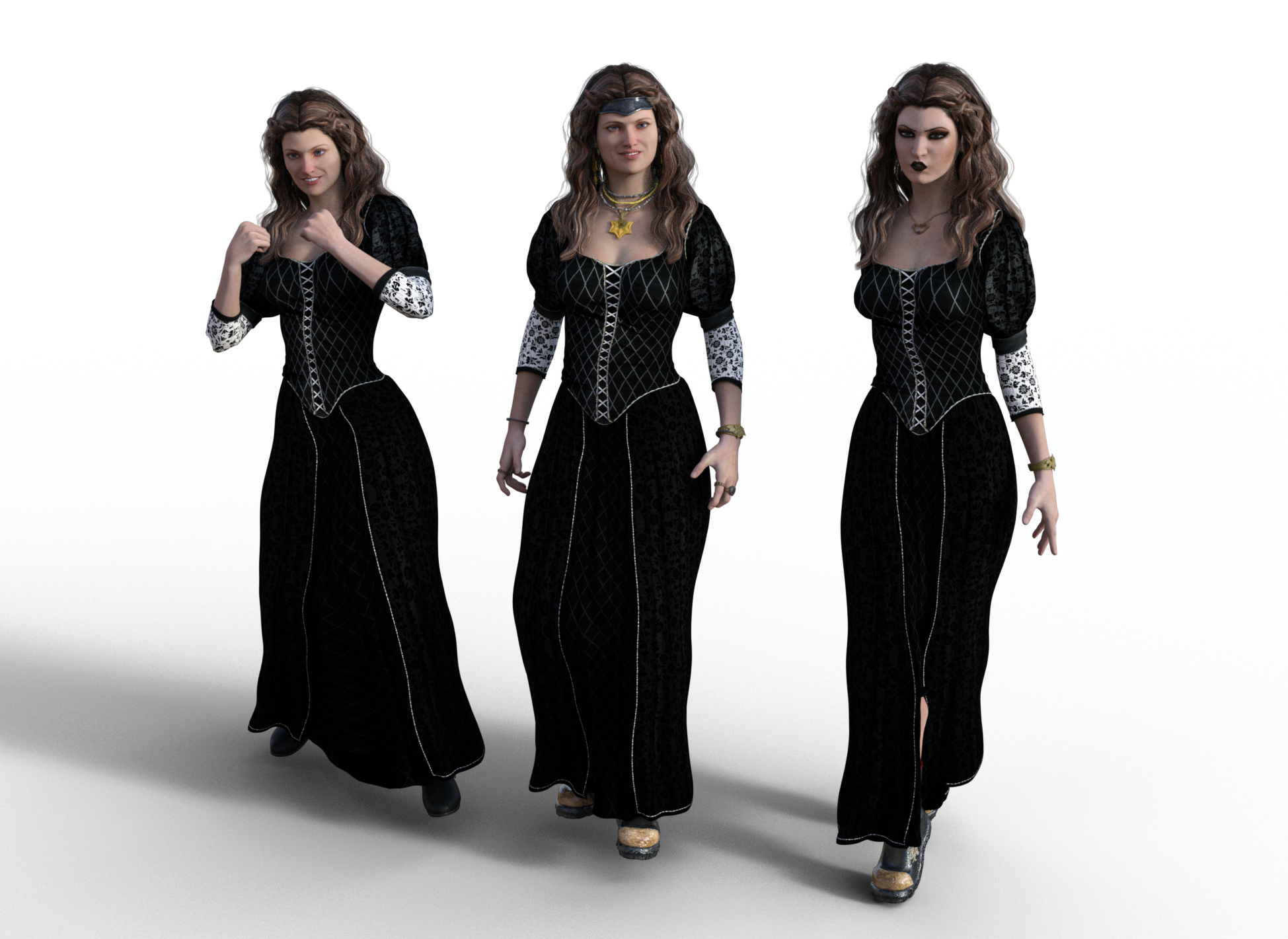 You see the video and the image on the left. If an NPC describes someone as good-looking, which of the three women fits? What if I say they used the words slim and thin? You would rule out the middle one. Suppose you meet the witness's previous five girlfriends and none weighs under ninety kilograms. You know that is their point of comparison, and that even an eighty-kilogram woman is already too thin for them. You can then consider what it means that a witness thinking this way did not add “practically a skeleton” or at least “skin and bones.” The image you have in mind will probably change completely.
In an investigative adventure, subjectivity is the most important element of NPC personality.
One interesting possibility is the character immediately following up “thin” by asking for an estimated weight. Another is returning after discovering the woman was not thin by the characters' standards. In the latter case, the edge to the follow-up question may affect the mood of the whole conversation and future cooperation. Of course, someone else may draw attention to the statement's inaccuracy too.
The NPC is mistaken
On the previous page I raised the connection between mistaken identification and poor visibility, and the way the human mind influences what it adds to the information seen. For your world to be believable, not every NPC can be infallible. You need to include mistakes. Characters therefore often need to assess how accurate a claim may be.
A few careful questions may suffice to check it; the NPC may even point out their own mistake to the group, provided the group lets them.
The NPC is prejudiced
If Lovecraft mentions his own racism, it is worth considering that there will be NPCs far more racist than he was, but also sexist ones, or people who simply dislike a particular family. Malicious gossip can also underpin prejudice. Truth's greatest enemy is not lies but prejudice. Since the NPC rejects most information contradicting their conviction and interprets compatible information as continual confirmation, their opinion becomes increasingly firm.
Prejudice is part of the NPC's personality, however, and probing it too hard can lead to confrontation. Returning to investigate it may therefore not be worthwhile for the group. Others, however, may know the NPC is prejudiced.
The NPC tries too hard to help
If you motivate an NPC to give you information, they may strain their memory and create a false recollection, producing further incorrect information. This becomes increasingly likely as questioning is pushed further. The NPC then becomes confused, making even their earlier, previously accurate information increasingly difficult to use.
The NPC protects someone unnecessarily
An NPC may protect loved ones even when they have done nothing, merely believing you might suspect them, or suspecting them personally. Challenging this can easily be risky. But the NPC may become disillusioned with their loved one, or realize the person has a genuine alibi, and initiate a correction to their statement themselves.
The PC influences the NPC
In the TWA Flight 800 accident, FBI investigators asked witnesses whether they had seen the missile hit the aircraft. Many saw the trail of burning leaking fuel after noticing the stricken plane, but that certainly could not have been a missile. The wrong question, however, led everyone to believe what they saw was a missile because the interviewer, who knew more than they did, said so. That is why our discussion of questionnaires and the related series also address influence. A PC can have the same influence through a direct question, but also when obtaining information from many people through a questionnaire. In the latter case, even an NPC-created questionnaire may contain this flaw.
This can permanently add to the memory or information fixed in the NPC's mind, so the problem must be accounted for from then on. If the characters question the NPC's honesty on that basis, it is a very serious problem indeed.
The NPC has been deceived
Anything that deceives player characters can deceive non-player characters. The manipulative methods raised at the top of this page—deception, hypnosis, manipulation with drugs, and so on—are possibilities. So is entirely ordinary deception through misleading information or exploiting someone's gullibility.
The NPC has a reason to lie
They may be guilty or protecting the guilty party. They may have another secret. If they lie, their resistance must somehow be broken, but how helpful they would be afterward is questionable. Returning to confront such a character may therefore be justified when the group no longer expects much other help from them and has sufficient ammunition. Otherwise, the NPC may later actively influence or obstruct the investigation, and the PCs may reveal how much they know.
Misleading clues
They say evidence does not lie, but that is far from certain. I will try a few examples to illuminate situations where evidence certainly lies, at least partly. A location does not take offense. Someone unable to enter their home, denied a loved one's body for burial, or annoyed by harassment caused by an investigation following a false lead certainly may. And locations change with time and ordinary use.
A deliberately planted false lead
A deliberately planted false lead is particularly interesting when it is placed after the location was first searched, but the person planting it does not know that. It is equally interesting if a witness saw the location between the act and the later planting of the false clue. Deliberately planted false leads are relatively straightforward to handle.
The PC is mistaken
I could call this the result of a failed roll, but in many cases it does not depend on a roll. When I referred to the Three Clue Rule building redundancy around one missed clue and one misinterpreted clue, we could infer that players and player characters sometimes misunderstand a clue. That is natural.
A false lead based on prejudice
As game master, you are your players' eyes and ears, describing what they see and how they see it. This also matters when comparing what they see with something else. A discovered clue often resembles something, creating a “perhaps it is this” situation in which you can freely draw on the player characters' possible prejudices.
Irrelevant evidence
The simplest case is evidence unrelated to the matter being investigated. They are investigating murder, but the evidence belongs to a different theft, smuggling case, or something similar. Or to an event that does not belong in crime fiction at all. Those happen too. Someone can be injured in an entirely everyday situation and leave blood traces.
A failed test or faulty scientific evidence
There will be failed tests and critical failures too. The wildly misleading evidence produced by these will also appear. Evidence may be contaminated or unintentionally falsified in the process.
The above shows three important kinds of interaction at locations during an investigation: collecting testimony, collecting other evidence, and exchanging information within the group. For the rest of the adventure, each player can use only information their character knows, making communication and information sharing between players important here. Many people say noticing individual pieces of evidence is as important as social interaction in an investigative adventure. They account neither for sharing information among player characters, which also draws on their social skills, nor for the many social skills and abilities involved in establishing motive, profiling, and related investigative steps.
An interesting case is one of Call of Cthulhu's most important skills, Library Use, which we use in many investigative adventures. Searching even an enormous library may take only a few seconds of playing time, while the conversations and requests for favors leading to the roll may require much longer interaction. Most important is interaction built on information sharing among PCs, followed by questioning witnesses and then calling in favors. On that basis, I feel a predominance of social activity is a justified consideration. Naturally, you will roll for other things too.
Here I must draw attention to a problem discussed a thousand times. When considering game balance, we can identify which skill helped solve the adventure. But being the star for a ten-second skill test does not necessarily equal receiving the spotlight in many longer scenes. That is why I often say that when a slower combat system produces relatively long combat scenes in which someone can become a star through tactics, we gradually reach a point where everyone wants a larger, preferably equal, share of the spotlight precisely there, while combat gradually pushes other areas into the background. Fortunately, Call of Cthulhu did not take that path, but running an investigative adventure in Pathfinder, for example, would be harder.
In Call of Cthulhu, many rulebooks call the player characters investigators, influencing which skills receive greater emphasis during play. In an investigative adventure set in a fantasy world, the emphasis could readily shift.
Whenever a player character discusses information they personally discovered, it is worth noting that they shared it with the others, allowing the other PCs to discover further information and ask questions based on it. You therefore need to take notes during play as GM, but must also allow and indeed encourage your players to do so.
As the above shows, questioning witnesses and comparing testimony with evidence often matter most. Forget the stereotype that social situations involve only social expertise. Keep a copy of every player's character sheet and do not tell them what a roll is for or exactly when you will use it. Asking for “everyone's next test, whatever it is and whenever it happens” prevents the roll from giving information away. A combat skill or scientific skill, for example, may be what lets a particular PC spot a lie.
Characters' differing aptitudes can appear in this way too, and if it matters to your group you can still seek relative balance. Often the relevant test belongs not to the person asking but to someone hearing the answer who has a chance to recognize the NPC's mistake, lie, or prejudice. Such recognition can let the group acquire much information and react to it earlier, with fewer return visits and less time taken from NPCs. These rolls also work when a PC is speaking and the others can supplement or question what was said on the basis of their own skills.
During the group's information exchange, additions beginning “You didn't notice at the time, but now that ... mentions it, you remember...” can expand earlier descriptions, making interaction between characters a useful information source too. This may require some rolls. If players become accustomed to gaining new information and rewards by playing out information sharing, with later effects on character advancement too, and that extra information often helps them survive an adventure, they learn it is better than metagaming information known only by another character into their own play. That generally improves their roleplaying.
The above keeps the dice rolling a little, while combat-focused characters also get a role when one of their skills supplements the information in a basically social situation. They can then become the group's center of attention for a while. But they surely want to see combat too. Someone else may want to use another skill. An ambush may provide enough combat, but there are many other ways to loosen up an investigative adventure for those who prefer something else. It is a cliché that questioning the wrong person in a pub can lead to a fight. Another consideration is that, when PCs try to obtain information or equipment needed for the investigation and the other party has no obligation to help, a “something for something” situation can arise, letting you include a different situation as a side branch.
In such cases, a few rolls—a Luck roll, for example—can create a fortunate situation. The additional task may take them somewhere they seemingly happen upon new evidence. Planning the non-investigative scene some players expect, outside the adventure's normal course, lets you place a clue there too. You might hide evidence directly, or simply provide an experience that immediately changes their interpretation of earlier clues. During the more combat-heavy, dice-rattling side branch, even those less pleased by the detour can thus receive a little spotlight.
Obtaining particular information may also require breaking in somewhere. The group can then play commandos a little and obtain written information and evidence. How illegal this is naturally depends on the group's background, but it is worth recognizing that different player preferences may require such scenes. Again, the others watching a more experienced companion act can compare what they see with other evidence, making this an information source.
Such side branches also matter because, to keep the adventure manageable, you are building on a limited environment. Whether optional, because some players value them, or mandatory parts of the adventure, the surroundings they require often matter. A train, ship, or noble's manor is a restricted setting in which many types of event are awkward to run. The group's preferences therefore help determine where you can set the adventure—if you want to accommodate them. Otherwise, prepare for some players to initiate unjustified combat if none is provided ready-made.
Investigative adventures involve two basic kinds of player motivation. One is fundamentally roleplaying: players want to feel a little like investigators. It then matters that they recognize many things themselves rather than relying only on rolls. In the other case, the player does not care what kind of adventure it is, as long as they play. The character's knowledge matters anyway, and the character sheet and dice handle that. Yet social interaction is largely a part of roleplaying we rarely entrust to dice. Some adventures emphasize it less, so it takes little time, but it is exceptionally rare for it to depend only on rolls. That cuts the group off from valuable information.
The same applies to deductions and decisions, which causes problems when the player relies on dice. If, however, the game focuses much less on dice, rolls, and their results, and much more on described actions and making the player feel like a hero themselves, you should maintain that goal when running combat or anything else in a side branch. This too is part of consistent resolution and the description appropriate to it. Announcing a hit and recording damage is brutally little compared with six to eight pieces of descriptive information.
Strange results arising during combat and other activities could themselves look like strange clues to the characters, so consider the risk of derailing the adventure that way. Here you may have reason to fudge, and to avoid creating unjustified oddities in players' actions too. Remember that you are entitled to cheat a little. Compared with its contemporaries, Call of Cthulhu tries to offer relatively good resolution in advancement and in depicting differences in characters' knowledge. Randomness, however, can easily overwhelm those differences, which is not necessarily ideal.
Following the earlier outline brings us to an important question. The title previously given was “The next level of balance: gathering information through abilities,” which is not very descriptive. So far I have discussed locations changing, revisiting them for new information, the importance of sharing information there, and communication as a basis for gaining it. For investigations, The Wire is almost required viewing, and it has a striking example. Two characters receive a cold case and look for previously undiscovered evidence at a scene already searched by others. Interestingly, their communication uses no particularly large vocabulary. There is a reason many refer to it by the repeated word as the “fuck scene.”
The two detectives understand each other from barely a word. Tone and many other details make their communication quite expressive. When the tone suggests “I've found something” that may be interesting, the other detective can try again from a new perspective, and they have time for many attempts until the matter is resolved. Checking new information, a fundamentally new attempt, can readily mean another roll. Sooner or later, several characters can take turns rolling at Easy difficulty. This is a typical situation in which the d20 system offers “take 20,” while Call of Cthulhu, like many other systems, says no roll is needed. Call of Cthulhu also has the Luck roll for chance, so “let's roll to see what you found” would not arise. What matters, however, is having the relevant skill at a level that would permit the roll.
Social situations such as questioning witnesses rarely allow repeated rerolls, so when a test is needed there, the dice may come into play more.
The holy trinity of Know, Idea, and Luck immediately arises, along with how much they should be rolled. I have a few observations, and this is an important balance question. A high characteristic makes a Know roll easy for one PC, but they know nothing about this particular subject. Another PC is generally less educated but knows this subject precisely. How does the system handle that? Such a general test is not tied to a specific action. When you want a Know, Idea, or Luck roll, it effectively covers the scene, and one such roll will not give you seven or eight clues.
Skill use, however, can occur action by action, and the GM may order an additional roll when you might recognize something. In a situation where “you could roll many times, and it is recognizable even at your level,” perhaps also “it would be Easy,” you readily receive extra information during the sequence of actions. But these advantages of skills go hand in hand with communication that creates examinations from ever more perspectives and ever more opportunities to test. Skill use, action, and the instinctive communication described alongside it—even merely a change in the emphasis of “fuck”—arise from an ability used within a social situation.
An action and its natural reaction, seen and heard by another character who reacts in turn, establish a typically nonverbal communication channel among PCs, an important part of these scenes. Asking a follow-up at the right moment and many other small things may depend on Psychology. One character can spot when another becomes uncertain or when something might be added to the findings so far. And it is often important to note that persistence—not giving up—is among a character's greatest assets during investigation and information gathering. Motivating companions to persist with a well-timed question or sentence can help enormously.
Characters designed more for combat-oriented adventures usually have persistence too, since it is advantageous there as well. If a character is dexterous because their player partly designed them for combat, that dexterity may let them reach evidence or objects the others cannot. They may enable a new attempt with a new method, or create the situation where repeated attempts make a roll unnecessary: success is achieved. The spotlight is shared between them and the character with some relevant training. The three more universal rolls do not solve everything; abilities and skills receive more room.
Populating the clue pyramid
As noted earlier, five provable facts stand at the top of the clue pyramid: a conceivable and demonstrably possible narrative, a confession that may be obtained, the discovered murder weapon or object linking someone to the event, the opportunity approached through the absence of an alibi, and finally motive or motivation. When creating an investigative adventure, your first decision is obviously what happened and what must be discovered. You therefore know the perpetrator and have at least one correct version of every fact at this level, making it relatively straightforward to populate. But recognize that an individual piece of evidence or lead does not point to only one place. Why? A profile establishes motive, can underpin the story of a possible narrative, and may enable the characters to extract a confession. Almost any evidence of motive may help obtain a confession. A possible narrative depends heavily on skillful, creative use of evidence obtained in other connections. Crucially, a possible narrative need only be a story people can be brought to believe, with no evidence against it; it need not be true.
A possible narrative is also the easiest thing to overturn with exculpatory evidence. When I said you could begin with one PC accused, the accuser probably has a possible narrative they believe proven to some degree. One of the group's first tasks is then to overturn it. The second is to disprove opportunity and motive. For the latter, it suffices to show that although the character may have had a motive, knowing their personality, it would never have been enough for murder. An important foundation of investigative adventures is always providing several pieces of information the PCs can pursue. Always maintain sufficient redundancy. Saying that three of the five top-level criteria must fit was a useful guide. But only two of the three useful leads pointing to each need be recognized. At this level, the player needs only 40% of the leads. If, one level down, they need three of four, they need only 30% at that level; then two of three is plenty, bringing it to 20%.
The first guarantee that characters can solve the adventure is redundancy.
Because you know what happened, you can easily imagine what traces the perpetrator left. When discussing consistent resolution and new information, a small detail soon arose.
The information about her is that she is a woman, white, tall, attractive, brown-haired, wearing comfortable clothing primarily intended for home that nevertheless reveals quite a lot, and sitting comfortably on the sofa. The next information you provide under your consistent six-to-eight rule concerns her behavior and what she says. We can guess that, out of those twenty-one pieces of information, players will deal with at most seven.
As you can see, although one subject remains at six to eight details while the characters focus on it, focus changes within a scene. Giving twenty or thirty pieces of information while walking through a crime scene is therefore quite possible. Ten or twelve may be usable evidence. Once these have been noted and collected, the characters begin searching, revealing less obvious evidence. Obtaining the first several elements of the clue pyramid requires little effort. But the description can repeatedly specify that character X notices thing Y, so communicating observations, interaction, and roleplaying can already take more time here.
If you inserted every detail in the description into the clue pyramid as a further level of observations and assumed that many would be discussed, you would calculate a very high time requirement. But the wall's color surely will not produce more than two sentences of communication. All right, with the previous page's communication based on emphasizing a single word, perhaps one one-word sentence per PC could fit. The point is that what they can learn immediately can be placed at the appropriate level of the clue pyramid, giving it a source there. For some noticeable details, however, also note that a particular witness saw them, when they would mention them, and when the players can learn them from that source.
Next you can fill in the alibi database, accounts from potential eyewitnesses and people who heard something, and statements from those who discovered the crime. Testimony often contains not only observed facts but deductions too, providing leads to higher levels of the clue pyramid. That is why I said the group possesses a substantial proportion of the clues at the beginning. You have some guesses about what they will pursue next and can devise answers to their likely questions. Many deductions can fill gaps, and where information is sparse you can supplement it.
Call of Cthulhu covers several periods. The game appearing in the late 1980s also addresses the then-present day, and a supplement covered the 1990s. Any information source you could have used in that period is available to the characters too. Questionnaires appeared in several Criminal Minds episodes. We recommended them as an investigative tool in the first article of our questionnaire series too. Many searchable databases contain enormous amounts of information. Getting to know real files is worthwhile: it shows you what data characters can find and can also inspire excellent NPCs. If you do not feel like visiting archives... Ügynöksorsok offers excellent examples of the details accessible records can reveal today.
On December 10, 1958, Major Imre Erdei submitted a summary report on his three meetings with “Ibolya” up to that point. At their first meeting, he assigned her to visit the writer Miklós Szabó and inquire about the possibilities for her husband's return. He also instructed her to visit a lawyer, but the woman “firmly refused to comply and declared that she had no intention of accepting the financial assistance her husband wished to send her through [...] a lawyer.” Her handwritten report, signed in her own name and bound into the M-file, confirms that she nevertheless visited the lawyer. Concerning their second meeting, the operational officer wrote that “Ibolya” had completed some of the assigned tasks and had visited Miklós Szabó in person.
Source of the quotation: Ügynöksorsok – Ügynök? Sorsok? – A hálózati lét sokfélesége és a megismerés korlátai [Agents' Fates – Agent? Fates? – The Diversity of Life in the Network and the Limits of Knowledge] — Authors: Katalin Kónyáné Kutrucz and Ida Petrikné Vámos
The clue pyramid can also contain information indicating many NPCs' characteristic traits. As long as an alternative scenario exists, the prosecution's narrative often rests on shaky ground. For the narrative, motive, and opportunity, it therefore needs to be shown that the perpetrator had a better opportunity and stronger motivation to commit the act. You can accordingly place exculpatory evidence concerning other suspects at different levels of the pyramid.
The general view is that group members must work for clues. In reality, they receive some for free. It is easy to imagine clues leading characters between every pair of locations. In practice, placing clues toward every nearby pub merely so the PCs can ask whether patrons have seen strangers in the village would be very difficult. Movement between locations is often determined not by clues but by the adventure's surroundings and the playing area's physical structure. At other times, the very absence of clues prompts PCs to search more widely. Although clues ultimately point to the real perpetrator, in the short term we see them forming independent structures.
We can present clues to players in many ways. Giving information directly after a roll is the most immediate option; hiding it in descriptions is another. We can hand players counterparts of documents existing in the world, which make excellent clues, as do pictures and maps.
In the previous article, I suggested that if characters fail to find something, you basically still have six options.
- Get them to search the place again because they suspect something must be there.
- Many other pieces of evidence point in the same direction, so losing one clue is no problem.
- The chain breaks there, but they see both halves and can infer what is missing.
- The world is alive: someone else may find the object, and the characters can obtain it through them.
- Not every adventure must be solved completely; they can bear the consequences.
- You can cheat in their favor.
I would not recommend the last option even in fantasy, let alone Call of Cthulhu. Putting information in unrealistic places for this purpose, rather than where the person would have hidden it, creates a serious problem. Players either gloss over “How did this get here? It belongs somewhere completely different,” learning that many things can and should be ignored—a very dangerous direction in a series of investigative adventures—or interpret the relocation itself as a clue. Option five is not particularly good either, but is permissible despite the disappointment. Call of Cthulhu is not about superheroes, after all, but people whose chances of success are not high to begin with.
But hold on a moment. The clue pyramid, like many other approaches, provides substantial redundancy to ensure progress. In most adventures, you simply will not design an element that can cause failure at a single point. Genuine choices also mean PCs will not resolve every branch. Option two therefore deserves emphasis: where the group failed to persist, steering them back is not ideal either. But we discussed several ways to present clues. Some clues will appear both in the description and in the displayed picture or map, while a successful roll also draws the player's attention to them. NPCs knowing about them provides another reserve. This degree of backup is more than enough unless the PCs go completely astray.
The redundancy mentioned here also means pictures and descriptions convey atmosphere as well as information. As a Call of Cthulhu GM, few tasks are more important. Which aspect of Call of Cthulhu you are trying to convey matters too. We readily call Lovecraft's work horror, but much of it is weird fiction, where the important point is that the story need not be bloody and the opponent need not be invincibly, incomprehensibly powerful. What matters much more is that the result is strange. An encounter with the inexplicable confronts the PC with the unknown.
Option four can fit if the adventure does not rely on isolation, there is a suitable person, and it makes the story more lifelike. But players dislike an NPC solving too much for them, even as a consequence of their mistakes. Much information, however, is available from several people by design. Someone saw something, someone heard something, someone found something, so this sort of plan B follows from the clue pyramid's construction. I feel option three fits Call of Cthulhu or a fantasy setting, since some details will remain unexplained. Here, sufficient evidence is enough.
There is, however, a cheating method that works. In an investigative adventure, pictures, maps, and objects placed in players' hands—found letters, records, and so on—are good ways to convey information. These remain in the PCs' possession between adventures too. During a break in play for food or anything else, you can let the player of a more intelligent character derive new information from clues already received, within realistic limits. A little conversation about whose character might notice what can guide them toward a few details.
 In every adventure, the GM's greatest enemy is an unexpected event that sends things astray. During an investigation, dice can easily create an odd result interpretable as a false lead precisely when that is disruptive. With an open roll, the player may see the dice behind the unusual event, but the character has found no explanation. How should we assess this? It is easy to say unusual results and almost inexplicable events belong to the genre and should be welcomed. But there are at least as many arguments for saying that a bad roll puts something unusual—a potential clue—where we do not want it and can derail the adventure.
Consider a skilled tradesperson's chance of succeeding at an easy task. With a reject rate like that, they could not work anywhere. That is why you should not call for a roll when there is no exceptional pressure and the character is doing something within their competence. The probabilities would not be realistic. Wherever you call for or make a roll, the situation and odds are already outside the ordinary. These are unusual events whose unusual nature the characters will ideally investigate.
Worse, they may grow accustomed to your world being full of unexplained, unusual elements and fail to notice when a piece of evidence or important clue stands out. An interesting possibility is preparing for strange situations produced by bad rolls. Decide where investigation will lead if the group looks into that or anything else. You say the players will not investigate? Explain the bad roll in a way that makes them investigate the explanation, turning a risky situation to your advantage.
If a roll does not produce the strange scene and no other oddity leads in the desired direction, this remains available. If characters go astray by misinterpreting evidence or a clue without rolling, use the fact that Call of Cthulhu contains things the average person would call supernatural. It might be a vision or an unusually strong intuition. A failed roll remains a failure in its particular situation, but can lead to different evidence in the same way. Try explaining strange results so they build atmosphere and lead to evidence.
That evidence is not free: the supernatural experience may reduce Sanity, it is hard to cite the knowledge gained, and finding a suitable natural explanation for events is difficult. The apparently free help received upon failure is therefore not necessarily advantageous. There is no free lunch, and in this respect the help a frequently rolling player receives on failure is expensive.
Which tools to use is an interesting subject. Campaign Cartographer, DAZ Studio, and Visio, which I use when preparing many adventures, are all excellent tools for creating an investigative adventure. But there is a problem with them. Each could be the subject of many long articles and tutorials, while here there is not room even for superficial introductions. And I have not yet discussed how often an adventure requires linking evidence and information to people and places. If it is full of cross-references, we use appropriate software for that too. There are tools for keeping large amounts of data organized, and in many cases I should write extensively about information sources and the tools used to obtain the data.
A beginner's best tools are Facebook, where they can ask, and Google, where they can search. A few larger, well-known websites could also be mentioned. A place to ask questions is the best foundation, and they can request help there, since someone will be able to put together a map or illustration. But by that logic I could also say you can get the entire adventure module ready-made, with a GM available too. You, however, want to write an adventure and expect at most examples and outlines. Pictures can be obtained from many places, or often created with help. Your chief tool as GM is not what produces the pictures, but the picture itself that you show the PCs. What matters is not how you learned to create a believable case file when the PCs acquire one and you want to hand it to the player, but what the file contains, regardless of the data's source or the printer used. What you print it on is more interesting. Transparencies are your friend: they let you use layers in the physical world, shift one over another, and rearrange the location.
Paper becomes particularly interesting when your tools include papercraft models to cut out and fold. These are quite accessible, with printable materials available in many places. Even the simplest map sketch helps determine how to arrange the surroundings. The simplest illustration anyone can make may consist of these. It is imperfect, and hiding clues is not straightforward, but it is among the simplest tools. A simple room map is also easy to make in Campaign Cartographer 3 if you buy it and are willing to spend the money. Arranging a scene in DAZ Studio is easy too if you have the models. The Layered Image Editor helps place text, pictures, and so on within a scene. For documents to hand to players, good old Word is available.
But those are technical tools. Music you play, and perhaps many sound effects, add to the adventure's atmosphere. Descriptions are GMing tools, as are rolls with no real purpose that may influence players, playing a little with the available time, repeating information at suitable moments, or bending the rules. I have explained why drawing PCs' attention to small details through rolls or changes in descriptive depth is dangerous.
Weather, omens, even prophecies, or equipment failing at the wrong moment: many small things shape atmosphere and can steer players in the right direction. Such tricks are GMing tools, as is shifting the emphasis between illustrations and descriptions. Each subject deserves an article longer and more thorough than this one. As a beginner, you will not use them all. But in many investigative adventures, the main problem is having much more information to convey than usual. The sheer amount creates a problem too, so use every tool you can. You know your abilities and which tools you would dare try and learn. Use what you can.
Isolation is every beginning GM's friend. If the group still wants to go off the map, keep a few clues in reserve. Since the supernatural is available, a vision can appear. If the group stalls, NPCs or visions can provide many hints. The greater risk is that they do something stupid: start a fight where they should not, against someone they should not, cutting themselves off from important information. Call of Cthulhu is very much not about combat. If events nevertheless move that way, the characters may become suspects in the resulting case, among many other possible problems. Another problem is that, despite repeated backup, abundant initial information, and some potential assistance, they still head in the wrong direction.
A bigger problem is overlooking something while constructing the adventure and introducing a logical contradiction you do not know how to handle. The resulting situation may be strange, which could even be good. But your first task is to buy time. Use side plots. Feel free to use a vision. Buy time so you can talk to others who can offer advice. Think through the options yourself too. If you cannot provide a natural, believable explanation, build things so that the unbelievable explanation becomes a working twist in the story.
Avoiding errors is better, of course, but suggesting you review the adventure several times and perhaps ask someone else to review it is a rather tired cliché.
When I recommend reviewing the adventure repeatedly, doing so with fresh eyes matters. Sleep on it after finishing, then reread it. If something fails during play but you manage to buy enough time to devise a solution for the next session, try to give yourself at least a week, or two if possible.
But let us hope that if you followed the advice on the preceding pages, thoroughly reviewed your adventure, and decided you needed no further help, everything will be fine.
A sample adventure in outline
A complete adventure with numerous NPCs would be terribly long, so we attach only an adventure outline to this article.
Basic story
János Tánczos, a resident of Tiszanekeresd, used his Lada Niva to force the Suzuki Swift driven by Budapest resident Melinda Takács off the road leading into the village. The innocent driver's car struck a tree, and she died at the scene. At the time of the offense, the perpetrator was under the influence of alcohol and drugs. Partly out of fear of the police and partly because of the drugs, he drove away without rendering assistance. He took the drugs because an esoteric magazine he had bought claimed they could let him contact spirits of the afterlife.
Clues for the clue pyramid
Clues leading to motivation
The act is not a classic murder, but the motivational issue is an altered state of consciousness. This can be established by blood-test results, with sufficient suspicion for the test supported by drugs found on the property, an open bottle of pálinka left out, and the chronology showing János Tánczos could have been at the scene. The discovered esoteric magazine and numerous locals' statements also point to an altered state. So do visible signs of intoxication if he is visited soon enough. If the drugs are found, he does not deny being under their influence. Some statements point to the problem only rather indirectly.
Alibi and opportunity
The drugs have left János Tánczos's memories confused, and he cannot give usable testimony on many questions. The other villagers who own cars have alibis for the time of the incident and the surrounding period. Nobody confirms János Tánczos's alibi. One false lead may be that the statement confirming Márta Sárosdi's alibi is untrue, but since someone else was using her family's car, she certainly could not have caused the accident. Her daughter confirmed the alibi that she was at home, although the daughter was then playing Rex with her boyfriend in the village pub, as many witnesses confirm. Relatively few villagers own a suitable car, at most two or three families; among them, only János Tánczos cannot establish an alibi.
Clues leading to the murder weapon
Melinda Takács's car is at the accident scene. As a trace of being forced off the road, it bears paint marks indicating a red, socialist-manufactured car. The ferry operator confirms that this was the day's last arrival on this bank, so the perpetrator could not have left. The victim was the ferry's only passenger.
His car, the “murder weapon,” is neither near his house nor on his property during the investigation, so the search must expand. He says he still had it one day, but could not find it when he returned. The alleged theft coincides with the accident. The car can, however, be found in the area where János usually gathers mushrooms and herbs. There are no signs of theft; numerous witness statements lead to the car's location. In the otherwise unlocked car's luggage compartment, the characters find plants suspected to be drugs and psychoactive mushrooms of the kind witnesses and blood-test results indicate János Tánczos consumes.
The route to a confession
Knowing the facts and the profile lets the characters break his resistance. Although he still cannot remember the incident, he then changes his statement to a confession.
Narrative
Either the local police officer or the prosecutor can devise the narrative to present about the case.
Locations
The accident scene, the homes of people questioned in the village, the place by the small wood where the car is found, the pub, and the Tánczos property not far from the village. The setting is a tiny Hungarian village. The road in one direction is currently impassable; the road in the other leads to a ferry.
Witnesses
Villagers.
Suspects who can be ruled out
Villagers. Anyone without a suitable vehicle or with an alibi can be ruled out, and neighbors also provide character testimony for many of them. A car of the wrong color can likewise be excluded.
The characters' task
The local police officer asks the characters to help the investigation, partly as official procedural witnesses and partly as assistants to a public official, since rumor has it they understand this sort of thing.