
A good investigative adventure works differently in many respects from a conventional adventure built around combat, traps, and a few dilemmas. In a somewhat more combat-oriented adventure (whether Delta Green or D&D), you rarely need to do anything at the site of an earlier scene, whereas returning to somewhere you have already visited is entirely natural in an investigative adventure. Why? Think through the following situation. First you ask somebody, in general terms, whether they have seen anything unusual in the neighborhood. You will probably get a no. But later they might provide an innocent suspect with an alibi. Then, a little later, when you start to suspect that the killer worked for a courier service, and their presence in the neighborhood would not have been unusual, you need to go around the neighborhood again asking residents whether they saw a courier on the street that day.
Three visits, and the relationship established during the first will have a considerable influence on how the later ones go. But stop a moment. Almost without exception, these visits revolve around social interaction, and your group may include a player who plays a tiny, skinny girl but needed that Size of 16 for the HP, and whose character, not exactly legal but supposedly fine as far as they are concerned, knows more about weapons than a commando. Of course you can suggest a different game, or, heaven forbid, put a name to the problem, either to their face (they get offended) or behind their back... But that is no solution. Except the last one, that is, because at least that can be part of a solution. If you frame it as a problem rather than attaching their name to it. They need rattling dice, combat, and so on, even when the game is not about that and it is not what the group agreed to. From here, there are five possibilities.
- You deliberately give them an opportunity for slaughter and victory.
- The group decides whether they can come; otherwise you let them get on with it. If they beat up someone they should not, the group suffers for it.
- You try to talk some sense into them and hope they take it more seriously than what you said about character creation.
- “I will arrange for them to pick a fight with someone they should not. If they get slaughtered, I have a bloody horror scene.” In other words, you lure them into a trap.
- You ask them not to play in your game.
You guessed it: the first is the obvious solution. Provided the group can get as far as paying for information, equipment important to the investigation, or other items with small favors, thereby catering to the players who did not come to play for the investigation itself. The problem only arises if, say, all three out of three players say they would like to join an investigative game in the hope of the above, but fail to grasp the basics, and would even storm the local commandos' barracks because they need dice and, as they see it, their characters' backgrounds justify it. In any case, knowing when not to fight matters more to player characters in investigative adventures.
The other important element is gathering information through skills and abilities. Just the other day, for instance, one character was thinking in terms of a Know roll to obtain information about food. But however high a general score like that may be, if the character has never encountered many kinds of food, even a success at impossible difficulty will yield only limited information. If the relevant scientific skill rises from its 1% base to 4–5%, even an easy roll may provide more information. Differences between characters, and any specializations, need to matter in an investigative adventure too.
We make no secret of it. We watch TV series too. That also inspired us to point out that a questionnaire is another tool available to investigators. And Call of Cthulhu is a roleplaying game where you can build on that. But alongside questionnaires, characters may have access to a great many other sources. Even in medieval fantasy there can be parish registers and archives, while the intelligence services of various groups may keep files on all sorts of things. Temples may also keep track of how much religious tax came in from where, and how much in donations. If you are playing Call of Cthulhu rather than D&D or Pathfinder, however, these sources become even more prominent. Ügynöksorsok offers excellent examples of the details that can now be discovered in files open to research.
On December 10, 1958, Major Imre Erdei gave an account in a summary report of his three meetings with “Ibolya” up to that point. On the first occasion he instructed her to visit the writer Miklós Szabó and find out about the possibilities for her husband's return. He also instructed her to visit a lawyer, but the woman “flatly refused, stating that she had no intention of accepting the financial assistance her husband […] wished to provide through a lawyer.” Her handwritten report, signed with her own name and bound into the M file, confirms that she did visit the lawyer after all. Of the second meeting, the operational officer wrote that “Ibolya” had carried out some of her assigned tasks, visiting Miklós Szabó in person.
Source of the quotation: Ügynöksorsok — “Agent? Fates? The Diversity of Life in the Network and the Limits of What We Can Know” — Authors: Katalin Kónyáné Kutrucz, Ida Petrikné Vámos
Files open to research. Who can research them? Anyone who declares themselves a researcher. So even when you are doing a little preliminary research for a Call of Cthulhu adventure to collect some stories, it is easy enough to call yourself a researcher and, under freedom of research, go in and read whatever details that entitles you to access. In an investigative adventure, it is worth thinking through the data sources the group can use for research. There is a reason Library Use is an important skill in Call of Cthulhu. Although our article focuses primarily on Call of Cthulhu, investigative adventures can also be run in Shadowrun, M.A.G.U.S., or even Pathfinder, and virtually every roleplaying game in existence could be added to the list. But Call of Cthulhu itself also has a medieval version; the 1920s are a popular period; and, having started in the early 1980s, the game also covers what was then the present day.
The period from 1980 to 2000 was a turbulent era of Hungary's change of regime. A more substantial article about it is in progress, except that even the half-finished article was criticized in its first outside reviews: how dare I describe the corruption surrounding fuel laundering without mentioning some scandal of the current governing parties outside the period under discussion, and why, in the reviewer's opinion, should the fuel-laundering-and-compensation-voucher racket that laid the foundations of enormous fortunes be forgotten in light of certain later thefts? The trouble is that investigative adventures set back then will bring up the names of the people involved back then. They may also bring up the fact that the associated smuggling extended to cigarettes, weapons, and other things. But people smuggling, human trafficking, and the situation of imported cultists were also significant. So the subject is a minefield, yet no treatment of investigative adventures would be complete without the issue of formerly secret information becoming available to researchers.
Another characteristic problem of investigative adventures is that players may need much more information: pictures, descriptions, or data obtained here and there. And they examine that information in context. This time their job is not to suspend disbelief and accept everything the GM tells them; what matters is precisely that they notice when something is wrong. Cynics say it is no coincidence that Call of Cthulhu uses a scale similar to D&D's for characteristics, but percentages for many other things. Greater resolution lets us see smaller differences. But resolution is not the only cornerstone of running investigative adventures. It is also important that neither the dice, the system, nor the GM fills the game with strange events when the players are supposed to spot something less strange precisely because it is unusual.
“Characters only need to visit the bathroom when their alibi might fall apart over it” is hardly an elegant solution either. The game's resolution needs to remain more or less constant. Players should not be able to draw conclusions from what you emphasize and what you do not, because their characters do not have that information. Opponents use their equipment, disguises, and any supernatural abilities they possess. And it is very important that every character in an investigative story be multidimensional. That makes them both more believable and more interesting to understand and investigate. Your descriptions and the images you create of characters need to reflect that too.
When we talk about images of characters, we very often hear “I do not like 3D graphics,” or “I do not show pictures of characters; I describe them instead.” Well, that is all very well up to a point. But when we discuss character images, we are also discussing small details that appear in descriptions, or in the physical descriptions supplied by NPC witnesses. The latter are always subjective. But let us take an image from our article on creating character pictures.
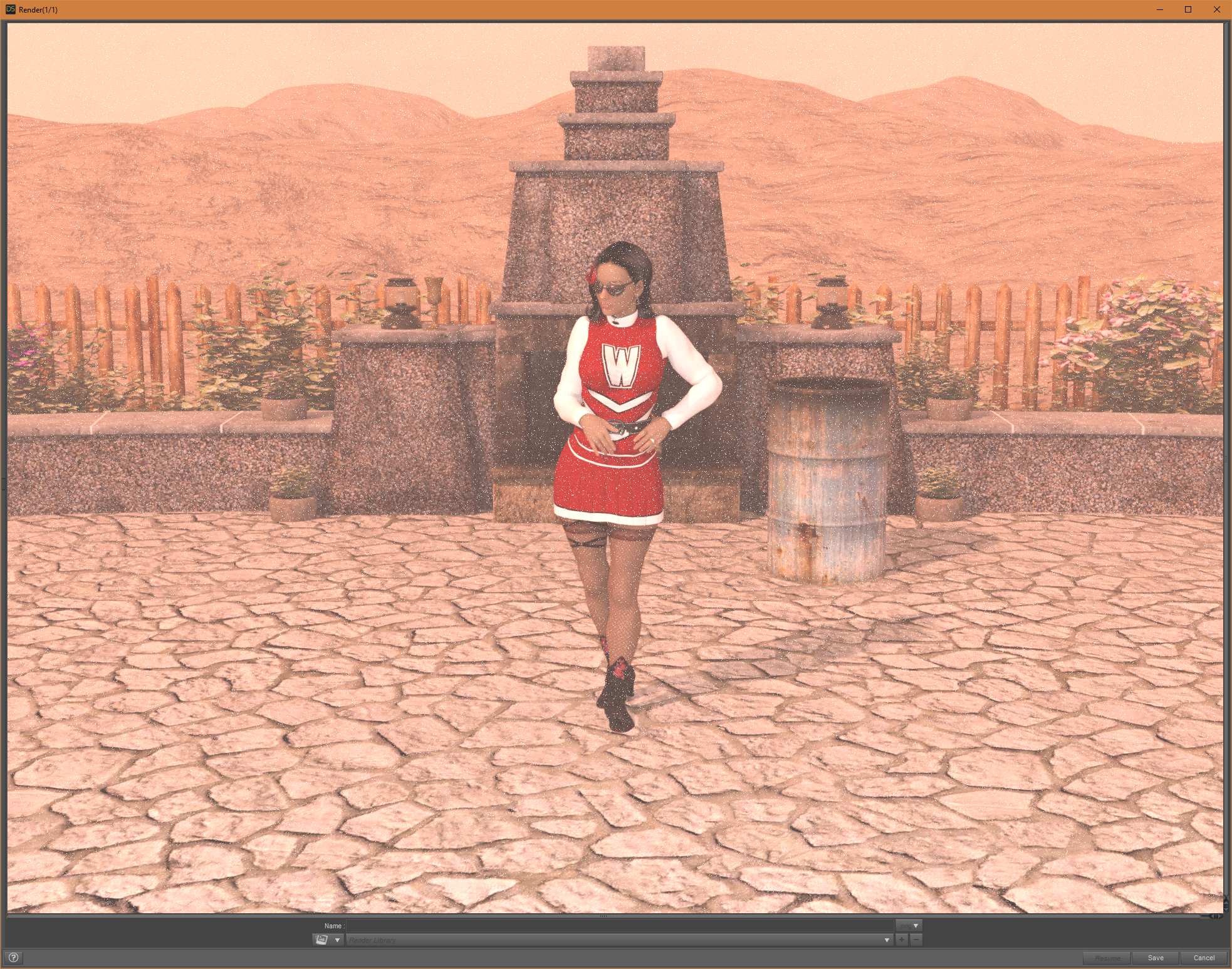 What characteristics might occur to you when you see the picture? I would certainly think of how fit and athletic I made her. But also of the fact that I played with the age modifier. What would a few NPCs say about her, though? Some would mention how odd the thigh-high stockings and cheerleader outfit are, remembering her hair color, sunglasses, or movements. Others would surely estimate her height, describe her skin color, or mention her weight. In an investigative adventure, you need to prepare many descriptions of an NPC, not just one: as the witnesses saw them, as the characters see them now, and as they were at the scene.
An image also offers a more neutral perspective, from which players know how they themselves would describe the person pictured. A partial verbal description, by contrast, always comes from a particular person's point of view. A player has the most fun in an investigative adventure when they are actually investigating, stepping into their character's shoes a little. Failing to find something because a random roll handled by the GM happens to fail is a disappointment neither the player nor the character could do anything about. Descriptions and visual aids exist so that the player can participate in the investigation, rather than merely pray that the GM rolls well. Rolls are needed in two situations: when what the player wants to attempt would not really fit the character, or when the player is out of ideas but the character would realistically have one.
Being used to rolling, and being too lazy to develop the environment so that the player can succeed by looking through it and thinking it over, is no reason to roll. If the players mess up the adventure because you, as GM, withheld information and rolled dice instead, that is disillusioning. “The character is in the library, but the d10000 did not come up with book 6873, so they do not get the information and the adventure fails,” even though the character has plenty of methods for looking in exactly the right place, is a GM mistake a player character will not necessarily swallow.
If the characters do not find something, you essentially still have six options.
- Get them to search the place again because they suspect there must be something there.
- Plenty of other evidence points in the same direction, so losing one clue is no problem.
- The chain breaks at that point, but they can see both halves and may infer what is missing.
- The world is alive; somebody else may find the thing they were looking for, and they can obtain it that way.
- They can live with the consequences, on the basis that not every adventure has to be fully solved.
- You can cheat in their favor.
I would not recommend the last even in fantasy, let alone Call of Cthulhu. When it puts information in implausible places instead of wherever that person would have hidden something, there is a serious problem. Either the players gloss over “How did this get here? It belongs somewhere completely different,” in which case they get used to being allowed and expected to gloss over all sorts of things—a very dangerous direction in a series of investigative adventures—or they see the relocation itself as a clue. Option five is not really a good one either, but it is acceptable despite the disappointment. After all, Call of Cthulhu is not about superheroes; it is about people whose chances of success were never particularly high to begin with.
Option four is acceptable if the adventure does not rely on isolation, there is a suitable person for it, and it makes the story more plausible. But players do not like an NPC solving too many things for them, even when it is a consequence of their mistakes. I feel that option three works in Call of Cthulhu or a fantasy setting, since some details will remain unexplained there anyway.
There is, however, one method of cheating that works. In an investigative adventure, much information is best conveyed through pictures, maps, and objects handed to the players (a discovered letter, files they have found, and so on). These remain in the PCs' hands during the breaks between adventures too. If, during any break in the adventure—for food, say—you allow the player of the more intelligent character to work out new information from clues already received, within the bounds of plausibility, there can be a little discussion of what each person's character might notice. That can even let you steer them toward a few small details.
We plan to continue this article with further details, small points, and tricks.