
 Many people say we must give it a chance if we want to see a modern system for M.A.G.U.S. The main problem, however, begins with the fact that the most serious problems concern the world, not the system. Almost every player and game master can point to one version of Ynev they like and at least five they cannot stand. Decades of contradictory writing also mean that there is no consensus on numerous fundamental questions about the world. Back then, among the differences between the first few editions of M.A.G.U.S. and the Első Törvénykönyv offering an “almost identical system,” alongside the rise of the “a largely unnecessary rule for everything” approach, one small detail was just as prominent: alignments acquired little labels, and their meanings expanded a little with them. Where corrections were needed, they were rarely made.
A cliché: with a good GM, you can have a good game in any system. So we can predict the answer in advance: the new M.A.G.U.S. will be no different. We do not need to read the book to know this; it is enough to know that whatever it contains, the GM can override it and must do so when necessary. In other words, if a new book began with this and then merely listed the previous and current creative teams' most ridiculous mistakes, giving us something to laugh at and learn from at others' expense, the response would still immediately arise: there are no unplayable systems, only bad GMs. Yet there are better and worse systems, and for some reason many people want a modern system without even saying what that means. Meanwhile, of course, there is also a strong retro, “old school” movement, and some people want that. So the system does matter after all. And it matters that since ETK there has been a “demon alignment.”
I Like Mathematics...
Having to divide or multiply does not bother me. I also refer to concepts such as the normal distribution. And I know that the pyramid in a diagram of social stratification is not the same as the bell curve of a normal distribution. I do not want to correct people from one to the other without reason. A little probability calculation is fine too.
But I also know that most educated players are less bothered by a book not being in Hungarian. For the less educated, however, mathematics is unfamiliar. Division, but also probability. The main advantage of d100- and d10-based solutions was that probabilities were easy to calculate, making it easy to design adventures and challenges.
In discussing a 2d10 proposal that corrected many flaws, I even met a player training for a career in IT who did not understand that, in probability calculations, rolling 1 on the blue die and 3 on the red is not the same outcome as rolling 3 on the blue and 1 on the red.
The d6 is a fine thing... We will get to calculate with plenty of nonterminating decimals.
Anyone who thinks it is a joke that I singled this out as an important change forgets two things. One consideration, important in my view, is that we have heard ever since that an up-to-date, modern system rejects the rule-for-everything approach. The other is that conflicts in stories can follow many character traits, going beyond a simple “good versus evil” opposition. The original alignment system offered an interesting picture by putting one's attitude toward the value of life first, instead of good/evil, and establishing priorities between alignments along the two axes. With a few examples, of course. But once the “demon alignment” appeared, it immediately became a pigeonhole. M.A.G.U.S. aged considerably. Thanks to mandatory ÉP loss, the combat system now offered some lovely division too. Magical exhaustion meant paying attention to bookkeeping for every spell; quickly counting mana points with counters was no longer enough. The effects of wounds also allowed numerous things to be continually recalculated. The system became much slower and aged about ten years.
Many changes introduced in the name of balance were better described as destruction. All because perhaps the GM might not be creative enough to describe a 14 FP wound inflicted by, say, a two-handed sword. Or a 41 FP (0 ÉP) wound caused by a fire eruption. With the latter, I could describe perfectly well how the heat of the tongues of flame stopped at the boundary of the personal aura burned, how painful it was... And I conveyed that if this protection disappeared, the flames of the spell's raging inferno reaching and gnawing at the target's body could easily kill. One of roleplaying's most important distinguishing features is that you can leave the prescribed path and surprise the GM, but the combat system can also produce surprising situations. These can only be resolved with creativity. Period.
The additional bookkeeping, however, cannot be reduced through creativity alone. That required changing the rules. And because many people only obtained a book after ETK, while many earlier players had stopped playing M.A.G.U.S., ETK became the benchmark. It is precisely why we so often hear that X or Y fails to play the stereotype described under their alignment, and even deviates from a sufficiently unreadable novel they have never encountered. Yet they use the original core book's framework honestly and creatively. One hallmark of modern systems is that unnecessary rules impose no additional restrictions, and the system's self-serving mathematical tricks do not make the GM's job harder.
Even GMs who met this requirement less well had to show more creativity than it takes to surprise readers with “a bolt machine gun after the repeating crossbow.” Something we had previously understood to be impossible for good reason. I am not saying the average GM is the pinnacle of creativity. But they show more than this. And anyone saying literature needs greater freedom should remember that famous and prolific crime writers, for example, did not need it. I single them out because two or three books—even ones that become mandatory core reading—do not require freedom for the sake of still surprising readers after all the others. With detective novels following an established structure, however, the question becomes more difficult. Natural laws and historical facts often provide not merely restrictions, but a foundation for imagining the world.
Limitation or Feature?
 Back then, wizards could do many things, but quite a few spells explicitly said that wizards did not yet understand them. This was about more than game balance: it meant there were things to research, things to try to understand. The mosaic principle also appeared in Ynev's history, making many limitations comprehensible. Now, by contrast, the idea is to make the wizard capable of doing anything. I think of World of Darkness and the various incarnations of Mage, where magic has a completely different explanation and freeform magic is damned well nothing new. In fact, a precursor of freeform magic use was that in AD&D we could design new spells relatively freely too. It simply took time. Mage gives us a supernatural explanation of what is quick and why. Mosaic magic provided a rational explanation.
Until now, mosaic magic was a feature, not a bug. Even if M.A.G.U.S.'s most disagreeable trait arose from labeling many supposedly overpowered things “NPCs only.” And gradually grinding away the idea that in a life-path campaign, the aim was for the PC to become like the heroes of the novels. Mosaic magic's constraints often provided a foundation rather than a limitation. Of course, CODEX and the third-circle wizard can be mentioned too. Except that first, you had to become a second-circle wizard... Now it will be different. Nearly a hundred years will pass, and much can change in that time.
World and System
One of the biggest flame wars in this site's history arose from a very simple question: what is rare, and how rare? When are we talking about an interesting, creative character idea, and when about a “fucking special snowflake”? What makes a character realistic if some selection takes place, and how good should the character be in the attributes involved in that selection?
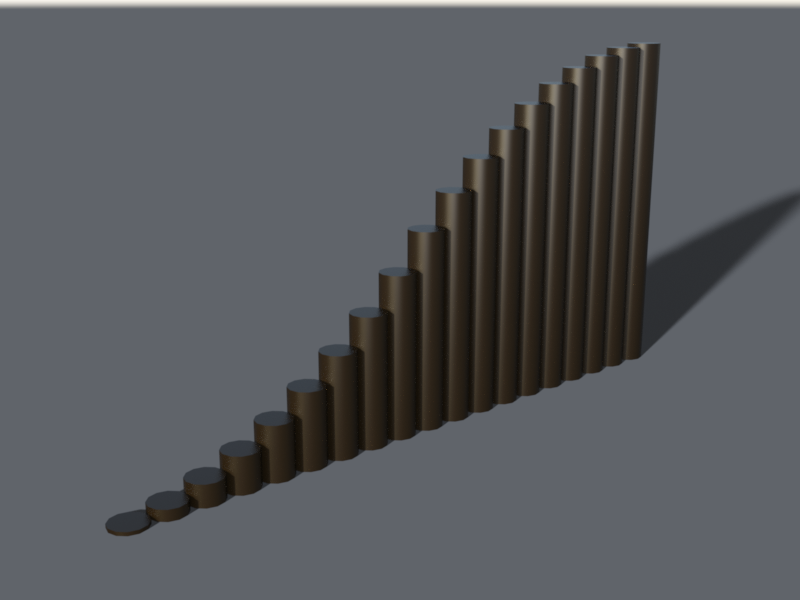
Remember the picture at the beginning of the article? The first column represents 1%, the last 100%. You would call the 1% a flat coin, not a column. And say it is rare. Sometimes we are talking about only “half a percent,” or one in a thousand. Sometimes someone has searched among a hundred thousand people for the greatest talent. If I plotted a frequency of 1:100,000, the wafer, thinner than a hair, would look almost the same.
Yet those two almost identical wafers would differ by a factor of a thousand, while the current first and last columns differ by only a hundred. The 1:100 rarity, the thin little wafer, is something “you encounter every day,” perhaps more than once. If your warrior's strength or your witch's beauty is like that, it means little. If we are around 1:100,000? There is a good chance the character could be one of a city-state's champions.
And if the declared aim were for PCs to become heroes of Ynev comparable to the heroes of the novels, we would need the latter.
A hundred Ynevian years, moreover, corresponds to more than 140 Earth years. Just look at how much even our own world changed between 1877 and 2017. Maps, power relations, and countless everyday objects were replaced. Such a jump is enough to count as a soft reboot. New Pyarron is no longer quite so new; it is not being built now. It may have had a considerable influence on the surrounding area's development and redrawn the map, to give just one example. But much time has passed in Yllinor too... For younger countries and cities, the geography changes as well. Different things are taught, the balance of power changes, we see different things. In other words, breakthroughs in magical development may occur too. Thus abandoning mosaic magic is acceptable if it is not retroactive.
Although until now it was understandable that someone emerging as a warrior from an army or fighting school wielded different power from someone emerging as a priest or wizard from an elite institution, a system seeking balance could be backed by a suitable concept within the world, even through literature. But right now we are not talking about literature serving the game, novels adapting to a conception of the world tailored to the game. We are talking about the opposite. About how a lack of creativity and individual solutions has often been patched over with ideas gathered here and there, with an “even more overpowered version” of a solution, and how the system wants to move toward that. Retroactively, I suspect.
But they do not want to throw away novel projects in progress or have a truly different world, and one suspects that bringing the world and the novels closer together is problematic given these considerations. All right, there is no Eighth Age, and the Flag War has not even begun. But the Manifestation War does not last that long, and if we follow the novels and the authors' previously described concepts and visions of the future, the map of southern Ynev has indeed been redrawn. The world envisioned for the end of the Manifestation War included, for example, the idea that Gorvik would largely cease to exist while Shadon's influence grew. But there will be a conversion to fit a Gorvik adventurer into an era in which they could not necessarily exist. If we discard the previously described future instead, however, we fail to bring the two points closer together. All right, a hundred Ynevian years could also be enough for a “New Gorvik” to emerge. But we are not seeing creative ideas about that, or short stories introducing such a world.
Forgive me for speaking a little programmer: mosaic magic is rather like a framework that is difficult to develop further, even harder to refactor, and whose workings we do not fully understand. Anyone not tied to this principle develops anything much more slowly, but does not have to contend with the framework's restrictions. Anyone who sticks with mosaic magic gets results faster—a spell does not take months—but must accept the limitations of the available elements. Where people saw the future, what they considered right and good, what they respected: this enriched sufficiently creative players' characters. Meanwhile, we could complain about the novels' sometimes rather one-dimensional heroes.
Under these circumstances, abandoning mosaic magic can certainly produce some fine arguments. Some say it grants freedom and serves creativity. Others point out that most people never even tried to use the mosaic principle truly creatively. Yet if we add its entire linguistic foundation—the spell is a sentence, we write down sentence fragments for the mosaics, see how the wizard tries to fill the gaps, allow research and the discovery of concepts—that makes room for creativity. Precisely because it was not “I saw or heard something, and my character just does it,” but required clever, creative solutions to many problems. And there was a goal. That mattered. So did the GM daring to say during a story: the player characters' story continues the writing of history.
And they were special. When people compare M.A.G.U.S. to AD&D or D&D, I usually point out the classic situation in which the (A)D&D character starts out very weak and does not stand out. Looking at NPC and PC combat values in the original core book, we see that here the adventurer was chosen from the outset. Their story was being written in that monastery for a reason. This too is a foundation of the M.A.G.U.S. feel, and precisely why many of us dared to be special. Yes, the stereotypical practitioner of empirical magic does not research, only uses it. But empirical magic was an important milestone in magical research. Its free and slow research, the associated goals, and numerous other things contributed to characters just as much as outstanding attributes did.
Giving wizards freedom instead of mosaic magic immediately kills these ideas. There is no need to choose among paths, and the character cannot be rare in where they end up. And in my view, if spells come quickly and freely, it becomes very difficult to maintain the idea that they really are terribly complicated, immediately raising the question: if it is this simple, why has everyone not become a wizard? Many new supernatural explanations can follow, of course... But this immediately changes the essence of Ynev and the game.
Continuing to Write History
Many M.A.G.U.S. rules were unnecessary if you merely wanted to “go adventuring” and were thinking of the legendary AD&D adventure modules. But they mattered greatly when the world provided a solid foundation for the characters' research and stories, which could slowly influence that world. This too defined M.A.G.U.S.'s market position, alongside its appeal as a widespread Hungarian RPG to people who did not speak English. Or those who could not afford every important supplement for the systems dominating the international market, but did not want to remain at the level of pirated PC action RPGs.
And we get a usable tabletop roleplaying game cheaply. The emphasis is on tabletop, and on having a GM. Back when Mass Effect 3 appeared, we heard how much its ending was an “artistic vision,” and that its inconsistencies were no worse than those we see in many other places. The problem is that even in a computer game, we would expect our own conception of our own character to prevail. Since then we have had Mass Effect: Andromeda, some criticisms of which also concern the creator imposing their vision. And that is an action RPG. But even there I had to write that the game consists not only of what we see, but also of what we must imagine alongside it. It is about freedom and creativity. M.A.G.U.S., with few “mandatory” supplements, offers the freedom of a tabletop RPG cheaply.
It was also a good foundation that literary Ynev and the roleplaying game's world were somewhat independent, and even literary Ynev's contradictions could be explained through multiple versions. This produced an interesting mix: the literary Ynevs presented possibilities that the GM could adopt where justified if they gave players fertile ground, while the party could remain the protagonists and those events serve as examples. Examples to develop further. If the game receives a single canonical Ynev also based on contradictory and often unreadable novels, freedom shrinks. Yet precisely this is valuable: we can shape the story's ending, its later continuation, and its continuation elsewhere.
The new M.A.G.U.S.'s premise differs here too. Of course, creation remains possible within these boundaries; the shift turning many inspirations into restrictions and foundations into walls does not yet kill creativity. Not even though many criticized GMs treating the mass of rules and literature as scripture precisely for restricting creativity. For killing many creative ideas. And now everything will be like this. Because there are “creative” ideas I too would shoot down. Others, however, fitted perfectly well before and will not afterward.
A New Spell, a Knightly Order
The history of Facebook's M.A.G.U.S. group also includes an interesting debate about female knights and paladins. Someone thought it a good idea to bring the argument to Delta Vision's page and the publisher's forum behind the participants' backs. My position was entirely straightforward. There are documented examples of female knights on Ynev. And creating many kinds of knightly order may be necessary for one simple reason: M.A.G.U.S. is about life-path campaigns.
It does not matter what the creator imagined or what the GM prepared for. We play tabletop roleplaying games so players can do and achieve things neither the GM nor the creator anticipated. If we give that up, PC RPGs would be better.
Making history in a life-path campaign need not mean saving the world or “battling gods.” It can also mean seeing the spell we invented or the knightly order we founded and made successful return after years of play. Saying that a player is unfamiliar with them is no argument against playing such characters. Nor is their rarity, if the adventure takes place there.
And yes, I dislike PPL; in many respects it does not even reach the standard of homemade online supplements. I disagree with its priestess of Ellana, because Ellana is, among other things, the goddess of infidelity, whereas loyalty matters in a spy. Handing fertility and much else over to her was, I think, a mistake that undermined fidelity to the world. But it happened. And if someone wants to play a priestess of Ellana, I have to allow her. Her published background and combat knowledge are facts within the game world.
Where there is no class system and anything can be put together, this will be even more true. And if she is just as good in combat as other adventurers, she has just as much chance of attaining rank and titles and attracting followers through her example. Arguing about which creator imagined what and how, contradicting what was written and taking digs at someone else, initially behind their back too, is a rat's attitude.
It is also fundamentally incompatible with one defining feature of tabletop roleplaying: that players can do and achieve things neither the GM nor the creator anticipated. With freer spellcasting, the PC will not invent some new, ingenious solution allowing them to do something previously impossible.
And I have a concern: whatever a character establishes or achieves, the freedom sought at the system level runs into a problem when you seek a solution—András Gáspár and company's attitude remains unchanged. They recognize neither that roleplaying must support things they never considered... Nor that if someone receives weapon-use skills beyond a priest's basic abilities—even at basic proficiency—I will not say such a priest never learns to fight.
If they did not learn, they could not acquire weapon-use skills, would receive none among a priest's basic abilities, and would have worse combat values too.
The “only we are allowed” and “your character should not try to achieve anything” stance contradicts what Rúna magazine's article on life-path campaigns said.
This, however, is a fundamentally different arrangement from what M.A.G.U.S. has been about, and that has consequences. I disagree that it removes all room for creativity. Just as we contrast the writing team with truly creative writers, we can contrast players who are not particularly creative in a constrained world with those same writers and many GMs and players. At the same time, we can say that a more constrained world and system do not provide the ideal foundation for certain ideas of theirs.
Because on that basis we would have to override every new restriction and rule. And not just the rules: we would also have to handle the player's very different expectations. But I will go further: as I wrote, mosaic magic's limitations underpinned many creative ideas. They were not unnecessary restrictions at the system level, but an approach to the world described so far that was advantageous in many ways. If mosaic magic's limitations matter to my story, there is no point choosing a system that removes them. If I want to give players opportunities to research and invent, I will not necessarily start from “why bother, when complete freedom was already available without effort?”
Gorvik's situation and numerous other questions tell us whether M.A.G.U.S. and Ynev are the right tools for realizing a particular idea. I will go further: they establish whether edition X or Y is the right tool. Arguing about which edition is better can easily become entirely pointless if only one is suitable for achieving our particular goal. But what is the right tool, anyway? After all, the system's obstacles can be overcome in every case! Well, the right tool is the one that does not throw dozens of entirely unnecessary obstacles in our path.
I have often said that making many unnecessary rules optional could produce a smooth-running M.A.G.U.S. system. Then sourcebooks could remedy its greatest flaw: many characters become “NPCs only” simply because players do not know enough about Ynev, its natural laws—including the laws of magic—its cultures and education to portray them. A new system with a world that is new in many respects does not solve this problem. Giving the wizard such freedom is pointless if it still does not make them a magus and many research possibilities disappear. This flushes much work already invested down the toilet, and talk of how this or that can be transferred into the system is pointless if their places in the world, goals, and stories are lost. Making what once distinguished them commonplace tomorrow can be enough.
For me, one of the greatest disappointments in D&D's history came when we were told that D&D 3 would let us create every kind of character. Most of my already-written characters could not be made. Not even across the whole 3.x series. They invoked balance, which nevertheless accommodated unkillable super-builds. Taking away a good character who fit the world in the name of nonexistent balance smelled rather like a con. I have never been able to view D&D the way I previously viewed AD&D since.
But there was another side to the story: “Now you can have a dwarf wizard.” Well, we had an example of that in AD&D too. A stubborn dwarf whose nature was so opposed to magic that it affected him less readily kept turning everywhere for someone to heal a friend, until he even promised the goddess of magic that if his friend recovered, he would learn wizardly magic. Needless to say, his training required everything from a wish spell to dozens of adventures. But the dwarf wizard surprised his enemies.
What did they invoke when anyone could now have a dwarf wizard? The fact that D&D serves several worlds. There cannot be restrictions everywhere. Yet resistance to magic because of a nature incompatible with it remained, minus the restriction. And a longsword costs the same everywhere across those many worlds... Many discovered spells are identical too. Indeed, imagine that: the racial pantheons appearing among the religions, alongside the world's own human religions, are universal as well. In other words, the argument treats us like idiots again.
The promise of freedom does not mean complete freedom, thanks to the slogan of balance. The promise of balance does not deliver balance, because that is impossible. Instead, many special characters who fit the world cannot be created this way or remain special. And here in M.A.G.U.S., if the concept that a wizard should imitate all empirical magic remains, then, for example, the historical precedent of an empirical magic-user creating something genuinely new through research falls away.
And the biggest problem is that they want to release it this year. Without publishing plans mentioning literature that would help show us what changed over a hundred years. They point to no breakthroughs, offer no justification for the changes; they simply happen because they do. And if you discard things built through much hard work for this, you cannot know when you will have to discard this too. Because how supplement X describes the followers of a religion means nothing to András Gáspár and company.
And if the tendency toward contradictory writing and much else remains, people will hardly dare give players room to shape the world and be truly creative in many areas under the new system. This is far worse than creativity being constrained merely by strict interpretations of rules and a snapshot of the world. And yes, the risk created by the creators' ad hoc pronouncements is the worst kind of unnecessary rule that can restrict GMs and players.