
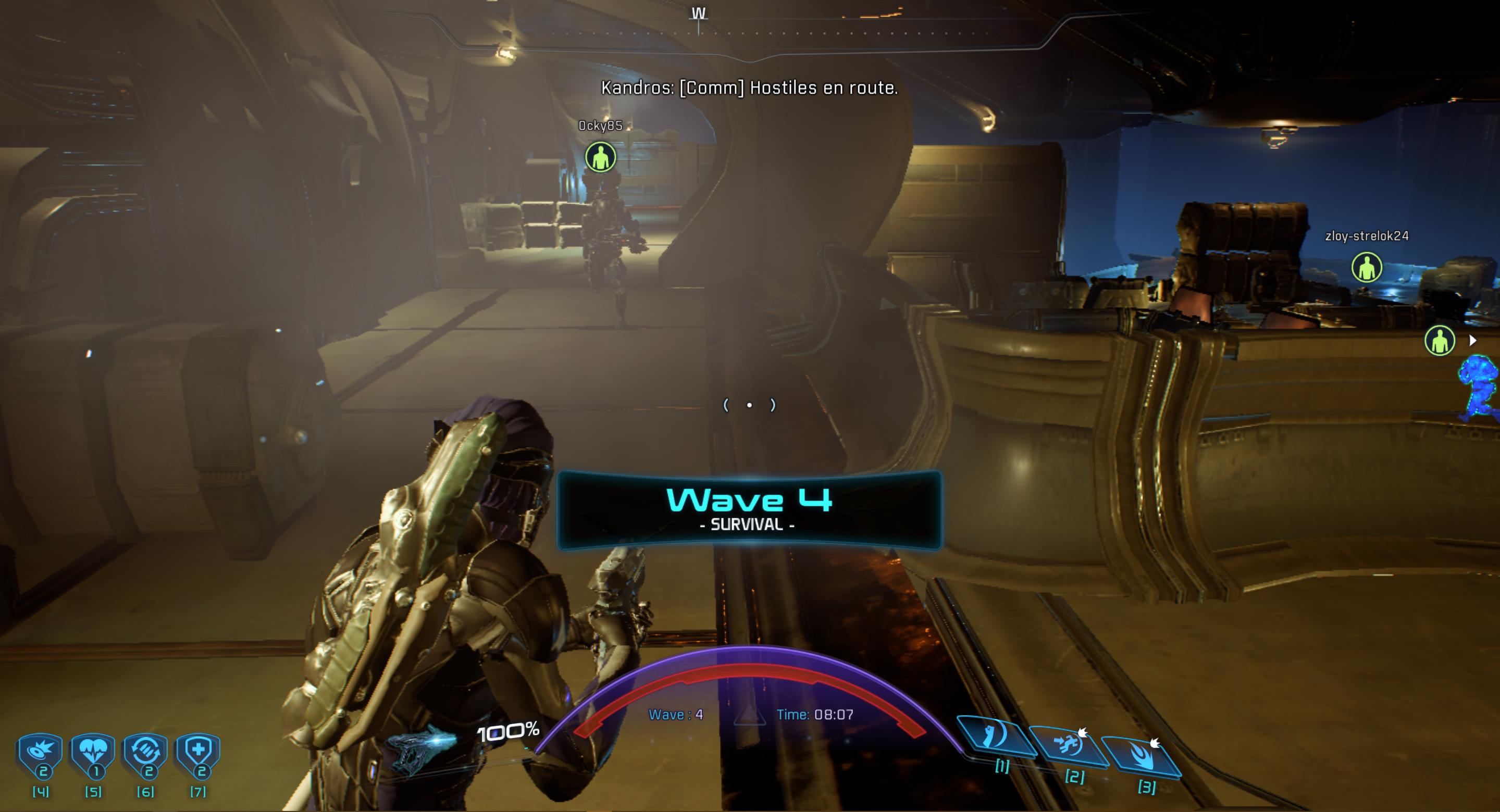
 The year's most anticipated game, and the first uproar concerns animations and character models. The truth is that good games existed ten, twenty, even thirty years ago, and their facial expressions were no more lifelike than these; after a while, it does not bother me now either. Much of a game concerns not what you see, but what you imagine alongside it. Otherwise, you would point out that even a large colony often has zero toilets, zero washrooms, and zero kitchens. Every visual and mechanical element—including multiplayer shooting—is a tool enabling us to imagine something far greater in both time and space. And I have to say, it is not a bad tool.
And we must accept that other games having done it, and today's technology being capable of good facial animation, does not mean it must be done. Or even that it should be allowed. It is foolish to think good facial animation is something we are entitled to expect. Developing it would have cost time and money proportional to the number of characters and volume of dialogue. A game's development cannot cost more than its expected revenue. And yes, conveying the story of battles and finding one's way matters to the narrative at least as much as conveying conversations. Indeed, even cramped or spacious locations communicate something.
Sometimes enormous maps are needed so we feel that “an entire galaxy has opened up” before the team. More dynamic combat is needed because we cannot rely on built fortifications and infrastructure. Numerous elements have a role, and they need money spent on them too. We cannot insist that the animations must be perfect. I saw a video criticizing the clumsy research menu interface and a few other things. It was right. We too find the menu awful. But imagine Ryder, who is not a scientist, looking at a serious scientific system: the variables mean nothing to them, and in many places they must dig into the data for summaries. And Ryder is not the only one encountering new things in the galaxy; sometimes even journalists find it hard to remain professional...
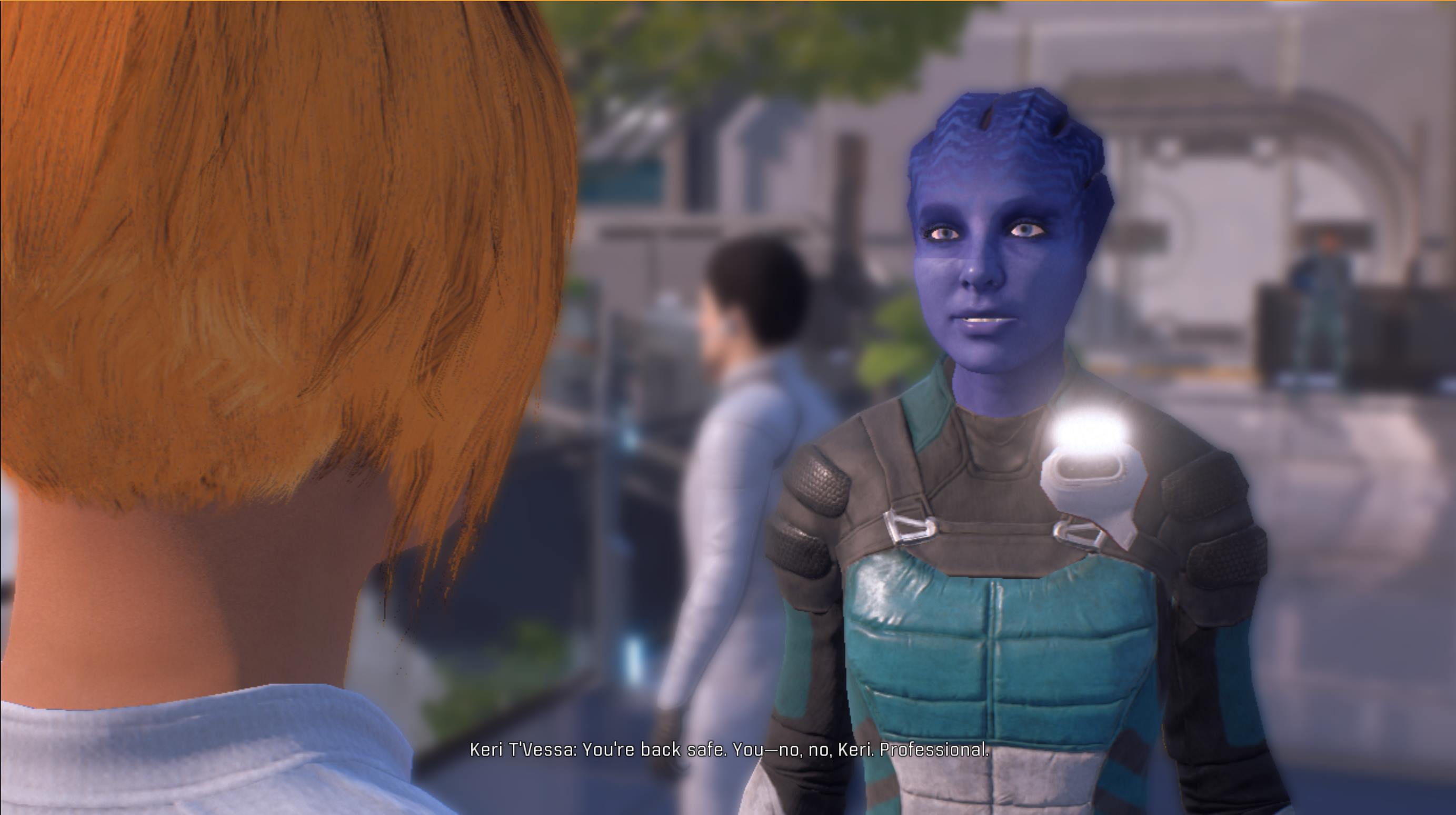 Research, strategy, and numerous other things would normally require lengthy training; Ryder has not undergone it, this was not supposed to be their role, and now they must contend with all these systems. Unskippable animations and time spent on uneventful travel convey precisely that we too are waiting for something to happen. We too feel how much time passes while people wait for us. And yes, the distances between suitable colonization sites are enormous; for Ryder, many hours or even days may pass in boredom inside an all-terrain vehicle. It is no bad thing if some of that comes across.
Here I point to multiplayer again: sending a team on an APEX mission takes several hours, while playing it ourselves is much quicker. Dispatched teams keep working even when we are logged out and Ryder is, say, asleep. Many details communicate that we are seeing a much longer story compressed and condensed. And that the game is simple and “works well” precisely where Ryder is strong: exploration, combat, reaching impossible places. It is weak where Ryder is weak.
Ryder and SAM's symbiosis is effectively a condition resembling savant syndrome. Reading faces and handling human gestures is difficult for a character with similar traits. The game's visual effects include film grain for a cinematic look, but also chromatic aberration simulating lens defects. This is a visual medium to some extent. Index recently ran an article marking the twentieth anniversary of the Hungarian film Csinibaba. And we know how much filmmakers work to make what we see in a film something other than lifelike: to reproduce the viewpoint of a young man of that era or another character. This also conveys the difficulties with faces and gestures experienced by an explorer living in symbiosis with an AI, with savant syndrome—and thus Asperger's.
Do some limited-option conversations surprise us with their outcomes and prevent us from going exactly where we want? The same explanation works. These traits partly mean Ryder sees the world differently, views human problems through a different lens, and can make better decisions as Pathfinder than the more experienced alternative, the former second-in-command. If this were intentional, BioWare would have said so already. They would boast about deliberately spoiled animations. But they do not. Of course, they too say you must imagine things alongside it to complete the picture... It is just that bringing up the importance of a shared vision would not look good after the artistic-vision justification used for Mass Effect 3's ending.
I see the hysteria on many sites: disappointment because we have the Pathfinder title right from the beginning, just as people complained during Dragon Age 2 that we were champions immediately. Yes. At the beginning of Dragon Age 1, we have the pivotal Grey Warden role; at the beginning of Mass Effect 1, we immediately receive our Spectre appointment; and early in Dragon Age: Inquisition, we become the Inquisitor. These games are not about attaining those titles, but about what we do with them. What we do when our decisions carry weight. In none of these cases is “we are already the...” a problem, and I think this is a considerably better direction than the solutions of many well-known competitors.
One Problem in Focus
The problem comes when the story and mechanics lead us to expect something that never materializes. We can talk about Eos, Prodromos, and the Nexus. Twenty thousand people, plus those who came with the Nexus. Our first settlement houses a few dozen. Of course, I know this is highly abstract and probably represents a larger settlement. But not much larger: it is still a small research or military outpost. Perhaps a few hundred people at most. Colonization would hardly work that way. Two earlier attempts were made on the planet. We visited both sites. Neither worked out amid the storms and kett attacks. But they lasted a while, and had previously been expected to work. Once we did something about the storms and radiation, their situation became much better too, with a serious chance of survival. And there could be a research base to help them.
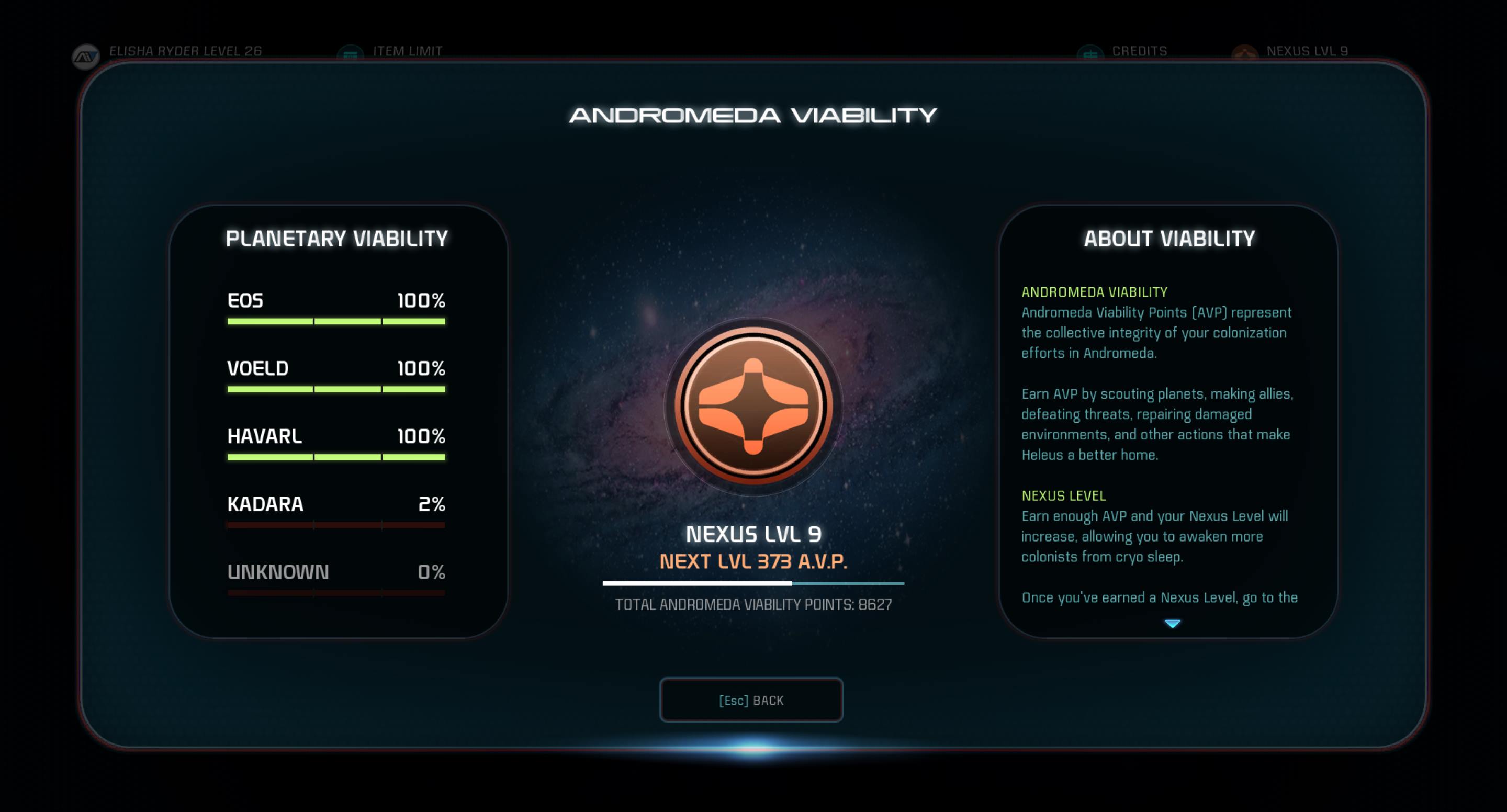
Using the results of a successful scientific base, the other two settlements' prospects also improve dramatically. Common sense dictates that at this point these bases should be considered viable too. Shields, power, buildings, and water supply already exist. Conditions are improving. Both sites could soon produce things. But they must remain empty while the fate of six or eight people causes a rebellion on the Nexus. We can have trade teams, but there are no industrial teams and no agricultural base. And if the Nexus is imitating a self-sufficient base, why was it not designed to be self-sufficient? The game talks about six hundred years, and many obstructive changes being more recent than that. But the images did not show conditions at the moment they were taken: the light had to reach the observers. The people behind the Initiative knew these data would be quite old by the time the expedition reached its designated worlds. But even counting only six hundred years: how much change might have occurred in the Milky Way between, say, 1650 and 2250?
Trouble, and all those headlines, were foreseeable:
Eos: Disaster, 35 Dead!
What can a krogan tell us about such a span of time? Yes, the people who bombed their own world to pieces. A human, for whom climate is only one of many issues. An asari who has seen how much many worlds can change in that time? Are we beginning to understand the problems? Setting out without industrial and agricultural teams, not preparing for self-sufficiency, not considering the consequences of the timescale, lacking preparation for efficient asteroid mining, and so on. And when we decide thawing out many people could now make the team more viable, where do we meet them? Nowhere. Despite another Nexus threshold, no development is visible. Even thawing out lots of traders gives us no new shop to visit, which can easily disappoint.
But when it is supposedly up to us to give many people opportunities to be thawed out and live, because the Nexus develops thanks to us, and we see no new room or faces but only a few points to distribute for bonuses, that is immensely disillusioning. Especially when the engine supports large maps and interactivity, and many closed doors would be easy to open. Then, after the initial “unfinished” state, we would not see a single step of “the office is nice now, but nothing changed over the past five levels.” In truth, the problem runs deeper.
Realistically, a planet can easily support twenty thousand people. Developing the station, however, costs time and resources and would be slower, and it would help to see some of the work. And the surprises awaiting us there. Newly discovered technologies could even influence its development. So could shortages of expertise caused by lost specialists—through rebellion or accidents—and the fact that development requires data. Many things we thought were obvious must now be scanned and made available to SAM. Hasty colonization is risky, and until viability reaches 100%, we should continually weigh how much we are risking.
The criticism of Mass Effect 3 was that BioWare promised technically achievable things, but the game delivered considerably less. This time, Nexus development was one of the promises. But the game delivers less. A familiar promise is that we will see many consequences of our actions and shape the world. Yet when we override everything to thaw a few people, as though it were otherwise impossible, we leave fully built bases standing empty. And no answer explains why we do nothing with their improved prospects. So alongside grand promises and perfectly adequate technical capabilities, we receive something that gives the impression BioWare keeping its word did not fit the budget or deadline. Yet they expect us to spend considerable money on multiplayer item packs. Because the game is big and needs extra money, but somehow there was still not enough to make the work feel finished. And this affects things we cannot and should not have to imagine into existence.
Customizing the Nexus is now the great unfulfilled promise implied by the game itself, a disappointment just like Mass Effect 3's ending. Fixing that may require a helping of Nexus DLC. I will go further: virtually any number of planet DLCs could follow. The familiar argument that tabletop roleplaying is better because its freedom is unlimited has often prompted the response that not every GM lets you go somewhere their written adventure does not. Handling this much space and lively, fast-paced combat is difficult.
And yes, anyone who began saying during the ten-hour trial that the story was nothing special, when they had encountered almost none of the story, was talking nonsense. They did not know what would happen to the abducted people. But somehow I am reminded that the Reapers also promised transformation and ascension, while we saw only destruction and monsters. The kett show precisely this; they too have a demigod-like leader, as the Reapers did. And surely they too will have motives we can debate. When kett and angara met, the kett were not necessarily immediately the bad guys; their experiences and much else enter into it. Indeed, the fact that eventually everyone becomes kett is not so different from the fact that eventually the offspring of more and more people—everyone—can be asari, while pureblood asari... Surely I need not finish for the monsters that appear there to spring to mind too?
Many opportunities were missed. Much cannot be known in ten hours. But we can know that EA lacked the courage to let us progress through ten hours of story. In other games, preordering let us continue beyond ten hours before release; here it did not. EA feared many of us trying it early; neither developer nor publisher trusted the game. They did not trust a game. They did not trust a game they released half-finished, into which they did not believe enough content could be fitted. And the problem is that a good way to reduce costs and increase revenue is already known: involve some players in creating content. Neverwinter Nights did it back in the day. And the homes you can build in Star Wars: The Old Republic would have provided a good foundation for gameplay involving Nexus development.
What if there were a planet editor, individual Nexus blocks could be developed and furnished, designs exchanged, perhaps even a “marketplace” where EA received a share of paid content while designing premium content of its own? Then it could be the game of the decade and remain active for a long time. That is how big the missed opportunity was. And that bothers me much more.