
 There are programs I certainly would not have bought on their commercial merits alone. At $30 on sale, this program is not expensive, but it is not the cheapest on the market either, since permanently free solutions also exist. And the various content packs soon follow. Wilderness support costs another $25, effects appropriate for magic $10, then music, this and that... Yet the program is still an alpha version, an Early Access offering we may have confidence in, and hope is heading in the right direction, but cannot know for sure. Testing it and trying it only costs time. When I happen to have some free. That is immediately promising. I go through registration and all the important steps. Download, then updates. I have a good hour to think.
PC and Mac: great, at first glance it is very cross-platform, and I am not the sort of person who immediately asks what about Linux support. Besides, I may prefer FreeBSD or OpenBSD to Linux anyway. My problem, however, is that when you dash off somewhere and put a screen on the table, there is a good chance it will be a tablet. Yet mobile platforms such as iOS and Android are not on the horizon for now. So while web-based solutions and those supporting a web client work in this situation, neither Arkenforge: MastersToolkit nor Fantasy Grounds nor Skwyre does. Roll20 supposedly does, and we have seen something similar with ScreenMonkey.
You would need a Windows tablet or a two-in-one with a dedicated graphics card. Older, lower-resolution devices will not do, because even the launcher would extend beyond the screen. So far this does not seem particularly appealing. Fortunately, AnyDesk, TeamViewer, Twitch, VNC and many other solutions can help you access an application running on a remote PC from a tablet or a TV. And of course you can build an old TV into a table. Just not an HD Ready one, because anything below Full HD still lacks the resolution. But the next blow soon arrives:
| Feature | Paper map / image file | Single-computer VTT | Networked VTT |
| Fog of war | Generally none; the game master can cover sections | Party-wide | Party-wide or per character |
| Moving miniatures | Anyone can move them | Depends on the input device | Everyone can control their own |
| Saving the current state | If you leave the table as it is, or make notes | Automatic | Automatic |
| Zoom | No | Yes | Yes |
| "Scrolling" | Move the map or lay out another section | Yes | Yes, with individual visibility |
| Works without power, for example in the woods | Yes | No | No |
| Works without internet | Yes | Yes | If it supports LAN play |
| People can sit around a "large map" on a table | Yes | Yes | One extra client |
| Individual copies of the map | Yes, as handouts | Exported... See left | Depends on the licence, or exported |
As we can see, the game master will be moving the miniatures, because there are not many affordable touchscreen solutions that allow an alternative. Of course, the second display can show the players' map and the first the GUI, but if we have one screen and the players' own devices do not supplement it, line of sight and fog of war will not be tied to individual characters. We understand the difference. We feel the extra work and the extra restrictions.
For players to make plans on some of the maps, such as the map of their estate, they need to own the program too. In fact, they need all the purchased content as well. All content is tied to the program and comes in its format, creating strong platform lock-in in many cases. The question is how significant the price difference of less than $10 compared with Fantasy Grounds really is. Is it worth the differences above?
Talking to the developers, of course, I hear that they are cheaper than Campaign Cartographer. It may do more for mapmaking, but it has no music and lacks some other VTT support. Granted, there is no rules-system handling here yet either, but Arkenforge: MastersToolkit does other things too and is cheaper. True enough: between $30 with the discount, $35 without it, and Campaign Cartographer 3+'s price of almost £30, or almost $37.50, the difference is roughly the price of a gyros. And with the GM moving tokens around, you have to save the image again and share it to the display in question, while the music comes from YouTube.
What costs money everywhere is content.
What costs money everywhere is content. $25 for wilderness art assets? £14.95 for a Symbol Set pack, or £27.95 for something as powerful as City Designer 3. And its PNG symbols can easily be moved into other programs. In Early Access, this is nine dollars cheaper than the mature Fantasy Grounds, including basic, SRD-level support for a few systems.
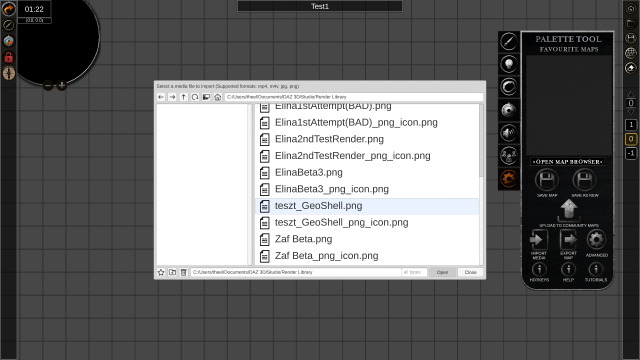
What Arkenforge can do, however: although the import dialog is currently quite awkward, inserted content can be an .mp4 animation or movie as well as a PNG or JPG. Important, relevant information for anyone thinking about animation: animated GIFs are not supported. By the time you have thought all this through, patching is complete. Especially since it became much faster after I complained about it.
So the update is done; we can try it. The program was made in Unity, and as we can see, its default presentation is a fullscreen application. Only one instance can run at a time, with only one map open inside it. That makes copying and pasting, copying from a reference, and many other things harder. For the latter, of course, we can view an exported map on another screen, or import the exported image into the "background" and draw on top of it, but it is not quite the same.
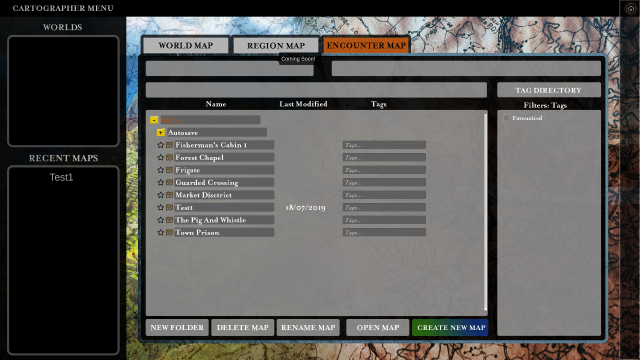 Alongside world maps, regional maps and encounter maps, I somewhat miss the astronomical-map scale and the city-map scale. We understand that this will create demand for many different packs later, at which point the total cost will no longer be cheap. In the UI design, we can see the aim is to make it easy to use now, with nice large tabs for the map types. But as demand arises for more scales and map types, more tabs will be needed, and eventually fitting them in will become harder. And beyond the scales I mentioned, there will certainly be demand for others.
Because I am quite sure some RPGs may also need maps of computer systems. Beyond near-future games, I can also imagine a present-day Call of Cthulhu game in which a few simple database schemas help when we want to see where and how a player intends to search for and analyse data, and so on. The "crime scene" maps I mentioned, relevant to investigative games, can be handled as encounter maps; they simply need different objects. The fact is that competing mapmaking programs may offer twenty or thirty substantially different options. An interface that is clear for newcomers, with few options during Early Access, is all very well. Everything is large enough; there is no hunting around. This approach made the iPhone great back in the day too. Yet nowadays more and more people say it has become the hardest mobile platform to use, and not because others took the same approach further.
Simply because as the options multiply, they no longer fit on one screen, and more things are hidden away behind extra button presses. I immediately have another example, though this one is not about tabs... I would like the walls to align with the grid, because drawing them with the mouse is a little awkward, and not everybody is that dexterous. On Discord, someone says pressing one of two keys on the keyboard—they are not sure which—would enable snap to grid. Modifiers such as snapping something to the grid, snapping it to another object and so on would need feedback too, which immediately complicates the interface; otherwise we are flying blind.
Clicking an object brings up a menu. It reminds me a little of The Sims' menu. But it is hard to expand, with little room for scrolling. Let us move on a little.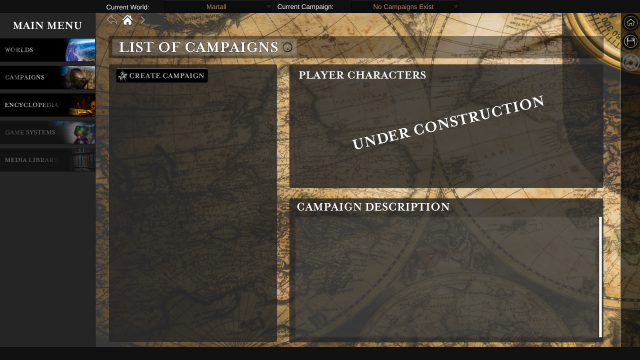
Managing the GM's campaign notes on this basis feels a little strange. I think of NBOS's The Keep, my own Access databases, or even the fact that Fantasy Grounds handles NPCs and data, with notes kept separate from the "encyclopaedia". The Keep's Inspiration Pad-style content generators and many other tools that help you keep track of gangs in a Shadowrun campaign, for example, are very useful once we are digitising our tabletop campaign.
The problem is not just that it cannot do this today, or that the design accommodates only a fairly limited number of functions. It is also that the default is fullscreen on both the DM's and the players' monitors, leaving little room or opportunity to see this and the GM's other applications at the same time. Even if we turn off fullscreen mode, the window remains a fixed size and cannot be arranged as part of a larger workspace. Despite offering only fixed resolutions, they have not managed to avoid wide black bars inside the window at certain resolutions, or to make the main menu fit even these few aspect ratios.
Everything is fine on a Full HD monitor in landscape orientation. What if our monitor is in portrait? Or ultrawide? A display that automatically adjusts to the resolution is hardly a new idea, and on that basis a resizable window that fits better into a workflow using several programs should be possible too. If the fixed window size leaves little usable space beside it, we can consider fullscreen almost compulsory. Without it, the program becomes uglier, but no more usable. It would be good to see resizing and support for all sorts of unusual resolutions, such as a portrait monitor. We hope this is only five minutes of development, but surprises may await us.
Either it should do everything so that external applications are unnecessary, or it should coexist easily with other applications. At least for the GM functions, it would be good if it fitted comfortably into smaller windows alongside other programs. But the structure and design we see now are not necessarily ideal for that either.
At present, many aspects of encounter management are hard to take advantage of, but sound effects, ambient audio and so on provide an interesting foundation. Yet anyone who says development will be cheaper because of the smaller team and simpler office is mistaken. Not just because economists talk about economies of scale, but because developing the same feature does not take fewer work hours, or less money, merely because nobody else is simultaneously working on an entirely unrelated feature or, say, a symbol set in another style.
If an additional development takes longer this way than it would with more people, you still have to pay the person throughout, while the competition also advances. The one fortunate thing is that other people can create content for programs like these, so the disadvantage in developer numbers may not necessarily be so bad if we count everyone developing content for the game that matters to us.
My experience so far is that, apart from a few almost unusable programs, most make it easy to reach the point of producing something beautiful. There is no problem with that here either, and for the price, it is good that we can create several months' worth of maps before reaching the problem almost every similar program encounters. The process leading there is surprisingly similar, and there are points along the way when an ordinary user feels they have hit a serious wall. Get past it and another wall appears, then another.
When we try a new program, we find a few objects that inspire us, beautiful enough that we gladly use them in a map or adventure, and we get that first taste of success despite barely knowing how to use the program. After trying a few new possibilities, our first reaction to the result is amazement at how beautiful it is. And the next program may have another object we have been missing; we jump on it, and the result is beautiful, good and wonderful thanks to the consistent visual style, the new possibility and our initial enthusiasm. As a hard-hearted reviewer, however, this is precisely the feeling I must be able to put aside.
We put together all sorts of things and happily accept our players' praise: we have improved, learned, made something better than last time. We have managed many kinds of location, our adventures are varied, and the program helped us achieve that. It is a familiar feeling, and Arkenforge delivers it too. After a while, of course, we notice that we already know the objects available in the program, but the particular one we have in mind is not there. At first we turn to plan B, hoping it will be added soon. Perhaps it will.
Arkenforge has not only few developers but also few enough users for them to pay attention to reasonable requests. So for a while, the missing thing will probably appear soon, allowing the next map to be made, only for a few more things it struggles with to come up afterwards. This is not a problem, just a slight limitation. We have grown used to the tools; we work and plan the adventure. If we need something other than fantasy and the tool does not suit it, we look for another one. Not everything will suit every task.
Then comes the criticism we may never have thought of because we are working inside the program: the map was good for the adventure, considering the program's limitations. The same tables, in the same sizes, and the same chests, in the same sizes, turn up too often. The objects in the program are no longer novelties; they have become a force making the adventure uniform.
If we look around the VTT market rather than dedicated mapmaking software, I immediately have to defend the Arkenforge team. They are a small team currently listening closely to feature requests, so you have a particularly good chance of getting a few extra things made that you happen to need, and other VTT applications offer no substantially better possibilities in this respect. So at first glance, this is good.
And it is particularly good for a beginner learning to design a few kinds of location. But this situation will arise, just as it arises in many other contexts. When beautiful graphics look too similar in too many places, feel sterile and so on, more and more people say that what they imagined was better. If imagination gets more room and beautiful graphics less, then a simpler and in many respects abstract visual style is better. Here, however, we get yet more effects, lovely colours and animation, and the system is not really equipped for simpler floor plans.
We appreciate beautifully drawn content. I praise it too. But when I discover that there are not many different tables and I need more variety, I either ask them to help find a solution or experiment. I experiment because they have shown how to build a bar counter out of walls and flooring, so perhaps a table will not be hard either. Benches, booths and many other things come to mind. Lots of things are a little harder to make this way. Either the developer helps, or we are stuck.
Because these symbols would not take stretching or distortion very well, and it would be hard to combine them effectively with other symbols. With beautifully and carefully drawn assets, a pretty table edge sometimes takes far greater priority than functionality like this. And we know the limits. If you need different goddess statues for many cultures and religions, say ten goddesses and ten gods, and then mortals in all sorts of roles, not every warrior statue will be the same, so you need ten or so warriors, ten wizards, and the list goes on until it becomes clear that we would need hundreds of statue symbols alone.
It is easy to feel that this is impossible. And we find that the map which initially brought variety and visual inspiration to game master and player alike is now making everything uniform. A simple floor plan is a perfect handout for many investigative adventures, because it really looks like those in books from the 1920s and even contributes to the atmosphere, but it is woefully inadequate as a D&D battlemat. When I often say that prewritten, published adventures are not really for me, and that the pressure to stick to the supplied maps and levels reminds me of CRPGs in many ways, I quite reasonably hear the answer: the battlemat, the map and the situation visualised on it matter, and the issues above make a good one hard to create.
Because even in the first few adventures, it becomes noticeable that every inn has the same chairs and the same roasts when we make our own maps, even if the culture is entirely different and they are made from different things in different ways. When a professional publisher has an artist design everything individually, we cross that boundary. We have little chance of doing that ourselves, although we can try assembling many things. But after the wonder of "Wow, there is a proper bar counter on their map," we realise that it is not only made of walls, but that the walls do not even join perfectly—and the development team's professional artist put it together. What chance will I have here?
In truth, I do know one solution. Computer-game developers realised that, although 3D puts greater strain on our machines, it makes development cheaper and easier. We have a multitude of models available that can be customised with all sorts of morphs, and with a nicely posed warrior we can switch the material to marble at any time. Not just a hundred different statues are possible; even a thousand is no problem. If the level designer is not lazy and the models and morphs are good, there is room for variety and visuals closer to what we imagine. If we work with prerendered content instead of beautifully drawn content, and have settings for a number of programs that let us render new content at any time, with plenty of assets that can be extended, resized and distorted gracefully, those boundaries can be pushed outward.
And nobody forbids us from using elements created this way, whether in this program or another. In that case, though, the ready-made content becomes less valuable, and almost every other program will be suitable too. Of course, I am not claiming with 100% certainty that you will agree with me on this. Simply because there will be three kinds of player. Some will dislike the easier route towards 3D in the first place. Some will have no problem with that, but, like me, will complain about the disharmony of mixing different styles. And some will marvel at seeing several different statues on the same battlemat: it signals variety, reflects the culture and so on. No fantasy map is perfect, and despite the inconsistent style it gives them more than they expected.
What we expect here matters a great deal when it comes to extensibility.
It would be easy to say that 3D is merely the easier route, since so many game developers choose it for that reason. But making a bar counter built out of walls and flooring behave differently from walls and floors for fog of war and occlusion, allowing differences in elevation between parts of a map, and showing those differences on the map would require more than a 2D approach working with prerendered images. That is where 3D enters the picture.
Around a table, we have models, paper models and many ways to build simpler terrain, and can easily account for many of these considerations. Yet numerous VTT solutions are predominantly 2D. In many cases the visibility system does not know what would obscure what, because it lacks 3D models. What we see can therefore be misleading, and we have to work around this conflicting information to reach an intuitive understanding of what our character actually sees. Here the VTT solution is often not just a help but a serious complication too.
Arkenforge: MastersToolkit is a new program, with the opportunity to eliminate mistakes made by so many others. It can learn from those mistakes and from unique possibilities, and its engine can inspire the developer. But it is equally possible for it to become the umpteenth program retaining the same limitations for the same reasons, because its developers learned less from others' mistakes.
And make no mistake: even when an old program moves to a Unity-based solution, the old content was made according to the old design principles. It is very hard not only to replace the program, but also to open it up to handling other kinds of world and recreate successors to the existing content under entirely different design principles. So many things about the future of such a program are already decided around the release of its first version. Because changing the foundations would be too expensive and too difficult.
Arkenforge: MastersToolkit has chosen a difficult path. Most VTT solutions help when a group cannot or does not want to meet physically. There is no table, no opportunity to build a terrain table, no paper maps and no personal miniatures. Since there is no physical table, we cannot say, let us put a few books, boxes or anything else under the map's higher sections to help handle differences in elevation. We cannot say the room is 2D but the furniture consists of models... Arkenforge: MastersToolkit accepts that it will be used precisely when physical solutions may be its competition.
And excuse me, but here comes the brutal criticism: a hell of a lot of programs carry years or decades of burdensome legacy that restricts their concept, yet here, with a new program, we see no leap forward. Underneath it is a game engine that could handle destructible environments, which would be an enormous advance over paper, many other 2D programs and a host of other solutions. But the ambition does not reach very far, and even the things planned, such as regional maps, raise the question of how well they will be implemented.
Because in my experience, a regional map can be harder than a world map, city map or encounter map. In many places, a mountain can be represented by a "mountain symbol", and these combine into beautiful mountain ranges. The trouble begins when that symbol would cover a quarter of our map: then we need a different tool. Contour lines capturing the mountain's shape, or many other options, come to mind, with waterways and many other layers overlaid, but achieving an acceptable result here is an awkward business. If we avoid relief, or the landscape is sufficiently flat, making the map interesting can be challenging, and the question is which tool we will use. The program would need to offer very good solutions for that. But that is still a long way off.
From this perspective, making a 2D approach the program's basic concept is a very risky step. Naturally, there are advantages too. It serves beginners better while their tasks remain simpler, many people prefer the visual style it offers, and over the longer term, after optimisation, it will have lower hardware requirements. Within LEGO's range we expect different things from Duplo, LEGO City, LEGO Technic and LEGO Mindstorms sets. Each has its market. For people who do not want to GM online and are a little wary of VTT solutions, an entry-level solution and its simplicity will surely have value.
With this you learn part of the process of designing an environment, and can use other programs for the rest. Arkenforge: MastersToolkit is attractive, new, modern and easy to use, and does many beautiful things others cannot. It is the best of its kind in a market that looks as if everyone is making Duplo sets except one manufacturer who has reached LEGO City, while many people are waiting for Technic and Mindstorms. Perhaps using a few other solutions alongside one program would be enough for that, but we would need the ability to move a detail from one place, one map in a campaign, to another. The latter does not currently seem possible, while the former would require at least support for a resizable window.
Let us hope the next versions will be prepared for this too.
There are quite a few potentially important things I have not touched on above. A Hungarian development team also means the possibility of a Hungarian-language interface. Those who even call Hungarian localisation "Hungarianisation", who will not touch a computer game without it; who also use M.A.G.U.S. to play adventures D&D was designed for because there is no English-language supplement for it; who are outraged that certain qualifications require the ability to understand international specialist literature and conduct independent research involving it; who feel their hands would fall off if they put Duolingo on their phones to learn a language, have surely decided long ago: the program's useful features include its Hungarian developer. Support available in Hungarian. And the chance to beg for a Hungarian localisation.
The people choosing it will not be those who say M*'s strengths lie in certain parts of its background and its deliberate support for particular game and character concepts. Because let us face it: probably less than 1% of M* players think they would choose M.A.G.U.S. only in certain cases, that it is not even their default fantasy RPG. Merely one among many. After watching a M.A.G.U.S. group for years, I kept running into essentially the same problem. One I badly misunderstood.
A hell of a lot of players complained that the system was bad here or there. They changed it, interpreted it to suit their tastes, and complained that it did not work. Go to a club and play with a random group, and you are sure to run into this. Most of the past twenty-five years of M.A.G.U.S. development have followed this spirit too. But the problem was not that these players used M* incorrectly, in the wrong style or for the wrong purpose. It was that they wanted M.A.G.U.S. to satisfy needs it was not suited to. Understandably, they therefore ignored every solution that would have made M* work well but would not have served their needs.
Why choose a system that is not even among the fifty best suited to meeting their needs? Because this one is available in Hungarian. That preference means Hungarian support, a free product key and the idea that "we can beg for a localisation" are always welcome. And where the priority is having a M.A.G.U.S. chat instead of Roll20 or Fantasy Grounds, and people ask for help arranging hosting for it, Hungarian support clearly matters to them too. Even if plenty of the website's team speak English, they expect that not everyone will. If the program gets a full localisation, and they work out how to embed a map shown through a video stream into their website—through Twitch, say—Arkenforge could sweep the board in that circle.
That is the possibility I see for them. What comes to my mind, however, is that after someone could not even start the program when the launcher was not running and could not reach the server, I checked whether a program that had previously been launched and worked could still start in airplane mode or with no signal. I can report that it works. It would probably also work and retain all our content if those servers shut down, so there is no such risk. That is a much better situation than with Roll20.
An external display that works without mains power, however, is not something we can readily take to many places to play. The question immediately arose: how can we solve this? Would SpaceDesk help? Would any of the many other solutions that let us use another laptop, a tablet, or simply a "bare browser" on an HTML5-capable device as a secondary monitor help? Can we broadcast the players' screen to several places? The long list of questions could go on. Fortunately, most questions like these can receive favourable answers. This time, those choosing the Hungarian developers' tool will probably face few additional compromises.