
Does Ibra k'dibra (אברא כדברא) sound familiar? How about “abracadabra”? Or the Avada Kedavra incantation in the Harry Potter books, for which the author cites this too? She should really cite its opposite. We all recognize a magic word. Some even know its origin and meaning. But if it really worked, a wizard would know not only that “abracadabra” is a magic word, and not only what it does, but at least how to use it. To research and discover new things, however, they would also need to know how it works, and perhaps why. At that level, magic is no longer something inexplicable and infinitely mysterious. If a practitioner does not understand how magic works, that too means much: the magic is not truly theirs. They may have received it, inherited it, or copied it by observation, but cannot truly master it.
They cannot master it because their spells may have side effects, consequences, or costs unknown even to them. They do not know precisely what their actions entail, only the effects they can see and recognize. We can understand this as a Faustian bargain: you receive power, but the price is unknown. Running a horror adventure, I would gladly use such bargains, and give things a further twist. Perhaps not even a small one: I would almost certainly connect the dark magic bestowed by evil to some good religion. An innocent priest could heal using an old prayer book. He would heal a sinner while transferring the disease to two innocents.
Miraculous recoveries would attract pilgrims, but increasing numbers of local children would fall fatally ill. Cancer cases would multiply inexplicably, yet many “rotten little brats” among them would recover. A CDC investigation, inquiries by investigators and lawyers hired by affected parents, the press sniffing out a story: all would present it from numerous perspectives. How? This could be a Call of Cthulhu adventure centered on Nyarlathotep's tricks. Without a single cultist, only a well-meaning priest at its center. A pleasant possibility? Where magic's source and workings are unknown, something similar is just as easy to run. Only decades or centuries might separate the spellcasting from its consequences, and someone on another continent might pay the price. Good luck investigating, or even recognizing the problem.
Is this really how we imagine heroic fantasy? Is this really characteristic of an adventuring wizard? Not even knowing whom their spells kill, yet neither asking nor trying to understand how magic works. Not caring about consequences, having already struck their little bargain. Receiving known power at an unknown price, without knowing who pays. A wizard therefore asks questions and tries to verify the answers. The knowledge they acquire and verify is precisely the magical theory we argue about so often. It determines how the wizard sees magic, what price they pay, what underpins their research, and why and how they behave. Magical theory is thus the foundation of roleplaying magic-users.
From here, “it is magic; it needs no explanation” is difficult to argue. Insisting magic should be mysterious rather than explicable unfortunately undermines roleplaying wizards. Making spellcasting mysterious and seemingly inexplicable while the wizard understands its relationships is very difficult. The two considerations seem hard to reconcile. Even if we say people's beliefs shape magical laws and much is difficult to explain, that fundamental law of magical theory—magic shaped by belief—already exists, and people's beliefs allow deductions.
We must accept that magical theory appears even at this level, and this is precisely why reasoning has a place in discussing spells. It is best to begin with a relatively simple question: how do we interpret spell descriptions? This matters beyond magical theory. There is a more important consideration: the integrity of the game and story. If the player imagines their character's capabilities and a spell's workings one way, while the game master imagines them another, a strange situation may arise. The character bases tactics on an option the game master considers nonexistent. Four basic possibilities follow:
The GM accepts the character's interpretation, is surprised by the tactic, but may adapt without a serious break in the story.
On the basis that the GM is right, the character's tactic proves unworkable. But then the character would not have acted that way, making the story illogical.
The GM rewinds time as necessary so the character can behave logically.
Play stops to discuss the problem.
None is ideal, is it? One important function of the system is to let GM and player see the character's abilities roughly alike. The system thus forms a kind of language. This must be interpreted properly, and understanding a few simple laws of magical theory helps. For example, if a spell affects only one object, what is one object? The latch? The lock? The door? The house? What a good question “one object” becomes! We can ask where the boundaries lie.
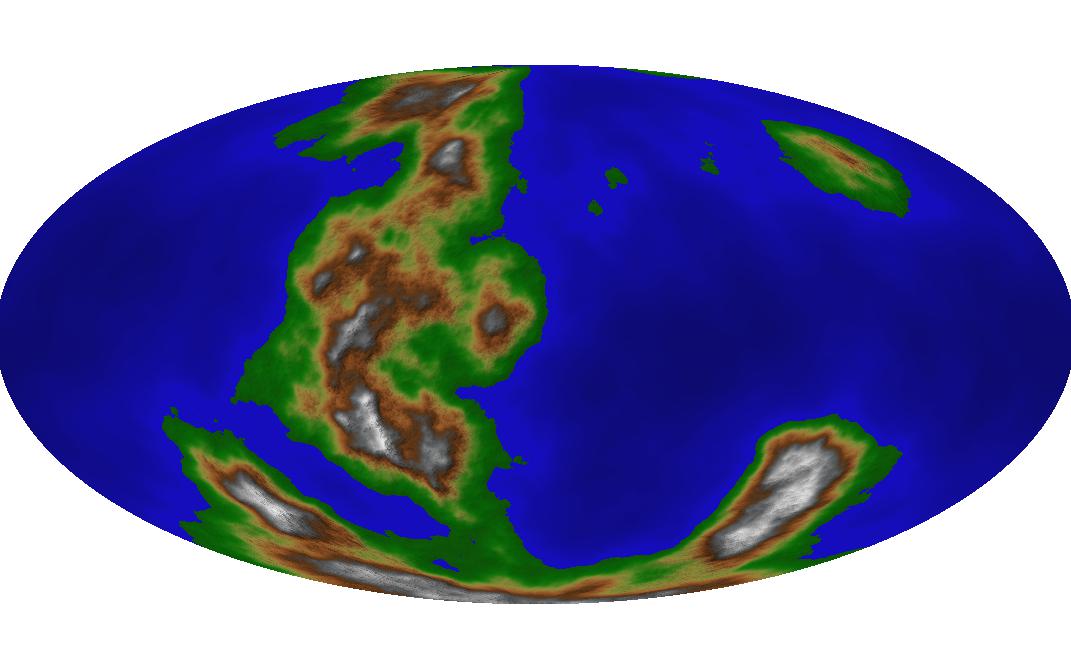 Of course, a single object might be not only a latch, lock, door, or house, but a rock, mountain, mountain range, continent, or world. Look left at this strange world. It too can be divided into parts and a whole. But from far away, someone might see neither mountains, continents, nor the planet, only a system or galaxy. Could all that be one object to them? If not, why can a door, likewise composed of parts, be one? The answer is simple: what counts as one object for whom is mostly subjective. Thinking through how a wizard works will show us exactly why. We need only follow a simple theory.
Merely speaking the magic word does nothing by itself. Are gestures required, or some material used as a focus? Is concentration enough? Must the incantation be supplemented? The questions vary between worlds, but the fact remains: it is not enough merely to know what we want to do. We must somehow define the target and, sometimes, the time. Defining directions or pointing at something may be easy, but how do we define an object? A substance? How do we affect composite objects? The answer is relatively simple: either precisely imagine the effect, or name them. Both approaches have consequences.
Precisely imagining the effect is difficult: from outside, it is hard to imagine a lock mechanism's construction and what we change into what. Knowledge of mechanics and geometry, excellent spatial perception, and who knows what else are often important. This seems the harder route in many respects, but it lets us affect parts of objects, while almost freely shaped spells can easily affect crowds. If “disintegration” affects a thin disc rather than one victim, it can decapitate armies. To avoid this, it helps if the spell affects only a smaller area from the outset. Boiling one liter of water would be just as difficult as killing three or four people.
That leaves plan B: naming the target, substance, and effect. A solution in which a magical symbol acts upon an object by naming the target and substance assumes that this name, symbol, or conception is already connected to the object. The object can be targeted through its function, name, or identifying symbol. This permits not merely targeting and identification, but “recalling” and summoning it, creating it, or shaping it from existing objects.
Naming-based magic, the gift of tongues, idea magic: we can list concepts built precisely on this. They declare a peculiar system of symbols to be magic's foundation. The focus mentioned in Mage is essentially like this too. So many systems resemble one another not because their creators lack imagination so badly, but because few other possibilities can be constructed.
There are strained attempts, of course. If Zsolt Nyulászi envisioned M.A.G.U.S. with idea magic, everyone wanting to contradict him stipulates that they do not want idea magic, thereby undermining players and game masters alike. Yet no particularly good solution has been presented so far, precisely because of this difficulty. And because a certain gift of tongues has been mentioned there from the beginning.
Of course, we can ask whether ideas describe the world or merely one possible method of spellcasting. Consider that idea magic could work even if spells were fundamentally nothing more than Faustian bargains. Whoever makes the spells work could simply arrange numerous things during experiments too. Likewise, if we discard ideas, the gap between an “imagined” effect and the real one can be bridged similarly. The possibility of a “Faustian bargain” remains ever present. But there is an important distinction even here.
Someone who does not ask questions and accepts power at an unknown price that anyone might pay at any time has only themselves to blame for the bargain. That is what a Faustian bargain means. If you have done everything possible and your own frailty did not lead you into sin, the situation differs. I know some devout but anti-science Catholic will say your mistake was precisely believing you knew everything and failing to recognize your limits. Back to the Middle Ages. In any case, many say that anyone who considers asking questions and building on our knowledge sinful has something to hide.
Can we settle this question? How much can a wizard know? We will find out on the next page.