
Against that background, I am a little bothered by how often we hear that an adventurer is “only first level.” At that point they possess relatively many skills and have learned a great deal. In many respects, they are already seen as chosen as an adventurer. But it is a little troubling when the wizard, partly thanks to abilities better than the average person's, can outperform many city guards in melee, yet has no chance of using magical power to boil water and make tea. For the thief, defeating a soldier, perhaps several, is routine, but routine pickpocketing gets them caught several times a day. We understand the problem, do we not? There was a picture on the first page. Let us look at it enlarged:
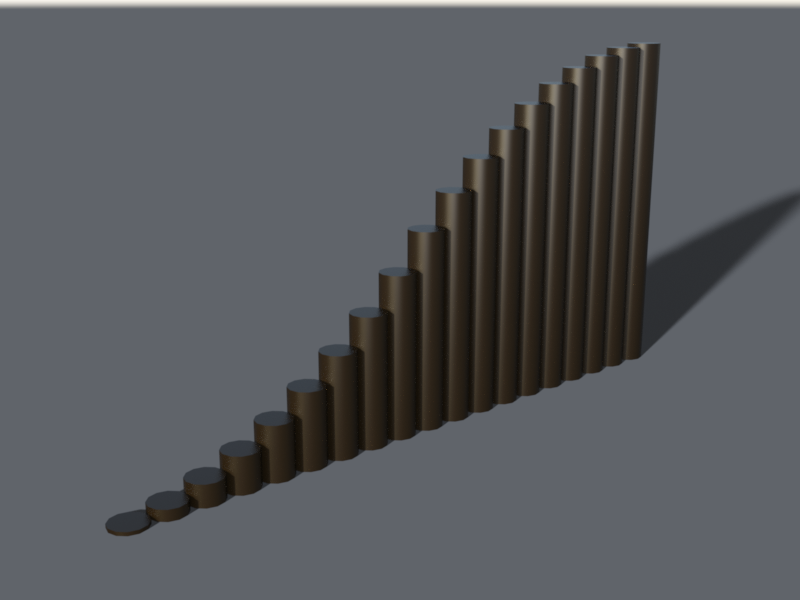
If you read many of our articles, you may recognize it: the graph was originally about 2d10, and about replacing an ability check that rolls d10 under the portion above ten with a check that rolls 2d10 under the full ability score. Compare the graph above with the table below. Look beyond the numbers to the “pyramid shape” in the Possibilities column. The triangle has straight lines, while the graph above traces a softer curve. Some mathematically minded people mention differentiation and integration (The relationship between two pictures: The probability mass function is the first derivative of the cumulative distribution function... Looking at the relationship between the functions in the other direction, we will of course integrate.) in connection with the relationship between the two pictures.
| Value | Possibilities | Chance of this roll % | Chance of a successful check % |
|---|---|---|---|
| 2 | 1 1 | 1% | 1% |
| 3 | 1 2, 2 1 | 2% | 3% |
| 4 | 1 3, 2 2, 3 1 | 3% | 6% |
| 5 | 1 4, 2 3, 3 2, 4 1 | 4% | 10% |
| 6 | 1 5, 2 4, 3 3, 4 2, 5 1 | 5% | 15% |
| 7 | 1 6, 2 5, 3 4, 4 3, 5 2, 6 1 | 6% | 21% |
| 8 | 1 7, 2 6, 3 5, 4 4, 5 3, 6 2, 7 1 | 7% | 28% |
| 9 | 1 8, 2 7, 3 6, 4 5, 5 4, 6 3, 7 2, 8 1 | 8% | 36% |
| 10 | 1 9, 2 8, 3 7, 4 6, 5 5, 6 4, 7 3, 8 2, 9 1 | 9% | 45% |
| 11 | 1 0, 2 9, 3 8, 4 7, 5 6, 6 5, 7 4, 8 3, 9 2, 0 1 | 10% | 55% |
| 12 | 2 0, 3 9, 4 8, 5 7, 6 6, 7 5, 8 4, 9 3, 0 2 | 9% | 64% |
| 13 | 3 0, 4 9, 5 8, 6 7, 7 6, 8 5, 9 4, 0 3 | 8% | 72% |
| 14 | 4 0, 5 9, 6 8, 7 7, 8 6, 9 5, 0 4 | 7% | 79% |
| 15 | 5 0, 6 9, 7 8, 8 7, 9 6, 0 5 | 6% | 85% |
| 16 | 6 0, 7 9, 8 8, 9 7, 0 6 | 5% | 90% |
| 17 | 7 0, 8 9, 9 8, 0 7 | 4% | 94% |
| 18 | 8 0, 9 9, 0 8 | 3% | 97% |
| 19 | 9 0, 0 9 | 2% | 99% |
| 20 | 0 0 | 1% | 100% |
We could draw many similar diagrams for 3d6 or 5d4, or even 6d4−4. Indeed, for 11d10−10 too. There we would see a bell curve rather than a triangle or pyramid. And what the other diagram shows would become even more pronounced with more dice. Moving from a discrete uniform distribution toward a natural distribution, we see that at truly high values the character “gains less and less.” A small departure from average, upward or downward, is significant, while at extreme values a change is much less pronounced. Advancement and the first few points of modifiers that establish the character's basic abilities can deliver great gains; after that, less. The 6d4−4 mentioned above also produces random numbers from 2 to 20, just like 2d10. In that case, however, we would roll a 20 not once in a hundred cases, but once in 4,096.
The mathematics of success-counting systems is a little different. They may have a variable target number, not just a simple modifier. In Shadowrun's 2nd and 3rd Editions, both published in Hungarian too, a six is rerolled and target numbers can often exceed six. There, probability depends on both the number of dice and the target number, and even a single die's distribution is “more interesting” because it is not entirely regular. And of course I remember that sometimes even that system does not have us calculate a target number, but look for the highest target number rolled instead—for example, for Impact under Shadowbeat. It matters that even here, having “more dice” makes you feel in advance that you are good, and that conditioned reflex shapes the play experience too. An extra die remains an advantage for a very long time, but each extra die offers a diminishing advantage here as well.
Interestingly, in Call of Cthulhu, the “check” received for advancement also leads to a roll deciding whether we improve. As our skill rises, the chance of improving falls, so each advancement roll is worth less. Here, a graph of the number of checks rolled against the skill's expected value might be interesting. Oddly enough, you can rarely use low skills in a way that earns a check, while at high levels a check is worth little. Thus the rate of advancement can initially accelerate there too, because you are the one performing those tasks, then begin to slow.
The problem mentioned in connection with traditional M.A.G.U.S.—characters being very good at combat but not at other things—can only be resolved once we have made a decision about the world concept. That decision also concerns what a beginning player character should be like. And whether there should be a level where you say, “All right, I gain a level, but what for? I already always made every roll I needed.” Before some clever person pipes up, “You could not always have made them, because 01,” I would point out that at such high levels a lucky amulet may appear, directly modifying the roll. Critical failure disappears, while critical success happens twice as often as normal. And your gaining levels does not make every opponent in the world higher-level too...
Some say that if each point of improvement eventually yields less benefit, players will develop their characters in other directions instead. Many point-based systems charge more to buy each point at high attribute levels. Plenty of other considerations may enter character advancement too. Having goals for longer is beneficial in a life-spanning campaign. And it is a legitimate aim for the “above-average adventurer” to have good chances while preventing the overpowered character from dominating.