
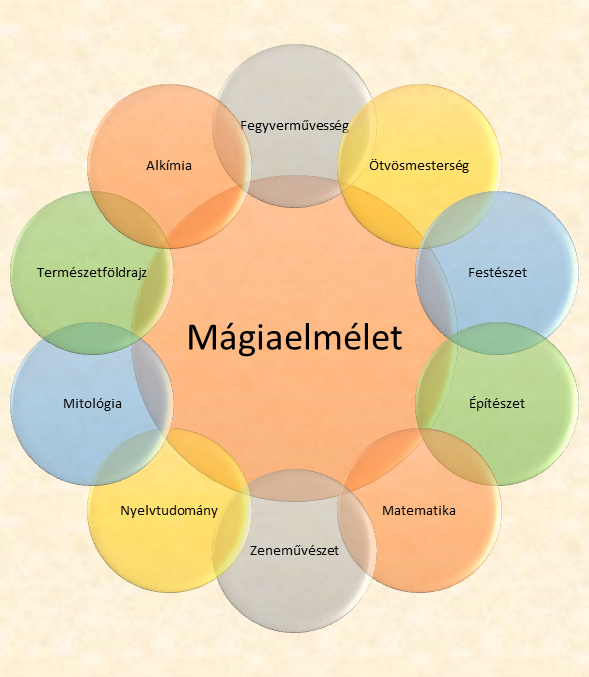
 When Delta Vision suggested that they had also been expecting homebrew systems, I pointed out that many people have or had finished systems, but did not send them for one reason or another. One concept mentioned in connection with the expected material was tuning up the old system. That idea stands against the direction of developing a new system. And examples of it certainly exist: most people play a modified, tuned system and have plenty of favorite house rules. Please glance to the left. The diagram points to something important to me in M.A.G.U.S. But most young roleplayers do not initially concern themselves with such questions. They play more casually, focusing on their characters' relationships and personalities, often on a forum or in chat. The age of hefty rulebooks trying to look serious is over. Often the question should be how a beginner can play from a few pages, using available tools. Tools that are available to almost anyone, anywhere, even when they are encountering roleplaying games for the first time.
The old, traditional core rulebook is a little over four hundred pages. But from page three hundred onward it includes things such as a sample adventure and a rather sketchy description of Ynev. Fine: even if we say a playable starter set does not normally include the rules collection intended for game masters, the old M.A.G.U.S. was still 250 pages. A4, with pictures. Much of that was simply descriptions of individual spells and psionic disciplines. Describing a particular spell in the game system's language is primarily a matter of data, a kind of reference material, rather than part of the game system itself. The actual rules are much shorter. Some spells also had a problem: realistically, the overwhelming majority of player characters would never have enough mana points for them. Such things have little business being in a core rulebook.
155 mana points for a priest? At an average of eight mana points per level, you get there at level twenty. But under the concept of the time, twentieth experience level was almost unattainable. There were many other cases where a spell went in because AD&D had something similar and there was room. And because the criterion then was that a real roleplaying game had a core rulebook of a suitable size, rather than merely two booklets like Harc és Varázslat, which had appeared years earlier anyway. Today, a simpler system is precisely the mark of modernity. So is avoiding carrying around information merely to fill a book. Spells requiring power beyond the reach of the overwhelming majority of player characters belong in supplements. The selling point was really that the core rulebook was a real, thick book. That mattered in comparison with AD&D's three volumes of core rules, of course.
What is all this?
There has not been a successful new M.A.G.U.S. system for a long time. Many of us play from twenty-year-old publications that are practically falling apart. We wait for new solutions, then the grumbling begins: why does the new system roll attacks that way?
But we have often heard that the rights holder would welcome homebrew and other attempts too. It has even been said that perhaps more than one could get a chance. They waited in vain. We did not trust that there really would be a chance. Delta Vision's developers are currently working on a new system. The fans are working on grumbling about the d6.
But let us admit that four alternatives currently exist:
- We get the d6-based system.
- It fails and we get nothing.
- We deliver a finished system and it gets a chance, either instead of or alongside the d6-based one.
- A series of articles presents a method for producing a new core rulebook.
No developers of a homebrew system have been sued. And we have heard of at least four or five solutions. But there is official* permission for supplements and articles, and none for a homebrew system.
Even if permission eventually comes, the articles will not form complete “core rulebooks,” only an SRD. Let us call this the Second Chance (Második Esély) system.
* This does not make the resulting supplement official or officially approved. Only the permission for fan material and house rules is official in the legal sense.
The other day I had a conversation about rallying words, mostly in a political context. But the same applies to marketing, for example when you want to sell a game system. And someone said: d100 is a rallying word. Many features of the old system are rallying words that many identify with and use as the basis of their choices. But what is d100's advantage? Viewed practically, it makes probabilities easy to calculate and outcomes easy to estimate. At the same time, advancement has no enormous steps, and many subtle differences can be represented. The list could go on; it had numerous advantages from the start. But those are not its two most important advantages today. One is that we are used to it, and that familiarity brings conditioned reflexes. We get excited when we reach for the dice; a well-timed 00 or ill-timed 01 is iconic; and when the GM calls for a roll, they can build on those reflexes. After the fiasco surrounding d20-based M.A.G.U.S., it also became a “rallying word” that many are attached to, almost part of their identity as roleplayers.
There is one problem: Delta Vision can rely on bookshops to distribute a new M.A.G.U.S. core rulebook. And bookshops do not sell d10s. New players therefore either need dice or are encouraged to pick up their smartphones during play and roll with a program, which is not a good idea. d6s are everywhere. But I will tell you something else: the history of roleplaying games already contains examples of systems using cards instead of dice, even the standard French-suited playing cards available everywhere. Those are widely accessible too, and even allow some tricks.
An ace is worth one. Taking every card's value from one to ten gives us a “strange” kind of d10; only the J, Q, and K are a problem. Remove those from the deck. Split the deck into two, say by red and black, just as solitaire does not distinguish all four suits. Drawing a red card gives you the first digit of the d100, and black the second. There is your accessible d100. Better still if the system lets you manipulate the deck in certain circumstances, such as with a lucky amulet. Removing a card or adding a face card of a given value is an interesting possibility. Cards have conditioned reflexes associated with them too. An optional deck made specifically for the purpose could have cards supporting a few optional rules. Lo and behold, anyone going out to buy something would buy the publisher's product rather than generic dice. Keeping the traditional d100 can remain an option.
That lets us tune the old system into something genuinely fresh, accessible to new players, and offering new possibilities.
We are tuning the old one. But which old one? The 250 pages in the book? Or perhaps what we actually play? The rulebook said the skill-point cost of master-level proficiency had to be “paid” on top of the basic-level proficiency. Rúna magazine's Magisztérium column said the master-level skill-point requirement was the total, and advancing from basic to master required paying only the difference. And some said master level cost that much in total, but when you went somewhere new to learn a skill, the training also included the basic portion. You had to be there, spend the time represented by skill points, and therefore pay the basic cost again. Know what is interesting? Új Tekercsek adopted the concept, except for the first degree. Basic proficiency, the second degree, did not get cheaper, nor did mastery, the fourth degree; now you simply had to pay for the intervening third degree too. But if we take the proposition that basic proficiency is 50% and mastery 90%, and use it to say “make every skill percentile,” treating the degrees merely as names for particular skill levels and levels of assured knowledge, we get a system. It is among our top ten house rules for the old system. For us, that is the starting point.
We have taken a little away from the few genuinely rigid rules. Many people alter character creation, the combat system, and so on, until every defining rule has been replaced by a house rule. The system is still recognizable, of course, and we understand that it is the old system. Imagine the tuned-up old system taking another large step forward even from there. No rule was untouched before; now almost every rule is new. Suppose every skill gets a base value calculated from level and attributes. But you can be undertrained in many things, taking penalties, and better trained in others, taking bonuses, so you only need to record where you differ from the base. Even if new skills are added to the system, you no longer run into “I used to know this in line with my experience, but now I have no skill points for it.” The names of the degrees, the suggested assured knowledge at those levels, and much else remain.
Tie FP, combat values, mana, and much else to skills, and we already see a more modern system. Cut back the proliferating modifiers, because the deciding factor is the character's knowledge rather than the player's “chess-playing” ability, and make every combat-situation modifier depend on how well you exploit its advantages and how far you let a disadvantage overcome you, and many things become unnecessary in the “core rulebook.” We are tuning the twenty-five or thirty sentences that constitute genuinely important rules with interesting ideas. Creative ideas can build a great deal on them.
Suppose you have a core rulebook with many collected skill and spell descriptions and character creation. But if a great many works also include a sample character, minimal basic rules allowing beginners to play, and perhaps a map, then the basics are already playable from a few pages bundled with any literary work. The barrier to entry is near zero, while the extra skills, spells, and perhaps “NPCs” or sample characters bundled with it add value. Despite simplifying many things, a damn lot can be carried over from the old system and old content. In a system like this, you could welcome many things as old friends.
A core rulebook collecting many things together, and companion volumes with optional rules, could support using such a system at tournaments and in many other settings.
The discussion above has chiefly concerned business considerations. The fact that many people, ourselves included, are attached to old M.A.G.U.S. and particular elements of it, while new players need an appealing, modern system that anyone can start playing. We have not yet reached the decision between d10, d100, or a purely d6-based system; the advantages and disadvantages can be analyzed at length. But we do have a proof of concept showing that a modern, marketable system can be built while keeping d100 and many ideas inherited from the old system. The next installment will address precisely the question of d100.