
First Steps
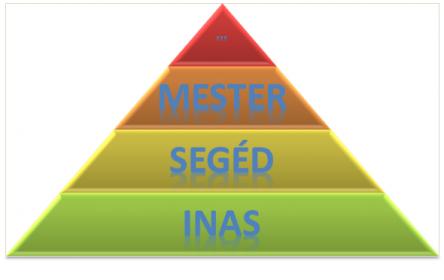 Looking at learning, we noted that its end is truly difficult, with natural aptitude mattering greatly here too. Its very beginning would be similarly difficult if characters lacked appropriate examples, a school system prepared for this, and teaching methods designed to advance them as effectively as possible. The problem is that methods easing the first steps and positive examples scarcely existed before Kyr-based mosaic magic was invented. On the left is another older illustration, made for the skill system... The apprentice is unskilled labor, the journeyman corresponds to basic proficiency, and the master to master-level knowledge. But there is a small triangle at the top. We will now learn a few more details about that little triangle.
In the article describing our favorite house rules, I immediately pointed out that many skills have related skills. After master proficiency in Profession (Blacksmith), for example, Profession (Weaponsmith) can follow, placing another pyramid on the little red triangle. Then further training for smiths specializing in unusual metals, weapon lore, weapon crafting, and numerous similar skills can follow. And someone may know which runes should be engraved into an object so they can be charged even with empirical magic. Gemstones could naturally have been used too, but...
Such engravings and early rune-based empirical magic made familiar details recognizable and nameable in terms of styles and procedures. Presumably this was when and how the earliest prototype of one of mosaic magic's first mosaics could have developed. The magical aura sigil can readily be supplemented with, say, the change sigil or change mark, and a method of rewriting the appropriate empirical magic. We immediately have related signs; once these were recognized, it is not difficult to imagine the shell mosaic's prototype appearing, still as a spell, and certain time- and space-magic formulas appearing as a kind of metamagic.
From there, the mosaic principle could become an accessible field of research with examples and teaching, making the road to mosaic magic's development straightforward. We can also understand how people merely supplementing substantial expertise in another field with magic achieved, in a narrow area, the knowledge needed to create mosaics' primitive predecessors. This model shows an almost inevitable result. But these proto-mosaics still had dozens of fundamental flaws. They lacked, for example, the unified system underpinning free combination. They consisted of complex effects, difficult to learn and even harder to combine. Yet people recognized that linguistic relationships and certain design principles could be used in designing them, and experimentation could begin along that path.
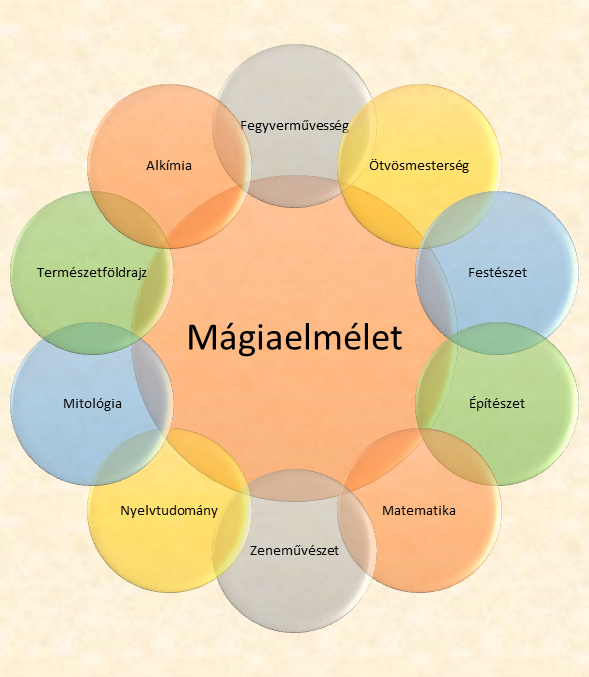 Once magical effects were simplified, simple effects regarded as elementary identified, and research begun into the essence of different things expressible in magical languages, the rest was only a matter of time. What makes this explanation interesting is that advanced knowledge in other fields—their late, difficult stage of development—created the teachable body of knowledge also covering magical theory's initially difficult stage. But, as the illustration on the right shows, there is an interesting problem.
Someone working with weapons also approached the appropriate concepts and associated magical knowledge... But a portion of their knowledge could scarcely be compared with other fields' magical knowledge. Only a few areas possessed expertise advanced enough to lead to the mosaic principle. Comparison worked when the magical-theory aspects of several disciplines were covered. This, however, represented only a small part of available knowledge. And it essentially described the borderlands of magical theory. Researchers in magical theory therefore primarily have to infer axioms from complex observed relationships. With an effect they describe as extracting primal fire from matter, it is difficult to determine what actually happens. The spell might easily cool one place while igniting fire elsewhere. But how do they know primal fire is elemental, or that such an effect is not composite?
From the number of runes it contains, for example; how far they can achieve a similar goal—lighting a fire—differently and more efficiently; how many reactions they can reproduce through alchemical methods... We could list more considerations and recognize why a good wizard school needs good masters in many bordering disciplines. Even some who are not wizards.
Looking at the empirical magic available for study and numerous other fields, the first wizard's appearance is not surprising at all. Wizards' separation from other magic-users is an interesting process too. As is how their initiation method became more efficient—how it grants more mana per level...