
Where Does Mosaic Magic Come From?
Only a magus can create a mosaic, Rúna explains. Rúna is largely optional: the GM may or may not allow it, and it is easy to point to weak articles as reasons not to. But we also see that the known magi of the present age began their careers as wizards or, very rarely, as slan. Gaining experience using mosaic magic was an important stage in acquiring the magical knowledge needed to create mosaics. But mosaic magic's creator had to possess the knowledge needed to create it first, and only afterward could they have practiced anything using the mosaic principle.
 We therefore must view the mosaic principle as a simplification aiding learning and understanding. Its creator no longer needed it, already possessing knowledge reaching into magic's deeper relationships. Fortunately, we know rune magic rests on deeper relationships than mosaic magic. It is freer in many respects too.
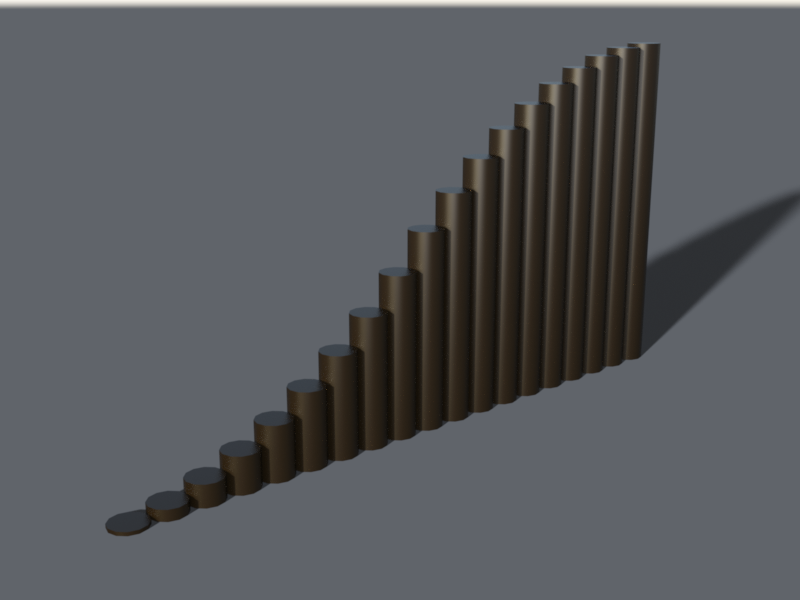
I previously mentioned that the little chart on the right would come up many more times. Then, it explained an alternative attribute check. But it is interesting in many other respects. I am also reminded that when people first learn, they understand little of a subject, so they must repeatedly work through even the basics and progress slowly. Later, fewer and fewer things tell them something new while remaining comprehensible, so progress slows. Increasingly small advances require increasingly more suffering, and this is where many give up.
The mosaic principle, however, does not aim to simplify the many learning processes concerning how magic works at this stage; it addresses a slightly different situation. But let us review one of my favorite subjects: four important considerations in magical theory.
- First, spells can affect only whole objects, not their individual parts. But is a latch a whole object, or a lock, or only the house or city? And what makes an object a complete object?
- You must know the object you shape, but need not know how to manufacture it. You must, however, know the concepts themselves.
- Third, from the gift of tongues through the linguistic foundation of the described forms of magic, the steps required for spellcasting also demonstrate its linguistic basis.
- Since the first edition, we have known that the material and mental planes have a hierarchical relationship.
These are the strong considerations affecting the system. There are weaker ones too.
- Why is gold harder to create than clay? The wizard does not think in terms of Earth's structure of matter.
- How can it be impossible to create a substance, yet possible to create an alloy containing 9.99% of it? What would happen if we were “building from elements and compounds”?
- When elemental magic extracts primal water from matter, the matter's structure nevertheless does not break down.
- Official sources also point out that a structure of matter resembling Earth's would cause problems with ethereality too.
When M.A.G.U.S. appeared, the extent of its unfinished material became clear, and change was promised for the system-reforming Második Törvénykönyv. Reading accounts summarizing M.A.G.U.S.'s history and reforms, we understand how the second rulebook became something else, why the system's principal creator continued separately, and how CODEX emerged as a continuation of that concept. We also know magical theory was not developed until the CODEX Grimoire, but that there was no drastic shift in the conception of the world. This supplies another source linking the creative thought—the idea—to language-based magic. There are few contrary sources, unless we count the internal consensus of little sites collecting “new, even more overpowered classes found here and there online.” According to this, the mosaic principle assembles magical text from fragments, linking individual sections and substituting appropriate concepts elsewhere.
 We have seen why mosaic magic simplifies rune magic, which operates with magical languages and their written signs. And in teaching an ancient magical language, we understand why comprehending many nonmagical source texts matters. Without the ability to read runes and knowledge of the appropriate ancient language, understanding mosaic magic, and often using it, would hardly work. Spellcasting through master-level Magic Use without a wizard's constraints is interesting, but differs in many respects and represents further dumbed-down knowledge. We will return to it; for now, it is enough to know it is no more—and sometimes less—than an average witch's knowledge. In both cases, however, a wizard's mosaic magic and that of master-level Magic Use, assembling something from prebuilt parts simplifies numerous stages of spell design.
A wizard learns substitution, to think somewhat according to the magical language's logic, and to fill in details independently at the appropriate points in a spell. But the mosaic principle can be simplified further by making many of the appropriate substitutions beforehand; the character does not fully understand what they cast or how, possessing only the knowledge needed to recognize it. With master-level Magic Use, although the same creation mosaic may underpin it as for a wizard, the character often learns the formulas for creating water, wine, and iron, and many shapes, as “different versions” of it. The range of magically known objects and substances is consequently narrow: with the substitutions included, considerably more must be learned to expand one's knowledge.
An interesting question is whether a witch learns a single version of a spell—let Slave's Embrace be the example—to apply to different positions and situations, or the method for adapting the formula appropriately. I suspect it depends on the school. But it is a fact that neither empirical nor mosaic magic involves just one level of knowledge.
Up to one point this route is quicker; beyond another, the wizard's is. Beyond another still, the quickest is that of people independently designing spells without the mosaic principle. How much they study, risk, or copy varies individually... But that route is viable too. It is merely harder through an intermediate stretch. The main problem, however, again comes from the curve mentioned when discussing development.