
It is difficult to deal with a player who refuses to understand that a seven-year-old child does not cast spells, especially not through random experimentation, and of course has no mana, even if admitted to a wizard school. It is particularly difficult when they insist this is a huge system bug: if magic is not innate, and mana points require, for example, initiation received at school, how did the first wizard come about when there was nobody to initiate them? I could say look a little to the right at the picture for the answer, but really, the question is best divided into three parts straight away.
It is difficult to deal with a player who refuses to understand that a seven-year-old child does not cast spells, especially not through random experimentation, and of course has no mana, even if admitted to a wizard school. It is particularly difficult when they insist this is a huge system bug: if magic is not innate, and mana points require, for example, initiation received at school, how did the first wizard come about when there was nobody to initiate them? I could say look a little farther down at the picture for the answer, but really, the question is best divided into three parts straight away.
Obviously, “I do not understand the world; I think it is flawed” can be expressed civilly, without trying to rewrite the world over the GM's head. The second point is simply that in a life-path campaign including wizard school, the game master is there to tell you when you can start casting spells, and meanwhile you will receive answers to numerous questions about the world. These are obvious considerations most players understand on their own. The third question, however, is interesting: if the issue arises in your game, how do you answer it as GM?
Obviously, crude answers range from because I say so, and I am the GM to the first magic-user was not a wizard; wizards developed from another kind of magic-user who already had mana. The latter answers the question literally and tells us how we get to the first wizard, but not how someone first acquired mana points. Obviously, we cannot answer questions on the level of who created the first creator, and Ynev's creation story has changed more than once too. But a little exploration of magic's history does no harm.
And of course, this raises which creators' ideas and which sources we consider authoritative.
Let us begin with the most obvious answer: although humans and most races alive today do not possess magic from birth, other races do. They can even teach. I think of Seyrine the Tormentor in the Bestiárium, and the teaching spell described there, which immediately answers the question. According to an official source, an inherently magical being from the outer planes can enable another to use magic and provide the mana points too. The newly trained witch can then make further developments.
It matters that many witch orders are tied to religions and trace their knowledge to their deity and its emissaries. The gods' power and knowledge allow any of them to have emissaries capable of the same. From here, we see numerous orders of magic-users tied to religions. Some to gods, others to demons, but all possess teachable magic with which to train further spellcasters.
Opening the rulebooks at the chapters on priestly magic, we find the observation that the Lesser Arcana's Litanies do not necessarily require real gods: faith and the appropriate formula suffice. In that case, magic manipulating creative forces could easily pass from devout clergy into the hands of heretics pursuing worldly interests. They could then readily begin independent research. This can also occur among creatures of the outer planes. Although the creators have tinkered with Ynev's creation story, I still consider this an easy foundation to build upon.
This is precisely the point in magical history where I find ÚTK's separation of Grace Points and Mana Points problematic: from heretical magic, it is easy to arrive at constructed faiths and the question of what those behind them can create. In comparing divine and mortal powers, I would like to point out that the Kyr defeated Orwella, and divine power is not unstoppable in Amhe-Ramun's manifestation either.
Naturally, numerous other sources of magic arise. Ancient magic based on the gift of tongues may offer a solution depending on how we treat it within our conception of the world. Likewise, any procedure by which non-spellcasters created objects with magical properties, using magical materials, for example. The list could continue for pages. But the question of the first wizard has another aspect, and this is no longer neutral regarding one's conception of the world. Fortunately, it is a softer question.
Where Does Mosaic Magic Come From?
Only a magus can create a mosaic, Rúna explains. Rúna is largely optional: the GM may or may not allow it, and it is easy to point to weak articles as reasons not to. But we also see that the known magi of the present age began their careers as wizards or, very rarely, as slan. Gaining experience using mosaic magic was an important stage in acquiring the magical knowledge needed to create mosaics. But mosaic magic's creator had to possess the knowledge needed to create it first, and only afterward could they have practiced anything using the mosaic principle.
 We therefore must view the mosaic principle as a simplification aiding learning and understanding. Its creator no longer needed it, already possessing knowledge reaching into magic's deeper relationships. Fortunately, we know rune magic rests on deeper relationships than mosaic magic. It is freer in many respects too.
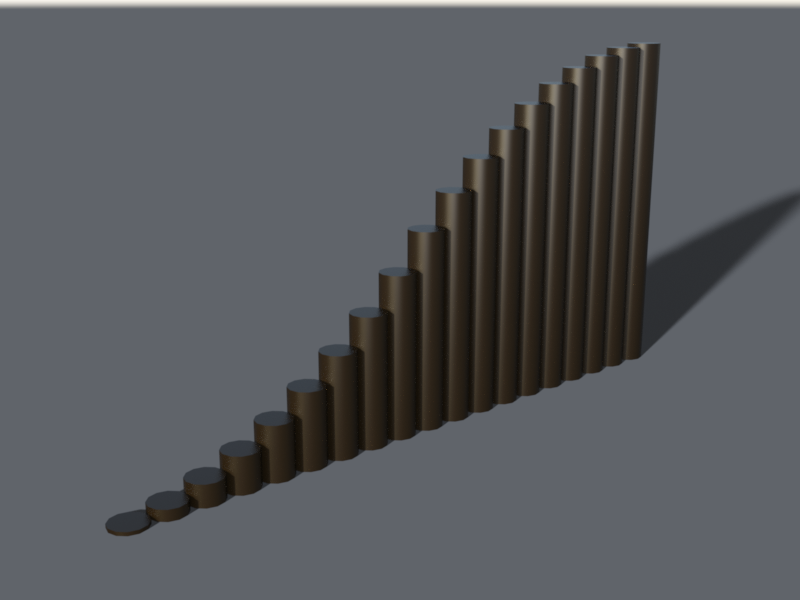
I previously mentioned that the little chart on the right would come up many more times. Then, it explained an alternative attribute check. But it is interesting in many other respects. I am also reminded that when people first learn, they understand little of a subject, so they must repeatedly work through even the basics and progress slowly. Later, fewer and fewer things tell them something new while remaining comprehensible, so progress slows. Increasingly small advances require increasingly more suffering, and this is where many give up.
The mosaic principle, however, does not aim to simplify the many learning processes concerning how magic works at this stage; it addresses a slightly different situation. But let us review one of my favorite subjects: four important considerations in magical theory.
- First, spells can affect only whole objects, not their individual parts. But is a latch a whole object, or a lock, or only the house or city? And what makes an object a complete object?
- You must know the object you shape, but need not know how to manufacture it. You must, however, know the concepts themselves.
- Third, from the gift of tongues through the linguistic foundation of the described forms of magic, the steps required for spellcasting also demonstrate its linguistic basis.
- Since the first edition, we have known that the material and mental planes have a hierarchical relationship.
These are the strong considerations affecting the system. There are weaker ones too.
- Why is gold harder to create than clay? The wizard does not think in terms of Earth's structure of matter.
- How can it be impossible to create a substance, yet possible to create an alloy containing 9.99% of it? What would happen if we were “building from elements and compounds”?
- When elemental magic extracts primal water from matter, the matter's structure nevertheless does not break down.
- Official sources also point out that a structure of matter resembling Earth's would cause problems with ethereality too.
When M.A.G.U.S. appeared, the extent of its unfinished material became clear, and change was promised for the system-reforming Második Törvénykönyv. Reading accounts summarizing M.A.G.U.S.'s history and reforms, we understand how the second rulebook became something else, why the system's principal creator continued separately, and how CODEX emerged as a continuation of that concept. We also know magical theory was not developed until the CODEX Grimoire, but that there was no drastic shift in the conception of the world. This supplies another source linking the creative thought—the idea—to language-based magic. There are few contrary sources, unless we count the internal consensus of little sites collecting “new, even more overpowered classes found here and there online.” According to this, the mosaic principle assembles magical text from fragments, linking individual sections and substituting appropriate concepts elsewhere.
 We have seen why mosaic magic simplifies rune magic, which operates with magical languages and their written signs. And in teaching an ancient magical language, we understand why comprehending many nonmagical source texts matters. Without the ability to read runes and knowledge of the appropriate ancient language, understanding mosaic magic, and often using it, would hardly work. Spellcasting through master-level Magic Use without a wizard's constraints is interesting, but differs in many respects and represents further dumbed-down knowledge. We will return to it; for now, it is enough to know it is no more—and sometimes less—than an average witch's knowledge. In both cases, however, a wizard's mosaic magic and that of master-level Magic Use, assembling something from prebuilt parts simplifies numerous stages of spell design.
A wizard learns substitution, to think somewhat according to the magical language's logic, and to fill in details independently at the appropriate points in a spell. But the mosaic principle can be simplified further by making many of the appropriate substitutions beforehand; the character does not fully understand what they cast or how, possessing only the knowledge needed to recognize it. With master-level Magic Use, although the same creation mosaic may underpin it as for a wizard, the character often learns the formulas for creating water, wine, and iron, and many shapes, as “different versions” of it. The range of magically known objects and substances is consequently narrow: with the substitutions included, considerably more must be learned to expand one's knowledge.
An interesting question is whether a witch learns a single version of a spell—let Slave's Embrace be the example—to apply to different positions and situations, or the method for adapting the formula appropriately. I suspect it depends on the school. But it is a fact that neither empirical nor mosaic magic involves just one level of knowledge.
Up to one point this route is quicker; beyond another, the wizard's is. Beyond another still, the quickest is that of people independently designing spells without the mosaic principle. How much they study, risk, or copy varies individually... But that route is viable too. It is merely harder through an intermediate stretch. The main problem, however, again comes from the curve mentioned when discussing development.
First Steps
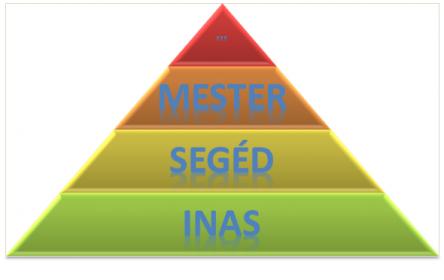 Looking at learning, we noted that its end is truly difficult, with natural aptitude mattering greatly here too. Its very beginning would be similarly difficult if characters lacked appropriate examples, a school system prepared for this, and teaching methods designed to advance them as effectively as possible. The problem is that methods easing the first steps and positive examples scarcely existed before Kyr-based mosaic magic was invented. On the left is another older illustration, made for the skill system... The apprentice is unskilled labor, the journeyman corresponds to basic proficiency, and the master to master-level knowledge. But there is a small triangle at the top. We will now learn a few more details about that little triangle.
In the article describing our favorite house rules, I immediately pointed out that many skills have related skills. After master proficiency in Profession (Blacksmith), for example, Profession (Weaponsmith) can follow, placing another pyramid on the little red triangle. Then further training for smiths specializing in unusual metals, weapon lore, weapon crafting, and numerous similar skills can follow. And someone may know which runes should be engraved into an object so they can be charged even with empirical magic. Gemstones could naturally have been used too, but...
Such engravings and early rune-based empirical magic made familiar details recognizable and nameable in terms of styles and procedures. Presumably this was when and how the earliest prototype of one of mosaic magic's first mosaics could have developed. The magical aura sigil can readily be supplemented with, say, the change sigil or change mark, and a method of rewriting the appropriate empirical magic. We immediately have related signs; once these were recognized, it is not difficult to imagine the shell mosaic's prototype appearing, still as a spell, and certain time- and space-magic formulas appearing as a kind of metamagic.
From there, the mosaic principle could become an accessible field of research with examples and teaching, making the road to mosaic magic's development straightforward. We can also understand how people merely supplementing substantial expertise in another field with magic achieved, in a narrow area, the knowledge needed to create mosaics' primitive predecessors. This model shows an almost inevitable result. But these proto-mosaics still had dozens of fundamental flaws. They lacked, for example, the unified system underpinning free combination. They consisted of complex effects, difficult to learn and even harder to combine. Yet people recognized that linguistic relationships and certain design principles could be used in designing them, and experimentation could begin along that path.
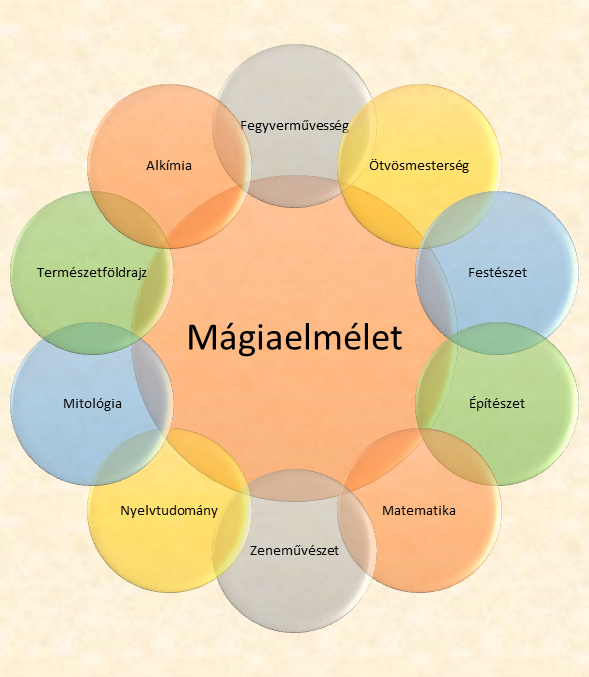 Once magical effects were simplified, simple effects regarded as elementary identified, and research begun into the essence of different things expressible in magical languages, the rest was only a matter of time. What makes this explanation interesting is that advanced knowledge in other fields—their late, difficult stage of development—created the teachable body of knowledge also covering magical theory's initially difficult stage. But, as the illustration on the right shows, there is an interesting problem.
Someone working with weapons also approached the appropriate concepts and associated magical knowledge... But a portion of their knowledge could scarcely be compared with other fields' magical knowledge. Only a few areas possessed expertise advanced enough to lead to the mosaic principle. Comparison worked when the magical-theory aspects of several disciplines were covered. This, however, represented only a small part of available knowledge. And it essentially described the borderlands of magical theory. Researchers in magical theory therefore primarily have to infer axioms from complex observed relationships. With an effect they describe as extracting primal fire from matter, it is difficult to determine what actually happens. The spell might easily cool one place while igniting fire elsewhere. But how do they know primal fire is elemental, or that such an effect is not composite?
From the number of runes it contains, for example; how far they can achieve a similar goal—lighting a fire—differently and more efficiently; how many reactions they can reproduce through alchemical methods... We could list more considerations and recognize why a good wizard school needs good masters in many bordering disciplines. Even some who are not wizards.
Looking at the empirical magic available for study and numerous other fields, the first wizard's appearance is not surprising at all. Wizards' separation from other magic-users is an interesting process too. As is how their initiation method became more efficient—how it grants more mana per level...