
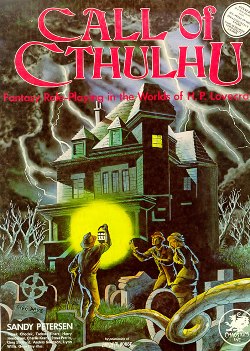
 1981: the Call of Cthulhu roleplaying game was published. In Hungary, the Kádár regime was still in full swing. Obtaining the boxed set would have been nearly impossible, if only because an ordinary person would have struggled to acquire a passport valid for the West, the appropriate foreign currency, and much else besides. Even if somebody brought it in, most people did not know English: Russian was compulsory in school. Children were Little Drummers and Pioneers, preparing for Pioneer camps and construction camps, not RPG parties. When we talk about modern rules being simple, fast, and small, it is worth knowing that the BRP rules booklet in the box was sixteen pages long. But rebellious teenagers did not know about it, so the typewriters acquired here and there produced political samizdat rather than rulebooks.
Instead of exploring mazes, dungeons, and caves, a new concept appeared, compared in the specialist literature to the layers of an onion: characters dig deeper and deeper into the story, step by step, making ever deeper discoveries. Narrative works on an entirely different basis here. Of course the truth is a little more complicated: if adventures have one kind of structure, it is natural for the next to have it too. Once there are two kinds, it is natural to wonder whether a third path is possible. Surely it surprises no one that by 1984 AD&D also had Dragonlance Chronicles, showing another possibility with a story following the novel cycle. But the new structure brought new challenges. To let characters notice what was strange in many situations, it helped if players understood how the world worked. It was natural for Call of Cthulhu to begin opening toward the then-present day.
Not many European supplements?
My fellow editor began the second part of the article on the 1990s with a personal story and an observation. In Call of Cthulhu, there is the USA and there is the USA. And Horror on the Orient Express, which he did not mention. So it is not only translations turned distortions and Hungarian fan-made material that have Hungarian connections.
The lack of European material cannot be traced solely to Lovecraft, however. It also comes from the fact that we have a different culture here. After its brief introduction, the article on the 1990s immediately began with historical background. Producing a good supplement for the American market would be a very difficult undertaking: even more would need explaining, making it long and cumbersome.
Surprisingly, this era was also the last when the isolation that helps horror stories was still natural in many places. The Internet and mobile phones changed many things, as did more modern investigative methods. The 1980s and 1990s are a period for which we can obtain firsthand information to build on, but where numerous new developments have not yet disrupted the workings of investigative adventures. Moreover, the world order was changing, so in many stories a character had to decide why something was strange: was it a clue, or merely a change in the world order? And here at home in Hungary, we were effectively sitting in the middle of it all.
Although you appear not to be in Hungary, you are reading an article about Hungary in Hungarian. Hungarian reality is probably not unfamiliar to you. Whether you run games in Hungarian for Hungarian players or in a foreign language at a local club or online, a Hungarian setting offers you a good opportunity. You know the situation where a caller has to be kept on the phone so we can find out where they are? That film cliché is nonsense today. Modern telecommunications systems have to know the exact route to the caller. IP-based geolocation has also been around on the Internet for a long time. Many websites can offer conditional content accordingly. But in Hungary at the time of the change of regime, voice was not transmitted digitally, and many telephone exchanges were electromechanical.
There was no Caller ID, so it was difficult for the recipient to determine who had called. All right: the caller could be traced. At the exchange nearest us, someone could check where the call connected to us had come from. A local line? Or another exchange forwarding the call? In the latter case, on a circuit-switched network you saw that the call had come from another exchange on cable X, wire pair Y. Fine, then you had to check what exchange X had connected to wire pair Y, and where that had come from. Often even manually. If attention was paid to it, there was a definite time needed to trace a local call or a long-distance call, providing the basis of the film scene where the caller must be kept talking for a while. Of course, even then the timings in films were presented so that the police would succeed.
But as more people reached the West, some sort of computer became available to more people too. In computer gaming, individual games referred to roleplaying games. And of course the Cthulhu Mythos inspired many games. Novels slowly found their way into the country as well. And, according to the cynics, so did AD&D. More and more adults faced the problem that young people these days behaved very differently from the way they themselves once had, and they could not decide whether many things were dangerous or harmless. As the change of regime approached, many ideological debates also gained space that would not really have been possible before.