
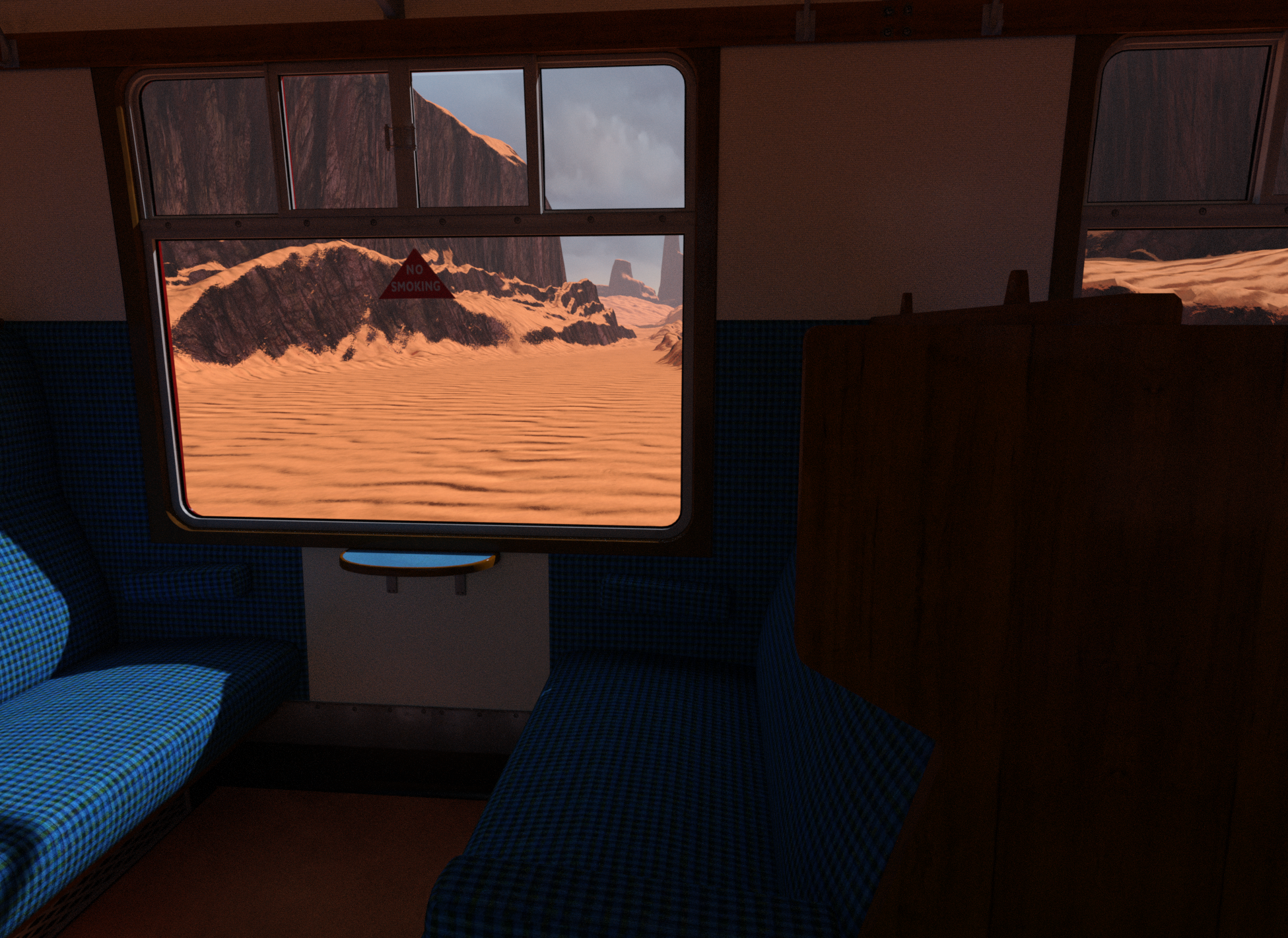
 We recently published an article about an era in which I mentioned adventures set on trains. The truth is that I left out the obvious question: why a train? An important detail is that railways, ships, and airplanes mean both confinement together and isolation. Flying was not widespread in Lovecraft's day, and even now it is not an ideal example of several days confined together. Of course, multiple landings and a hostage-taker or something else can sustain that confinement, but it is not quite the same. Many ships are large and better equipped—with radios and other things—and may even have lifeboats. That leaves the train, with first- and second-class carriages, open seating and compartments, and the numerous services typical of such trains. And a train journey there can easily differ from one in present-day Hungary or on many lines in today's United Kingdom.
Board a Bzmot railcar, and unless there is an accident, you can expect within ten minutes to reach somewhere you could walk to in thirty. Now imagine the railway surrounded by desert, snowfields, or mountains impassable to you, with the next settlement far away even by train and almost unreachable on foot. The heating will not run indefinitely; the dining car's food and drink supplies are finite. You are stranded, the environment is dangerous, and a murder has occurred in one of the carriages. A modern second-class seating coach may have eighty seats. Now imagine the following train formation: lovely long four-axle carriages, two axles on each bogie. It could even be a modern long-distance sleeper train carrying holidaymakers.
Ten passengers can afford the luxury of double sleeping compartments. Whenever they get up, the daytime accommodation and all its possibilities remain available; they can comfortably spread out the newspaper bought earlier at the station. With only a small service compartment, two single compartments would remain at the ends of the carriages; with more service space, perhaps two showers, those ten passengers already fill two carriages. And how far is that from a modern luxury hotel train with more showers and slightly larger compartments? There it could easily justify three or four carriages.
With single compartments for married couples, twenty people—ten couples—suffice for another twenty compartments, bringing our train to at least four carriages. Add three carriages' worth of compartments for younger people and second-class passengers. We have not yet reached a hundred people—as many travel on a Bzmot at peak times, though many standing—but our train already has seven carriages. At least one dining and/or saloon car is needed, but if we do not want to rush passengers or make them wait long, one carriage is insufficient for catering. I am not saying two identical cars are needed, but at least two carriages' worth of communal space would fit. Checked baggage is hardly unprecedented, so feel free to add baggage cars, perhaps offering other services too. We are certainly beyond ten carriages, yet our lovely long train confines a manageable number of passengers, PCs and NPCs alike.
Moreover, this picture assumes occupancy around 100%. There could easily be several of many carriage types, because traffic may be heavier, with some cars simply empty this time. That provides enough unobserved space to explain why so many things have no witnesses. Surely it does not surprise you when I point out how interesting this is for a GM running an investigative adventure. Though confinement naturally suggests the corridor is the only route, many action films and other works show that movement outside is possible too. In sleeping cars, passages between connecting compartments also offer interesting possibilities.
In investigative adventures, the pool of suspects can therefore be finite, and eliminating individual suspects can be interesting, while handling outside information sources becomes harder. Many railway routes in the USA still lack mobile reception in places today. These possibilities are why the location can contribute so much to an adventure set on a train. But it is also true that their significance differs across settings and eras.