
After turning the page, the two pictures are no longer side by side, but we can see that the colors and skin texture are a little different. Which is better is a good question, but the fact is that the Genesis 1 platform was designed for the solution used in the previous image. It is also a fact, however, that Iray is better, that DAZ Studio is prepared for the switch, and that the latter ought to look better in many respects. At the same time, the difference between the pictures draws your attention to another small point, even when you do not see them simultaneously. Lighting matters a great deal and can fundamentally determine an image's atmosphere. Whether you depict a character alone or together with their surroundings makes a difference too. These decisions are worth making early.
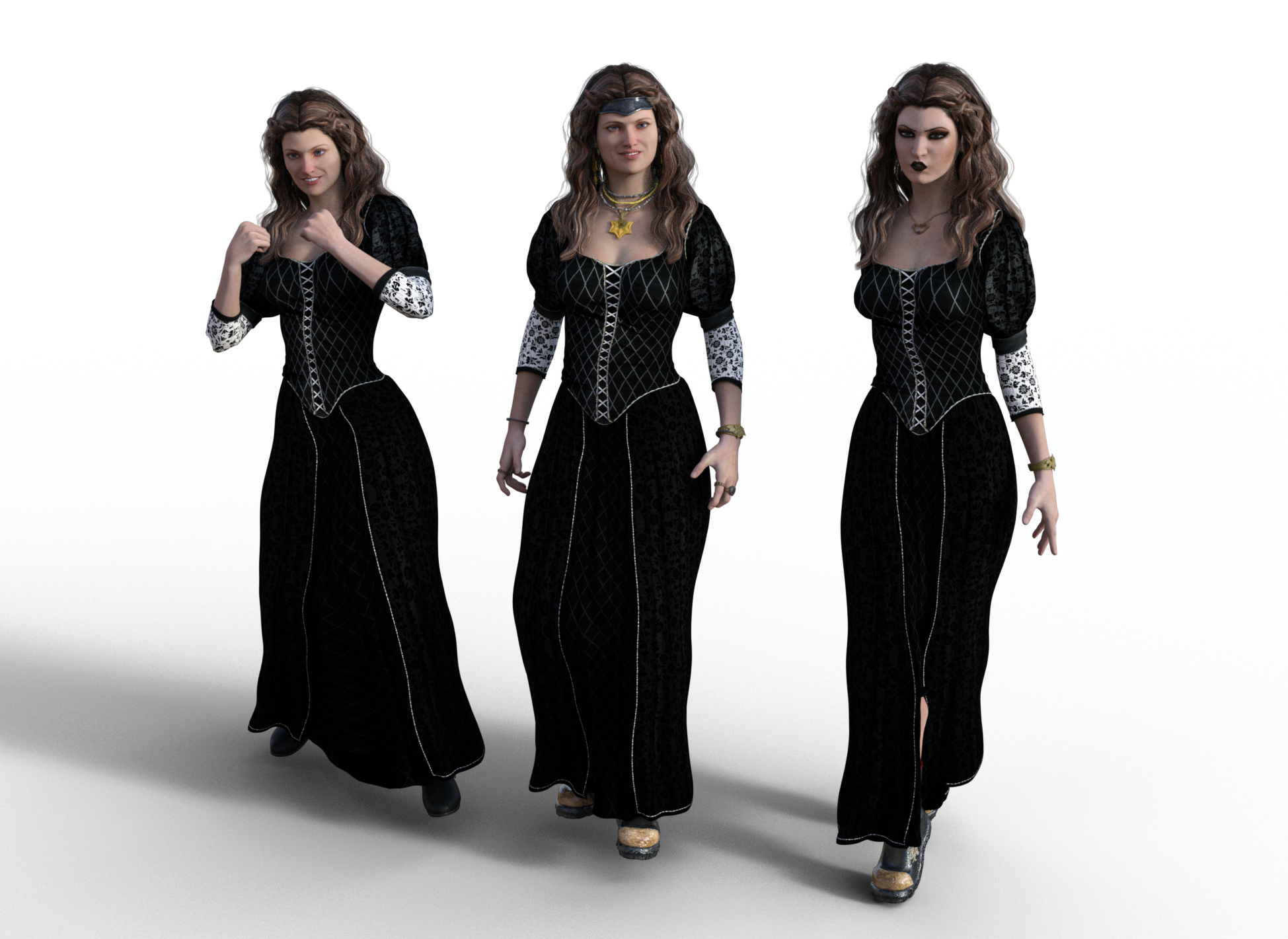 As a roleplayer, you would probably say that characters have attributes. In this image I am building on the base figure called Victoria 5 Supermodel. In one case the modifier relative to that is Heavy +0.14; she is in the middle. In another it is Voluptuous +0.20, and of course she is on the right. On the left, Fitness and Fitness Details come in at around +0.40. Of course, when it comes to the “pursing her lips for kissing or sucking while mentally sizing everyone up” attitude, it is easy to say that amid all the calculations the duckface is not there yet. Still, plenty is quite recognizable and contributes a little to the character's feel.
When we design a system, the difference between the mathematics taught in technical education and the economics version comes to mind too. And plenty of other things, of course, since we know that for most people secondary-school level is the maximum. The “one, two, many” approach is no longer typical of roleplayers. Someone did once count how many decision points there were on an issue using the sergeant's mathematics of “one, one, two, one.” “One! One! Two! One! — One! One! Two! One! — One! One!” more or less did the job. In this case, however, I would ask even the most blinkered M.A.G.U.S. fan to set aside for a moment the line of thought that you have to roll for the portion above ten as well. In most cases, it is better to stay below one. Except where there is a % sign, of course, because a percent is a hundredth.
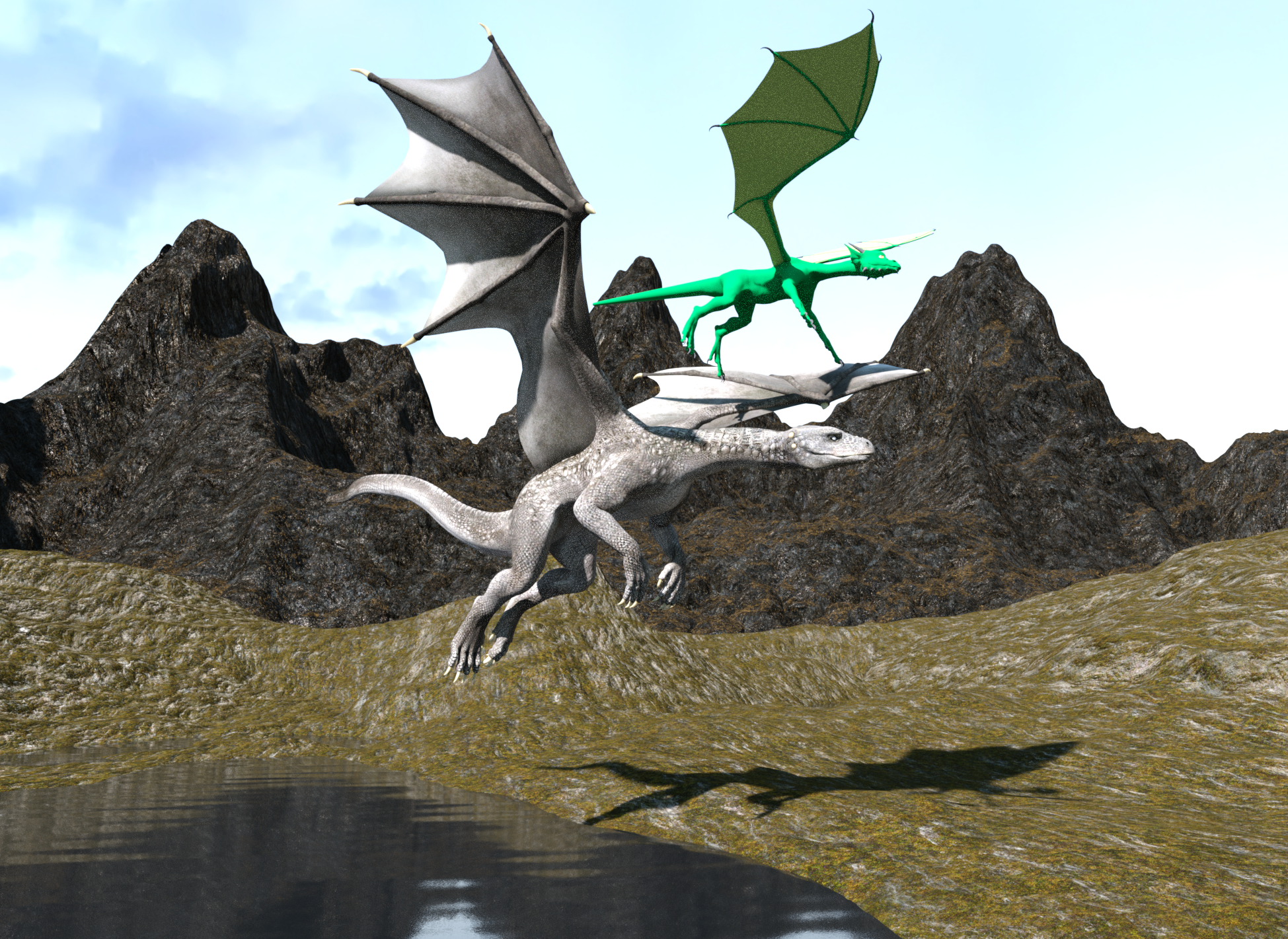
Too many changes are not always good. If you do not know what you are doing, you do not know what combines well with what. And it is worth thinking through what looks good and how. One example is that nonhuman characters need not resemble the demon at the beginning of the article: they might be two dragons. Either could actually be good, but in the case of the two dragons, their different wings and different shaders do not necessarily look very good in the same picture. You need to account for that when composing it too. And image composition can have a major influence on the impression your character makes.
 To cater to more than just fantasy fans, with the next picture we will try to offer a little something to Call of Cthulhu enthusiasts. Again, the picture takes only a few steps, and here I would like to talk briefly about how laziness can sometimes give you an advantage. Specifically, you can stop rendering at a half-finished image and save the result. That is not what we did here: we merely took a screenshot, which could be cropped, and could even have a little film grain, blur, and plenty of other things added. Our story's protagonist is Lisa. I could also say Lisa the cultist. Lisa the cultist, who slipped onto a dangerous path not so long ago, but who will now be the “damsel in distress” in a horror adventure whose rescue is a serious mistake on the characters' part. The source of the distortion could be anything supernatural, or even some radioactivity. My guess is a combination of the two.
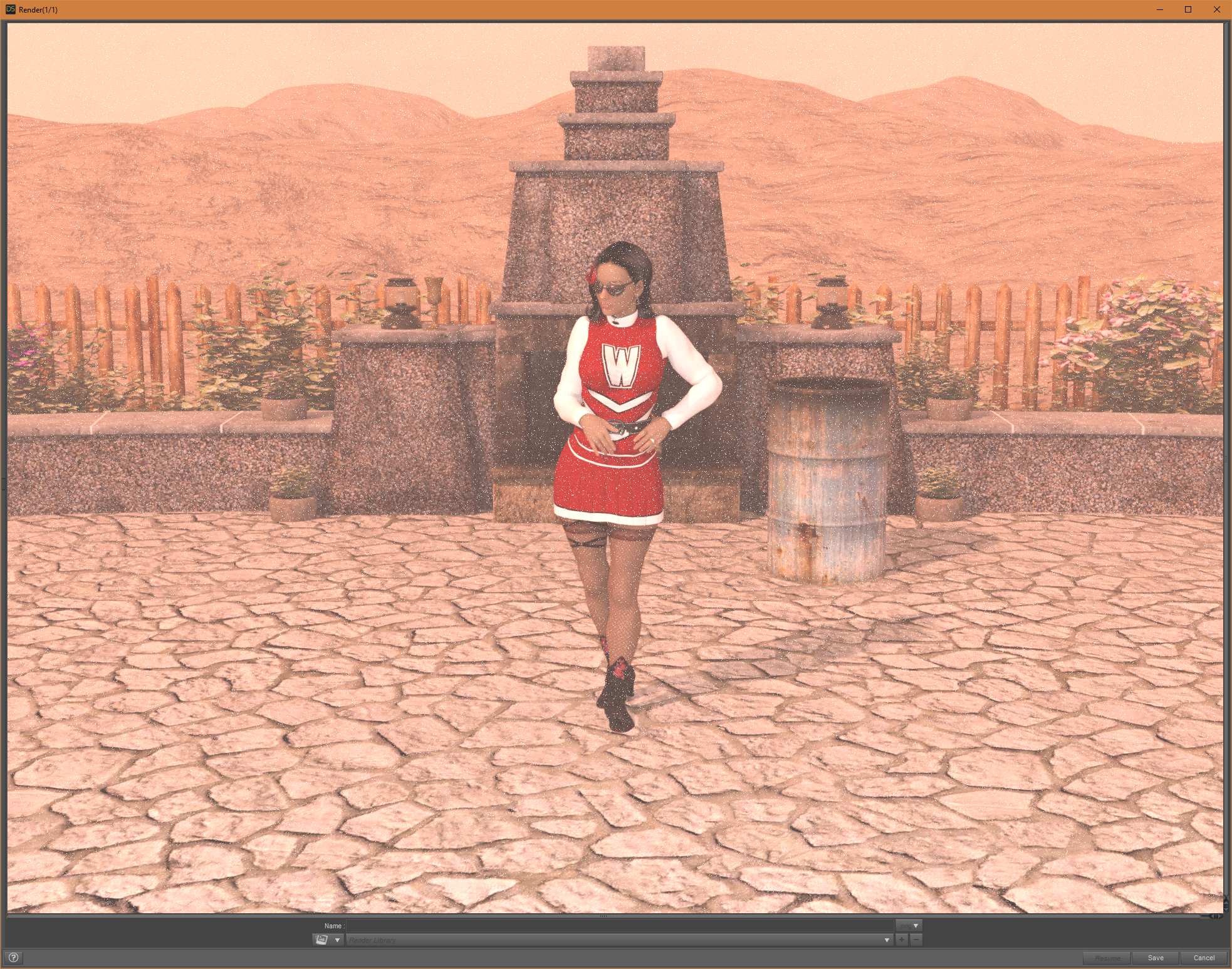
You can be pleased with the visible noise because, for instance, the combination of noise caused by ionizing radiation, the suspicious barrel, and the old chalice on the mantelpiece can establish the atmosphere. Lisa is coming apart ever so slightly. She would not once have worn a belt with an outfit like this, and the slight discord between the little ornament on her thigh and her thigh-high stockings also warns her friends: something has changed. They think Lisa has fallen victim to a cult, and they eagerly tell the player characters so. In reality, Lisa is the leader of the genuinely dangerous cult, which already has a few murders behind it. Drugs opened her mind to the horror looking at us from alien worlds. She sees the signs in the radioactive noise too, which changes her through slow mutations. Sunglasses are now an accessory even in the dark... The eyes are the mirror of the soul, and Lisa does not want to show hers. Whether they have visibly changed can be left to the imagination.
In any case, the wealthy “good girl” from a good family, a member of the elite, progressed from opiate medication after a sports injury to dangerous substances, then, by opening her mind to many things, to the role of a dangerous cult leader. But thanks to feminism, she can only be a victim. She knows perfectly well that indulging her own perversion and encouraging her followers to do the same will help with that too, since who would dare talk about a female ringleader when sexual crimes are involved? The image noise and half-finished render add something to the situation. The finished image will be used in an adventure. Switching between harmony and discord can thus become a tool in creating an image. So can the fact that the render window can effectively be incorporated into the interface seen by the player characters, making the picture a better handout. Win-win.
Making the picture did not require much work. Choosing the Olympia 6 model, the clothing, hair, and sunglasses is trivial, and the outdoor environment is largely built on two foundations: TerraDome 3 supplies the background, while The Backyard provides the foreground. That leaves the barrel from another package and the chalice as a point of interest. A few clicks and another basic pose. Of course placing the chalice does involve adjusting parameters. For the morphs we made her a little younger, with breasts appropriate to that (the Young Breast 1 morph) and Shape Adjust for her youth, but as one of the stronger members of the cheerleading squad, she also received a larger Fitness modifier. The other trick was setting the belt's parameters so that collision detection takes the clothing into account. Of course the woman's hands could have been gently moved a little, and many simple steps were left out. But we have deliberately stuck to the basics so far.
You can drop in a lighting set—that is not too difficult either—and you already have a whole collection of basic tools with which a few clicks and a few values set on sliders let you communicate lots of little details. It is no more complicated than customizing a character's appearance with a few sliders in any computer game. Naturally, over time you can fine-tune the pose by hand. You may also get to the point of copying a tattoo onto the skin with the Layered Image Editor. You can play with lighting too; many outfits require attention to their material zones, and clothing and hair can both be customized.
For now, we have discussed the ideas behind an image, the concept, and the things that are straightforward to do alongside the basic tutorial. The question is whether you can make these conceptual decisions. If you can, clicking through a few basic settings will not be difficult. But since we have not changed much about either the clothing or the characters, and have been talking about filling the content library, this really is only enough to decide whether we want to get into it. If we do, following our next article will let us learn a thing or two about the basics as well. Good luck making your character pictures.