
 A picture of your character. Often that is all you want. But producing one is not quite so simple. Many people think the problem starts with your character being truly special, unique, colorful, and bringing a lot to the game, while the available pictures are not of that character, and a bunch of other players use the same ones, so they can hardly be called unique either. The other problem: I am no artist, and most readers would not be offended if I said they were not graphic artists either. Anyone who is a graphic artist probably already has their own way of making character pictures and can even supply them for the whole group. That means our article chiefly needs to address the situation where there is no graphic artist around. Indeed, where you decide even “I will pay a beginning artist the price of a few beers” does not appeal. Because I have seen very fine pencil drawings, more atmospheric than any 3D render, and perhaps less dark too. It is just that lots of small details were always missing from them.
Then someone recommended The Sims series, since it has ways to do things such as elf ears. Cynics even say you can make a witch with gigantic breasts. Somebody pointed out that buying the right packs would also let us make pictures of our character's home, and with more and more tools it would keep improving. But there were two problems with it: it was never really good. And certainly not because EA's animators understand character animation less well than I do. All right, in Mass Effect: Andromeda I saw facial expressions, poses, and running animations of a standard that even I would not let out of my hands, despite being a complete amateur, so I could slag off EA and its subsidiaries. But that still would not make me right. That game stood out precisely because we had become accustomed to good work. But what is wrong with good? First I will try to give an example, drawing a little on M.A.G.U.S., but explaining both the idea and the decisions based on it in detail. Let us look at three characters. They are triplets, followers of the Pyarronian faith, and witches. I could say everyone knows M.A.G.U.S., but that is not entirely true, so it is worth explaining that a M.A.G.U.S. witch falls into the seductive beauty category, rather than the old hag category. Interestingly, the Hungarian concise explanatory dictionary supports that interpretation; Wiktionary does not. Which provides a good example of how easy it is to imagine a character incorrectly when they are introduced through a class name without a description or picture.
boszorka noun 1. folk, literary Witch. 2. jocular A spirited, sly or mischievous young woman. A pretty little minx!
boszorkány noun 1. In folk belief, a woman imagined to possess supernatural power (and harmful intentions) through consorting with the devil. | In fairy tales, an evil being embodied as an old woman. 2. pejorative An evil (old) woman. 3. jocular Boszorka. [Turkic]
But the English word “witch,” the Wiccan religion, and the seductive women persecuted during witch hunts can all serve as the basis of a class too. If we take The Sims 3 and depict the three witch triplets above in it, we immediately see that the underlined sense is the one intended. Just as we would if the player read the rulebook all the way through. But increasingly often it turns out that even the game master is unfamiliar with a class from the core rulebook, so without a picture or description we would not be on safe ground. Consorting with the devil, meanwhile, is how heresy, adherence to another religion, appears through the filter of a religious Christian value system. Thus the ecclesiastical and religious ties of witch orders, which many GMs take for granted on Ynev, really do follow from the concept of a witch. Slyness, mischievousness, and many other things symbolize values different from Christian ones. That is why many witches may be religious figures, even almost priests. Imagine our three witches going to the same celebration in very similar clothes, with very similar hairstyles and makeup. The same things suit them, the same fashions apply, and often mandatory considerations also make them look alike. How do you tell them apart most easily?
Their actions and movements will differ. And if each of the three feels particularly close to a different goddess, let us admit it: their movements and posture will differ drastically. Solutions like The Sims do not support this; pictures hunted down online would rarely get this right too; Character Artist and Hero Machine do not deal with it. Poser and DAZ Studio, however, are in their element here. Naturally there will be other differences too, but if the three characters have different personalities, we would depict each in a different movement. Three witches can be connected to three goddesses within a particular pantheon. Let us look at three good options, allowing myself a little criticism—though all the harsher for being brief—of the authors of the Papok, Paplovagok volumes, and of András Gáspár. And, of course, highlighting some of the goddesses' main qualities in bold.
An obvious choice is Ellana, goddess of love, beauty, pleasure, frivolity and infidelity.
léha I. adjective 1. Frivolous, interested only in amusement and empty-headed <person>, or characteristic of such a person. 2. regional, agriculture Empty or bearing stunted seeds or ears. 3. regional Loosely woven, poor-quality <fabric>. 4. folk Idle, lazy. 5. regional Fond of joking <person>. II. noun 1. elevated or folk A frivolous person. 2. regional Chaff. [↔lehel, or West Slavic]
So, for this witch, we need to decide what the Ellana she prays to is like. And already I have to explain the connection between choice and faith even to M.A.G.U.S. fans, because there are three different pictures of Ellana right off the bat. And I have the cheek to claim that two of them are official and the third is good. I will go further: when setting aside irreconcilable differences came up in connection with DV's current project, the contradiction between the two official pictures and the minimum of acceptability was the basis of my irreconcilable difference. But the concept of the three Pyarronian witches shows how tiny the details that matter can be, and Ellana's role cannot be avoided here. If I want to explain what sort of witch I am depicting, I have to choose between those three pictures.
One option is to take the direction represented by the Papok, Paplovagok supplement. People pledge eternal fidelity to one another before the goddess of infidelity; they expect the goddess of frivolity to grant them a bountiful harvest as the result of their diligent labor. What? Such a massive self-contradiction that it is unbelievable? So what? That creator is official, and if you dare point out that this kind of destruction does great damage to a game that many websites' teams work for—including sites and teams I do not like—and that contradictory writing and illogic undermine everybody's work, they throw you out like a cat sent out to shit. The official label and a place in that circle mean power, and the munchkin goddess that a GM-turned-creator carved out of something else back when he was still a GM, to please his favorite girlfriend, may rule over anything, however alien to her. Period. But if you think his girlfriend's overpowered heroic exploits are not the only ones that count, and that a PC winning a battle that way should be recognized too, then you are the stupid, quarrelsome one.
Since I think I would rather focus on players and game masters, and do not know the creator's favorite girlfriend anyway—and he might even sue me out of jealousy if I tried to please her—I have to forgo a visual depiction of that concept. Is that a problem? I have practical reasons for rejecting the direction represented by András Gáspár as well. Specifically, he described very clearly how he envisioned these priestesses only at various levels of prostitution, but once they had to be made playable, there were examples of other things too. For instance, someone who does it not for money but for her own amusement, representing frivolity rather well. Within Ellana's religious organization, however, there must also be someone to teach the priestesses, since secrets known only to Ellana's priestesses can hardly be taught by, say, an ordained servant of the god of knowledge, Krad. Most religions are not such narrow pigeonholes, and the existing “commando priestess of Ellana” can be made somewhat acceptable by saying that she does the work for Ellana's church alone, rather than for Pyarron or the Pyarronian Church.
So alongside the omnipotent one and the mere prostitute, there is a somewhat broader picture, naturally focusing on all five elements of her domain. But what witch would not embody love and beauty? Pleasure can come later, in private, rather than in front of everyone, leaving a depiction that conveys frivolity and infidelity. A lustful gaze, pursed lips, and a “natural curiosity” that sizes up every man and every woman from the same particular perspective complement an emphasis on her assets and a not-too-athletic version of the basic appearance.
You see correctly: if faith in Ellana is present, Dreina can appear as a counterpoint. Power, order, wealth, loyalty. Loyalty does not mean monogamy for a witch, but in many directions her loyalty is unassailable. Here the duckface pout disappears, and she is far less intent on emphasizing her curves with every movement and pose; what you see instead is pride. Her jewelry is obviously different too, heavier, and does not always draw the eye toward her cleavage. Within the limits of her build, she would be less slender, having attended more aristocratic dinners. So although they are triplets and the concept rests on the same foundations, we can already see how to distinguish the two witches visually. Poses and movements matter in this.
Let the third girl be a follower of Arel, goddess of battle, nature, rain, courage, heroism, stubbornness, and recklessness. Many would also associate freedom with her, because few things matter more to Arel, but that comes from nature. Heroism brings loyalty with it, while stubbornness and independence bring a little disloyalty too. Our witch connected to Arel is a real troublemaker, the rebellious type. Magical healing makes wounds heal without a trace, but all that fighting still leaves its mark. In musculature suggesting a battle-hardened predator, for example. She feels practically naked because her jewelry and clothes would normally include some weaponry, most of which was not allowed into the ballroom.
To her, witchcraft and seduction are simply combat fought with different weapons, and those are good when they are dangerous and fought for a good cause too. Fine, fine, they took away more than half her weapons, but her mind is still on making a move on the most dangerous figures in the ballroom, and the resulting mayhem, pleasing to mighty Arel, will of course serve a good cause. She is hunting, all right...
Put the three girls next to one another and the difference would be obvious. Even if we were not looking at their behavior in the ballroom, but simply an everyday pose with no surroundings. I am not a graphic artist or a good animator. Really. But I can put in a basic hint that you will recognize. And The Sims is not enough for that. I am no good animator; capturing a character is difficult for me, but even I can manage, for example, to “keep adjusting the eye morphs until they roughly match the description of an amund.” The result is not the GM's girlfriend's universally beautiful character: you can see the cult of beauty in it, but also its alienness, and why it is wiser for them to wear masks among humans. Most pictures hunted down online cannot even manage that much.
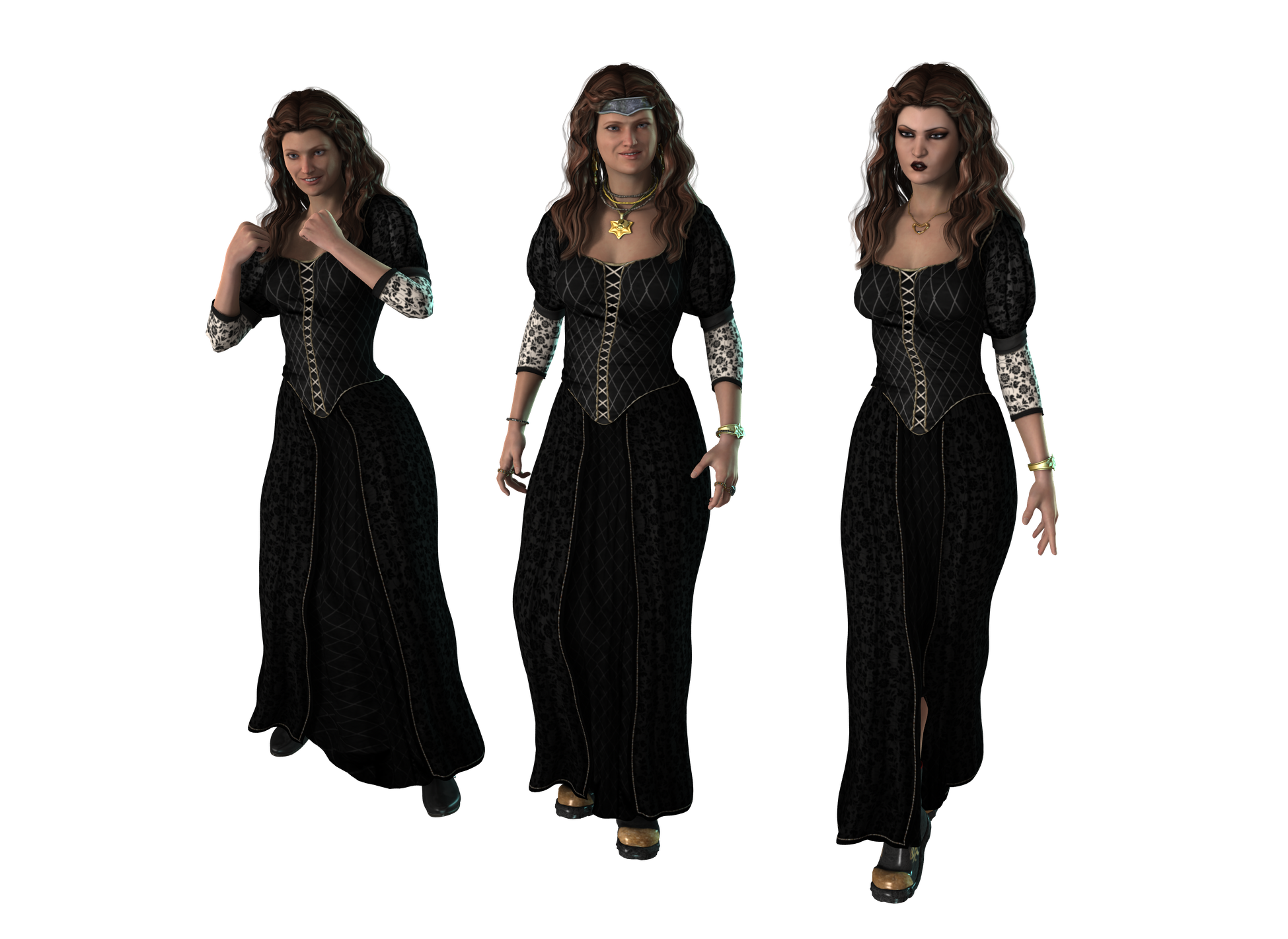
Nothing much: this is still the Genesis 1 platform, with clothing made for it. The old 3Delight renderer, simple shaders. Just a few settings tweaked, deliberately avoiding the latest platform. Of course I can show the same thing with the NVIDIA Iray renderer too. Minimal differences present three completely different characters in the three women. Yet you can accept each as a witch. With our splendid follower of Arel, of course, you can imagine that she takes less care to keep her dress intact. And she feels too naked at the moment, without either bow or longsword. Even the daggers had to be hidden. But let us jump to the next page, where we will deal with plenty of other questions.
After turning the page, the two pictures are no longer side by side, but we can see that the colors and skin texture are a little different. Which is better is a good question, but the fact is that the Genesis 1 platform was designed for the solution used in the previous image. It is also a fact, however, that Iray is better, that DAZ Studio is prepared for the switch, and that the latter ought to look better in many respects. At the same time, the difference between the pictures draws your attention to another small point, even when you do not see them simultaneously. Lighting matters a great deal and can fundamentally determine an image's atmosphere. Whether you depict a character alone or together with their surroundings makes a difference too. These decisions are worth making early.
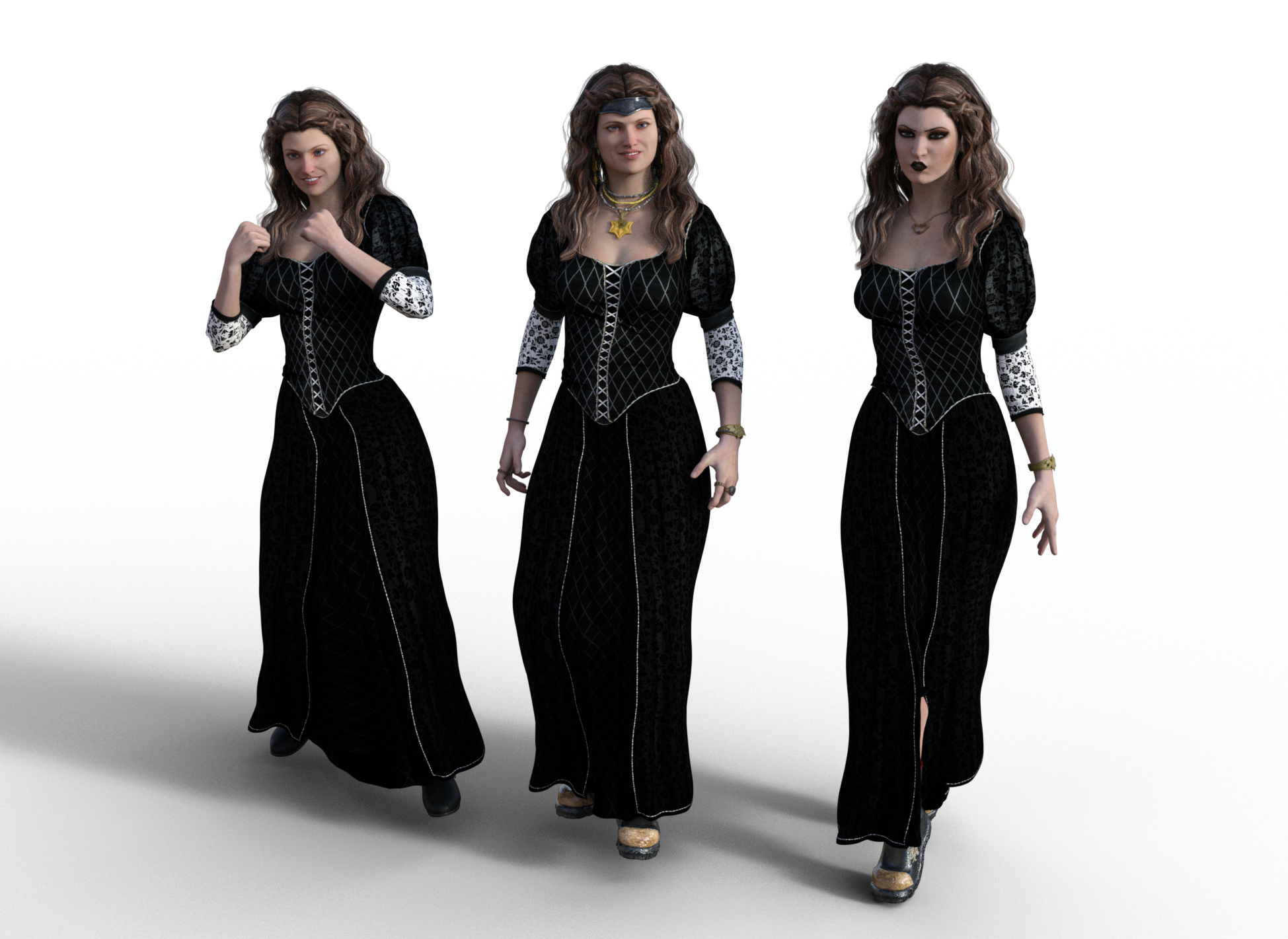 As a roleplayer, you would probably say that characters have attributes. In this image I am building on the base figure called Victoria 5 Supermodel. In one case the modifier relative to that is Heavy +0.14; she is in the middle. In another it is Voluptuous +0.20, and of course she is on the right. On the left, Fitness and Fitness Details come in at around +0.40. Of course, when it comes to the “pursing her lips for kissing or sucking while mentally sizing everyone up” attitude, it is easy to say that amid all the calculations the duckface is not there yet. Still, plenty is quite recognizable and contributes a little to the character's feel.
When we design a system, the difference between the mathematics taught in technical education and the economics version comes to mind too. And plenty of other things, of course, since we know that for most people secondary-school level is the maximum. The “one, two, many” approach is no longer typical of roleplayers. Someone did once count how many decision points there were on an issue using the sergeant's mathematics of “one, one, two, one.” “One! One! Two! One! — One! One! Two! One! — One! One!” more or less did the job. In this case, however, I would ask even the most blinkered M.A.G.U.S. fan to set aside for a moment the line of thought that you have to roll for the portion above ten as well. In most cases, it is better to stay below one. Except where there is a % sign, of course, because a percent is a hundredth.
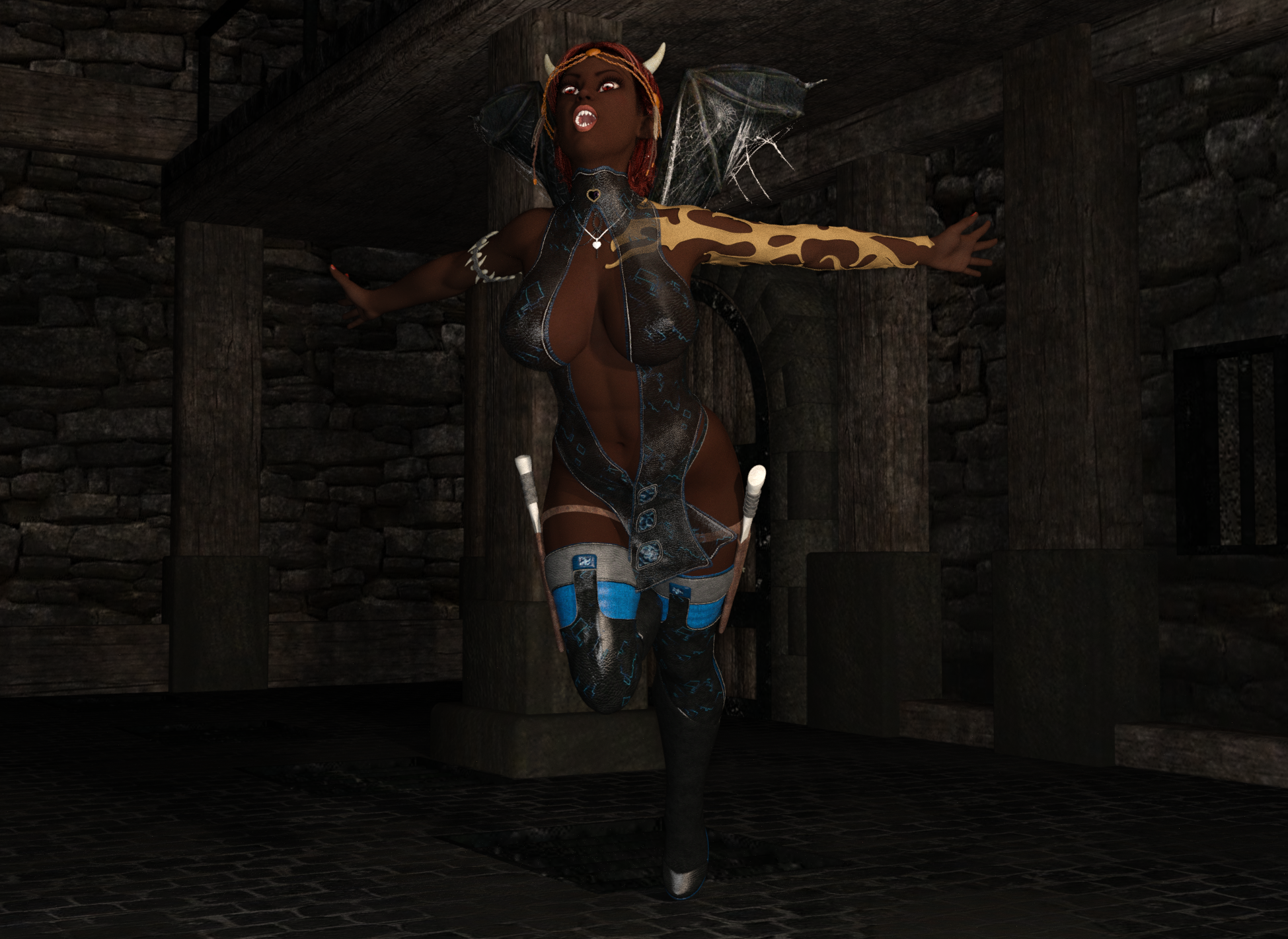
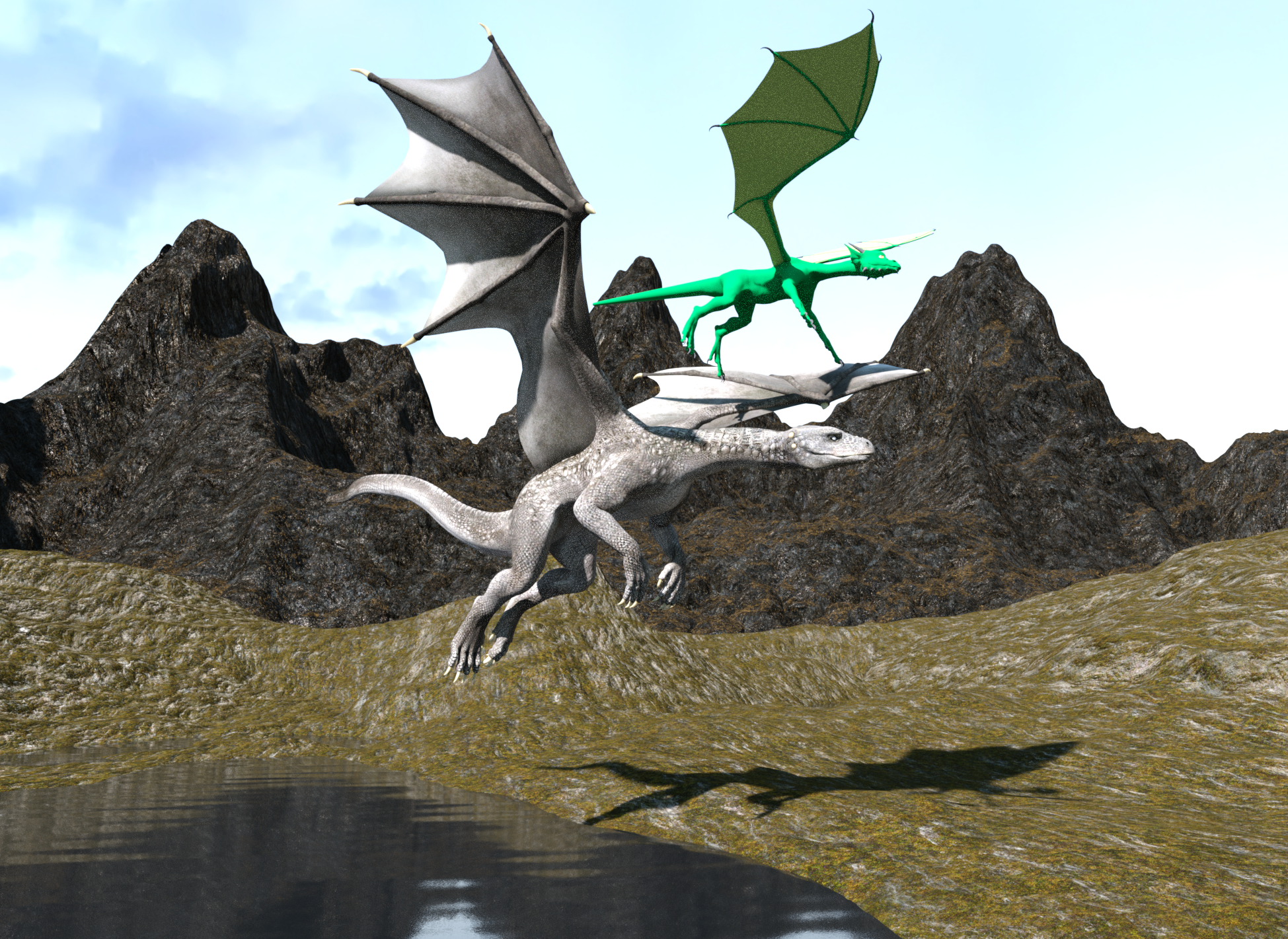
Too many changes are not always good. If you do not know what you are doing, you do not know what combines well with what. And it is worth thinking through what looks good and how. One example is that nonhuman characters need not resemble the demon at the beginning of the article: they might be two dragons. Either could actually be good, but in the case of the two dragons, their different wings and different shaders do not necessarily look very good in the same picture. You need to account for that when composing it too. And image composition can have a major influence on the impression your character makes.
 To cater to more than just fantasy fans, with the next picture we will try to offer a little something to Call of Cthulhu enthusiasts. Again, the picture takes only a few steps, and here I would like to talk briefly about how laziness can sometimes give you an advantage. Specifically, you can stop rendering at a half-finished image and save the result. That is not what we did here: we merely took a screenshot, which could be cropped, and could even have a little film grain, blur, and plenty of other things added. Our story's protagonist is Lisa. I could also say Lisa the cultist. Lisa the cultist, who slipped onto a dangerous path not so long ago, but who will now be the “damsel in distress” in a horror adventure whose rescue is a serious mistake on the characters' part. The source of the distortion could be anything supernatural, or even some radioactivity. My guess is a combination of the two.
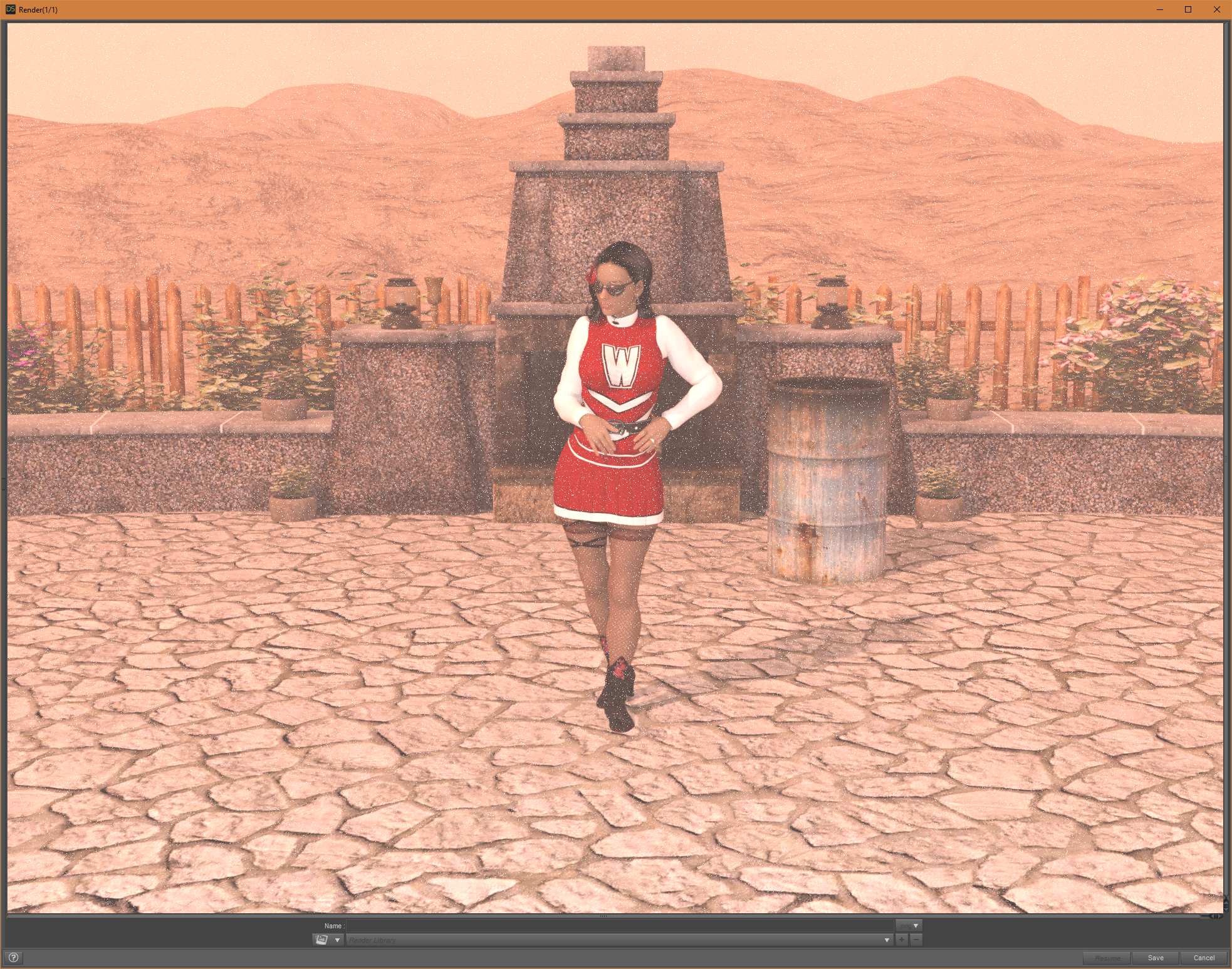
You can be pleased with the visible noise because, for instance, the combination of noise caused by ionizing radiation, the suspicious barrel, and the old chalice on the mantelpiece can establish the atmosphere. Lisa is coming apart ever so slightly. She would not once have worn a belt with an outfit like this, and the slight discord between the little ornament on her thigh and her thigh-high stockings also warns her friends: something has changed. They think Lisa has fallen victim to a cult, and they eagerly tell the player characters so. In reality, Lisa is the leader of the genuinely dangerous cult, which already has a few murders behind it. Drugs opened her mind to the horror looking at us from alien worlds. She sees the signs in the radioactive noise too, which changes her through slow mutations. Sunglasses are now an accessory even in the dark... The eyes are the mirror of the soul, and Lisa does not want to show hers. Whether they have visibly changed can be left to the imagination.
In any case, the wealthy “good girl” from a good family, a member of the elite, progressed from opiate medication after a sports injury to dangerous substances, then, by opening her mind to many things, to the role of a dangerous cult leader. But thanks to feminism, she can only be a victim. She knows perfectly well that indulging her own perversion and encouraging her followers to do the same will help with that too, since who would dare talk about a female ringleader when sexual crimes are involved? The image noise and half-finished render add something to the situation. The finished image will be used in an adventure. Switching between harmony and discord can thus become a tool in creating an image. So can the fact that the render window can effectively be incorporated into the interface seen by the player characters, making the picture a better handout. Win-win.
Making the picture did not require much work. Choosing the Olympia 6 model, the clothing, hair, and sunglasses is trivial, and the outdoor environment is largely built on two foundations: TerraDome 3 supplies the background, while The Backyard provides the foreground. That leaves the barrel from another package and the chalice as a point of interest. A few clicks and another basic pose. Of course placing the chalice does involve adjusting parameters. For the morphs we made her a little younger, with breasts appropriate to that (the Young Breast 1 morph) and Shape Adjust for her youth, but as one of the stronger members of the cheerleading squad, she also received a larger Fitness modifier. The other trick was setting the belt's parameters so that collision detection takes the clothing into account. Of course the woman's hands could have been gently moved a little, and many simple steps were left out. But we have deliberately stuck to the basics so far.
You can drop in a lighting set—that is not too difficult either—and you already have a whole collection of basic tools with which a few clicks and a few values set on sliders let you communicate lots of little details. It is no more complicated than customizing a character's appearance with a few sliders in any computer game. Naturally, over time you can fine-tune the pose by hand. You may also get to the point of copying a tattoo onto the skin with the Layered Image Editor. You can play with lighting too; many outfits require attention to their material zones, and clothing and hair can both be customized.
For now, we have discussed the ideas behind an image, the concept, and the things that are straightforward to do alongside the basic tutorial. The question is whether you can make these conceptual decisions. If you can, clicking through a few basic settings will not be difficult. But since we have not changed much about either the clothing or the characters, and have been talking about filling the content library, this really is only enough to decide whether we want to get into it. If we do, following our next article will let us learn a thing or two about the basics as well. Good luck making your character pictures.