
Improved Attribute Checks
Originally I summarized this change simply: “Instead of rolling d10 under the portion of the attribute above 10, roll 2d10 under the whole attribute. This gives an ordinary person, with an attribute of 10–11, a chance at ordinary attribute checks, and players are less likely to feel that their actually above-average attributes of 12–13 are low. The solution improves the harmony between system and world, and although it weakens poisons and diseases a little, that is no bad thing. It gives an ordinary person a reasonable chance against an ordinary, not-too-serious illness. That was not the case before, and it was hardly heroic that adventurers could fear a cold more than a dozen orcs.”
The wording soon brought disappointment, however, when a university student preparing for a career in computing commented: “But I don't know whether 2d10 is a good solution. Its distribution out of all 55 possible outcomes is:” Honestly, I was surprised that anyone would speak of 55 possible outcomes here. A roleplayer, a university student, a future computing professional, who cared so little about the whole thing that they would not look at the probabilities of a dice roll? As it turned out, they arrived at 55 possible cases by starting from “the order of the dice doesn't matter, after all.” But with 2d10 it also does not matter whether 4 is 2+2, 1+3 or 3+1... In other words, they had not thought through even the basics. That would also make it difficult for them to estimate the chance of a given damage roll killing someone—there are multiple dice there too.
There is little point talking about a natural distribution if the basic mathematical concepts are missing. Roleplaying often spread through the “university geek community,” many of whom could differentiate and integrate as a matter of routine and easily estimate probabilities. Nowadays some say that even calculating percentages is difficult for many people, and that it is hard to distinguish between many probabilities. So I offer you a little table for 2d10. The first column shows the “value” in question. The “combinations” column then tells you how to roll exactly that amount. The “chance” column gives the probability of rolling exactly that amount. And the chance of success gives the probability of rolling that amount or less, making the check successful.
| Value | Combinations | Chance % | Chance of success % |
|---|---|---|---|
| 2 | 1 1 | 1% | 1% |
| 3 | 1 2, 2 1 | 2% | 3% |
| 4 | 1 3, 2 2, 3 1 | 3% | 6% |
| 5 | 1 4, 2 3, 3 2, 4 1 | 4% | 10% |
| 6 | 1 5, 2 4, 3 3, 4 2, 5 1 | 5% | 15% |
| 7 | 1 6, 2 5, 3 4, 4 3, 5 2, 6 1 | 6% | 21% |
| 8 | 1 7, 2 6, 3 5, 4 4, 5 3, 6 2, 7 1 | 7% | 28% |
| 9 | 1 8, 2 7, 3 6, 4 5, 5 4, 6 3, 7 2, 8 1 | 8% | 36% |
| 10 | 1 9, 2 8, 3 7, 4 6, 5 5, 6 4, 7 3, 8 2, 9 1 | 9% | 45% |
| 11 | 1 0, 2 9, 3 8, 4 7, 5 6, 6 5, 7 4, 8 3, 9 2, 0 1 | 10% | 55% |
| 12 | 2 0, 3 9, 4 8, 5 7, 6 6, 7 5, 8 4, 9 3, 0 2 | 9% | 64% |
| 13 | 3 0, 4 9, 5 8, 6 7, 7 6, 8 5, 9 4, 0 3 | 8% | 72% |
| 14 | 4 0, 5 9, 6 8, 7 7, 8 6, 9 5, 0 4 | 7% | 79% |
| 15 | 5 0, 6 9, 7 8, 8 7, 9 6, 0 5 | 6% | 85% |
| 16 | 6 0, 7 9, 8 8, 9 7, 0 6 | 5% | 90% |
| 17 | 7 0, 8 9, 9 8, 0 7 | 4% | 94% |
| 18 | 8 0, 9 9, 0 8 | 3% | 97% |
| 19 | 9 0, 0 9 | 2% | 99% |
| 20 | 0 0 | 1% | 100% |
The table's combinations column draws a nice graph, and yes, as usual with d10 rolls, 0 means 10 here too. This makes the distribution interesting, and if I were considering a M.A.G.U.S. reform, I too would build heavily on 2d10. Not because of the graph on the left, either. Look instead at how the chance of success changes. Now that is a nicer result. Why? You can see the numbers; let us look at a little visualization, and you will soon see why all this matters.
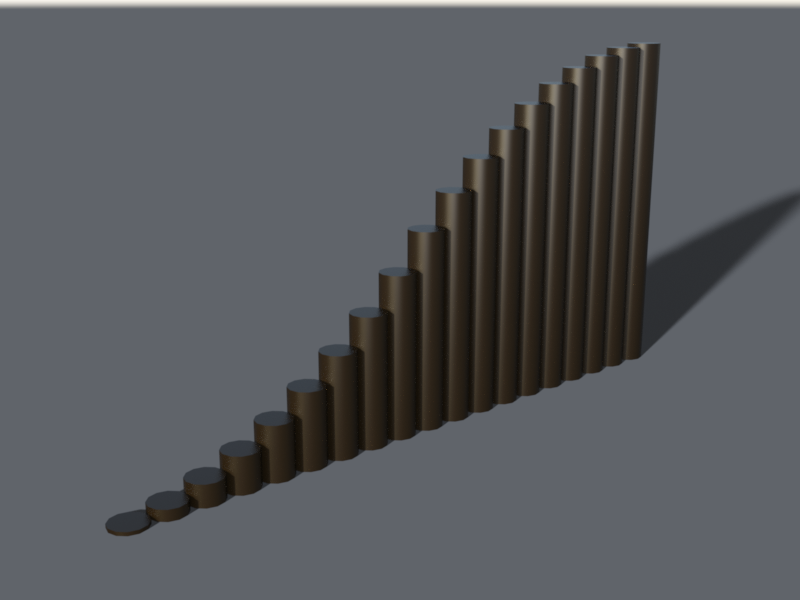 Take a moment to look at the figure and you will see a pleasing curve, one I find particularly elegant in many cases. Above all, the chances initially rise slowly, then quickly, then slowly again. With attribute checks, this solves more than the problem of giving ordinary people a chance... It also means that around the average, you can easily tell who has above-average strength and who is more beautiful than average. That is not difficult.
Likewise, across the other nice big steps, you can tell whom you would guess to have an attribute above 14. But distinguishing extremely high values from one another generally takes a good panel of judges and plenty of experts. The same applies to extremely low values. These steps are natural. Of course, this is also connected to what we see often and what comparisons become ingrained in us, so it is easy to say that the expected picture is natural and has something to do with a natural distribution.
With high values, player characters will of course avoid fumbling around, while low values give them a little more character. But a contest between strong people will no longer be a foregone conclusion: it will be more exciting. I feel that this is an important, beneficial situation. There is often good reason to welcome it, because it improves the game even if high scores make spectacularly incompetent characters rare. The game becomes both more lifelike and exciting.
But there is another consideration, built partly around the dynamics of improvement. Take exercise: initially, someone who previously did little physical activity finds training difficult, so they improve very slowly. Then it gets easier as they become accustomed to training, and finally, as they approach their limits, it becomes harder again. We would expect a similar curve here too. It is a familiar phenomenon.
Of course, this curve can appear not only in this area but elsewhere in advancement too. It is worth considering, and this curve will come up many more times.