
On the previous version of the site, fans were greeted by a top-ten list. But let us ask: why should exactly ten rules matter? And where does a rule end and an interpretation of a rule begin? When are we talking about choosing between several contradictory official rules? When I say that the original core rulebook is my foundation, and that I do not adopt mandatory ÉP loss from the changes in the Első Törvénykönyv, things are not so simple if the Első Törvénykönyv is all you own. In that case, ignoring mandatory ÉP loss would already be a house rule. So should it go in a top-ten list? I think that is a fair question.
As is the question of what happens when I say that elven head-hunters exist—we see them in connection with Krán, for example. There is an official source for that, and in any case anything can be allowed with a suitable backstory. Is it a house rule if I lay down a number of clear conditions for this? Many other solutions, however, are clearly rule changes. So let us begin with the simpler, smaller fixes, ones that are also easy to justify. Primarily by taking a closer look at the rules of the Második Törvénykönyv. Malicious tongues say the book drew rather too much from amateur mailing-list sources and was poorly thought out. But we can decide whether or not to use particular chapters. In other cases, the rules we already use must first be corrected.
Amund Beauty
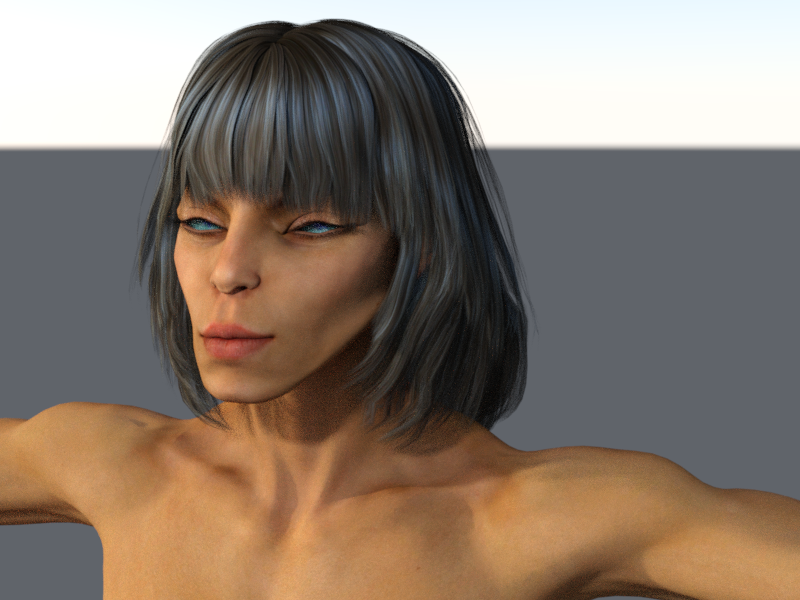
We also know the culture of the amund race: they consciously shape their bodies, and their beauty largely comes from deliberate work rather than innate gifts or talent. Although it is undoubtedly true that well-developed muscles are an important form of male beauty and can make up for many things, it is not the amunds who are also known on Ynev as the “beautiful people.” Amunds feature in many terrifying stories, so their eyes, and thus their alien facial structure, may repel many people. Except girls who specifically go for dangerous “bad boys,” because they are attracted to danger, to the amunds' wickedness and the possibility of taming them. In this situation, high Beauty may indeed be justified in some form. The illustration on page 7 of the Második Törvénykönyv, with its strange eyes, strong jaw and so on, presents an image like this.
But if we say that the face of a woman with a somewhat more powerful build, in keeping with these features, evokes all those horror stories, that its unnatural proportions are strange and may even repel many people, while the character did not receive an amund upbringing and therefore does not know how to make the best use of her gifts, we see a different picture. A player invoking “but she has Beauty 23” for such a “Cruella” can rather spoil the atmosphere. That is, if someone allows her in at all. In cases like these, however, the “killer beauty” is usually the GM's favorite girlfriend, with her appearance modified on the grounds that “her eyes should not be quite so strange, though.” Personally, I would not allow it. Especially not in the role of someone who can do anything, whom everyone must desire, and who must be the center of everything.
Personally, I would adjust the Beauty score to fit the description, rather than start overturning how the world works because of a 23 written down in the spirit of munchkin kindergarten. That makes the large Beauty modifier unjustified. Of course, everyone can decide when to apply a modifier and how large it should be. Some people like developed muscles and many other things, such as the sharp features, projecting face and numerous little details visible in the illustrations. It is true that strong features, a muscular body, “something to hold on to,” scanty clothing and dancing with powerful movements may be attractive in certain cultures. But even together with their cult of the body, that does not necessarily justify a higher racial modifier that also applies to amunds raised outside their culture.
Since amund culture certainly pays attention to beauty, an amund raised among their own people can probably roll Beauty as d6+12, thanks to the local schools, and may often have access to special preparation too. An amund raised outside the culture does not receive this modifier. The modifier in the Második Törvénykönyv would not really be warranted for any amund. And amund beauty is understood within the race. How beautiful members of other races find them, and what situational modifiers they receive as a result, is determined by the observations above.
Make no mistake: seen from a suitable distance, every spectator will call the oiled, muscular body of an amund gladiator walking into an arena beautiful. His hard features and strange, alien, frighteningly cold gaze will have half the city talking about him. His perfect proportions alone will make more people discuss him and more people bet on him than on the reigning champion. This too is a form of beauty. We simply should not try to present someone possessing this form of beauty as an attractive woman too.
And it is also an acceptable general rule that the racial modifier to Beauty may differ by sex. A wier's beauty comes from being full of vitality. An elf is instinctively something of an artist, has a sense of style and, in many respects, also “radiates life.” These are all qualities that may justify a general modifier. But a cult of the body pursuing the ideals of a warlike, cruel people will not make those same qualities the marks of an attractive woman to a human who regards that people as enemies and fears them a little. And +3 is an extremely large modifier... For these reasons I would generally not apply it, though there may be exceptional cases where I would. As for racial maximums, however, I would point out that the Második Törvénykönyv does not address that issue. “Better than human is generally not available, and if possible, let us stay realistic with the character's appearance in mind.”
The Wier Race and Classes
For the wier “race,” the curse only manifests at the end of adolescence. In many cases the character's training is already complete by then, and their thought patterns are identical to a human's. Thus they can learn almost any class. Their personality has been shaped by the school to suit its requirements, so any class is acceptable, although addiction to blood is harder to handle as a martial artist, sword artist or wizard. Nevertheless, they can learn any class. This is more than an example of combinations permitted “with a good backstory” even when marked N. It is much more about the wier not being a true race: they are born human, their children are human, and in most respects they count as human.
The stipulation that a wier does not age when drinking “human blood” also extends to those of kyr blood, other wiers, and “humans of mixed blood,” so I generally consider the blood of any PC race suitable. Even if created magically. Create Food/Drink, the bottomless jug and the wizard's Create Matter can produce blood that halts aging, although such blood contains no ÉP.
Of course, the boundaries between races are interesting from other perspectives too...
Races and Witch Magic
This rule will sound overpowered and like favoritism toward a preferred race, but essentially, for many witch spells I allow the Beauty modifier to be used against more than just members of the same race. When M.A.G.U.S. appeared, only humans could be witches. Since then, wiers have appeared, and several cultures have raised the possibility that elves can be witches after all—and therefore half-elves too. With wiers we already sense that we are not dealing with a true race, but the question is whether we consider half-elves a separate race for this purpose. And what about those of kyr blood, who have since appeared in so many places? Or someone from Krán who might have as little as 1% aquir blood?
I allow the Beauty modifier when the intended victim finds the “witch's race” attractive in general, so the spell can build on an existing foundation of natural attraction. This attraction based on “racial compatibility” does not require rigid boundaries between races; “well, that could work” is enough. The attraction need not be mutual, and it also depends on the individual. Most humans would not be attracted to a wier; nobody there has written the Twilight series yet. A wier, however, is generally attracted to humans and those of kyr blood, and possibly half-elves and elves too. Many call elves the beautiful people, and many are attracted to them... But such attraction is not always mutual.
What matters here is primarily desire, not respect, love and so on. Thus even a racist Toronian, Gorviki or the like who finds members of a despised race attractive for a single encounter—even one unpleasant for the chosen person—may sometimes be vulnerable.
Age and Attribute Modifiers
Although the rolled attributes apply to the character's starting age, modifiers that reduce physical attributes because of age also reduce the racial maximum. A character's starting attributes may not exceed the modified racial maximum. For a character starting in adolescence, at least half a year must pass before they enter young adulthood. In other words, there is no opportunity to powergame on the grounds that “the character's seventeenth birthday is tomorrow,” especially if that would take an attribute above the normal racial maximum.
Even if a player character can rejuvenate themselves, at the start of play they are expected not to be in an “I want to rejuvenate tomorrow” situation, and not to powergame that way either. Indeed, it helps to explain why someone capable of rejuvenation, who would often have had reason to do so, is at an age that already carries substantial modifiers.
Skill Ranks
Basic rank represents the level of a “journeyman” in the world, and master rank that of a master. There is usually an examination and actual training behind this, as well as a title recognized in the world. In the overwhelming majority of cases, it is worth portraying it that way. Characters may also have an annual income appropriate to their level of knowledge. In many cases, however, students, scholars-in-training and cadets studying scholarly skills already have a real income, while many of the more expensive nonmagical skills go beyond a simple trade. Multiple skills complement one another. Managing guilds, schools and other organizations can be learned in the same way as Estate Management, so advancement often depends on three complementary skills. Several factors influence how annual income develops:
| Skill / situation | Annual income | |||
|---|---|---|---|---|
| Saturated market | Average market | Few competitors | Poor market | |
| None - Day laborer, apprentice |
500c | 1g | 2g | 5g |
|
Trade, Basic rank |
1g | 2.5g | 5g | 10g |
|
Trade, Master rank |
2.5g | 5-6g | 10-12g | 20-30g |
|
Trade, Master rank + "Estate Management, Basic" |
5-6g | 10-12g | 20-25g | 30-40g |
|
Scholarship / Art, Basic rank |
5-10g | 10-20g | 20-30g | 20-30g |
| Trade, Master + Estate Management Basic + Related skill at Basic rank - Guild official, etc. |
8-10g | 15-20g | --- | 20-40g |
| Scholarship / Art, Master rank - Scholar, judge, officer |
20-25g | 30-50g | --- | 60-100g |
|
Trade, Master + Estate Management Master + Related skill at Basic rank |
50-100g | 100-200g | --- | --- |
| Trade, Master + Estate Management Master + Related skill at Master rank - Better-known masters |
--- | --- | 150-300g | --- |
| Several Master ranks / Exceptional talent + Master, etc. - Famous masters |
--- | --- | 250g+ | --- |
For the table above, I used the official annual incomes of day laborers, master craftsmen, townspeople, merchants, scholars and guildmasters as my starting point. Fewer competitors often mean not only higher prices but also fewer customers. A master blacksmith with a workshop of their own can easily supplement its income in a saturated market (2.5–3.5 gold) by training beyond ordinary smithing to become a more specialized weaponsmith. Although the income from their own work initially falls to 2 gold, the lack of competitors starts bringing in ringing gold coins as soon as they acquire the title of journeyman weaponsmith. Their annual income can then be another 5 gold on top of the workshop's 2.5–3.5 gold profit, for a total of around 8 gold instead of the previous 5–6.
When they are made a master, they have a choice. They can earn 10–12 in their own workshop, or even 20–25 gold if there are still no competitors. Or they can stay where they learned weaponsmithing: with few competitors and the workshop's reputation, they can earn just as much, on top of the profit from their own workshop. Or they can learn to work a more exotic material. Supply is so scarce here that their income does not fall even as an apprentice abbith smith. As a journeyman, they profit handsomely from their knowledge...
Ranks and Percentages
Since the Második Törvénykönyv, Basic rank corresponds to 50% and Master rank to 90%. The knowledge described under Basic and Master ranks is reliable knowledge. Checks matter for tasks more difficult than the reliable knowledge described in the skill—for example, when something else complicates the check, or when you must compete with someone. But if both ranks already have percentage values, why should advancement not happen one percentage point at a time? For a given skill, Basic rank (a journeyman's knowledge) and Master rank (a master's knowledge) usually have different difficulties. Dividing Basic rank's 50% by its KP cost tells us how many percentage points one KP buys up to Basic rank. Then dividing Master rank's extra 40% by the additional KP required tells us how many percentage points one KP buys at that stage. Advancement can thus happen one skill point at a time too.
For tasks representing reliable knowledge at Basic rank, you can generally roll with a +50 modifier, while reliable knowledge at Master rank receives +10. Advancement beyond Master rank can grant 3% per KP, as with most percentage-based skills.
Although Basic rank generally means 50%, in languages this applies to Basic rank 5; lower skill levels are worth proportionately smaller percentages. We can also say that one KP is worth 10% up to Basic rank here. For understanding an ordinary conversation between native speakers, however, it is better to multiply the character's skill by 2 rather than use a fixed +50% modifier. Particularly simple, clearly articulated speech, for which Basic rank 2 is sufficient, can even mean a multiplier of 4.
Skills and XP
When a character acquires a skill, the XP received for the experience gained through studying should generally provide enough KP to take that skill. In this case, XP can automatically be converted into KP, addressing both advancement that stalls without a level increase and the problem of lacking enough KP for what has been learned. However, this largely applies to actual study. Much other knowledge becomes part of what XP represents rather than part of skills, so not every piece of knowledge learned or tried out can immediately be converted into KP and a skill.
Improved Attribute Checks
Originally I summarized this change simply: “Instead of rolling d10 under the portion of the attribute above 10, roll 2d10 under the whole attribute. This gives an ordinary person, with an attribute of 10–11, a chance at ordinary attribute checks, and players are less likely to feel that their actually above-average attributes of 12–13 are low. The solution improves the harmony between system and world, and although it weakens poisons and diseases a little, that is no bad thing. It gives an ordinary person a reasonable chance against an ordinary, not-too-serious illness. That was not the case before, and it was hardly heroic that adventurers could fear a cold more than a dozen orcs.”
The wording soon brought disappointment, however, when a university student preparing for a career in computing commented: “But I don't know whether 2d10 is a good solution. Its distribution out of all 55 possible outcomes is:” Honestly, I was surprised that anyone would speak of 55 possible outcomes here. A roleplayer, a university student, a future computing professional, who cared so little about the whole thing that they would not look at the probabilities of a dice roll? As it turned out, they arrived at 55 possible cases by starting from “the order of the dice doesn't matter, after all.” But with 2d10 it also does not matter whether 4 is 2+2, 1+3 or 3+1... In other words, they had not thought through even the basics. That would also make it difficult for them to estimate the chance of a given damage roll killing someone—there are multiple dice there too.
There is little point talking about a natural distribution if the basic mathematical concepts are missing. Roleplaying often spread through the “university geek community,” many of whom could differentiate and integrate as a matter of routine and easily estimate probabilities. Nowadays some say that even calculating percentages is difficult for many people, and that it is hard to distinguish between many probabilities. So I offer you a little table for 2d10. The first column shows the “value” in question. The “combinations” column then tells you how to roll exactly that amount. The “chance” column gives the probability of rolling exactly that amount. And the chance of success gives the probability of rolling that amount or less, making the check successful.
| Value | Combinations | Chance % | Chance of success % |
|---|---|---|---|
| 2 | 1 1 | 1% | 1% |
| 3 | 1 2, 2 1 | 2% | 3% |
| 4 | 1 3, 2 2, 3 1 | 3% | 6% |
| 5 | 1 4, 2 3, 3 2, 4 1 | 4% | 10% |
| 6 | 1 5, 2 4, 3 3, 4 2, 5 1 | 5% | 15% |
| 7 | 1 6, 2 5, 3 4, 4 3, 5 2, 6 1 | 6% | 21% |
| 8 | 1 7, 2 6, 3 5, 4 4, 5 3, 6 2, 7 1 | 7% | 28% |
| 9 | 1 8, 2 7, 3 6, 4 5, 5 4, 6 3, 7 2, 8 1 | 8% | 36% |
| 10 | 1 9, 2 8, 3 7, 4 6, 5 5, 6 4, 7 3, 8 2, 9 1 | 9% | 45% |
| 11 | 1 0, 2 9, 3 8, 4 7, 5 6, 6 5, 7 4, 8 3, 9 2, 0 1 | 10% | 55% |
| 12 | 2 0, 3 9, 4 8, 5 7, 6 6, 7 5, 8 4, 9 3, 0 2 | 9% | 64% |
| 13 | 3 0, 4 9, 5 8, 6 7, 7 6, 8 5, 9 4, 0 3 | 8% | 72% |
| 14 | 4 0, 5 9, 6 8, 7 7, 8 6, 9 5, 0 4 | 7% | 79% |
| 15 | 5 0, 6 9, 7 8, 8 7, 9 6, 0 5 | 6% | 85% |
| 16 | 6 0, 7 9, 8 8, 9 7, 0 6 | 5% | 90% |
| 17 | 7 0, 8 9, 9 8, 0 7 | 4% | 94% |
| 18 | 8 0, 9 9, 0 8 | 3% | 97% |
| 19 | 9 0, 0 9 | 2% | 99% |
| 20 | 0 0 | 1% | 100% |
The table's combinations column draws a nice graph, and yes, as usual with d10 rolls, 0 means 10 here too. This makes the distribution interesting, and if I were considering a M.A.G.U.S. reform, I too would build heavily on 2d10. Not because of the graph on the left, either. Look instead at how the chance of success changes. Now that is a nicer result. Why? You can see the numbers; let us look at a little visualization, and you will soon see why all this matters.
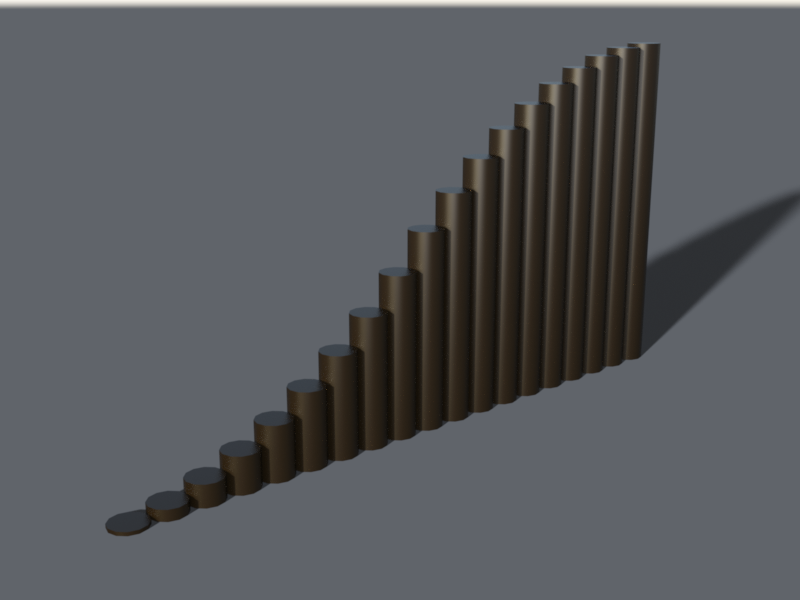 Take a moment to look at the figure and you will see a pleasing curve, one I find particularly elegant in many cases. Above all, the chances initially rise slowly, then quickly, then slowly again. With attribute checks, this solves more than the problem of giving ordinary people a chance... It also means that around the average, you can easily tell who has above-average strength and who is more beautiful than average. That is not difficult.
Likewise, across the other nice big steps, you can tell whom you would guess to have an attribute above 14. But distinguishing extremely high values from one another generally takes a good panel of judges and plenty of experts. The same applies to extremely low values. These steps are natural. Of course, this is also connected to what we see often and what comparisons become ingrained in us, so it is easy to say that the expected picture is natural and has something to do with a natural distribution.
With high values, player characters will of course avoid fumbling around, while low values give them a little more character. But a contest between strong people will no longer be a foregone conclusion: it will be more exciting. I feel that this is an important, beneficial situation. There is often good reason to welcome it, because it improves the game even if high scores make spectacularly incompetent characters rare. The game becomes both more lifelike and exciting.
But there is another consideration, built partly around the dynamics of improvement. Take exercise: initially, someone who previously did little physical activity finds training difficult, so they improve very slowly. Then it gets easier as they become accustomed to training, and finally, as they approach their limits, it becomes harder again. We would expect a similar curve here too. It is a familiar phenomenon.
Of course, this curve can appear not only in this area but elsewhere in advancement too. It is worth considering, and this curve will come up many more times.