
We often hear that a man cannot believably play a female character, or a woman a male character. Of course, centuries-old characters, other species, completely alien cultures, and the different ways of thinking they entail do not usually cause problems. Many of the complainers also approach believable roleplaying quite simply: they are not really willing to deal with it. Indeed, they are positively bothered when someone else wants to, branding it nitpicking, unnecessary rules-lawyering, slowing down the game, or—with ears firmly blocked—meaningless nonsense. Then the personal attacks can continue elsewhere too. So does believable roleplaying matter? And to what extent can the system solve these problems or cause them? Let us establish an order of priorities. The beginning is simple: players play to enjoy themselves. Their own entertainment and opportunities to play therefore matter. They expect plenty of enjoyment from the time and money invested, and preferably relatively few unnecessary obstacles and difficulties.
The problem begins with the fact that many tasks, obstacles, and difficulties are not unnecessary. Extra work makes things easier for others and adds to their enjoyment. Other personal requirements may enter the list too—a detailed, lifelike character, a life-spanning campaign, a desire to improve—along with many other considerations, such as taste and preferred play style. Ranking these is no longer so simple. We only know that if the game offered no enjoyment, the player would not play. Individual enjoyment therefore sits at one end of the priorities, and meeting criteria irrelevant to that group at the other. If a group accepts one character being another's master, with a substantial level difference, nobody will invest work in balancing the classes, for example. Likewise, where no characters differ in gender from their players, little extra work goes into the steps needed to handle that.
Who is the character?
For a character to be more than Peti's assassin or Klári's Ventrue—to be a real, living person in the world imagined by every group member—everyone has to put work into the game. They need to get to know the character, requiring much information to be both shared and absorbed. Usually, a person involves more information than is easy to keep in mind at once. There is a harder obstacle already. You can work on it and adapt, or say the other person's character is the obstacle. The same happens if that character deals with a problem that does not obstruct our own play, or raises questions the player or GM is not prepared for. In most cases, neither the adventure nor many GMs are prepared for a player character whose gender is unusual in that setting. But let us return briefly to handling questions outside the comfort zone.
“Is the system's odd behavior the reason... Or is that NPC not who they claim to be after all?”
Well, not like the ordinary World of Darkness fan who has commented in more than one place solely to make personal attacks. He has few on-topic arguments. It is simple: his favorite game is lousy at the system level. Average professional expertise would modify the probability of success by the same amount for an industrial rope-access worker—where the minimum is a roughly 100% chance even with bad equipment and in stressful, difficult conditions, such as unexpected wind or a slippery surface, where an ordinary person has no chance—and in a profession where the average specialist will usually not get every subtask right. Far from it... Police work, for instance. The problem is that after an unrealistically bungled attempt, neither player nor character could tell whether the system's odd behavior caused it, or whether that NPC is not who they claim to be because they are abnormally incompetent or professional. That would be a basic requirement for investigation and realistic roleplaying. Not a “hat on, hat off” double bind: other books provide examples for the system, so anyone mentioning this flaw is an idiot... And anyone bringing in those other books to show the scale is wrong is an idiot too. Few reference points are needed because the game is based on the real world... Yet totally unrealistic outcomes are fine because it very much is not the real world. He and his group also create characters solely by distributing points, approaching them through the system, because that works for them. But it leaves many details, supports, and reference points missing.
However much he says he is a roleplayer and plays well, the question arises: how would he respond well to a sketchy, incompletely described NPC? Is that character also poorly portrayed because of gender, impossible to respond to, and destructive of roleplaying? I feel the roots of the problem have far less to do with the character's gender. If these same players said they enjoy computer-RPG-style adventuring with the GM leading them, there would be no problem. It would be easy to note that they give certain issues little emphasis and value the adventure and gameplay more... They have no intention of imagining that the character is completely different from the player. Who the hell cares what chance an industrial rope-access worker or police officer would have if the adventure is not about that? And if skills give the same advantage for the same points, nobody quickly becomes dominant. Seeing and knowing the player brings two or three character templates to mind; the character does not surprise you, upset the tactics, or overturn the GM's plans. The walls that are insurmountable software limits in a computer RPG merely mean here that the group trusts you not to overturn everyone's plans for the adventure. These groups consider themselves genuine, good roleplayers. The idiot is whoever notices the flaws and wants a system tuned toward greater realism.
Familiar good and bad solutions
LARP is also an ideal solution for the situation above. It really is easier there to start from what you see. The question of what works differently in another world does not arise. It is simple, quick, and builds on tradition. It is easy to say this is how I know it, this is how I understand it was, so as an authority I expect it to be this way. Much easier than accounting, in the development of armor in a fantasy world, for the influence of ogres, fireballs, or anything else. If we say “the strength of the creative will behind the weapon and the armor clash,” and work with ideas, armor designs expressing and focusing creative will can vary widely. Ornate, shapely armor with a strong idea behind it, perhaps covering less, might work perfectly in that world... But a padded sword's tip catches on the ornaments rather than sliding off, making the armor less effective. Conventional is better. Better to use what rests on the knowledge of scholars who sometimes recommended smearing wounds with dog excrement. But historically, in that era, that was how it worked. There is little to argue over then.
“Originally, D&D was a ‘roleplaying wargame’ too.”
LARP, computer RPGs, and often MMOs provide excellent tools for this. And yes, D&D was originally a “roleplaying wargame,” where believable character portrayal was not the goal either. If somebody enjoys that, they have every right to; there is no point arguing over taste. With luck they find a style meeting their needs. The problem is that players want more groups and players, giving them an interest in presenting their game as better than it is. Many then decide their favorite game is also good for other needs, for games and stories requiring believable probabilities. Anyone wanting to roleplay is the idiot. An exclusionary Nazi attitude follows toward many other roleplayers... Yes, on Facebook they even say a general roleplaying page that has supported every style until now is not about the sort of roleplaying the other person seeks. Yet many forum roleplayers develop their characters, roleplay, and so on, and could learn to love tabletop play in a conscientious group.
We understand the root of the problem too. It begins fundamentally with systems often wanting to restrict rather than support. Little workable balance has come from this, because designers cannot foresee how often each ability will be needed, what will matter, or when circumstances will make something more advantageous than usual. But we can choose. Either being good in different areas offers different advantages, with many skills handled differently, making the system slower and more complex; or some professions require far more points than others. Moreover, professions requiring more expertise also demand better aptitudes because of training requirements and the nature of the work. Either we loosen the point system or many things will not fit. Most systems have gradually maneuvered themselves into this error.
There are essentially two solutions. One is simple: relax the limits on the basis that “you can create a novice in one profession but a professional in another.” That makes problematic powergamer characters very easy to create, though. Skill levels can be calibrated nicely for many things. The other option is for the system to stop restricting and instead provide reference points. Without limits, nobody can calculate “the most overpowered character fitting within those limits.” Overpowered characters are at a disadvantage rather than an advantage in the longer term. Characters can solve their intended tasks without powergaming; what matters is how. Choosing the method is not about optimization, defeating an encounter, or frantic tactics, but roleplaying. Someone focusing on excessively grand things rather than development here undermines their own character's growth and makes their own game boring. It does not matter whether we favor “safety rails,” with the GM providing a solution in advance, or a sandbox where the group and characters choose goals for which they can also produce solutions.
Experiences
I have had the pleasure of seeing someone play their favorite dzsenn wizard in M.A.G.U.S. You may not know what a dzsenn wizard is if you have never dealt with M.A.G.U.S. But thinking about the starting level along the lines above and toward an available solution, you quickly recognize that an ordinary person probably will not be well protected against magical influence. A cult attempting dark things, concerned with protecting secrets and capable of countering mind reading, is a harder target for a character who knows how to read thoughts and memories. They learn the balance of power, develop, and more and more details fall into place.
We ran a few trials. There are chat games, virtual tabletops, and many other ways to play. We examined feedback on “how well X portrayed a female or male character.” The trick was that the other characters' players did not know the player's gender. Either there was no microphone, somebody relayed the words, or sometimes we used forum play. We checked whether a woman whose fellow players believed her to be a man received feedback judging her female character more believable than when a man played one. Then the same player played a male character, and we checked whether that character was considered believable. Here she was playing a character of the opposite gender. Then, in a group that knew she was a woman, we checked whether the female character she had previously played was believable. A few dozen games like this... And a few dozen with the genders reversed.
Six scenarios. We watched whether the real issue was playing a character of the opposite gender, or fellow players believing or knowing that this was happening. Obviously, most portrayals were not entirely believable, since knowledge could also be missing. But that was not primarily because the character's and player's genders differed. Many other shortcomings were easy to spot. Yet when a woman played a female character but the players thought a man was playing, the prevailing opinion was that the player had not portrayed the character's gender well. There was no problem with that same player's male characters. A male player believed to be a woman produced similar results in chat, virtual tabletop, and comparable games.
A conclusion?
The likely reason: a lifelike character would not conform entirely to gender stereotypes, while one that does is “one-dimensional and unrealistic.” For most such characters, neither the situation nor the solution is that simple. Gender generally matters to a player when they want more than a few words to describe the character, have more ideas, have researched and thought more, and are not frightened of putting in work to make a living character: someone whose gender, past, and personality matter more than game statistics. Think about it even a little and we must quickly recognize that two opposing expectations—do not be a stereotype, yet conform to all of it—cannot be met simultaneously. If no truly good solution exists, it is easier to complain about someone playing the opposite gender than recognize that this may be the most lifelike character in the group and ask everyone to adapt.
“The player sees only the character's gender.”
In many forum RPGs, players see only the character's gender, and this problem rarely arises. Believability is not primarily examined through gender either. Many complain that “you cannot avoid another player's character trying to get yours into bed”: a female player's female character pursuing a male player's male character. Honestly, if someone offered that as an example of portraying women around a tabletop, the accusation would soon come: that is not a woman, it is a whore. Sorry, but many characters can be both. There is another option too: she tries so hard because few people make a move on her. Imagine the following characters for a moment:
 A twenty-three-year-old blonde who often wears a shirt reading “This is what an anti-feminist looks like.” Associating her with many family-oriented anti-feminists, people may assume she wants a family, not just dates. That, and her frequent willingness to initiate and make advances, makes her somewhat intimidating to many. But her anti-feminism does not come from pushing a traditional family model. She is simply tired of complaints that “this or that objectifies women,” when she thinks many girls choose those condemned roles themselves. As a gamer, she is particularly annoyed that roles in games, modeling for them, and so on often make the list too. Her views are strong enough to make finding friends difficult, further complicating meeting people. She says “There are few female bosses at tech companies because few girls start tech companies,” but she is an exception: she has her own company, where the guys will not hit on the boss. She has little time to party, so meeting people elsewhere is hard too. Still, she wants company and tries. Like so many geeks, she comes on strongest when it frightens a potential partner instead of succeeding, and so on. However proactive she is, she would not agree to a conventional one-night stand...
A successful thirty-five-year-old lawyer. She is much closer to the feminist side, and not by accident. She is precisely the example that makes many girls say feminism has become extreme and seek equality as egalitarians. This narcissistic “Ms. Perfect” thinks that whenever she does not get something, others, usually men, are to blame. She is prejudiced and generalizes. Though she also speaks out against racism, that holds only until her own surroundings are involved; there, the underlying racism shows. Maintaining a perfect appearance matters to her. This attitude has driven everyone away. She has never had a boyfriend. She talks about the glass ceiling while being the youngest partner at her law firm, but wants to rise further. In divorce cases she is often a champion of aggressive pursuit of women's interests, frequently resorting to dirty methods. Some cases involve means bordering on false accusation. Though careful not to expose herself to attack, she apparently considers this acceptable, so many around her distrust her. Unscrupulous, she directly pursues whatever she wants. She naturally has “every right” to do things for which she would report a man for sexual harassment. Until now she has not missed boys or men, but she is beginning to worry that this way she will never become a mother... Let us say she does not want to “die a virgin old maid,” and pushes so hard that she mostly frightens the men she has chosen. And if they reject her afterward? That is men's fault too...
Now find a female stalker in a relevant Investigation Discovery series... There is more than one pushy girl who would make advances without being a whore. A one-word verdict on such characters is no good. Their conflicts, decisions about values, and motivations are adult subjects not because of sex, but because, for example, the lawyer's relationship with passing time and health is not necessarily something younger people would understand. Both also show that a character's gender matters not only for sex but can determine many other details of play. I would venture that the difference between these women is greater than between, say, a masculine “butch dyke” truck driver and her male colleague. Gender is not the greatest or hardest-to-bridge difference between characters.
If there are NPCs...
But the story does not end here. The next point is chiefly that roughly half of all non-player characters are of the opposite gender to the GM. If you accept that there, and the portrayal is good enough for your character to engage in anything... Or is the truth that your character does not see half the world and hangs in midair? Then the flaw would not lie with the other player's character. And the group may not actually want realism in every respect. Some aspects of realism have to be deliberately discarded; in other cases, many aspects of realism are simply never reached.
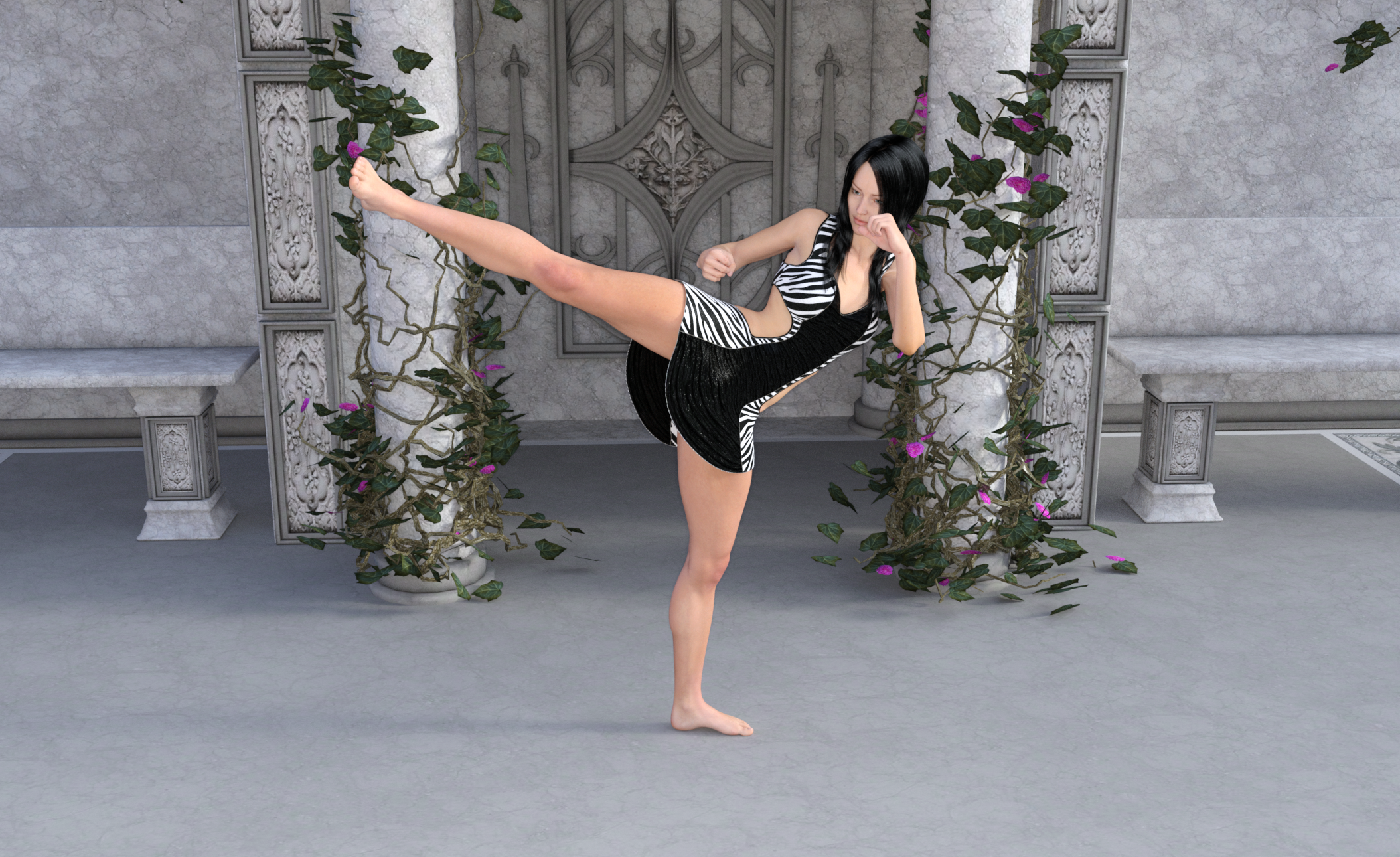
Look at a historical period and it soon becomes clear that gender roles can vary between periods and regions. Looking left may remind you that today it is normal for girls to practice combat sports and martial arts, but also that many instructors say they cannot overcome their innate disadvantages. Many girls consequently feel vulnerable, affecting their behavior and social role. Kima from The Wire is a brilliant example of this kind of role for a female character; she even explains why she thinks good female cops are rare.
Let us ask whether this was always the case. Whether a martial art originally practiced by women or particular female soldiers in the Parthian Empire, they were often fearsome and effective, and their experiences told them so—not that they had no chance against three large men on the street. Different experiences shape them differently, affecting thought and behavior. The other extreme? Certain Islamic states, where they must even give thanks for their vulnerable position. Or some tribal cultures where female genital mutilation occurs.
On these questions, we depart from reality, whether present-day or that of the period, primarily because we want every player to enjoy themselves and want to create a particular situation for player characters, so we distort things within limits. Suspension of disbelief can accommodate that much deliberate unreality. Different goals... But many people believe much of their own experience is universal. For a long time, pink was a masculine color and blue more feminine. Then the trend reversed. What, nevertheless, would the reaction be to a male character dressed in pink?
The question immediately arises: how much do we gain from pink? That accuracy would have value for very few people, while making it harder for most to know how to respond to particular issues. We depart from accuracy and realism. It is an obstacle. Expected and ideal accuracy and resolution also matter in play... We have seen very boyish girls, and Italian male fashion designers whose daily schedules and makeup collections would make you think of women instead. The variation is enormous. Allowing for that variation and the imprecision customary in play, most attempts fit. As NPCs, and for the same reason as PCs too.
Elsewhere, the problem is different...
In my opinion, most people in forum roleplaying games do not necessarily know the gender of the player behind an advertised character. It does not automatically emerge who registered that long-sought character, and players have no incentive to nitpick. The problems above therefore arise in FRPGs not around acceptance, but because there are far more female players, most do not want to create male characters, and male characters are consequently scarce. Remember that a particular feature of FRPGs is that most of our character's relationships must also be player characters, requiring a suitable player. The lack of appropriate relationships is therefore the greater problem. It is no accident that the community does not nitpick on this point.