
Sorry, but some mathematics is coming. And this is not only about dice. Simply because 3d6 as a way of rolling an ordinary person's attributes is a little odd. Initially it seems reasonable enough. Then we realize that a village of just under five hundred would generally contain two people with Strength 18, and another six with 17. If a character has ten attributes, the chance of all of them being below 14 would be around 17%. Player characters who want to stand out from the crowd could use better attributes than that. Inevitably we move somewhat toward powergaming. A knight who would ordinarily fall outside the ten strongest people even in such a small village is not necessarily a dream character.
A player reasonably decides 14 is not necessarily enough. In a village of five hundred, eighty-one people are generally at least that strong. The character would not win many arm-wrestling contests. If a player character wants to stand out in this environment, they must seek values granting substantial advantages. They powergame because they want to be just a little better than an ordinary person. And it is rather funny when someone in a Facebook debate is surprised I do not raise ordinary people to player-character levels. If I did, players would want to stand out from those ordinary people. They could only do so by exceeding that raised level, the party's average strength. Combined with more XP and rapid advancement from stronger opponents, this soon leads to the level-47 necromancer munchkin.
We began assembling the ÚTK NPC example collection. One of the biggest obstacles was the 125 distributable points. Why 125? Because we asked. Had we not asked, we would have said that for races of this level, 135 was the rules-compliant solution. With the average around 10—9 to 11—ten attributes make an “all average” character cost 100 points. The remaining twenty-five, distributed as 8+8+5+4, produce two 18s, a 15, and a 14. Does that fit the desire that “this is fantasy, so most supporting characters should stand out in something too”? We soon decided the young man's father owned the inn; by the time he becomes innkeeper, age will impose a five-point deduction. Is it surprising that someone wanting to stand out a little from this starts powergaming? Or, when the system constrains them, that they examine their remaining options?
Only Three Attributes at 18...
Distributing 135 points could produce three 18s, a 17, and a 14. For an innkeeper, peasant, or waitress, say. The result? Many players will powergame. Many people see this as a problem. They try to remedy powergaming at events through the system. Its numerous restrictions force people to abandon many character concepts, iconic abilities seen in novels, and much else. Many players lose their motivation to use that system, while the powergamer receives a small challenge: opponents face the same restrictions, and they will find another loophole. D&D fourth edition was locked down so successfully that many forums questioned whether it was still a roleplaying game, yet powergaming continued. Instead, powergaming eventually makes higher attributes widespread; when we choose only among these, the system's resolution shrinks.
What happens if we reverse the situation? If characters do not need outrageous abilities to stand out? If we assume characters choose tasks they can accomplish with considerable confidence, so players gain almost nothing from powergaming, earn approximately zero points for it at events and competitions, and elsewhere the group decides whether it wants to play with the powergamer... If, alongside all this, boundaries are loose and many colorful, interesting characters exist? And if the system's reward mechanism favors good roleplaying and development instead of characters who start out overpowered? I think much of the problem is then solved.
But this requires good reference points for attributes, and both players and game masters need sound guidance for human-scale attributes. It is easy here to discuss standard deviation and median alongside the mean. Why distinguish median from mean? Because selection may affect them differently. Suppose roughly 23–26% of people had Health 10: the median would remain 10 if, say, 27% were below 10, 24% at 10, and 49% above it. It would remain so in the reverse situation too. Yet different attributes would make someone stand out. Suppose the mean expected attribute at birth were 10... But far more people with attributes below 10 died in war or of disease... We can then suspect that truly low Health will be very rare. The mean will exceed the median. Evolution, however, may raise both together over the long term.
In a darker world where people with excessive natural gifts are likely to be executed because they could threaten the ruler? The reverse situation could arise. Clarifying this is therefore part of the world description, not a core system. Standard deviation helps determine what proportion of characters have above-average values. What if, instead of the roughly 3 standard deviation seen with 3d6, we seek around 1.5, assuming a normal distribution? Then a village of five hundred would generally contain about six people—5.85—with Strength 14 or higher. Strength 16, however, would suffice for the title of strongest person in a small town of eight thousand.
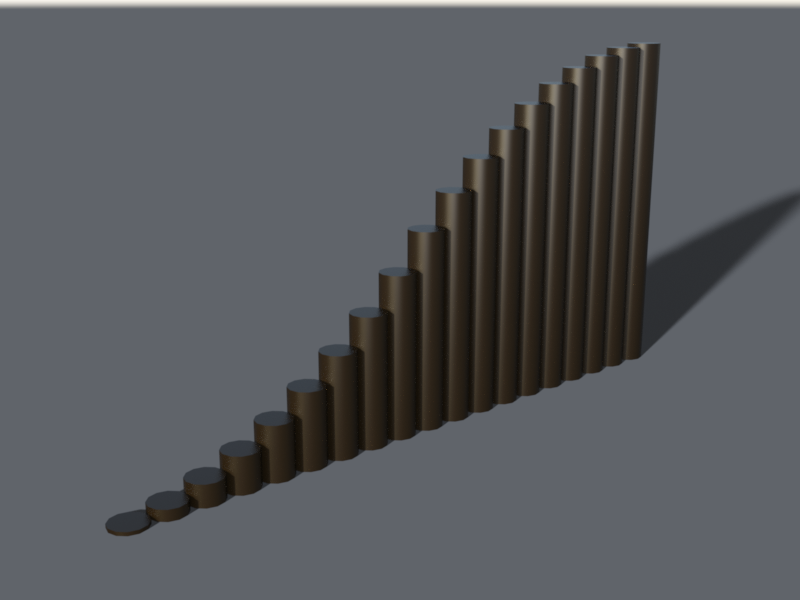 But if selection raises the mean by 0.5–1 point while the median stays... Then many NPCs could stand out a little. All right, “everyone stands out” is impossible, since nobody would stand out, but generally everyone would be talented to some extent. Instead of natural selection or Spartan methods, divine will, the world's fantasy nature, and so forth can produce similar effects. If you also accept one or two attributes of 9 for many supporting characters—hardly something striking—and distribute, say, 105 points rather than 125, or at most 110, interesting NPCs are still possible. Using more of the attribute scale immediately lets you emphasize differences between NPCs better. But look a little to the left! This odd little graph appeared in an earlier article. There we discussed attribute checks too. And the importance of having a reasonable chance on many checks even with the declared average attribute of 10. Partly because players will not accept complete hopelessness on many realistically achievable tasks. They will begin longing for far-above-average attributes that grant bonuses, developing their characters to remedy the problem; and if their attributes are “bland and hopeless” too, they will stand out with some ancient-magic race, overpowered class, or school hunted down online.
Abandoning rolls under only the portion above 10 and using the full attribute increases the system's resolution and solves numerous problems. But what should we roll? Some point to a twenty-sided die, which must be bought. An immediate alternative is rolling two ten-sided dice. The chart shows the chance of success. What if we roll 3d6 under the attribute? Again, the difference is standard deviation. Also, if the combat system and percentage skills did not require ten-sided dice... But they do. This change in standard deviation would make each single-point attribute difference much more pronounced.
That can be decided too. As can how much influence chance receives versus reliable knowledge. Or why so many players are attached to ten-sided dice. But let us accept that we have a good solution for attribute checks, perhaps the proposed one. All that remains is deciding how common an attribute of 13 or 17 should be in the world. How should these frequencies be understood at all? And surely nobody will be surprised when I say illustrating them is an even greater problem. We will return to that too.
Remember the odd little graph on the previous page? There is a reason I am not merely showing an ordinary Excel chart. And not just because individual columns being tangible objects “looks good.” It is ideal for our illustration, and you will soon understand why. See the leftmost column? How would you describe it as an object when GMing? Probably the word thin, rather than short, would occur to you. That is generally how people work. That represents 1%. Your chance of being the strongest person in a village of five hundred is 0.2%. That needs a column five times thinner, almost paper-thin. Becoming a wizard when there is, say, barely one per ten thousand people? Twenty times thinner again. Discussing such frequencies and pointing to a similar diagram could easily produce some amusing comments.
A Column? What Fucking Column? That Is Thin Even for a Coin...
You do not want to know how often I have encountered that even for 0.5%. Yet here we were discussing 0.2% for a little village of five hundred. For a village of two thousand, even 0.05% would arise. Strength 16 would be around 0.0112%. You could not distinguish these on a chart like this, could you? But take a small town of eight or nine thousand. To illustrate Strength 16, I would put one person in the main square: the captain of the guard, say. A true mountain of muscle. You would look and think, yes, he is the one few people in town challenge to arm-wrestling. For Strength 15 in the same town, I would show a group of ten. Soldiers, craftsmen... Even a large woman holding a rolling pin could belong. You could say she is the smith's daughter, with a fine inheritance: rare, but plausible. We are still below 0.1%. Strength 14? You would see around seventy to seventy-five people. Here I would make room for diversity. And that is the 1% represented by the thin little coin in the previous page's chart.
Know what is interesting? Starting from modern warfare, I would remember that BTR-80 personnel carriers carry eight-man squads. This could be two platoons, say. There are seventy-five-person companies too. Most fantasy worlds work similarly. On Ynev too, we could easily speak of two or three platoons, or a company. You understand this is a different scale from the captain of a town guard, right? And we are only now approaching the level many would say is not a column, but thin even for a coin. An attribute of 14 is roughly the level at which someone could join Mensa. There is a reason we consider it rare. Look at the third column on the previous page. You would think short rather than thick. That is 6%. You would not call that common either. To reach it, add everyone with the relevant attribute at 13 to all those already counted. There are about 315 of them. And almost a hundred of the best among those with 12.
That not-very-tall column means this many people in such a small town. Know the nice thing? Strength 13 already makes you stand out in a village. All right, four or five members of the smith's family have 14. All right, quite a few other people have similar strength. But suppose I say he is among the handful of strongest farm lads his age, attracting the girls' attention and gaining a pretty fiancée, some respect, and a reputation... It no longer seems so bad. Others will be among the most dexterous, cleverest, and so on. “If everyone stood out, the bar would simply rise, and ultimately nobody would stand out.” That is easy to recognize. And 13 is already good for this. Even with no attribute of 9 or lower, and perhaps a related 12, ten attributes still require only 105 distributable points.
Standing out in a town is considerably harder. But the situation differs anyway, since towns attract “specialists”... There are neighborhoods, and one needs to stand out within a smaller environment. Sometimes through skills, sometimes attributes, with “everyone good at something different” within that circle. Standing out remains possible. The opportunity exists. Counting ten attributes? Fine. Add that people can stand out through wealth, particular skills, and so forth. We discussed the “short rather than thick” column: remember, that was 6%. Not very common. A randomly selected person has a 94% chance of not belonging to the strongest 6%. You would readily bet on that. But on their not belonging to the top group in any of twelve independent characteristics—attributes, wealth, title, connections, luck, something about training? Those odds are already worse than a coin toss.
Some would say standard deviation differs between attributes: seemingly extreme values occur more often in some and less often in others. They might distinguish traditional M.A.G.U.S.'s Beauty and Health this way. But we can point out that this does not necessarily require changing standard deviation; describing differences differently in play suffices. Beauty's differences show even without really testing it. Temporary modifiers matter less there. Many other arguments fit too. But how common should various attributes be, and how would we describe them?
Average Category: 90% of People Belong Here
- 10—For a given attribute, about a quarter of people have similar ability.
- 11—Roughly one in five has this ability; their above-average talent is already noticeable. In certain things, they are the “good pupils” who may be singled out. It may already help them find a partner, enter guild training as craftspeople, and so forth.
- 9—The true opposite of 11. A similar proportion is natural here too. They are the “poor pupils” in something, but nothing exceptional.
- 12—About one person in ten. Not many: you could call them “one of the class's two or three best” at something. People around them may discuss their talent, which deserves to be developed. Girls can naturally take it into account too, provided nothing else spoils the overall impression. In the guild, “they will be among the first to become journeymen,” enduring little of the apprentice's lot and receiving good assignments.
- 8—As much a lack of talent as 12 is a talent. But many other things can still compensate.
Outstanding Category: The Top 5% of the Population
- 13—One in twenty-five, on average. But now I would say an elite school's class contains several, whereas an ordinary school's class may contain none... In a guild, the master notices them and sees a successor.
- 14—A fantasy world has no Mensa. Though this would mean membership in a select circle, it instead offers a chance to rise. They may hold a minor office. Perhaps they soldier outside wartime too and can reach sergeant's rank, or become an alchemist, priest, scholar, or scientist.
- 15—One in a thousand. Conspicuous... A town of eight to ten thousand may have ten such people, but the guard, smiths, and stonemasons all need strong people, so within a particular circle this can stand out even at town level. Of course, people can be clever or beautiful as well as strong. If you seek the town's most influential people and families by virtue of talent, this is where to choose.
- 16—One in ten thousand. I mentioned the captain of the town guard when discussing proportions, but forgot to say that many towns lose such talented people to more important national duties. People of similar strength may be smiths or soldiers, or work near mines or as stonemasons. A fighter with Strength 16 is therefore particularly rare. This is already an exceptional gift worthy of an adventurer. “National duties” and invitations from famous guilds, however, bring several together in more unusual places.
- 17—I am not far off saying one per 125,000. Since an attribute may matter to many professions, combining a particular 17 with a profession can stand out even nationally. A handful of people at important locations possess this value. Local legends are told about them.
- 18—One per several million. With perhaps four or five possible roles even for this, someone possessing it stands out among tens of millions.
- 19—Say one among 130 million? With such strength, heroic epics will almost certainly be written about you, some surviving. Comparable intelligence earns a place among wizard schools' more esteemed professors. In M.A.G.U.S., Krán might even approach you to ask whether you would like a small province. A witch of comparable beauty? Shall I say she dresses fashionably because everything looks good on her, and wearing something immediately creates a fashion?
- 20—The world's best. Period. The concept is that player characters may fill such roles in a life-path campaign, making values like this conceivable.
The Bottom 5% of the Population
- 7—There will be one in twenty-five. Yet they can still stumble along and get many places...
- 6 or below: a clear, conspicuous disability.
It is easy to say, from the above, that high attributes are rare and powerful. But they can also have brutal disadvantages. An attribute conspicuous in itself makes hiding difficult. A witch with Beauty 16 can already achieve her aims through beauty almost anywhere. One with Beauty 18 achieves no more, but her party can no longer walk through town “without attracting particular attention.” Pickpockets watch the people staring at her; the guard watches the pickpockets, and so on. But rest assured, a gladiator with Strength 18 can easily have a similar effect on the ladies.
Maintaining attributes may require plenty of expensive food, specialized training, and much of the day, leaving less time for other goals. If the GM requires you to play this out or the attribute declines, it can slow advancement. And once it slows advancement, that one- or two-point advantage becomes considerably less attractive to a powergamer. That is why I believe in good reference points.