
 Last time we designed a combat system, which received plenty of likes and a few shares. There was an interesting comment too. It was slightly odd, speaking of a single decision when the article already identified several possibilities. Once we tie many things to skill checks, which skill to use is itself a decision. Someone on Facebook asked a better question: why are Essence, pain tolerance, and combat reserves simpler and faster than having just two values, ÉP and FP? I pointed to the absence of SFÉ, penetration, initiative, mandatory ÉP loss, and numerous rules. Retreating or continuing combat, based on continual assessment, provides another decision. Objects can be picked up; who loses what opens many new tactical possibilities. Most concern portraying the character rather than multiplication and division. I hinted at the point without spelling it out. Then this week arrived, and as often happens, I dealt with the topical issue first, then began writing the solution here. Only this week, something else supplied the topical issue.
The previous week, the M.A.G.U.S. questionnaires announced the first phase had ended. There was therefore no Friday questionnaire this week and nothing making M.A.G.U.S. topical. But I had promised to discuss class systems. Then the Hungarian Tabletop Roleplaying Community supplied a topic too. Thanks to Gábor Terjék for an excellent question. Asking how to handle metagaming set me up nicely for two reasons. One concerned the combat system. Everyone understands that combat for the characters does not resemble what combat systems show with their little maps. Everyone also understands that characters do not know the modifiers. That kind of tactical combat rests on concepts and foundations unknown to the characters; player knowledge matters instead of character knowledge. We can debate the proposed system concept's quality, unfamiliarity, and what sort of system M.A.G.U.S. means to different people. But if we want roleplaying with little metagaming, a combat system that forces less metagaming is better.
My fellow editor Sol suggested “jerk points” as a way to reduce metagaming. I stuck to designing a system less favorable to it. One important kind is calculating “how much damage can I take?” from “I know their class and what weapons they can carry.” We tried removing that opportunity from the combat system, but the class system must address it too. We also need to explain why we want classes at all. One usual basic function is making character creation easier. Readers of earlier installments know I considered that, along with M.A.G.U.S. tradition, but neither is the decisive argument. Indeed, classes will be strongly optional during character creation. So why does M.A.G.U.S. need a class system, and how can it become optional?
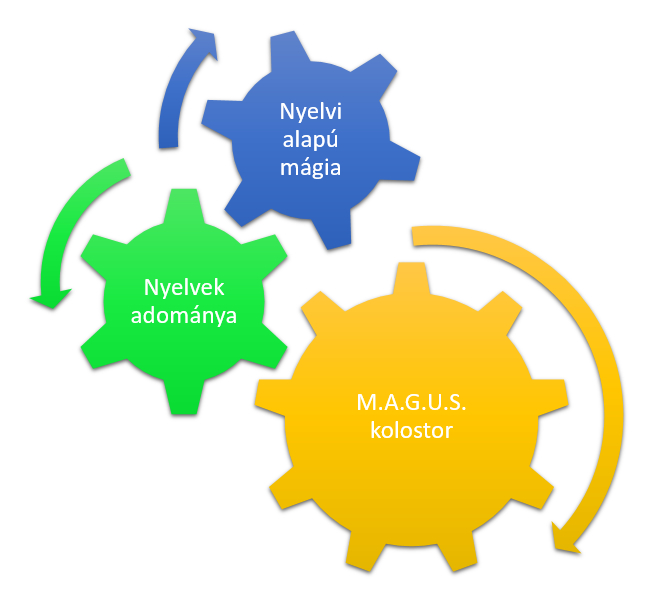
Three gears appear at the start of this article, an unusual illustration for M.A.G.U.S., but their interconnection is easy to see. Formulated thoughts and concepts expressed in language also appear on the mental plane. That is one reason I am reluctant to give up magic's linguistic foundation and the idea behind it. It also explains why you affect an entire object, how a component can be an independent object, and why a diamond can be more complicated than wood. How people can be transformed without precise knowledge of cellular structure and therefore the body's exact construction. Existing languages, however, contain a finite number of words describing a finite number of concepts. There are definite jumps between these, not merely smooth transitions.
A word written in the monastery affects the world; the concept changes, and that can be perceived on the mental plane through the Mental Eye discipline. Characters can therefore be categorized through a finite number of concepts. Each such word can represent a character class or caste existing in the world. When people begin using a different word for a character, the character changes too. But wizard and archmage are different concepts, perceptible as different classes, and frequently repeated words may reinforce the concept's expression. A system modeling that is a kind of class system. The concept used for a character can change, however. Computer RPGs also have systems replacing class with something changeable over time. A familiar example is Mass Effect: Andromeda, where integration with the AI SAM and loaded profiles explain it. Class here means much more than those profiles, but switching even between scenes is often possible. Conversely, acquiring the depth needed for a class and meeting its requirements can take decades or require membership of an order lasting the character's entire life.
Regular class changes have an earlier precedent. D&D 3, referenced by OGL M.A.G.U.S. too, introduced prestige classes, with a new class improving certain abilities of an earlier class, such as spellcasting level and the number of spells that can be memorized, as you move between specializations. Another interesting precedent is M.A.G.U.S.'s suggestion that a wizard could become a magus, and even a martial artist could become that same kind of magus. No class change occurred there, but in the classless CODEX RPG, a first-circle spellcaster using fixed spells could become a second-circle wizard using mosaic magic, then progress to third-circle free magic. Alongside quantitative increases in skills and magical power came qualitative development. Initiation in Shadowrun is also essentially qualitative development.
This qualitative development, fundamentally changing the character's essence alongside conventional levels or attribute increases, offers another path of advancement. Replacing the monastery's term priest with high priest is qualitative development, not merely “XP and leveling.” Delta Vision's project goal pyramid also seeks to break with XP and levels, with multiple rewards and much else. But many things were left out, including advancement between internal castes among Kránian or Yllinorian headhunters: effective “class changes.” Unlike becoming a magus, these development paths branch, as with D&D prestige classes. Meanwhile, M.A.G.U.S.'s class switching, unlike D&D and AD&D, emphasizes “forgetting” less-practiced knowledge and regressing. Every promotion in the sequator → messor → comtur sequence involves some regression. Varied leadership experience can nevertheless create situations requiring old knowledge to be refreshed, without needing to learn it anew.
What Is All This?
There has been no successful new M.A.G.U.S. system for a long time. Many of us play from twenty-year-old publications nearly falling apart. We await new solutions, then complain about why the new system rolls attacks that way.
We have often heard that the rights holder would welcome homebrew and other attempts. There was even talk of more than one getting a chance. They waited in vain. We did not trust that there really would be a chance. Delta Vision's developers are currently working on a new system, while fans work on complaining about the d6.
Let us admit that four alternatives currently exist:
- The d6-based system happens.
- It fails and nothing happens.
- We present a complete system that gets a chance instead of, or alongside, the d6 system.
- A series of articles demonstrates a method for producing a new core book.
No homebrew system's developers have been sued, though we have heard of at least four or five approaches. There is official* permission for supplements and articles, but none for homebrew systems.
Even if that permission arrives, these articles cannot assemble into complete “core books,” only an SRD. Let us call it the Second Chance (Második Esély) system.
* This does not make the finished supplement official or officially approved. Only the permission for fan material and house rules is official in the legal sense.
Acquiring the knowledge justifying membership in a class usually precedes such a change rather than follows it. Krán's internal castes, and even Kyr society's caste system, rest on concepts detectable through psi, Mental Eye, and perhaps magic, connected to the words used in the monastery. Social castes, NPC classes, and much else must connect to this, and our system should handle it, including changes and possible reversions. Those can happen too. Characters have only indirect influence over what the great book says about them. It may even depend on comparison with other party members and vary with the situation.
Character creation can follow the character's backstory and earlier life path. Every period and event can have an effect. How far should we follow it? Until a certain point total, perhaps, enabling an attempt at balance in tournaments, especially if the important skills are known. Or until a certain age, graduation from a particular school, or attainment of a class corresponding to the intended power level. The sufficiently general but in many respects weaker adventurer, the weapon wielder, the fighter, and the headhunter can all be classes. Fighter might refer to the former fighter main class. The fortune-seeker can be a class too, as can Toron's social caste, pietor. Attaining a class plus a specified point total is another possibility.
Entry requirements can involve skills, schools, events such as ordination or initiation, or achieving various goals. Alongside a class's name and description, its requirements therefore matter: how it can first be acquired and under what circumstances a character can revert to it. As we said, the monk in that monastery may decide “from one moment to the next” that grounds for reverting exist. Besides requirements allowing the player to take a class, there may be conditions permitting the game master to impose it. Needless to say, using the black mage class can have negative consequences. Leaving such classes can have requirements too.
Class determines what the “iconic ability: class focus” skill does. Changing class gives that skill new uses. At a skill value of zero, naturally, it does little, so class matters less in that respect. Class also governs the use of Essence, adding new uses to those the character has gained by other means. It can also add uses to a skill that the player would not willingly employ; in that case the GM can declare their use. Membership in some classes may therefore be more curse than blessing. Others combine beneficial and detrimental traits, so a cursed character destined to suffer in the long run may initially look “really cool.”
A particular situation complements this. Many skills may have a base value of zero or less. However, iconic ability: class focus and Essence can grant bonuses, as can the class's own skill modifiers, making the skill usable. Once it is usable, opportunities to improve through use can appear, eventually raising its value above zero. That advancement opportunity generally comes from the class. But the character's distinctive Essence traits and personal iconic ability can open the same path independently of class. Another class can naturally do so too.
Classes may additionally contain modifiers to any skill, including Essence and iconic ability, affecting either the whole skill or particular uses. These modifiers apply only while the character uses that class. Advancement, however, generally happens independently of class. Belonging to a class is a situational modifier.
The class system has one more new feature. If the description written about the character in the monastery changes their race, that change appears in the world too. The class system handles these cases as well. This includes a Kránian headhunter becoming somewhat more aquir afterward, while some chosen ones drawing close to their god may acquire a race-modifying element too. Discovering a little Kyr blood and learning to live with it, or the curse behind the Wier race, likewise modifies race. Changes like these appear in play. Another interesting idea is the monastery first comparing someone to a race, then using that race's name in quotation marks to describe them, and finally dropping the quotation marks. If changes in the book rewrite the world, the character changes too.
When a character becomes undead, taking a class will likewise modify their race. There can also be racial classes, as in original D&D and the Ravenloft: Requiem boxed set.
These foundations are now visible. For a concrete sample class and its requirements, we will also need the abilities and character creation systems.