
I had an interesting conversation about D&D 5 the other day. We talked about how you can criticise the discrete linear distribution. You can spend a hell of a lot of time discussing how many times more likely the most probable outcome is than the least probable one. And we had a very good conversation about a few things. For example, I did not like it when the developer treated an extra die and a flat modifier as equivalent because they have the same effect on the average. In terms of long-term benefits, he is right. But not everything is about that. If you take the higher result of 2d20, the chance of rolling a one is 1 in 400, while the chance of a twenty is roughly 1 in 10.256... The difference between the two is almost fortyfold. But there is an even more important consideration.
The probabilities of a "critical failure" and a "non-critical failure" can differ by almost a factor of 400. This is obviously a better ratio than not only the older editions but also d100-based systems. So on one side of the scales we have a better system, and on the other we have a system created by people who did not know why it would be better, giving me less reason to trust the expertise they displayed then. But there is a much deeper part to this story: BRP often boasts about how easy it makes determining probabilities and chances in percentages. Yet percentages are a terribly poor guide.
Here is an image from the IQ Comparison Site:
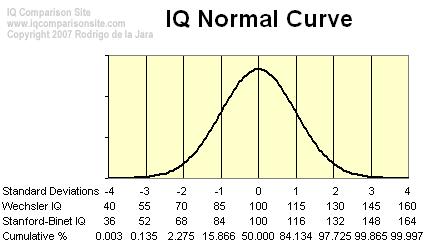
Back when we were discussing Storyteller, the question arose of how common a given IQ was, and someone argued that this curve was already flat at 1–2%. If we instead looked at how many people you would need for one of them to have that IQ, the curve would not get "flatter and flatter". Quite the opposite: this is where it would really start to rise. When we play or GM, percentages make it easy to calculate and estimate expected averages. But percentages give us a poor intuitive sense of what will be memorable and who will stand out in a given environment. A one-in- n ratio gives us a good one.
And here 1 in 400 is better than 1 in 100, with only systems using relatively large numbers of dice doing better. In Shadowrun, the chance of a critical failure from every die coming up one is still 1 in 216 with three dice. With four dice, it becomes 1 in 1,296...
How much a character stands out in a given environment, and how they compare with the human maximum, matters to me. Because these relative strengths can be important elements of the game if we pay attention to the natural reactions they provoke. Why the things D&D 5 improved matter is a much more interesting subject than the mere fact that it improved. Better, but incompatible.
When D&D promises more or less everything, claiming it will be good for everyone, it is inevitable that my first assessment is whether D&D supports the adventures that would make me choose one of its editions. Often it does not. A fan, however, will not investigate that way. They feel that everyone else has managed to make a character they like; if I have not, it must be my fault. Especially if I bring up all sorts of mathematical and other irrelevant nonsense that they do not notice in D&D. And if, heaven forbid, I refer to something described as final during the playtest, they can say that I clearly do not know what I am talking about. But their frequently ad hominem argument is nonsense.
After enough explanations, I often lose patience with this sort of nonsense, and after the umpteenth "TLDR" and other displays of disrespect, I respond in kind. Because by that point the person has forfeited the respect I initially extended, and I do not care what a jerk like that and others of the same ilk think of me. And they can see that D&D 5 is better than many earlier versions. Of course, it is better in the respect I have described here too. The features contradicting its promises, and the system's flaws, would not bother me that much during play either; I can live with worse flaws. So listing them point by point and even supporting the criticism mathematically lays the groundwork for the reaction, "You have way too much time on your hands, you stupid fuck."
But D&D 5 has one major problem.
TSR, WotC and so on are the Ford of roleplaying games. Their range includes many things that could inspire and bring change just like the Model T or Model A, still favourites among vintage-car enthusiasts and hot rod builders today. It is a fact that even a piece-of-junk Tata Nano or a Lada Granta is a better car than those, let alone a Ford Figo. Cars that make an Astra look inspiring by comparison, that make a Seat or a VW a huge step forward, and that you still would not compare with an Audi or BMW... Porsche, Rolls-Royce, Ferrari and Bugatti are another order of magnitude altogether.
But the Model T, the Model A, and even the old Mustang—mocked by many as a "Pusstang", and genuinely not very good in many respects—are more inspiring and can form the basis of more things than a Ford Figo, which is otherwise the better car by rational measures. And the Model T itself was once a people's car that made mobility accessible to the masses. Just as D&D, with Roleplaying Wargame printed on the box, brought the masses a hell of a lot of roleplaying elements that had been available within the wargaming community, giving it a historic role. The emergence of roleplaying as a category and concept is what allows this hobby to exist today.
Those who do not react aggressively, however, often look for a character that would make me want to play D&D 5. It is no secret that I liked Eilistraee's religion in the days of AD&D 2, for example, so they gleefully brought the news that it was back. I should make a worshipper, a priestess or someone else. I did. I invested just enough effort in the system to play that character, or enough to offer, while we were trying out Fantasy Grounds, to run a solo adventure converted from an earlier edition for a D&D 5 bard. Not much.
Not much, but not little either. And just as a Ford Figo or a stylish French microcar looks like a step forward through the window of a broken-down Bzmot railcar, or from behind the wheel of an ancient Warszawa, it gets us there, we are happy, it works, and we could have enormous adventures travelling the world in it, so there would be plenty to love. But it will not be as inspiring as either a Model T or a present-day Tesla. If I played it a hell of a lot, there could be a story that inspired a hundred other stories and gave me a reason to become attached to it. There is just one small problem.
With the priestess of Eilistraee came the experience of Forgotten Realms being rewritten back and forth more often than Ynev in M.A.G.U.S., and rewrites that create breaks in logic bother me in both places. So we can forget Forgotten Realms. And Eberron, popular a few editions ago, too. All right, I can take out a setting from an older edition, but it was rewritten precisely so that the world and the newer systems would fit together. Where there were good reasons for having no dwarf wizards, I can only adapt that to D&D 5 by not merely replacing the PHB races with newly designed ones, but overriding the SRD too. If I start saying that something which used to stand out from the crowd, and which I liked in part for that reason, should still stand out, and raise racial maximums accordingly, I am changing such fundamental rules that I have to think: this could have consequences in all sorts of places.
The world is large, and there are plenty of D&D 5 players and GMs. If I find an online group bothered by similar things, where the players build a world together with the GM and that world is good and inspiring, then there might be something that makes me feel I have a good reason to play D&D 5. Until then, D&D 5 is at best a compromise: it delivers the required minimum at an acceptable level, and has improved over many things from the past. But when several systems are possible and we are seeking a compromise, it is better to choose something the group can play just as easily, which offers an enjoyable character at that same level to anyone who needs one, while also giving some members of the group something they have wanted to play for a long time and have been waiting for a chance to try.
And you find it hard to believe that, among the inspirations provided by older editions, I see nothing that would work wonderfully in D&D 5 and justify investing more money, time and energy in it? Here is the completely trivial problem of Eilistraee's faith. I am glad it is back, and if D&D 5 and Forgotten Realms are required, I will certainly use it. If it had been like this in the mid-nineties, this is what I would have grown to love and become attached to, and the system has improved too. But the back-and-forth changes and the muddle in the setting count against it when you want a more consistent story. And there are well-functioning systems that do not start with that mark against them.
This is not about 5th edition having messed something up. It is about a dozen problems that most 5th-edition fans also agree were messed up by, for example, 3rd edition. And 5th edition faced three possibilities: reboot, leave the bad state of affairs alone, or patch and mend as the story continued. A reboot would have wiped out campaigns that started later, which would not suit many people, while the repairs, bodges and slapdash fixes quite reasonably cause disappointment. There are other settings, but I have no favourite there; a new one could be created and might eventually become a favourite. But to get all that worldbuilding done, find a new favourite and have something to be attached to, you need to play a lot and let it develop. If the thing that would provide the attraction is not ready until then, however, that is unlikely to happen.
To be continued