
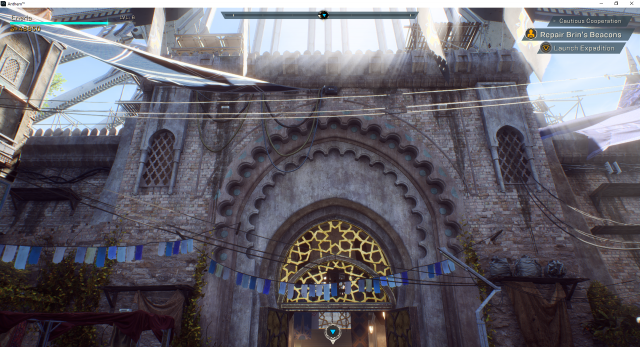
 Anthem turned out to be an interesting game. A hell of a lot of people are talking about its loading screens, because they do go on a bit. But honestly, a long loading screen is one thing; a long loading screen preceded by several other things is quite another. Since there is no single-player mode, we cannot save during a mission. So the game loads, then we load the fort. Then we walk up to our javelin to set off. We choose the mission, get an animation, then matchmaking for good measure, then a loading screen. At best, the fun can begin. At worst, despite an otherwise stable internet connection, a connection-error message appears and the fort loads all over again. When you do not have much time to play on a weekday, this can steal a substantial part of it.
The situation above is not particularly extreme; in many cases it is much worse. And remember, in that case we have to make the journey through the fort again. Simply placing us somewhere else when reconnecting after an error would have been enough to waste far less of our time. If the developer allowed for errors that are almost certain to occur, the same error would be much less irritating.
Making matters worse, we may get no help in a mission designed for four people. If our available playtime runs out and we have to stop, we face the same sequence all over again. We get to repeat the flight and the parts of the mission we have already completed. This is the situation saving games was invented for. But that solution does not work here. The game is built around a world changed by events, a kind of shared unfolding plot. That is pleasant. The trouble is that the first such step comes roughly a month after release. A month means four or five weekends, any of which may already have other plans.
My own experience was a little strange. There was a case where bugs and other issues forced me to restart a mission for the fifth time. Although I do not want to spoil anyone's fun and will therefore say little about the mission itself, it is no secret that running up to the javelin triggered a cutscene, then after a loading screen another cutscene began inside a strider, followed by the mission-selection screen, a short animation, matchmaking and another loading screen. And another error. This was during the game's hardest mission so far, let us say at the end of the story currently available. It was irritating.
Thanks to the bugs, reaching this point in the story in time is far from a trivial matter, as is finding time to farm the equipment needed for the event. If there is no time and no ordinary currency, players can buy shards with real money, introducing a paywall. When we see this truncated game without single-player, we may think of many other multiplayer-only titles. Admittedly, those are free, while this costs as much as a AAA game. And that AAA price is made worse by all the things killing the second-hand market. Someone joining later misses the beginning of the story; someone selling the game before the story ends misses the conclusion of the continuing narrative. This affects not only the second-hand market but also later sale pricing and the expected addition to the Origin Access: Basic vault.
The #loadingscreengate scandal with which Anthem successfully launched is not about a loading screen being a little longer but bothering nobody. Forcing multiplayer this way brings many other things to mind: not just loading screens made worse by matchmaking screens, but the general objections to the online-only direction. In fairness, though, the game gave an excellent answer to my concerns about internet instability: I had one connection problem during a mission. At the start of new missions? In the launch bay? In the places where everyone else has them? Regularly.
I would have torn my hair out if it had happened at the end of a longer, harder mission and I had to start everything again.
I was happy to try the game, and early on the story required some freeplay too. I ran into a rather ancient Ash Titan. At the time, as a beginner at a low level in a weak javelin, this was terribly difficult. It would go down faster today. Some help would have been welcome. But having an online friend I could invite was no use when four-player multiplayer remains four-player even if the three strangers forced on you are chasing their own goals on the other side of the world, nowhere near one another.
By making freeplay obligatorily public and assigning three strangers, the game removed my chance of receiving reinforcements from a friend when I ran into difficult content, leaving me alone to tackle content designed for a team within a combat system designed for a team. And of course, instead of loading during an animation—which could itself be one of several, adding variety—it gives us the animation, another wait for matchmaking, then the loading screen, only to leave us fighting team-oriented content without help. That is no damn fun.
The situation above is a problem because it severely obstructs a substantial proportion of players from progressing through the story even if they otherwise enjoy the game and its narrative. If a flaw in the game's construction, its basic structure, can potentially make it unenjoyable, calling the game good or even average would certainly be an exaggeration. Such shortcomings are only the foundation: bugs and a few other oddities come on top. When we assess how much all these problems spoil the game, it can only go downhill from there. This is worse than animations that are weak in many respects but which you can get used to, or sound that occasionally cuts out.
And yes, in many places the internet is less stable. When you have to struggle through a harder task alone because no help is available, a connection error may kick you out. Back to the beginning: start that terribly difficult mission again. Because behind the online-only operation there is no safety net, no saving or other options to rescue you in this situation. If these issues prevent someone from finishing the earlier story by the time of the event, so that they cannot enjoy the twist either, they will not praise the game for a wonderful idea they missed because of its design and technical flaws.
And game developers already understood perfectly well in the 1980s that it is unacceptable for a glitch to throw a player back to the beginning of an hour's suffering, with bugs once again the main enemies. There are flaws that, even if everything else about a game is perfect, can alone justify mass zero scores. And an independent outside review should be willing to say so.
The story could end here, as could the avoidance of spoilers: we could tell the story to the people excluded from experiencing it. At this point, we could be talking about one of 2019's worst games, one of the worst games in EA's history, or by far the worst game in BioWare's history. And Anthem arrived when several ugly missteps had made BioWare understandably unpopular with many people, just when it ought to have been winning back the trust of its science-fiction fans. Telling a player disappointed in this way to give the game yet another chance because element X or Y is entertaining would be a completely irrational expectation.
But EA can still save this story. Not BioWare, not any member of the development team, but EA. And that is what Anthem is about. It is about how, if a game like this had come out a year earlier, many of us would be cursing the wasted money, and even more of us would have bought it on a platform where getting a refund in such a case is difficult. But last summer, EA decided to introduce a more capable version of its Origin Access subscription: Origin Access: Premier. This gives EA reliable revenue. It also means that, as long as the package as a whole is good, they can easily serve niche interests. All sorts of games can appear that no sane publisher would otherwise risk.
EA, which we knew as the enemy of all innovation, the company I have myself said I wanted to boycott when I first discovered Poser and DAZ Studio, devised a business model that makes experimentation possible. I thought through what that meant. And why a fixed subscription fee is more honest than "buying a game" for as long as the shop stays open and compatibility lasts. Subscribing was natural. Meanwhile, many of those who fell for the hype around Anthem and eagerly awaited it are now terribly disappointed after paying the purchase price.
I was not enthusiastic. I was not enthusiastic because, when they expected immersion to come from often not seeing our character and never seeing them outside their armour, I suspected this would not help. Many other BioWare games had no trouble with immersion, while Quake is hardly the champion of roleplaying games. Of course, we can imagine what our character looks like; that is easy in a tabletop RPG, and I can even try realising that afterwards in DAZ Studio. But in a visual medium where this very thing is missing? It is much harder to grow fond of them.
The primal elements, the concept described sometimes as science fiction and sometimes as science fantasy, where science ultimately drops out and only a few futuristic elements resembling technology remain—yet the question arises of how building javelins works without the necessary robotics, displays, computers and so on. I only mention this because these questions, along with where food comes from and how the world works, matter more to immersion than a poorly positioned first-person camera. With the event-based story, I knew it would be the same for everyone, making the linear narrative much dumber in this respect than the branching stories of other BioWare games. I had a million and one reasons not to be enthusiastic.
At least I could not be disappointed. Six months ago I said this would not be a good game and I would not even download it. Yet however much I disliked many things, however certain I was that there would be at least one bartender mentioning a same-sex spouse, that excluding romance for our own character was taking the easy way out—so that not every character dates the same person—that it was irritating our actual comrades never appeared in town and never got faces, and however much I knew that the resources diverted to this piece of junk had played a significant role in ruining Mass Effect... That the people working on it were people who had messed things up there too, I downloaded the game anyway.
Because that is how Origin Access: Premier works. The slightest curiosity is enough to make me press Download. It surely cannot be worse than, say, This Is the Police 2, and that got its chance too. When you can go shooting after the loading screen, and the underlying system and content work for that, it is not bad. Purely cooperative games are rare. When a little action is needed to wake me up, this does the job, and cooperative gameplay also works for people who do not generally like action games. For a bit of light entertainment and relaxation, it is enough.
It adds a few more hours of entertainment to my Origin Access: Premier subscription. When we spend our time and money, the question is not which of two nearly identical games we want. Netflix, Origin Access, a novel, a cinema ticket and a rulebook are all competing on the same field. This extra option, these few hours of entertainment, are another in the long list of reasons I consider Origin Access: Premier a good arrangement.
And if that means I occasionally enjoy a bit of shooting in Anthem, I can also check out the events, and perhaps get a few good details and pleasant memories out of it.
Thinking through the many similar and dissimilar games, PvP and a million other things usually appear because they attract more players. But Origin Access: Premier is a business model with room for niche games, experimentation and failures, from which something good can ultimately emerge. When we criticise publishers for ruining everything with content forced in for the SJW crowd, we are not the ones facing the risk of a boycott. HBO also dares to be politically incorrect because long-term subscriptions create the business conditions for taking risks. And Origin Access: Premier is the flagship of this approach on PC.
Anthem is now carrying that flag, with all its clumsiness and all its faults. With every flaw in pacing, structure and so much else, yet still showing that a cooperative shooter where players cannot shoot one another may be a niche game for many reasons, but can nevertheless be worth the risk. That the flaws and blunders can be accepted because the subscription keeps running, and the concept will improve either in a patch or in a similar game one or two releases later.
And because, despite the flaws, keeping the game remains rational, and we can drop in for a little shooting now and then. Seen from that angle, Anthem is one of the best things that could have happened to the games industry. But the difference between a deserved zero and lavish praise comes not from the lionised, idolised BioWare, but from EA, so often hated for its sins. Thank you, Electronic Arts!