
When I began working with DAZ Studio, the first generation of the Genesis platform was relatively new. I quickly noticed its advantages: the same clothes and hairstyle could be used with every Genesis shape. That was one reason DAZ Studio seemed a smarter choice than Poser. Both programs have developed since, of course. DAZ Studio still has no dynamic hair, but a hair editor, Look at My Hair, is available for it. Poser lacks autofit and autofollow, but lets us alter clothing manually. Competition has not stopped. I still consider Poser a poor choice. Three versions currently come into consideration. Poser 10 has limited functionality and lacks precisely the headline features. At around $450, Poser Pro costs twice as much as Carrara Pro, even though the latter also offers a full modeling toolset, landscape editor, and so on. Then there is Poser Pro Game Dev, another fifty dollars more... DAZ Studio, by contrast, is now free, includes several good models, and has improved in many areas, such as iray. With Carrara, I would say the additional content we receive would cost much more without the program than with it. As a Platinum Club member, one can often get it on sale at an affordable price. It has autofit and autofollow, but also dynamic hair, a complete physics engine, and many other features. The success really depended not on this, however, but on the Genesis platform. And now I need to write about that platform's third generation.
The Genesis platform is not perfect in many respects. When Genesis 3 appeared, one of the first things I checked was a bug. These tests can also provide a little humor. I often make character pictures for other people too, and “a little more like this, a little more like that, let us find a blend between the two” comes up frequently. Genesis has several numbered breast shapes, natural and silicone effects, size adjustments, and twenty or thirty other morphs. This is no more mysterious than adjusting sliders in many installments of The Sims; there are simply more sliders here. The difficulty comes elsewhere. It soon turned out that blending two solutions is funny because every breast-shape setting also increases breast size, and several shapes add together. I tested it... Reported that it still did this. That soon led to wildly distorted proportions—not some enormous-breasted celebrity, but Warhammer-level exaggeration. Go on, then: it is easy to play with her face and ears, give her green skin, seek out sickly thinness and strange proportions, and distort them still further... In discussion between editors, we soon had many of the races mentioned. A goblin with assets that would do an orc, or ogre, proud.
Genesis 3 is still a new platform, so autofit has room for improvement too. Few outfits can be put on it, and the Smart Content tab does not indicate them either, but there was some foundation. When the image was finished, it still got a little laughter. The right morphs could have produced a small catlike creature, and the Look at My Hair package could have made it furry. It could also have been human, ogre-like, or imitated quite a few other races. There are even wings, horns, teeth, and so on, and we can already design monsters. These were still a little easier to fit to the previous Genesis generation, but many updates will come for the new version, so it probably will not be difficult here either. If you want to decide whether one of the many Genesis 3 packages is worth buying, three scenarios immediately suggest themselves.
If a new-generation model appears, exploits many new possibilities, and has no very serious problem, support will arrive sooner or later. It is worth buying for a beginner: the limited content for the platform is less of a disadvantage, and good sales will be available for it for a while. Until they buy much, beginners will have little content for anything; this is enough to learn the basics, it is the future, and free content exists for all three platforms. Genesis 3's Starter Essentials package is free too, and a few cheaper morph packages help customize it. One of the Victoria 7 bundles offers good value for money.
Someone with a medium-sized collection, missing many important things whose addition matters more than the new generation's introductory discount, can skip the purchase for now. Quickly obtaining a few specific products may matter more than a substantial discount. In that case, you can easily examine the free base, understand what each morph package does and how autofit works, and decide what you need. If the other package is worth more than some Genesis 3 content and its available discount, waiting is a workable strategy.
Introductory discounts exist for a reason. For lots of content to be made for the new generation, many people must use it, because they form the market for independent content creators. For many people to buy it, however, it needs good value for money. The amount of supplementary content partly determines that, so initially the models really are worth a little less. An introductory discount of around 30% is quite justified, as are related offers where a connected purchase can receive about 80% off. In other words, if you can afford it and have no more important purchase, this is the time to acquire every important base model.
It is well known that such easy blending between morphs unquestionably gives more freedom than the symbol sets of 2D character-picture tools, and that programs like these are better for character pictures and illustrations than “take a screenshot of a game.” There are many potential beginners in the market too. For them, the important differences from screenshots are precisely the different poses and expressions, better rendering quality, and significantly more morphs. A pose or movement suggesting a character's personality matters, sometimes more than many other details, and that requires programs and content like these. Genesis 3's significant innovations are primarily in poses, movements, and expressions, and secondarily in skin.
If only a skeleton controlled movement, however detailed, a problem would soon arise. It adds much to poses, but we also want to see which muscle needs tensing, how a body part sits in a particular position, and so on. That requires morphs. One advantage of Genesis is that many different figures are not separate base meshes, but morphs applied to the same figure. Many morphs therefore serve many different characters and figures, and autofit and autofollow generally let everything work with them too. That makes designing poses, morphs, and so on with attention to muscles and other details more economical, because they can be used on far more characters. This is what sold me on Genesis. And Genesis 3 promised precision and improvement in exactly this area.
Does somebody want to create not just character pictures but a comic based on a story? Poses, surroundings, and many other things really matter there, and Hero Machine, Character Artist, and the like fall permanently behind. Once we are thinking in terms of 3D and rendering, DAZ Studio is free, while Carrara is capable and cheap... Poser's advantage lies mostly in tradition, but autofit and autofollow are decisive. Although Genesis can be exported to many other programs, DAZ Studio and Carrara make the most of it: in principle, every outfit works with every morph package, including character morphs. DAZ 3D will obviously be busy developing Genesis 3, so anyone wanting to make inexpensive character pictures this way cannot avoid it.
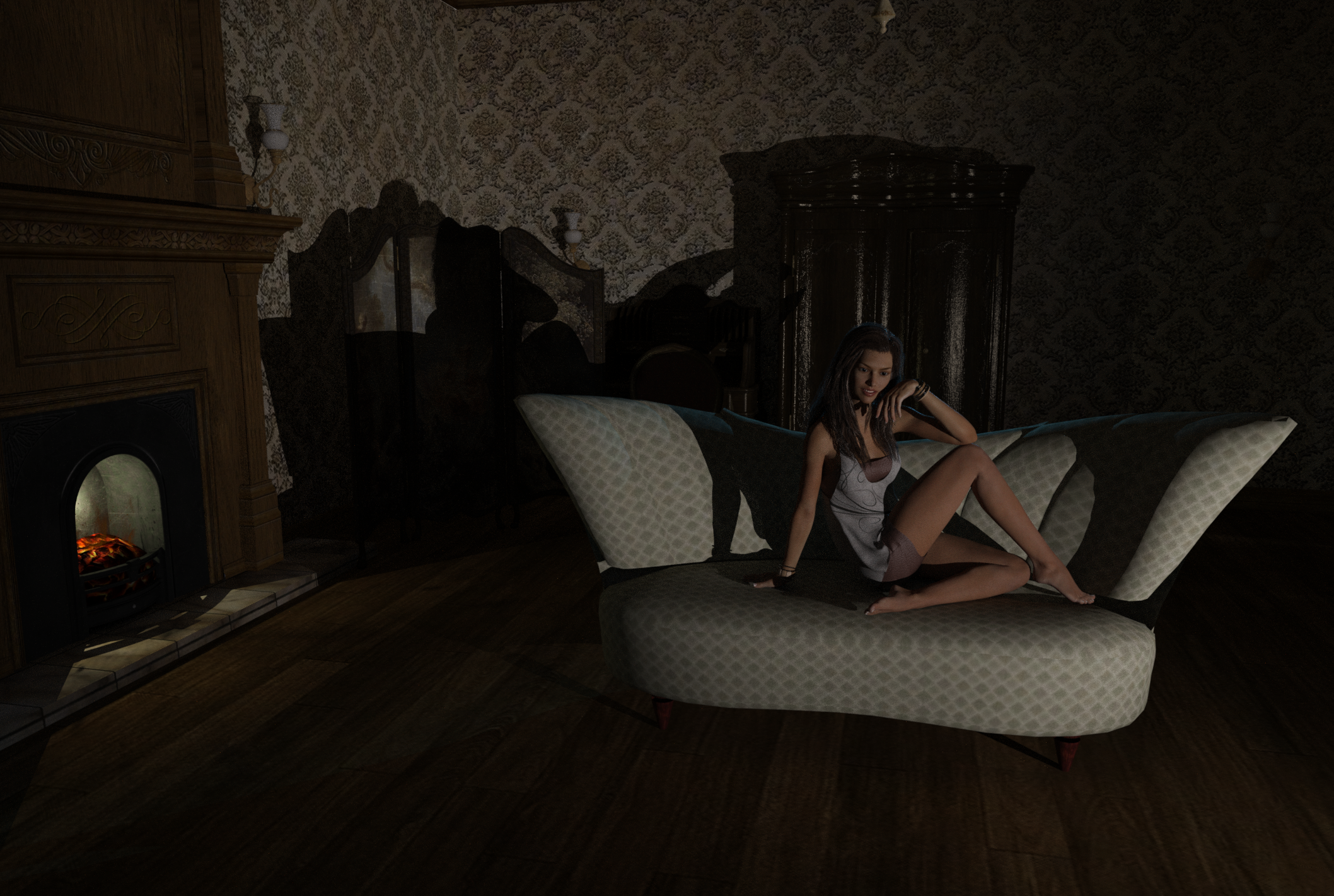
There are limitations, of course, but they arise less from the model than from the software. Unfortunately, DAZ Studio considers only one object for collision detection, which is not very good when it should consider two or three. With luck, a few morphs help fix problems and the result is good. Even without a suitable morph, the flaw is not necessarily visible. This allows attractive character pictures. The problem is that the process is not necessarily simple: people very quickly recognize what is wrong, but may not know how to make it right. The most common mistake is handling lighting, particularly overly sharp shadows and too little diffuse light. Adjusting the lights can change that; there is no problem there. But a flaw may also be intentional, adding a little to the atmosphere. Softer shadows would have taken two minutes here, but I think these contribute something to the mood.
High contrast and abrupt transitions between light and shadow give the picture a little drama. But they also draw attention more readily to details and flaws, real or perceived. The shadow by the foot hanging slightly off the sofa is odd, for example. The truth is, though, nobody cares whether a similar shadow could occur in a photograph; it will be considered a flaw. Its cause is much less the pose than the sofa and how physics works. Carrara would obviously help somewhat, but the system does not know how the sofa “works,” and a simplified physical model is problematic.
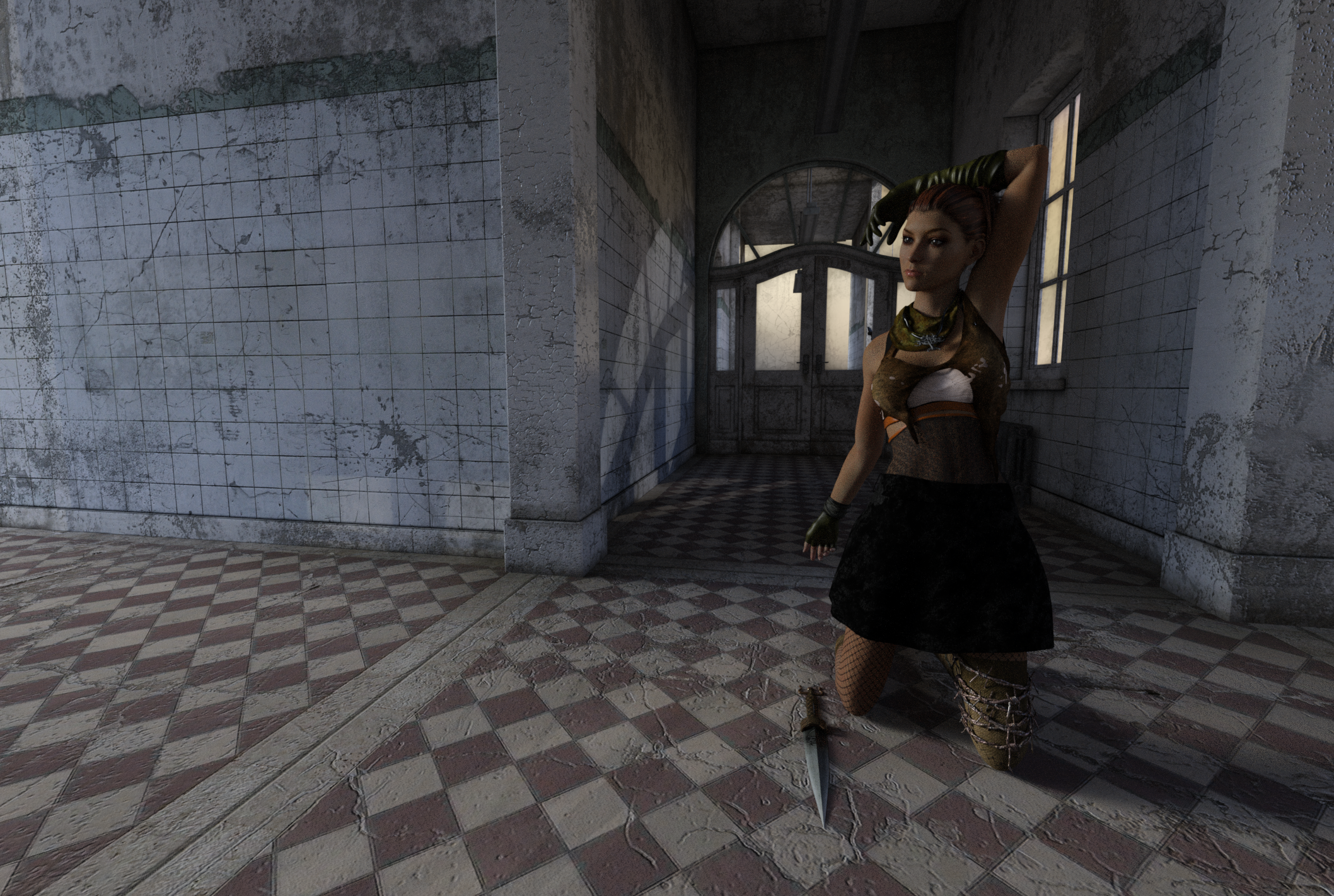
Likewise, you instinctively see when a pose is unnatural or an expression alien. Making it otherwise is harder. This is where Genesis 3 can do more. Genesis 3 Female Starter Essentials has appeared, with a few morphs, perhaps ten outfits in all, and the contents of the Victoria 7 Pro Bundle. The picture shows Victoria 7. They said she would move better, be easier to pose, and look more lifelike. True. They also promised more lifelike skin through materials optimized for iray. True too. They even said it would better support the extras in the newer version of the conventional rendering engine, making the image more lifelike. Up to a point.
I could call it substantial progress and innovation, and say this next-generation platform will be very convincing too. But I must immediately note that more lifelike models and animation were available several years ago; the computing requirements and the work behind the models mattered a great deal. Since then, more powerful hardware has become available, with good GPGPU support in this segment too. We can count on far more memory and computational power, requiring different compromises from a few years ago.
Competitor Smith Micro is trying to sell software, not only for this purpose and not only the Poser family, while DAZ lives from content and tries to support more than its own software. That makes it important for Genesis to be as competitive as possible, guaranteed by plentiful mutually compatible content. But plenty of compatible content is no use if some of it simply is not good. Look at the picture on the right. What is the biggest problem? The barbed wire. Defenders point out that “she has not wound it around her thigh,” suggesting it would not tear the woman's thigh... True, until she tries to close her legs. Fine, kicking someone in the balls with it makes an effective weapon... And I could imagine plenty of posers accepting that much discomfort, but it is not practical.
Why so many oddly creative attempts and so few lifelike clothes? Because of breasts, ladies and gentlemen. The esteemed artists struggle with a simple problem. Clothing follows the body's contours, which makes many suits of armor interesting, but the body does not try to adapt to the available space. Ignoring bras, historical corsets, and so on makes the result a little strange. Creative use of some morphs and posing options can compensate, but there is no suitable morph for everything. Nor is there a suitable morph for everything when you simply want to model clothes that are too tight.
There are many small workarounds, of course, such as reversing collision detection between clothing and body. If we use several copies of the same model in the same position, hiding different body parts on each—there will be several methods for this—the breasts respond to the too-tight bra for collision purposes, and the waist to the tightly drawn skirt. Mesh smoothing offers things to use and misuse. There is just one small problem: time.
DAZ Studio and Genesis offer enough freedom to make a tolerable-quality character picture in minutes, one that depicts the character better than a screenshot, many 2D character tools, or a sketch someone else makes on request. It even beats searching for images with Google. But when the question is whether character creation, including sheet, background, and picture, takes half an hour or perhaps only twenty minutes, you will not spend hours fiddling with workarounds, fighting the lighting, or studying 3D graphics for months and years for this. The pictures here, and recommending DAZ 3D, are credible only if you can do something similar to what we show you. That is why setting up a scene for an article written in a few hours cannot take days either. Right?
That will show. It has to. Even if you spend a week on a character including the background, you will try to spend six and a half days on habits, equipment, and background, with time for a more thorough character sheet than usual. In the remaining time, you want many pictures of the character, not just one. We will write about many interesting, useful tricks. But we know those will not be the deciding factor. Most artists know this too. If an outfit is strange and you argue over the concept, and their position can be defended with “self-defense matters more, and she learns to move without hurting herself,” “this is fantasy,” or many other arguments, a chainmail bikini could be defended too. If, on the other hand, you see one bad render after another of an unmistakably modern outfit, you will not buy the product.
The barbed wire and so on can be made to disappear somehow.
The new models keep getting better. But as long as the bottleneck is the time you devote rather than the model, they do not add much to image quality, however visible the change may be. Support for new technologies, however, greatly affects rendering time and work efficiency. Genesis 3, adjustable with fewer tricks and better parameter controls, is a good foundation in that respect.