
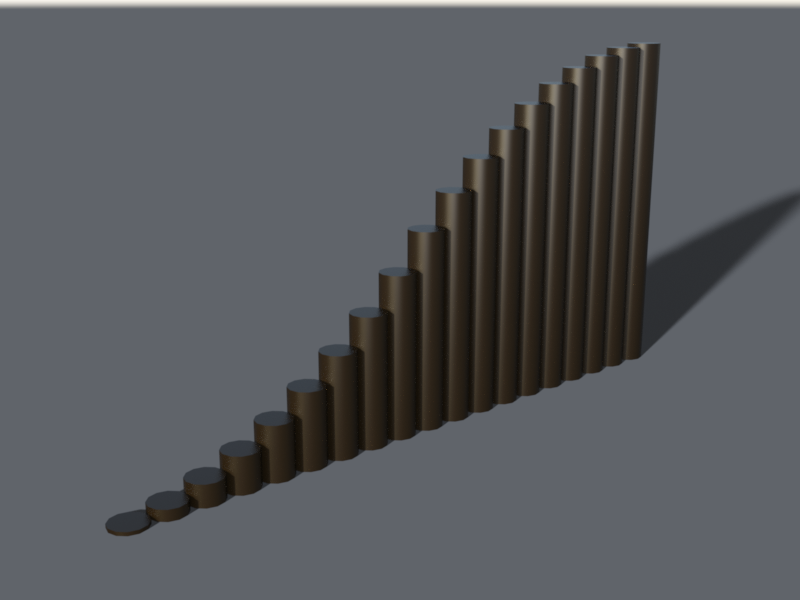
 DAZ Studio is evolving. It is still free. And we still say it is worth trying for many players and GMs. Of course, we can often render more than the usual human figures with it: here, for example, a little chart-like illustration helps explain the mathematics behind a rule. DAZ Studio may not offer many modeling tools, but the simple basic primitives are there, and here are nineteen cylinders. Let us ask: could you not make illustrations from a few simple shapes for many logic puzzles and other elements of an adventure, showing all sorts of situations? You can use lighting and much else too.
When it comes to rendering, what matters is not only that Iray can be faster than 3Delight, but also what happens if we press Cancel during the render—after a few percent, say. If we see the image throughout the process and relatively quickly get a potentially usable, if imperfect, result, we can decide whether to stop after five minutes or wait the full few hours. Or decide that it will not work this way after all: cancel, change the settings, and render the revised composition. Iray seems particularly good in this respect. There is no plug-in to buy, no unfamiliar interface to wrestle with, and with most DAZ content, shaders and materials will not be a problem either: things generally work the first time. I feel this is complemented by support helping wherever problems do arise, while new products are designed with it in mind from the outset.
DAZ Studio is evolving, then, not only in its content manager and content but in the essential business of rendering too. Of course, the question is when and how far it will gain capabilities such as handling air and atmosphere, or the many small and large innovations possible in lighting. I have a hunch we may not have to wait very long.
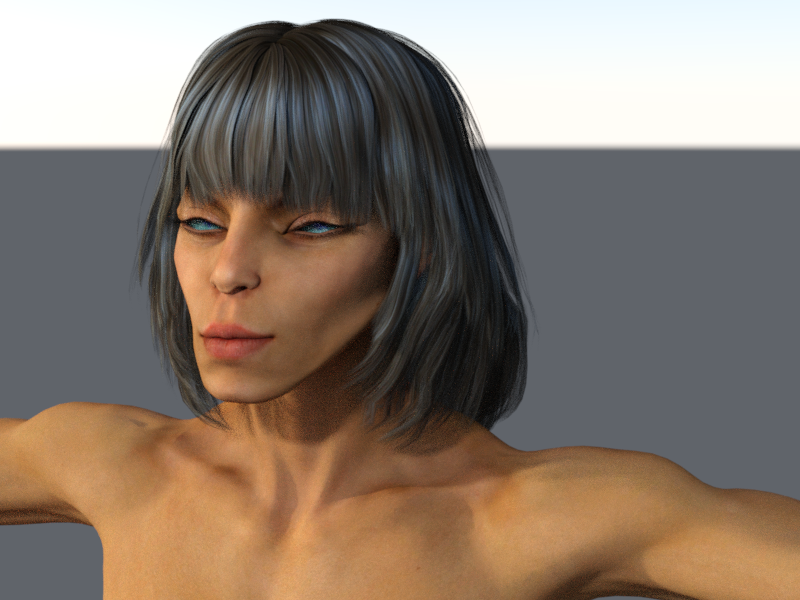 This naturally raises the question: what does a render actually look like when stopped after five or ten minutes? And why not spend plenty of time rendering if assembling the scene takes longer anyway? Well, please look to the right. I feel that the incomplete render and its slight "dither"-like appearance actually improve the image. Especially if we are not trying to render a scene, but instead recall the Second Rulebook's illustration of the amunds, think about the cultivation of the body that makes them beautiful and what their appearance conveys, and want to throw together a portrait.
Many races are represented in DAZ Studio as presets and morphs. But finding dedicated morphs for amund eyes, the sharper features shown there, the projecting muzzle, and the slightly tilted face would be difficult. Yet overriding several limits in many cases quickly makes the eyes more elongated, showing almost nothing but blue iris; a matching nose and many small details can soon be put together.
All right: anyone working from presets who is afraid to change individual morphs' maximum and minimum values will not get an amund this way. But if you do it, you soon have a good image, and since the face is all you need, you do not even have to worry about the pose.
The task is hardly complicated. Some people may say what a "great amund" they have made while leaving out most of the basic features; here the aim was to get at least those right with a few purposeful adjustments. No environment, other details, or post-processing. And here it really matters that by the time the article is finished, rendering can be stopped too, with no real time lost.
Even if you are not writing an article, you may often need a quick illustration. Perhaps you want to throw something together in five or ten minutes when the players ask a question. Would you wait then and tell everyone to be patient, or would a render stopped early but still good be enough? If the latter, you can understand why I am enthusiastic about the 4.8 beta.