
... the first questionnaire came with news: the developer blog had launched. Easy to post. It appeared in Facebook groups, on Facebook pages, and we reported the news too. Then came week two. A link. I was not happy. Not at all. Fine, I will share it somehow on Facebook. I promised to post it wherever possible. But we do not usually publish bare links here. Somehow it needed to become a news item or article. Something needed writing. I opened the second questionnaire. They thanked us for completing the previous one, and we learned that voting was now limited to once and the questionnaire would remain open. That would not supply article text. They did give a subject: "In the second week, we focus primarily on introductory questions about GMing and the world, still moving from broad, larger-scale characteristics towards smaller, more specific details." That could be useful. We could highlight what is interesting and why.
I skimmed the questions. Among those about GMing and the world was: "9 — What online support would you consider important?" Besides providing an excellent opportunity to share the questionnaire on the Szerepjáték Online Facebook page, it immediately made me wonder: what does this have to do with the world? I could also point out that name generators and spell generators hardly belong among GMing's major questions. If an article says they move from larger, more important subjects to smaller ones, then introduces online support under GMing and the world, someone will surely ask whether I am completely stupid or parodying the questionnaire.
A rescue plan! Fortunately, I do not run this site alone, and our team includes a sociologist who understands questionnaires. Let him give his opinion. A link to the subject fits there. If the professional assessment is not too negative, that solves the problem. It was negative, despite giving technical matters less attention: what we see is not genuine research or a genuine questionnaire, merely a large collection of polls, often in Facebook-poll style. That will hardly yield a useful data table. The site also lacks TLS, or HTTPS. Design is a matter of taste.
Then, thinking about communication through the launched developer blog, I remember its current contents:
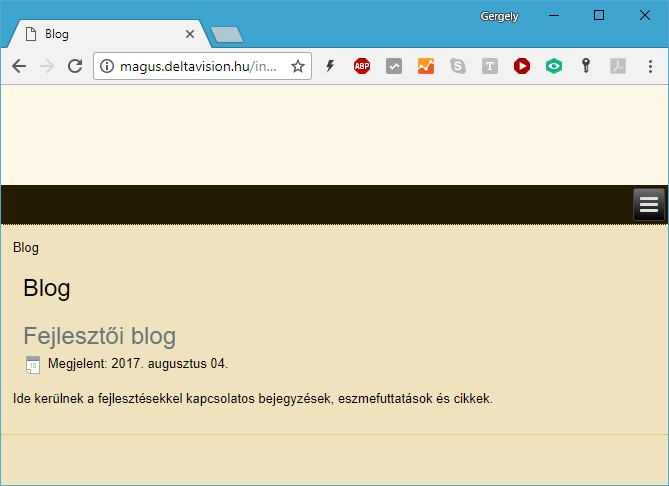
We used the relatively expensive vBulletin for a long time, but now use Joomla. The developer blog also runs on Joomla. A publicly accessible empty category looks a little strange, as does its description. So does leaving a broad band of solid colour when there is no header image. Of course, we also reported that the developer blog had launched, but this is not enough. The polling script displays others' votes, yet says nothing about conclusions drawn from the answers. Judging by the professional assessment, I might suspect none. Analysing visible results could have introduced and recommended the next questionnaire. But that assessment shows how little questions phrased this way reveal.
The professional assessment was gentle, though. Sol knew about the technical issues but naturally did not discuss them. He is also a roleplayer, an excellent GM who likes Mage but has played M.A.G.U.S., so he could offer opinions on the questions' substance. He did not, since that would not be a purely professional assessment. But let us examine a question from the first questionnaire:
2 — Which combat skills do you use most?
As an expanded investigation of the first question, we would like to see specific answers too, divided into the four main branches of the old core rulebook.
The first problem I see is that the question is only apparently unambiguous. Think a little, and using a skill will not mean the same thing to everyone answering. This seriously affects the answers' value, because the kind of use matters greatly.
- We use a skill as players even merely by choosing it and considering its possibilities. It need not come up during play: it still distinguishes characters and makes the game more interesting.
- A skill adding colour to a character is also used when it influences their portrayal.
- Many combat skills help a character infiltrate as an "instructor" or in another role. Battle Formation is interesting here too.
- Staying with Battle Formation: it helps understand enemy tactics and strategy. Alongside Alertness/Perception, observing troop movements may reveal how the character can get through.
- And you can use it for its combat-value modifiers.
We might remember that scarcely any M.A.G.U.S. class lacks at least one Weapon Use skill. This certainly does not mean the skill is common basic knowledge and can be deleted from the skill list. A rarely chosen skill that remains situational even then is not necessarily superfluous either. It may be among many characters' most important skills, making them a little more distinctive and interesting. Imagine a skill almost nobody ranks among their top five combat skills, but most players include in their top seven. They use it often not because "lots of people get it, so they might as well", but because it matters to them.
We soon reached a question about classes. Great! Except they had already decided long ago that there would be no classes. We must accept that decision. Continuing to answer and share the questionnaires is useful. But the question about classes shattered the illusion for me. Its predefined answers covered many abilities, even "how the player plays it". Perfectly good. But some respondents mostly GM. We introduce barbarians as NPCs less often than barbarian PCs appear. NPCs respond differently to a barbarian, whose role in the world and adventures differs, partly because of culture.
An important monastery on Ynev records "adventurers' chronicles", and the word used to describe someone matters. The mental eye also reveals a person's class; concepts can appear on the mental plane. These may be the same concepts written in the book. What is recorded there should appear in the world. Naturally, what they write matters. They do not always use the same word, but synonyms share a concept somehow present in the world, which the mental eye can perceive. Never mind: the monks can now replace "Droga the barbarian" with "Droga, battle-axe 4, battle frenzy 3, life force 5". With luck, M.A.G.U.S. novels and stories will follow this concept too.
But classes do more. When a system introduces a new skill, attaching mechanics to something previously dependent only on backstory, the problem quickly arises: "Where do I find that many skill points now?" A class was a label allowing us to say class Y receives new skill X. It did not cover every situation where a skill belonged to a character concept, but covered most. It disturbed the balance between available KP and those required for a "realistic character" less.
A questionable questionnaire can justify removing many skills, then reintroducing them later at players' request. But classes will no longer be there to mitigate the KP requirements of skills introduced retrospectively. Of course, without a problem needing mitigation, difficulty mitigating it is no problem either. No, writing about the first questionnaire does not make recommending the second with a clear conscience easy. Let us examine the one we ought to recommend, addressing not only the parody-worthy question but the others too.
On advancement speed, they ask how many adventures characters complete between levels. A quick mini-adventure for an event may take two or three hours. A regular group, however, may play longer adventures spanning multiple sessions, perhaps eighty hours. Who levels faster: someone advancing after every second eighty-hour adventure, or after every fifteenth three-hour adventure? Another datum is available: how many adventures we generally play with one character. That includes long campaigns, tournaments and much else, producing enormous variation. But dividing the number of adventures by the advancement interval yields how many level-ups occur on average over a character's play.
Many have since completed the questionnaire. From the median answers, we understand that four or five level-ups are typical. Does that mean very gradual advancement is unnecessary? Some players have more level-ups, certainly. But another problem remains: some prefer low levels, others medium or high levels. Some ongoing campaigns include them all. There are few characters for long campaigns and many for shorter games, making four or five levels per character understandable. We also know Delta Vision's developing system uses several d6s.
Sometimes an advancement step means one die, naturally so in success-counting systems. Where die values are added, 1d6 can be followed by 1d6+1, 1d6+2, then 2d6, replacing three points with a d6 averaging 3.5 and allowing advancement point by point. In that case, though, our chances rise too quickly early in progression. Multiple d6s raise questions about advancement speed and mechanical granularity. Answers suggesting relatively few level-ups can easily be interpreted as permission to reduce granularity. Equally, however, this is the existing upper limit for those preferring low-level play, and likewise for medium-level players. Those preferring high but not extremely high levels have no more room in the present system either. To play individual characters longer, granularity must increase so advancement brings a sense of achievement more often.
If the questionnaire consisted not of polls but of linked questions, perhaps also asking why we stop playing when we do, we would receive much better answers.
Fans of ongoing campaigns made up of long adventures may advance every three or four adventures. So may groups preferring four- or five-hour mini-adventures. Ten to twenty adventures, levelling every two to five: the commonest answers. Notice that where "one afternoon, one adventure" means four or five hours, and only ten or twelve adventures are completed, that is forty to sixty hours with a character who may be uninteresting and become boring. Respondents must choose between five-to-ten and ten-to-twenty adventures, with memorable characters raising the average. The other case? Adventures not as long as Shadowrun 2nd edition's Harlequin's Back, which comfortably exceeds a hundred hours, but fifty or sixty hours. They do not answer twenty-to-fifty adventures because events and other occasions also produce shorter-lived characters: "not all are long campaigns, and there are more short ones". Whether I calculate eighteen to twenty adventures or note that favourite characters and campaigns played longer than usual may exceed that, a cherished long campaign can total far more than 900–1,200 hours. And "we'd keep playing, but life intervenes, and this high a level is difficult".
I know real examples of both cases.
The developing system is no longer a document presenting competing concepts: it has completed at least two test rounds. The third early round, still capable of bringing many changes, is underway. After that come only fine-tuning and beta. We cannot influence very much of its structure because too much is finished. Where the two cases above produce identical answers, I cannot say the questionnaires tell the development team much or allow substantial adaptation.
Then what is the point? Why would I recommend visiting, examining, considering and completing these questionnaires, almost pointlessly in many respects?
Precisely because of their flaws. If they suggest answers, if their answers are one-dimensional because the creators think strongly in one direction, you see what certain objectives mean to them. That says much about the forthcoming M.A.G.U.S. You see their thinking and the questions they seek to solve, and can decide whether you like this direction or would trust differently minded developers more. The questionnaire tells things not to the developers, but to you: about the system, the Delta Vision team's standards and much else. It helps you decide what to expect.
Thinking through the fourth questionnaire this way, I will find it easier to recommend. I will not have to link it only from my fellow editor's professional analysis. Whether that is good for Delta Vision is for them to decide.