
Alina circled cautiously in the arena. She knew perfectly well that this time she faced a dangerous opponent. Drisqar the orc was not only bigger and stronger than the slender girl, but an experienced gladiator, champion of many contests. The crowd roared. They liked Alina's style, but the champion had plenty of admirers too, so the slow opening only heightened the excitement. Then Drisqar's eyes narrowed, and with a tremendous shout he hurled his battle-axe at his slight opponent. She dodged out of its path with lightning speed, and the weapon buried itself in the arena wall. Many angry spectators cursed the champion for throwing away his battle-axe so recklessly... And Alina cursed him too, for the skill of the throw. She would not have admitted it for all the riches in the world, but she knew perfectly well that her opponent had not thrown his weapon in vain.
Alina had leaped swiftly aside from the throw, timed with perfect calculation, but almost inevitably had strained her right leg a little. Neither the pain nor the strain was truly serious, yet she feared it might slow her down in time. The orc's attack had forced her into a painful movement. Some small fragments blasted from the wall had struck her back and added a few scratches? That mattered far less than the fact that her opponent was deliberately trying to do something about her speed and endurance. And the orc had another weapon. Another throw, another painful movement, and the slow circuit of the arena continued. When the orc reached his weapon, he freed it with a single tug; carrying the weapons did not burden him either. And the spectators liked the orc's more aggressive fighting style.
Drisqar, of course, did everything he could to maintain the situation. If his opponent tried to close, he would quickly force her to jump aside, pushing her back into circling and the slow ranged fight in which he could wear her down. It was excellent tactics. Alina knew that very well. But she also knew how she might outwit him. She did not need to jump away from the fourth such attack: she deftly leaned out of the incoming weapon's path and struck its shaft lightly with her own. The orc had made a mistake. A trident had found its way among his weapons, and his fragile-looking opponent easily claimed it after it was deflected and stuck point-first in the sand. Now both of them had a throwing weapon, which could make the next exchange more even. The old tactic no longer worked.
Drisqar was not the arena's champion by accident, of course. Even if he had lost one advantage, he was not yet struggling with strains, so he still felt he held a considerable edge. He moved toward his opponent in a feigned charge, waiting for her to throw the trident so the previous pattern could resume. But the throw never came. The girl held the trident loosely in one hand and had not even drawn her own weapon. Drisqar decided another charge would carry him across the distance between them. He expected a braced trident and did not want to run onto it, so he planned to dodge sideways at the last instant. But the girl surprised him. In her supposedly empty left hand she held a generous handful of arena sand, which she hurled at the charging, snorting orc. Sand in his eyes, mouth and nose was the last thing he was prepared for.
Alina had cleverly evened the odds. Though the orc snorted and coughed, troubled by the dust, he did not let his opponent gain the upper hand. With a similarly long weapon he felt advantaged, partly because he was stronger and partly because of the girl's height. What did her height matter? Her long limbs might let her attack from slightly farther away, but they also meant he did not have to strike so far “downward”... And an attack meant for the heart that passes a finger's breadth in front of the chest is one thing; a weapon raking across a fragile beauty's breasts is another. A tall girl seemed vulnerable in that respect. At least for a moment: then she changed stance with lightning speed, trying to gain the greatest possible advantage from her flexibility and springiness.
The combatants now circled each other, their weapons clashing again and again before separating once more. Hard parries and painful movements threatened to wear down both gladiators' reserves. The spectators had no real wounds to admire, but there was still plenty to enjoy in the contest. At one point the girl stepped backward, and her opponent reasonably expected her either to attack by throwing the weapon or to hold it in the path of a movement to prevent him closing. The distance between them quickly increased, until the girl charged. The orc thought she would not be able to dodge a swinging weapon, but she planted hers in the ground, vaulted over it and leaped high, coming over the orc's blow to land around his neck.
Drisqar, the arena's champion, had been knocked off his feet. The girl's thighs clamped tightly around his neck, and he was helpless. He watched the slender girl raise her weapon... She did not need to strike. The Arena had a new champion. After many long years, a nerton from Haonwell had once again triumphed over the tough court orcs of Abaszisz.
 Rules interpretation:A hit in game-mechanical terms does not necessarily mean a clean hit in the world. It can also mean forcing an opponent into a painful movement or showering them with fragments of an object struck nearby. A weapon's “damage” represents not only the injury caused by a direct hit but also the threat the weapon poses. It also determines how much pain, injury and disruption someone is willing to endure to dodge it or close in to neutralize it. In this latter case, the “threat” and risk are naturally determined by the expected “effective” damage, so SFÉ reduces this too.
This makes it easy to describe how someone can be hit repeatedly with heavy two-handed weapons during a fight yet lose only a few FP. It also highlights that even an “ordinary attack” can be described in many ways. It is very rare for a fighter to attack according to their “intentions” rather than their “opportunities.” Ignoring an opening and forcing a plan through is a mistake. Assigning modifiers to every variety of attack would therefore be foolish too. The dual life-point system, distinguishing FP from ÉP, was designed precisely to make fights more interesting through longer combat and more “indirect damage.”
Combat is usually dynamic, however, with both sides moving. It is worth avoiding the chesslike “tactical” combat familiar from several editions of D&D. The number of attacks also depends more on openings and vulnerabilities noticed than simply on a weapon's speed. Although in real life a two-handed sword was a fast weapon in many respects, creating suitable attacking opportunities with it was not automatic either.
Many players and GMs who complained about long fights could not describe FP damage well, which led later to “mandatory ÉP loss.” This stripped much of the significance from the dual life-point system and the FP gained each level. In this respect, the Első Törvénykönyv is less balanced than the original core rulebook. Remember that under this rule, any empirical magic-user freely displaying their power, who does not need an overwhelming hit, can easily cause a major wound and kill almost automatically through high damage. No attack roll is needed, and many spells cannot be defended against either. It is better to remain with the state of the rules before mandatory ÉP loss was introduced.
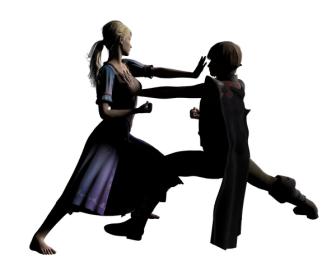
Height also played a role in the story. Which point lies close to the opponent's “shoulder,” and what can they reach easily? If it is the shoulder, the girl is not at a disadvantage. If it is, say, the stomach, she is not either. If it is her breasts, she is at a serious disadvantage. But that depends on both combatants' height and the height of their fighting stances. An attacker also steps forward a little, lowering their center of gravity and shoulder. So even if they are a little taller, a straight punch or thrust can reach the chest, while the face or head would be close for the defender. The picture on the right illustrates this situation, though imperfectly.
Reaching the thigh or attacking the more mobile arms and head is harder; most attacks would hit the upper body. When someone makes a “quick preemptive attack,” however, the attacker's arm and head can more readily be among the targets. This too is worth considering when describing combat.
Armor generally presses the breasts down because of its weight and many other factors. It is no easier to ogle the figure of a girl dressed for combat than that of a humanities student visiting the beauties of the Russian winter, thanks to the thick clothing that forms part of armor and protects against cold and, with some padding, blows.
Jumping or Acrobatics can increase the charging side's Defense value even during a charge, and it is possible to surprise the other combatant in the middle of a fight too. The story offers an interesting example.