
 Mention fear, and horror fans immediately point to their favorite books. Yet more people fear flying than zombies or Deep Ones. States and their leaders fear sabotage and elusive enemies. Many people chiefly fear being deceived, expend enormous energy researching supposed truths, and successfully deceive themselves with conspiracy theories. We will discuss these three forms of fear, primarily through several familiar accidents: the Comet disasters, the suburban railway accidents at Buda-Császárfürdő station, TWA Flight 800, and an EgyptAir accident. We will also touch on the Germanwings investigation, if only because of current events.
Fear of flying has two important basic forms. We feel one in the back of the aircraft, vulnerable, aware of dangers but unable to determine whether we arrive safely. Most people never experience the other. It requires operating and understanding some flying device or aircraft. No: neither a paper airplane, an unguided wooden model glider, nor even the average hobbyist's quadcopter qualifies. This fear begins where lives may depend on your mistakes. A healthy amount restrains you from pushing your limits excessively. It does not paralyze, but counsels caution. Every good pilot has it. The closer you come to your limits, and the closer crossing them would bring catastrophe, the stronger this fear becomes.
Only a brave person can face this fear, and a dedicated pilot can fly despite it. Today the aim is no longer dedication, knowing limits, and a healthy fear of crossing them, but cheap, untrained labor indebted to the company for training, never truly learning to fear those limits. Workers vulnerable and indebted to their employer have never represented a good situation. Fortunately, “vouchers redeemable only at the company store” do not apply here. Unfortunately, other ways exist to put employees into debt. The resulting insecurity and stress are another form of fear, for which life writes most horror stories. In any case, the fear experienced in this position more closely resembles passengers' fear.
Can constant fear and uncertainty make someone snap? Yes. Such a story, perhaps compounded by PTSD after a successfully managed emergency, is horror requiring no huge green tentacled monster: a human fate suffices. Call it personal horror. Its chief villain is neither an “ancient deity” nor a cultist, merely the passenger hoping to save one pound on a family trip, outraged that pilots do not earn less than London bus drivers and dare protest such conditions.
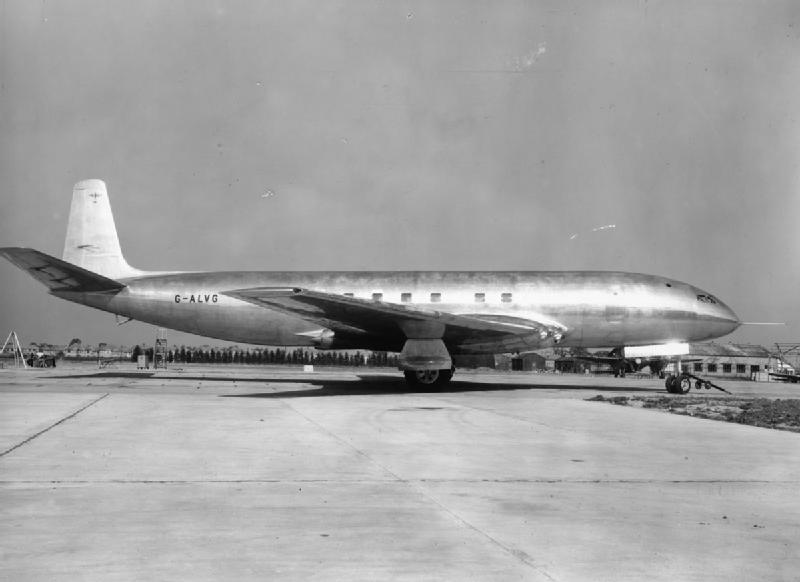
Fear of flying does not necessarily arise from fear of heights. More often, it comes from hearing about numerous disasters. Early aviation was dangerous, of course. Though faster than railways, the difference was not necessarily an order of magnitude. Ships and trains also suffered many mass disasters then; a crashed DC-3 would not necessarily dominate headlines and conversation for days or weeks. But an aircraft appeared that was faster, quieter, more elegant in many respects, shook less, and perhaps seemed safer: the de Havilland DH106 Comet. The comet. The first mass-produced jet airliner.
After little time in service, people read that unexplained accidents involving Comets breaking apart in midair had grounded every aircraft of the type. By the time the fault was corrected, the Boeing 707 and other American types were spreading and the jet age had truly begun. Aircraft became genuinely fast, greatly expanding air travel. Yet precisely here came many accidents that seemed worse even from afar than a sinking ship or a derailed, overturned, smashed train. Not only horrific images appeared: many thought of how little passengers could do up there in the sky.
The cause? Fuselage deformation from cabin pressurization, stresses accumulating at square window corners, and fatigue fractures. Boeing was fortunate to have pressurized-cabin experience from the Boeing 377, with round windows. They therefore probably never intended to make flying more luxurious with large, beautiful square picture windows. The Boeing 707 and 720 began a major success story. Of course, most people are somewhat wary of unfamiliar environments outside their comfort zone, whether water, dark cavities, or air. But fear of flying goes further: the image of helpless passengers, reinforced by accidents, is what truly triggers it.
Many recall the period using the phrase “Red Scare,” since half the West already feared communism's spread. Here in Hungary, state security feared sabotage instead. Especially when the second day of Christmas was a working day. Incorrect point-setting caused an accident at Buda-Császárfürdő station, killing twenty-six and injuring fifty-seven. A summary court sentenced the pointsman to death the next day. He was executed that evening. Sober fear would motivate people to discover what happened. It makes us respect limits and want to understand them: the foundation of scientific accident investigation.
The ÁVH's blind terror of every potential enemy produced show trials, and show trials conceal truth. Just as the regime's representatives fear dissent, terror appears on the other side. This is another kind of fear. A constant “fight or flight” condition continually drives people toward suspicion, fighting, hiding, or escape. Such a system is unlivable for anyone over the long term, but can be maintained by force. We no longer fear the ÁVH or saboteurs. Terrorists, cultists, zombies, huge green tentacled monsters, and even the Xenomorph often replace them.
I should note that the ÁVH could strike from almost any direction in that era. Whether Comrade Kovács II drooled from the ceiling chiefly depended on whether he was watching the female caretaker, the muscular East German swimmer, or shapely Julcsa trying to shower from above. But merely failing to meet a quota or plan, or refusing the rush that inevitably involved breaking safety rules, was enough for a “sabotage” accusation. Could this system itself have caused accidents? That could not be said, making scapegoating necessary too.
The EgyptAir case exemplified the opposite of this constant scapegoating: investigators concluded that the pilot deliberately caused the disaster. Against their scientific findings and genuine aviation expertise came the argument that suicide contradicts Islam. Fear of dissent and imperfection accompanies a narcissistic character. Some consider their own opinion important; others recognize their own imperfection but want to belong to something perfect. The desire to attach oneself to perfection connects to blind religious adoration.
Many fear their idol might fall. That idol underpins their personality. If it falls, their personality's foundation, their values, and everything by which they considered themselves normal and sane are questioned. Shall we say many here fear the unknown, frightening world of madness?
This fear has many faces too, and can push people ever farther from sanity. TWA 800 arises because the FBI was panicking there, its leading questions threatening to produce a show trial. Even after the Cold War, in a modern, developed democratic country, mixing professional investigation with a “witch hunt” caused serious problems. And though Special Agent White understood surveillance, and drooling only gave him away when watching brown skin, a hundred and fifty kilograms of flesh, and the accompanying curves, aircraft wreckage did not look like that. Yet the FBI's professionalism was questioned.
“Did you see the missile?” might have worked as a tactic with suspects. But what are its two likely answers? “I saw the missile” and “I did not see the missile.” “There was no missile” is less likely, since the witness believes the FBI. “I saw a streak of light, but it came from the aircraft rather than approaching it, so I do not think it was a missile,” in response to a tough FBI agent when the FBI has already examined the wreckage and surely knows what it is talking about... That hardly seemed likely.
The result? Accident-investigation scientists taught interrogation methods to the FBI's veteran counterterrorism team.
The causes? Everyone said an old aircraft was just as safe as a new one because it was regularly almost completely dismantled and reassembled, necessary parts replaced, every screw inspected. It turned out the screws were checked, but wire insulation was not. The resulting short circuit would not have mattered had they also examined how vapors in the fuel tank behaved at altitude... A semiconductor produced by chemical reactions inside the tank was dangerous only together with the other two causes.
Fear—in this case of terrorists—sufficed to make even the FBI irrational and see phantoms. In many horror stories, fear and the resulting irrationality are not merely reactions to danger, but the danger itself. Elsewhere, they blind us to other dangers, including ones that need attention.