
There is plenty to say about their scandals. But even more about the drop of over half a billion dollars in World of Warcraft and Hearthstone revenue. Fans readily point out, of course, that such a decline is no surprise, given the absence of an expansion release. I do not deny that there could be some truth in that. There could, that is, if the decline were only relative to 2018, and we did not also see a plunge compared with 2017. But the "Financial Model" uploaded by Blizzard can be followed quarter by quarter. Let's look at this little chart of the figures:
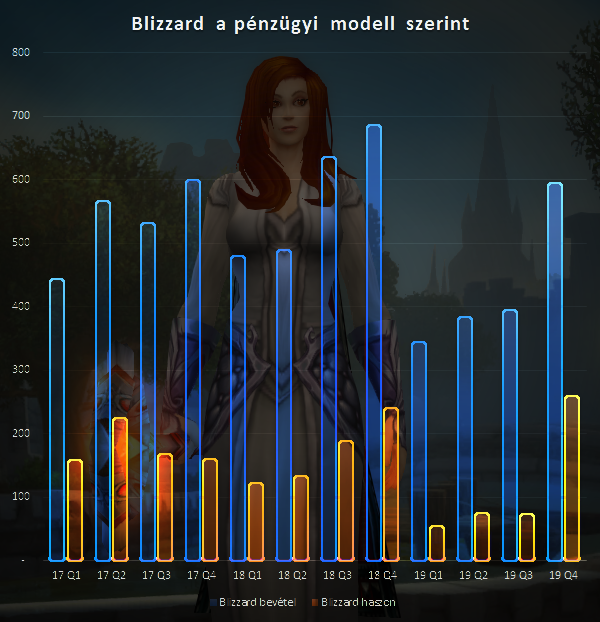 Well, the problem is easy to see: comparing 2017 and 2019 is revealing. We see a decline not only in revenue from external sources but also in profitability; indeed, that is where it really stands out. And I would point out that there was no release in 2017 either. It is easy to notice that revenue fell less than profit. Naturally, in a release year Blizzard's costs include manufacturing physical copies. Of course, those copies bring in revenue too. Isn't that last part wonderful news?
Certainly. Except that revenue from boxed expansions sold at retail is not the same as the price you pay in the shop. The shop may have its margin, and perhaps the wholesalers do too. After all, something has to pay for the cashier, the cleaner, the rent, and the business risk. So there was no launch-day rush to the shops. A lot of revenue and a lot of expenses did not materialize either, and that is a definite fact about 2019. We can also say of the returning and new players who appear with every expansion: no new expansion was released last year. But there was something else. Digital buyers jumped on Shadowlands preorders. And when it came to returning players' subscription fees, there was Classic.
Classic set viewing records too. According to Blizzard's annual reports, reactivations began as soon as it was announced, along with plenty else. A new expansion would have struggled to generate that level of interest. Some people returning for Classic ended up on retail and bought Battle for Azeroth as well. After trying Classic, they could try Legion, then buy BfA and preorder Shadowlands. There was a returning-player rush, and there were new players too. And Blizzard keeps a much larger share of digital purchases, since after a few mandatory taxes and card-company fees—which apply to retail copies too—there is little else to deduct. So the preorder packages, with their quite decent extras, generated a lot of sales, and I do not really believe purchases in the release year would give the game a much bigger boost. Why?
Because not every player is an idiot. Some players queue on release day. That takes at least as much enthusiasm as preordering, if you leave aside the added effect of the crowd. Yet at that point you do not know exactly what you are buying. An existing player, or someone taking only a short planned break, may return then, of course. But someone who previously got fed up with World of Warcraft will not trust blindly, buy immediately before player feedback arrives, and queue for a physical copy, with all the associated costs.
And this is where the problem comes in: a substantial proportion of players will talk their wait-and-see friends out of buying the new expansion. Not because it will necessarily be bad, but because whatever it is like, there will be room for subjective opinion. That opinion will be influenced by Classic, by how many people are there and do not want to return to retail, by the Warcraft III Reforged scandal, by distrust, or by a service provider struggling with increased traffic. And the main problem right now is the loss of trust. Someone who would have listened to a positive opinion a few years ago will now, because of confirmation bias, listen to the negative one. If Classic's player count falls, that means a further decline.
If the narrative that comes to mind about 2019 is that it had to be a bad year because no new expansion came out, and an expansion is such a big deal, it is worth considering that years in which an expansion is released rarely also see a new one announced, preorders opened, and much else. Expansion sales are, of course, supplemented by the masses returning around their release, but I do not believe the next expansion will generate more reactivated subscriptions than Classic.
It would also be hard to deny that the revenue figures concern Hearthstone as well as World of Warcraft. And there is a hell of a lot else to say, above all that this was still before the Reforged fiasco. The mess surrounding Reforged already affects the first quarter of 2020. Unfortunately, those figures are not available yet.
[UPDATE: The results have since become available:
- Blizzard is operating more efficiently, generating similar revenue at lower cost, and had a good first quarter this year.
- Last year's World of Warcraft growth, which was attributed to Classic, continued.
- Compared with 2018, Activision-Blizzard grew in the Far East and weakened in Europe and the USA.
- The increase in player numbers due to Classic continued during lockdown.
- In net revenue from external customers, both the Activision and King segments beat Blizzard.
]
And Reforged's release itself is not the really big problem. When Kotaku's Australian edition reports on the first major tournament after Reforged's release by saying that important matches are being lost to a host of technical errors and that the many problems caused by Reforged have undermined the championship's credibility, that is a problem. It affects more than esports: it also puts many potential players off the game. And it reinforces, a little further, the conviction of those who believe there are serious problems at Blizzard.
There are serious problems, and they also help explain the situations of Classic and Reforged. Revenue was particularly low in the first quarter of 2019. Nor is that when the physical release of Shadowlands brings in money in 2020. The second quarter was not good either. But the profit situation is even worse than the revenue situation. To understand that, a few small details matter.
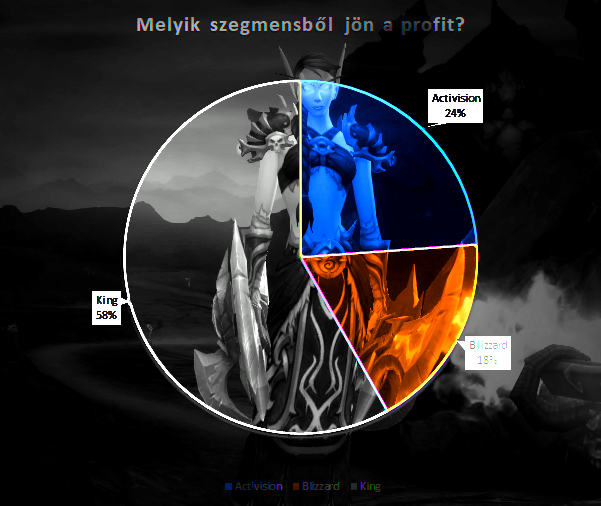
We can believe that Activision is the real problem. We can believe they ruin every partner they have. Or we can believe what the numbers say: Blizzard, which ought to be delivering a steady, reliable income, is underperforming. Not only because of the decline, but also because there was a quarter in which Blizzard was the weakest segment.
The latter, however, makes negative opinions increasingly easy to believe, while positive ones seem less and less credible. Many people will interpret opinions about the next expansions and the stream of criticism of Blizzard's next games accordingly. The real value of the Blizzard brand is changing too, and eventually that must be reflected in the books. Many hoped World of Warcraft Classic and Warcraft 3 Reforged would increase both the brand's value and the company's revenue. That expectation may not have been fulfilled.
The most important difference between 2019 and 2020 is precisely that World of Warcraft Classic generated revenue from returning players for only a small part of last year, while in 2020 it is available all year. The many refunds have certainly had some effect on Blizzard's 2020 results. Perhaps so has the number of people each patch drags back into the game. The quality of the coming expansion will certainly matter: it determines not only purchases but also how quickly players leave and the size of the player base that can be won back.
For a long time, Blizzard was considered a company in a privileged position because a substantial part of its revenue came from subscription fees, leaving it far less dependent on the quality of each new game than many other developers and publishers. But the subscription model also appears in Origin Access and XBOX Game Pass, albeit in a different form. The value of predictable, steady revenue is no longer confined to the MMORPG genre. Many games now derive most of their revenue from existing players' further spending rather than a one-off purchase. The market has changed.
And it is precisely that continuing revenue that lets the market improve a game after a bad launch. Delaying release after development gets off to a poor start works on the same basis, since substantial revenue independent of initial sales helps finance everything. In this new market, it is troubling that a significant share of the profit Blizzard previously generated steadily appears to be melting away. Revenue would not have to fall very far from the first quarter of 2019 to give investors serious cause for concern. The idea that Blizzard could have loss-making quarters no longer seems remotely unbelievable.
Something else is replacing predictable revenue. Although a strong final quarter can still be engineered with sufficiently aggressive marketing, two preorders, and plenty else, even that does not beat the Activision segment—not even close—and King tends to provide the profits during the rest of the year too. Following scandals affecting Blizzard but not the other parts of Activision-Blizzard, we have reached the point where, even if some saving idea appeared at Blizzard, it might well be sold under the Activision name instead.
Interestingly, in World of Warcraft, the alternative revenue sources of interest include not only pets, mounts, and other little extras, but also the WoW Token. I know that the game induces addiction by rationing loot, and many people obsess over it for that reason. Many buy boosts to get their equipment up to the required level. A pity their knowledge and experience do not reach it too. The WoW Token's other market is simple: people whose stated goal is not to obsess over the game or become addicted, but genuinely to have fun with friends and see some content, without needing a higher difficulty, also turn to WoW Tokens.
Why? Because on one side of the scale is farming something for days, suffering through some repetitive task: twenty or thirty hours of less than entertaining work to achieve something. On the other side is a twenty-euro token. So people prefer to earn those twenty euros through other work and concentrate on fun and enjoyment in the game. Yes, that costs more than an additional subscription fee and brings Blizzard more money. The problem comes when, for example, someone on a server full of Hungarians starts throwing a fit about a person pushing prices down while clearing out their bank because they need the space and a quick sale matters more to them than keeping prices high.
World of Warcraft Classic is primarily a game for people who do not want to fund their play by farming, but pay their subscription in money, and who may previously have spent that extra twenty euros on entertainment. In the short term, Classic brought many people back; in the longer term, it reduces the market for tokens, cash-shop pets, and much else. It leads to many people not returning to World of Warcraft because their circle of friends cannot agree on Classic or modern, while there is another game that suits everyone. Blizzard accepted these risks and sacrificed many expansion sales because it probably had neither a choice nor anything to lose.
Classic will keep bringing in some revenue for quite a while without substantial development.
And this deterioration is not Activision's doing at all. Blizzard is trying to live off three intellectual properties, reusing elements of those IPs in new genres when necessary. Those three brands are Diablo, Starcraft, and Warcraft. Starcraft was the last to launch. Since then, they can build a shooter or a card game on these foundations, but much of the gameplay is copied too. So Starcraft was the last truly big achievement; since then, it has been one rehash after another. Yet Starcraft nearly failed, because it was labeled "a boring rehash, Warcraft in space." But Blizzard made a U-turn then, just as it did over the revamp in Reforged.
And if Warcraft had borrowed an enormous amount from the Warhammer universe, the obvious solution was to open a few Warhammer 40000 rulebooks, take some factions and plenty of units from there, and make the game fresher and more varied. Thus Starcraft became a true legend and a landmark game instead of a failure. But we must not forget that this came from a developer so lazy that it had not even opened a book related to the source it had used before. There has been no new idea or new brand since, even though numerous genres have grown out of its existing tools thanks to countless mods. Because Blizzard was too lazy to notice the opportunities: it did not take risks, think, dream, or build.
Activision did not bring the problems. Quite the opposite. If Blizzard had been an innovative company with many creative ideas at the time, Activision probably could not have bought it. But it was entirely clear that growth potential on those foundations was finite. Partly because of the story surrounding Starcraft; partly because there was no new brand or new idea; partly because others were coming up with fresh ideas using its existing tool, the Warcraft III editor. Around World of Warcraft, too, people could see that many players searched in vain for instance groups, and the effect on the community of the expected matchmaking solutions—which materialized by WOTLK—was predictable. And World of Warcraft admittedly relied on addiction, on a form of gambling in which you pay and slog miserably for a chance, and on community pressure. Weakening that last element did not seem like a good idea, because when you go on holiday and cannot play, the addiction weakens. At the end of the holiday, two things can bring you back: the company, or hype around new content.
Even then, it was perfectly possible to see which Blizzard decisions had led to problems. If a studio is profitable and people see a future in it, most owners understand that it is not worth getting rid of it, and a publisher in trouble cannot buy it merely for the secure medium-term revenue. Its future is worth more than the profit that can be squeezed out of its finished games. Activision was able to buy Blizzard because a substantial proportion of Blizzard's problems already existed then.