
One of the first serious criticisms of traditional M.A.G.U.S. targeted its skill system: why are there only two ranks? After all, language examinations have basic, intermediate and master levels. Besides, characters could improve more gradually; reducing the entire path of development to just two levels is not necessarily a good idea. And even today, many people think they see the basic, intermediate and advanced trio in numerous courses and “professions.” Admittedly, this is more of a rare, exotic exception than general practice, because a machine operator with basic qualifications and a mechanical engineer most certainly do not represent successive levels of the same skill. As for languages, original M.A.G.U.S. had not two, not three, but six levels from the outset. Or seven, if we count complete lack of training. The arguments, such as they were, for changing things sometimes rested on very shaky ground. Yet they have shaped the history of M.A.G.U.S. ever since. They are why we got many new editions instead of many supplements, much to the regret of many of us, I think. And even if things seem to have been changing lately, the question is what good the change will do us: unfortunately, the damage has been done.
Promises appeared in the pages of Rúna Magazine of a five-rank skill system and who knows what else. As a result, instead of adventure modules and supplements filling in the blank spaces, we got a new edition in development. Which came to nothing. It is true that the M.A.G.U.S. system had room for refinement, but some of the promises appearing one after another were, to put it mildly, poorly thought out. At least they would have required the system's design to begin again from scratch. The promises also included a deadline, however, so the Második Törvénykönyv could not deliver the planned system reform. Instead, it contained material scavenged from mailing lists and became an odd patchwork: something had to be submitted, but meaningful work was no longer possible, and the creative team that had brought M.A.G.U.S. together had fallen apart. The attempt to reform the system gave birth to CODEX.
Remember, we are still before the publication of the Első Törvénykönyv. Development continued within VP, and work on the Summarium proceeded at full steam; we have already discussed its fate and so on. The solution promising a more adult worldview, a five-rank skill system and everything else failed. Customers wanted a M.A.G.U.S. core rulebook, not a new horror patchwork. Tough luck. And, of course, so many people still wanted five ranks, backed by the entire creative team of the time. Because, you see, there are basic, intermediate and master levels. This was just as important as the combined effort at the grand joint live Magisterium session that culminated in Csanád Novák shouting: “Because there is no hydrogen on Ynev!” This criticism is not aimed at Csanád Novák alone: the creative team achieved this together. There was not a single person there who could quickly answer those questions and put the answer in front of Csanád. Yet András Gáspár was on that team, and Zsolt Kornya was there too. Only the answer was absent. They did not see the connections.
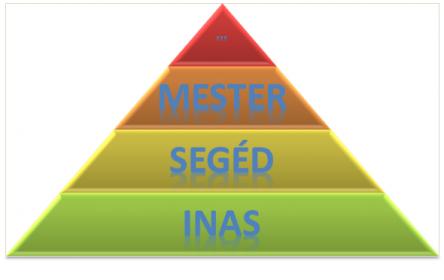 But many of us forgot other traditional ranks: apprentice, journeyman, master. This division worked for a long time and applied to almost every trade. And if we are talking about three ranks here, why should the system not aim to reflect them? Do we not need three ranks? I can give two good answers to that question. The first is relatively simple: the two ranks are not really two ranks, but somewhat more. Completely untrained, Basic rank, Master rank: even without adding anything, a character can have three different “skill levels.” In other words, complete lack of training is also a rank, one we must account for and one that does have a counterpart in the world.
We can therefore find an appropriate skill level for the apprentice as an untrained worker too. It corresponds to the apprentice's role. And no more ranks can be inserted if we also pay attention to tradition when teaching skills. After all, apprentice (untrained), journeyman (Basic rank), master (Master rank) are levels that exist in the world. The character sits an examination for each level; reaching it completes a coherent course of instruction. Until then, they are still “wearing out the school benches.” Traditional M.A.G.U.S.'s skill system thus gives characters a place in the world too. That is one of its virtues.
The problem with intermediate ranks is that while we know what can be expected of a journeyman or a master, we do not know the order in which a character acquires that knowledge. Different schools may use different teaching methods; examination requirements and the expectations attached to the levels recognized in the world are the only fixed points. Yet unlike many other systems, this system—even the traditional two-rank one—allows us to indicate that a character has only partially mastered a body of knowledge. KP already spent that has not yet produced a new skill rank represents precisely that. We can add plenty of detail in notes beside the skill. There is little to complain about in the system's freedom or gradual progression.
The required standard, the level recognized in the world, represents reliable knowledge, at least up to that standard. What lies between is less clear-cut. The same applies to the many titles above the level of master, or any divisions within that level. But even within skill ranks we can indicate how much time the character has already devoted to the skill, how many extra KP they have spent, and even what they still lack. So gradual advancement is generally possible.
Where mastering a body of knowledge costs a single point, this is rarely possible. But there are other oddities too, while we are discussing skill ranks. We know perfectly well that even in today's modern world, a machine operator with basic qualifications and a mechanical engineer have little knowledge in common. This difference is represented not by different ranks of skills but by different skills. Jewelry or Profession (Jeweler); Alchemy or Profession (Alchemist). The distinction can appear both in play and on the character sheet. That is no small virtue. Countless skills can complement one another and actually place the character in the world, rather than merely saying what they can do in a dungeon-crawl adventure.
A town alchemist does not necessarily need the Alchemy skill, because they mix specified ingredients according to a known recipe without understanding the real theory behind it. I would not call them a true scholar; they are another ordinary artisan, one who happens to mix various substances. Their knowledge is not much greater than a cook's; they simply work with different materials. They do, however, know what to obtain and where, when to expect demand for particular things, how to work quickly and efficiently, and what to recommend to whom. Their knowledge is a coherent whole even though they appear largely untrained in the Alchemy skill. Even a better-known town alchemist often has only Basic rank in Alchemy. By contrast, an alchemist at a wizard school or university knows the precise theories and methods of calculation, can handle many substances, is excellent in the laboratory, and produces new things—but knows little about supplying a small town with all manner of preparations. The two skills complement each other.
Skills representing specialized knowledge can supplement Master-rank Alchemy, whether they concern alloying particular metals or something else. Of course, alongside knowledge of metal alloys, knowledge of forging methods can also be useful, potentially including the smith's trade. In other words, we can describe an alchemist's knowledge in exhaustive detail by giving the character all kinds of skills. So it is also untrue that the character cannot improve during play, or can improve only a few times. A vast number of skills can complement the existing ones. Of course, explaining this is harder than promising a five-rank skill system and watching a whore remain a virgin even after many thousands of clients because she does not have 1 KP for the first rank of Sexual Culture...
Making promises and tossing out an inferior solution is easier than understanding a working solution and explaining it to the player too. Again, it was not only Csanád Novák who was ignorant, but almost the entire creative team of the time. Zsolt Kornya would have developed the five-rank Summarium, but András Gáspár was also part of the M.A.G.U.S. team then. He simply could not, or did not want to, contribute much to the concept. Make no mistake: in many respects they are excellent writers. But like most good writers, they value artistic freedom more than consistency between system and world. After all, a novel can remain internally coherent even if the many novels do not describe exactly the same world... It is only the poor player who suffers when their character encounters the inconsistencies.
Ever since, M.A.G.U.S. has continued to be built on that cracked foundation, with repeated attempts to patch the solutions together. The five ranks have remained. They even managed to invent “freer character creation.” I can just imagine a wizard at the Doran school passing the mandatory history examination because “I'm a freely created PC, for fuck's sake” is tattooed on their head. And yes, I can see all those “martial artists” loaded with HM who have merely forgotten about self-perfection and meditation, because that made them more powerful. Many new supplements, a renewed and coherent chronology, and novels with differing worldviews are all fine and good, and I enjoy reading them too—though I would not put them into the world. But without a solid foundation, they are worth little.
That solid foundation leads to the question: where does a master advance next? What sets apart those famous masters who rise above the rest? Special techniques and special skills. We know the skills that can be learned alongside Master-rank Weapon Use, and surely there are skills to learn alongside Master-rank Alchemy too. Alongside the alchemist's profession, one can take Alchemy, Herbalism, perhaps Poison Mixing, Physiology... There are numerous skills through which a master could improve, and learning them—even partially—could distinguish that master from the others. Talent, reputation and many other things can of course be mentioned separately too. The two-rank skill system, with its listed skills, is not a complete whole, merely a foundation. But at least it is a solid foundation, one that can work wonderfully with skills, descriptions and so on that build on and complement one another.
Many people identify “traditional M.A.G.U.S.” by its two-rank skill system. Yet the Első Törvénykönyv is a product of the period after the SUMMARIUM's publication—and, essentially, its failure—and contains numerous changes. Some of its new rules were likewise born in the spirit of “easier to promise than to explain.” Later came the Új Tekercsek to rescue the five-rank system... Then the unfinished system of the Grey Hoods, with forty-rank skills according to malicious tongues, written by authors who thought arrogantly confusing a bell curve with a pyramid diagram while hurling abuse was a cool thing to do. Of course, let us add that so far they are the only official creative team not to get as far as publishing even one volume of a core rulebook—but how well they disparaged all the previous creators. Then came d20, ÚTK, and who knows what Delta Vision is planning now.
To their credit, at least they are bringing out supplements as well, rather than just another new skill system.
But we can clearly see why a system of complementary skills matters for giving knowledge nuance, and why it is more than simply adding ranks. Looking at a good jeweler, we have the profession, Jewelry, and perhaps two or three related skills. Appraisal, for example; or just as Desert Survival was created on the model of Wilderness Survival, Trade could follow Estate Management and cover many things. That gives our skill system more than five significant steps, without tying the minimal experience gained in an adventure to a skill. If a character cannot improve in this area at every level increase because other things are needed too, then gradual progression is limited by the number of level increases, not by the number of skill ranks.
Although the existing system can easily be expanded into a percentage-based one, and I sometimes do that, this limit matters a great deal. So I see no point in a five-rank system that would immediately tie a moment's experience gained in an adventure—something belonging more to XP than to skills—to a skill and KP that must be spent.