
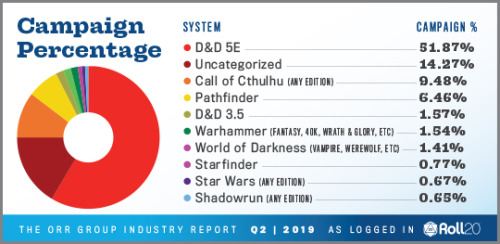
 We have seen charts like this in plenty of places. They are very easy to cite: there are lots of users, so obviously they must be representative. Well, the many official D&D platforms have plenty of users too, and there the share is 100%. Neither is representative, though, and there are several good reasons for that. One is that fans of different systems use platforms such as Roll20 at different rates. Perhaps because Roll20 does not support their system, and because that system does not need a “virtual tabletop” solution in the first place.
Only a tiny fraction of Storyteller players want a battle mat, fog-of-war support for it, or generic fantasy tilesets. Why? Because the system does not need them. Good file sharing for news that the characters can read, however, is very useful, and many VTT solutions are not particularly strong at that. If players with those needs use Roll20 less and are more likely to stay on Discord, Skype, and so on, a chart of Roll20 campaigns ceases to be representative of roleplayers as a whole.
Probably at least 30–40% of people playing D&D online end up on Roll20. Among fans of the Storyteller and Storytelling systems, the proportion is probably below 10%. When these tools do not really support Shadowrun either, lack suitable assets, and therefore add little to play while having drawbacks, it is hardly surprising if the proportions differ there too. But that is not the real problem. The real problem is that the chart above has only limited validity even for games played on Roll20 itself.
There are essentially two reasons for that.
There is plenty of content, short modules, that can be played through on Roll20 in a single day. Content designed for that purpose appears regularly for D&D. In other cases, whether in D&D or another game, campaigns would be longer if the group did not become inactive because of real-life problems. But figures produced by short campaigns and one-off trials—for example because of Stranger Things—do not amount to genuine long-term market share or popularity. However many problems I have with Vampire: The Masquerade, I can recognize that a long chronicle totaling 1,000 hours of play amounts to more than a GM running fifty short two-hour games.
And the options supporting lots of short games are prominent only in D&D, so D&D will already be substantially overrepresented in statistics like these. We were given no statistics on active minutes.
That is only one problem. I could introduce the other by quoting a meme. I assume you know this picture from Facebook?
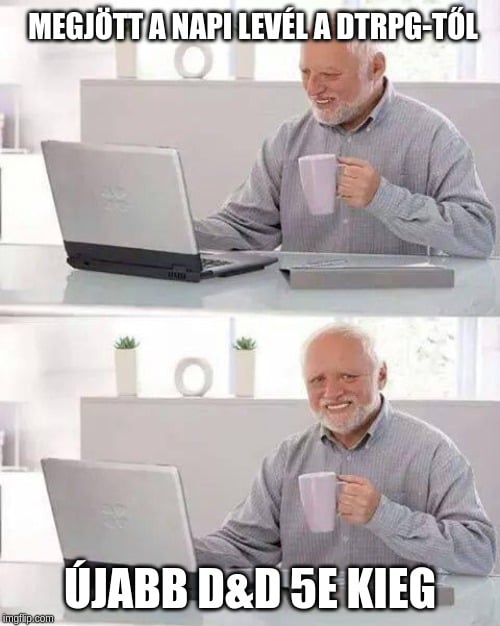
How the hell did a meme get in here? Because this is almost exactly the phenomenon in question. Almost, because in many cases making the meme is neither an authorized nor a permitted free use, and it damages the image's marketability. Systems compatible with 5E, however, are properly licensed under the OGL. The point is that counting every 5E-compatible system as D&D 5 is like praising only the photographer's creativity for every clever use of an image that became a meme, as if they had invented all the good and bad captions too.
Surely even the photographer is not that creative... Right? Yet the image becomes far harder to sell as a stock photo because it no longer carries its original meaning. I would not use it for an advertisement or buy a license to use it either. But I can show it and discuss it under permitted free use, pointing to precisely this process and critically noting that the photographer was not the one who recognized these possibilities.
It is no secret that I dislike D&D 5. Racial modifiers, certain class abilities, and other things contribute to that. A hell of a lot of people have tried to convince me it would be good; then what I see of their games often turns out not only to be bad, but not entirely D&D 5E either. Because they can deviate from it. Because, according to them, no sensible person plays certain things about hp as written, because they handle inspiration differently, because they do not even look up plenty of rules when building on the basics and guessing is easier...
There is the SRD, on which you can freely build another system. It will be a properly licensed product if you do not steal the setting to go with it. And if you do use a setting without permission, but nobody objects to homebrew systems and hobby projects, that works too. So there is the 5E-compatible approach, which encompasses more than D&D. It includes every development aimed at people who have had enough of one D&D flaw or another and want to play something that, while still 5E-compatible, differs considerably in many respects.
Up to what point do we count that as D&D and praise D&D for these independent creators' achievements? When do we acknowledge that, just as one photographer is not responsible for the creativity of every meme that uses an image well, we should not call the entire 5E-compatible ecosystem D&D 5? And if you say no normal person plays by various pieces of written nonsense, even regarding treasure, then is D&D good with its bad written rule, or is what you play closer to a 5E-compatible homebrew than actual D&D?
That question can fundamentally determine what we think of D&D.