
Index's Meanwhile column, citing Steam, says that because of the series, more people are playing the game now than at its release. There is the show's success: hooray for Netflix? Alongside the show, they mention sales too, of course. And the show motivates both people who like it and people who expected much more. We could debate which group is larger, but the truth is that it matters whose statistics we accept as authoritative. There are many games for which Steam's market-leading position would make me trust its figures; the Witcher game series, with its countless ties to another platform, is not one of them. All that is happening here is that the people who ignored GOG's many offers are now more active.
And it is no coincidence that The Witcher can be so well known today. Fundamentally, several things are involved. One is that it was created in the right place at the right time. The 1990s brought creative freedom to many countries in Eastern and Central Europe, more complex computer games with richer lore—and hardware capable of running them—to the world, and consumer Internet access on which communities formed for more serious fans hungry for lore. This also left some room for works by writers from the region who aspired to a "more serious, more adult" vision of the world.
It would be easy to say that M.A.G.U.S. got off to a better start: there was demand not only for sequels but for translations; the novel Két Hold and its related album opened a door to the music industry; and there was a "sister world" that could have been built on. The difference is that, while contradictory writing in M.A.G.U.S. destroyed its strengths, divided its fan base, and killed the possibility of successful continuation, The Witcher kept being developed. While Hungary's heavyweight managed to turn the mistress of debauchery—and here that really did mean feeble seed and, for the most part, infertility—into a fertility goddess because an earlier creator preferred the nature goddess, who was more suited to fertility, The Witcher remained consistent without such destruction. There is a reason The Witcher is a world-famous creation today.
But that is not what the real issue is about. The Witcher's success is not just about Geralt either, but also, among other things, about a much stronger subject. We do not see ten or twenty different attempts to save the world in the same period; instead, people are fighting an occupation. And there is no Polish author who lacks relevant experience to draw on or has not heard plenty from their family. Nazi rule, communist rule, the often ruthless dominance of globalization and the market, and the emergence of ideologies now felt to be totalitarian provided abundant material for writing The Witcher. In this respect, The Witcher's story is truer than many other fantasies, and its foundations may be better than those of Game of Thrones or many other familiar stories.
I say this despite not finding Geralt particularly likable. But that is precisely why I feel it is not only believable acting that matters: the portrayal of the conflict and the world needs some authenticity too. And that brings the casting controversy to mind.
Of Henry Cavill's acting I can say that he carries the show, is sensational, and deserves appreciation for his work. I can add that Anna Shaffer's acting receives, to put it mildly, rather less praise. But for a story with such strongly Polish characteristics, there are surprisingly few Polish cast members. And those who regularly find a character insufficiently Asian, Muslim, or something else keep their mouths shut, because Poles are white and therefore born oppressors. Strange: that is not how I learned the history of either the Second World War or the communist regime that followed, but apparently some people are not entitled to equal protection.
Somehow, what I learned was that the Poles suffered quite a lot during the Second World War, first under the Nazis and then the Soviets. Frankly, the kind of "oppressive white" Polish Jew who comes to mind is someone whose family could have had far more survivors if a few Arab attacks and the British government's betrayal had not deprived European Jewry of the Middle Eastern refuge they had fought for. It is an interesting question which family Netflix kicks in the teeth with quotas functioning as a new numerus clausus, in the name of political correctness, helping the "oppressed," and holding back the "oppressors."
I am not bothered by this or that cast member being insufficiently Polish. That is why they are actors. What does bother me is Netflix sticking to quotas on this issue, backed by the usual narrative, entirely insensitive to the fact that The Witcher, as a story of occupation, also concerns the historical events from which its author drew his material. Twentieth-century Polish history, including the history of Polish Jewry, is therefore relevant to The Witcher. And if those who pay and call the shots are insensitive to that context when casting, and hire people with the same attitude, then we must also be critical of changes to the story that are not ideologically neutral. All the more so when they undermine the story's credibility.
Incidentally, our money and time have value, and we vote by deciding what to spend them on. That is how most of the Witcher games ended up on my computer.
With the Polish publisher and the community surrounding the game, potential players and customers have already made their purchases. Many games in both the Witcher and Galactic Civilizations series ended up in my basket because I vote with my money for a business model that respects players, even if that particular game does not interest me, because I want the publisher to have money for the next game. Mixed feelings about The Witcher are justified. In a computer roleplaying game, I prefer having my own character. I struggled to accept the lack of one even in the sensational Planescape: Torment, and a monster exterminator like Geralt appealed to me less.
I said I vote with my money too, and if I launch the game and write a review, I immediately become biased. Even with my favorite games, I immediately mention a fixed character as a flaw. But with The Witcher, if I devote one sentence to that, I would devote two to how much it captures of the book's atmosphere and ideas. Because the developer's decency, thoroughness, and so on persuaded me, won me over, and handled the story well. The visuals also convey much of the novels' world, and that is easy to praise in a modern game. It is also easy to say that Netflix's series ought to convey more than this—and not merely in terms of 4K HDR and other technical matters.
Netflix, however, has not earned a similar bias in its favor.
Many complain that the Holocaust receives too much attention in Western filmmaking. Unfortunately, it does not receive enough to make certain things occur to the people making those films. Among other things, during casting they fail to remember that there were parts of the world swept first by Nazism and then by communism, with both Jewish and non-Jewish families among the victims. Niemöller summed up the problem with the Nazi, or National Socialist, regime well. Someone who did not speak out because they were not the enemy at that time and place could easily reach a point where, when their turn came, there was nobody left to speak for them.
Nazi ideology fundamentally rests on the realization that, just as the traditional left turns the emotions of rebellious, mostly left-wing groups against the ruling class—the class enemy—those emotions can be turned against any other group declared a scapegoat: Slavs, including Poles, Jews, trade union members, socialists, Roma, Hungarians, and so forth. The invention of Hitler's system was not antisemitism, which had existed in the West for centuries, but the realization that the oppression of the state-socialist, communist system could be deployed against any group.
If you are not a man, and therefore some grand dame of intersectional feminism does not deny your human rights on that basis, you can still be branded a born oppressor for being white, from the moment you are a newborn. Or you may be heterosexual, cisgender: by branding any new group oppressors by birth and excluding them from universal human rights, any enemy can be eliminated. This is how the perfect totalitarian politics, and history's most terrible killing machine, came into being. If this circle singles someone out, we reach the point where a person may be gay but not gay enough, allowing this new kind of Nazism to assign them the role of the "evil oppressor taking someone else's place who must be excluded."
On this issue Netflix has chosen its side, just as HBO has: HBO takes risks on many bold productions, is not always politically correct but is generally decent, seeks artistic freedom, and values artistic vision. Most viewers of the series are Netflix subscribers, and many audience reviews must be understood in the context that they come from someone who does not mind Netflix-style propaganda, who subscribes and watches its shows despite all its sins. If you are a Netflix fan, its recurring faults will not make you skip this series either, and if Netflix
It is an anomaly, not the natural order of things, that the series is also watched by someone who did not become a Netflix fan after seeing the famous—or notorious—Making a Murderer. I did not become one, because in response to its narrative, the justice system pointed to many scientifically supported facts showing that this much-celebrated "documentary" was not an authentic, anti-establishment record of its times, but false propaganda for a mainstream political movement. And since I do not swallow that from M1 or Origo, it could not count in Netflix's favor either. Many good acquired series, such as Mad Men, were also on HBO GO. Netflix was on the back burner. Perhaps I gave it another chance two or three times.
Then I happened upon Mindhunter's first season. If there is a Netflix production that deserves a like, then the trio of like, nothing, and dislike can provide meaningful feedback. Since then, there has been occasional room for Netflix, and it even surprised me with, for example, episode two of Criminal: Germany. Surprised me, but did not persuade me. A system capable of turning against anyone can end up on a side of a conflict I agree with, but so can someone who rejects the system itself. Netflix, so often ticking the propaganda box without real sensitivity, artistic vision, or perhaps artistic integrity, also came up short at the Golden Globes and had not won me over. But there was a chance that The Witcher would be a pleasant surprise.
In the series, we can infer that the religion of the White Flame likewise describes a totalitarian system and an empire seeking world conquest on that basis. Yet while we know that Star Wars grew out of Second World War stories Lucas misunderstood as a child, with the Polish cavalry's light sabers becoming lightsabers and the Jews becoming Jedi, creating perhaps the world's best-known film franchise to address the Holocaust too, The Witcher does not tell us whom Nilfgaard corresponds to. It nevertheless presents the same concepts of occupation and an inhuman occupier.
It can correspond to the German occupiers just as readily as to the Soviet ones. And with the sun as Nilfgaard's symbol, the story may also bring to mind the Nanjing massacre and Japan's role. But the image of Nilfgaard, blindly convinced of its own righteousness and goodness, fits equally well with the genocides in the former Yugoslavia taking place when the book was written, or the genocide in the Hutu-Tutsi conflict. And of course, if you submit, your system can remain, so there is no forcible export of democracy, as in Iraq: what remains is the media, propaganda, and stuffing the appropriate organizations with money.
One possible hint about which totalitarian system Nilfgaard truly represents is the situation in which everyone gets something, but everyone gets the same thing, which may point to communism. So may the enduring autonomy of satellite or occupied states, and this is a monster the author himself encountered in his lifetime. Yet the mention of religion and faith, and many other details, contradict that. The color white also emphasizes something else.
Geralt, who believes in "live and let live" even toward many monsters, can spare intelligent beings. Even when necessity makes him kill something for which he can do nothing else, because he cannot relocate it, he has principles. He has been able to achieve results with many other groups, but Nilfgaard is a human monstrosity against which he has had no chance to pursue a peaceful solution. The opening episode establishes Nilfgaard in a similar role. But...
But we cannot say for certain whom Nilfgaard copies, and part of the truth is that quite ordinary situations can suffice to violate human rights. A system might leave many people by the roadside to starve because their problems are politically unimportant, and the right to equal protection under the law is easily ranked below political goals. So a Polish story of occupation can be about many occupations from the last hundred years of history, including "democracy export" and its many present-day excesses.
That is another reason why changing the story and subordinating it to the familiar political narrative is unacceptable. The first season adapts short stories that establish the main characters' personalities, using several timelines to do so. In many other situations, Geralt has chosen live and let live, persuaded many people to do the same, and saved others. But a defining feature of Nilfgaard is that there is no chance of a peaceful and good solution, even though it does not currently treat the peoples who submit to it particularly badly.
The story often says that mutations strip witchers of much of their humanity, and that they mostly concern themselves only with monsters and money. Yet an important element of the actual main story is that Geralt does concern himself with more than that, and even finds himself involved in conflicts and wars between humans. That needed to be established to some degree.
It matters that when monsters are cursed humans who can be defeated but also saved, and cannot currently—yet—be considered intelligent beings, saving them is Geralt's first choice. But there also had to be an example of Geralt being largely compelled to intervene in a human conflict, specifically against a human monster who rejects an offered solution that would be good for everyone and is prepared to kill, or have killed, masses of people out of personal rage. We encounter this groundwork at the beginning of the story. Here was an originally logical, well-constructed short story that established the world well, and we get an episode that drastically changes its ending and conclusion.
Without a real artistic concept. The great pity is that this damages the context of one of the fundamental conflicts of the series and its stories without caring about the connections. The bigger problem is that the series thereby deals its own credibility a blow. If it distorts things this much in episode one, and in precisely the direction many Netflix series lean, there is a problem. But we should think not only of the context above and its connection to Nilfgaard. This incident is also why Geralt is called the Butcher of Blaviken; that reputation establishes his relationship with Jaskier, and that relationship leads to Geralt's and Ciri's destinies becoming intertwined.
So this situation is very much the foundation on which many other scenes and stories are built. It is not only Stregobor's character that matters, or who responds to Geralt's intervention and how, and what direction that takes Geralt in. We can mourn not only the conclusion arising from people's motivations, but another fundamental thing too. If Netflix reverses who the real asshole in the story is, so that this is no longer the person who dies, and Geralt never seriously confronts the real asshole, the protagonist's basic character has been subordinated to the political narrative.
There is a problem, because this is a pretty nasty punch in the gut. Anyone who wants to film feminist fantasy has the opportunity. There is no need to butcher the connections within a Polish work with a different tone. You would turn on the subtitles and take a screenshot. Well, the subtitles show up, but the picture is black. Netflix restricts screenshots. Taking a screenshot for criticism is a permitted free use throughout the world. Here, though, you immediately have to ask a lawyer or someone else whether circumventing the protection is allowed for that purpose, or obtain a screenshot from an alternative source.
I find this situation ironic. Ironic because CD Projekt's and GOG's extremely consumer-friendly policies contributed greatly to the Witcher games' success. It was natural to say we vote with our money and are happy to buy the game even if we are less keen to step into Geralt's shoes. Netflix's policy here runs counter to that consumer-friendly approach. Not only can we not buy the work, and not only is the DRM strong, but screenshots are blocked too. As part of permitted free use, a critique or review could use not only screenshots but excerpts. Yet circumventing the protection and using the subscription in this way would not be a straightforward matter either.
Of course, we can obtain the screenshot needed for criticism from someone who allows us to use their screenshot taken for that purpose, and who does not watch the work on Netflix's platform. Instead, they smile and point out that, through a collective rights-management organization, they have paid for the right to make a private copy, and that, under the courts' interpretation of the law, file-sharing services and torrent sites certainly fall within that lawful use, in their view.
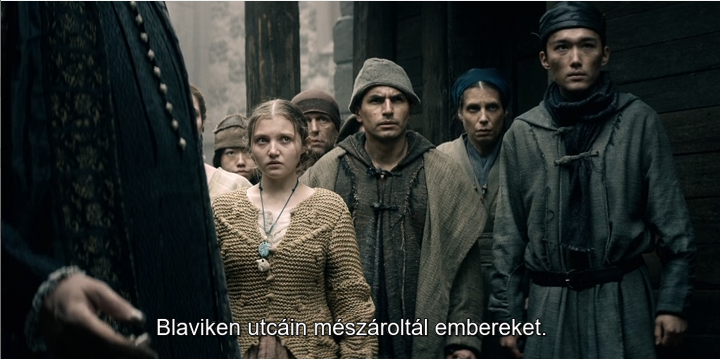
Alongside criticism of Nilfgaardian armor and a few poor casting choices, this scene perhaps receives the most criticism, precisely because it overturns the foundations. If, as with a television broadcast, viewers had a week to forget the disappointment, this might not be a problem. Netflix, however, released the whole season, all eight episodes, at once. It matters that Queen Kalis's story is not based on a short story. Neither her complaints there nor Yennefer's feminist-style remarks are therefore part of the previous canon.
What is part of it is Yennefer regretting other decisions: as a careerist sorceress who uses and exploits men, she made sacrifices she does not necessarily consider wise. So the propaganda inserted here may be just as alien to the original concept as the changes to Stregobor's behavior. And this whining is clearly intended to depict a society that oppresses women and makes them worthless. One small problem with the story is that Queen Kalis's other daughter, Meve, becomes Queen of Lyria and Rivia, a rather important historical figure and, incidentally, the protagonist of the video game Thronebreaker: The Witcher Tales.
Putting the claim that women are used only as vessels into the mouth of a sorceress who also exploits men and sees into their souls; denying the emotions on which her manipulation depends; portraying even a daughter who later becomes a successor as worthless, in a setting where inheritance through women exists and we know of no male heir born to a new wife: I find that strange. Of course, in Yennefer's past, starting with her childhood, we see many stories without a literary basis, carrying a kind of feminist narrative centered on the objectification and expendability of women. Even behind Yennefer's initial escape and magic is essentially the idea that women are judged by their beauty, or lack of it, and bought and sold as objects.
We hear the Queen of Cintra say what she could have done if she were a man. Yet in the same scene where she talks about traditions that bind her, she would break one of her people's most fundamental laws, even defying fate itself. So is she a feminist whining about patriarchy, or a warrior lioness who breaks the rules and confronts fate?
And here, with a few spoilers, we return to one of the scenes that establishes everything. Renfri, then. Geralt told her precisely that she would become the monster people consider her because of her mutation and the time of her birth if she began slaughtering innocents indiscriminately. As a human being, Renfri chose to become a monster. At the end of the original short story, Stregobor, who hunts people born under a similar conjunction because of a prophecy, may want to dissect and examine her, but when Geralt forbids it he moves on:
'As you wish.' The wizard turned away, his staff hitting the flagstones. 'I'm returning to Kovir. I'm not staying in this hole another day. Come with me rather than rot here. These people don't know anything, they've only seen you killing. And you kill nastily, Geralt. Well, are you coming?' Geralt didn't reply; he wasn't looking at him. He put his sword away.
Stregobor shrugged and walked away, his staff tapping rhythmically against the ground.
The quotation comes from the English translation. It is easy to see that Stregobor also offers Geralt refuge here. In the series, by contrast, he whips the crowd up against Geralt, effectively betraying the man who saved his life too. We can broadly understand that, in the book, Renfri is the human monster more difficult to deal with than her nonhuman counterparts; here, Stregobor has become the bigger asshole in the storyline. And because the dangerous mutation affects women, he can readily be portrayed as a misogynist. If the nudity in an illusion is different too, and the illusion is spoken about differently, then the series builds an image of patriarchy around Stregobor, who guides the careers of many mages.
Everything the Poles, including Polish Jews and others, went through counts for nothing: not when casting discriminates against them, not when quotas—the new numerus clausus—work against them in other jobs, and not when their story ought to remain in the series instead of the propaganda Netflix pushes elsewhere too. The suffering and rights of that people, and of many others, simply do not matter because they do not fit the usual narrative. Whether as white people, heterosexuals, or something else, they can be stripped of equal dignity and equal consideration as the "privileged Jews" of a new enemy image constructed using the Nazi method.
And of course it is a legitimate opinion to say you do not care about the politics. Fine. But what about a previously more logical and relatable story becoming worse because your expectation of better-quality entertainment does not matter? What about more and more things being botched because politics matters more than quality, to the point that many of us no longer go to the cinema for that very reason?
Looking at the foundations, I see in the books a story more interesting than Game of Thrones, addressing more important subjects. And this story has an ending and is written according to a proper concept. In the series we see mostly good costumes, beautiful surroundings, and sensational acting from many performers, so it could be a very good creation. From the other side, HBO showed great courage in undertaking Game of Thrones at the time: there were few comparable precedents, and its sprawling, unfinished story was a risk too. Netflix, looking toward the assured success it could already expect, bought a story that was easier to realize, somewhat timidly avoided direct competition, and began reproducing much stronger source material through political propaganda.
This happened in a year when many awards were a question of whether they would sweep the board or fall flat on their faces, and even journalists who normally tolerate this kind of propaganda let them fall flat. If we ignore the faults and the propaganda, we see the foundations of a visually impressive, interesting fantasy and can hope Netflix will improve matters. If we do not, however, we have to say that for someone who generally tolerates and likes Netflix-style propaganda, occasionally pushed too far, this is perfectly adequate as an attractively filmed Netflix production. No more, no less. For anyone who avoids Netflix for this or any other reason, it is not worth subscribing for. And the conclusion that it will do as one option in the catalog of a service that is worse in many respects is hardly a glowing opinion... Even with the best acting and cinematography, it is worth no more than 4/10.