
A glance to the left and I can see my printer. What I would have given in the early 1990s for a fast, efficient color printer that handled large sheets of paper. But owning equipment like that became realistic today, not back then. Just as with a Hayes-compatible smartmodem, the modem was smart, but anyone who thought an image over ten megabytes would reach every player within a reasonable time was not. Yet even then, while playing and running AD&D, we naturally wanted maps of the characters' estates and plenty of other locations. Sometimes drawn in ballpoint pen in a spiral notebook. Today, more and more people insist on purchased campaigns: they come with battle mats and maps, so why bother making maps or roleplaying when you can immediately play, roll dice, and win? Some people still refuse to appreciate the brilliance of this, though, and insist that even the first edition of D&D was about playing an imagined character.
If I look through a group today, I am bound to find some popular person widely considered intelligent who is surprised that an accent that is hard to understand interferes with play. The question is not how to improve the overall experience, but how to make carelessness count as just as good as care. And presumably nobody explains the game system to them in four or five sentences either, so why bother researching? Often even the basics are beyond them.
Some people do not even understand that the situation described by the DM does not depend on what the player thinks hp means. If someone cannot distinguish the two participants in an entirely simple situation and becomes an asshole as a result, there is no point burdening them with more than one NPC in an adventure about politics and intrigue. A dungeon and a succession of enemies to slaughter will suit them perfectly.
Before you say I am talking about one person and bad-mouthing them outside the group, let me point out that I deliberately named nobody. The debate about hp, for example, is as old as D&D, and scenes like this happen both when someone is rude to me and when I am merely reading. The presence of large numbers of unnamed idiots, however, is a market trend. What counts as modern will be determined by what suits them too. Even if, for example, DeviantArt has plenty of roleplaying groups whose members tend to thank people for criticism, respond intelligently, and pay attention to detail.
Campaign Cartographer 3+ and its many add-ons, however, do not suit these people. Even assembling the simplest usable map requires things they hate: thinking, calculating, learning, and experimenting. Like it or not, they are potential customers in this market too. And they substantially outnumber those who consider turning to 3D modeling when even the best program for maps like these is not enough. These masses are long-term customers for RPG publishers, and good customers at that: they buy almost every adventure and bring in the most money for the smallest investment. Those who think about overcoming the limitations of 2D software through 3D modeling when plenty of good programs are still insufficient will spend their money elsewhere. We buy software for making maps, printers, 3D printers, and similar things instead of adventure modules and miniatures.
And I think that is fine. The example above is deliberately stark and exaggerated, and someone will surely take offense that I am discussing the stupidest people. But the truth is that WOTC belongs to Hasbro. A marketing person there is unlikely to be a serious roleplayer and very likely to say they would rather open this market toward the less intelligent than toward the more intelligent. Precisely because printers, faster internet, a million and one possibilities, and a whole range of software makers from NBOS through ProFantasy to Autodesk are available. Someone who makes maps for characters' estates and political rivalries, and has spent hundreds of dollars on software for doing so, is far less likely to buy easily produced, profitable adventures and campaigns.
There is a much bigger problem too. Someone who looks for flaws in their own maps and 3D renders, who learns to recognize many mistakes there, increasingly does so instinctively. When they look through a published module or campaign, they will spot flaws instinctively because of that experience. This is not the crowd likely to enjoy Adventure League and other events either. Campaign Cartographer 3+, however, is a horrendously expensive solution. Even with a 46% discount, buying it costs £424.
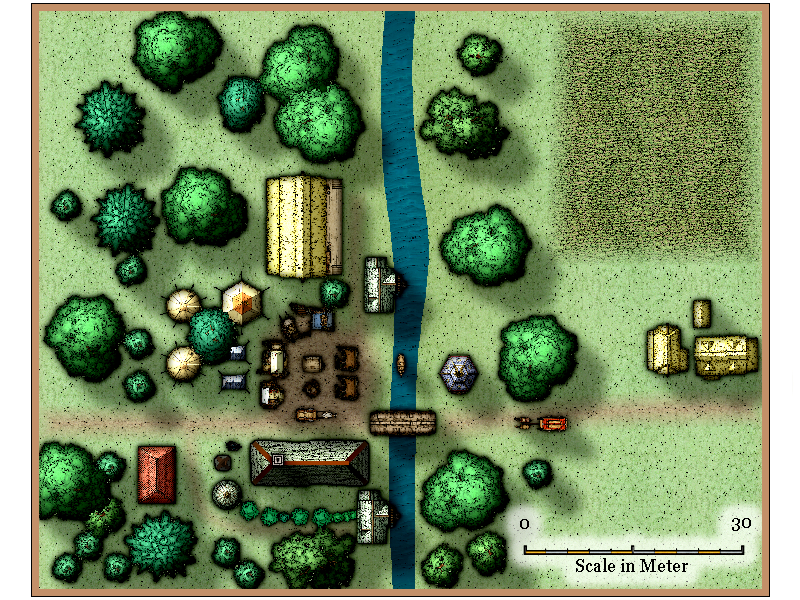
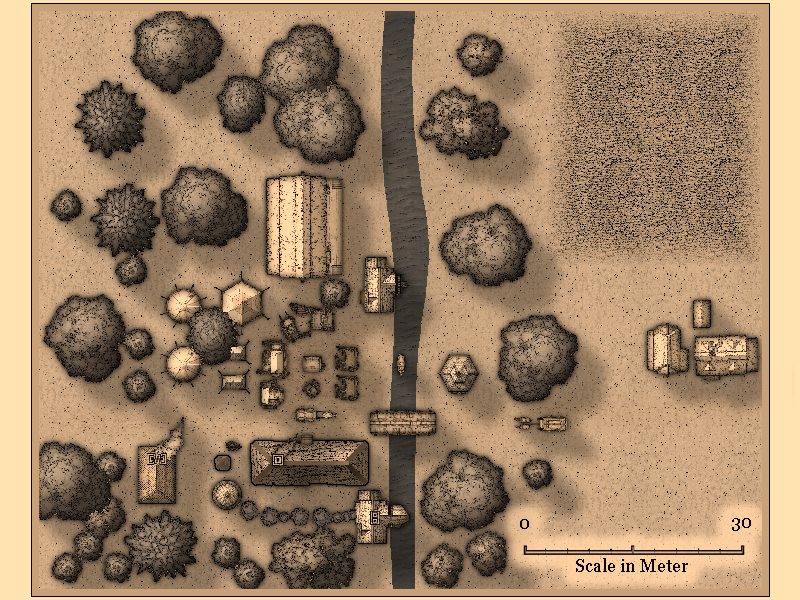
The basic User Manual is 99 pages, the “Essentials” booklet for an add-on chosen at random is 35 pages, and the paid handbook for learning the program runs to 724 pages. And of course you often have to consider several things, rather than just one. The story behind the map above is that when the party arrived in the area and was allowed to build, the first things we put together were a wooden bridge and a small inn. There was room for trading opposite it, and the group built outward from there. One detail to consider is that if a waterwheel is only available with the watermill building, then either the watermill or the sawmill needs a new design, so you do not have two identical buildings.
But there is a more important consideration. The party built so much out of wood because that was what they knew how to work with. Although their first building provided accommodation for themselves and a resting place for people using the bridge, naturally they wanted to be present both there and at the sawmill. The newer building can stand beside it. In the longer term, however, a better road will lead to the sawmill, a warehouse will stand beside it, and we can expand southward on the map. This is where more power from the water is needed, and where there should be more signs of industrial activity. In other words, it is natural to weigh several considerations together, and those often loosely related considerations determine what should be done and how. Sometimes, getting good advice means leafing through the book too.
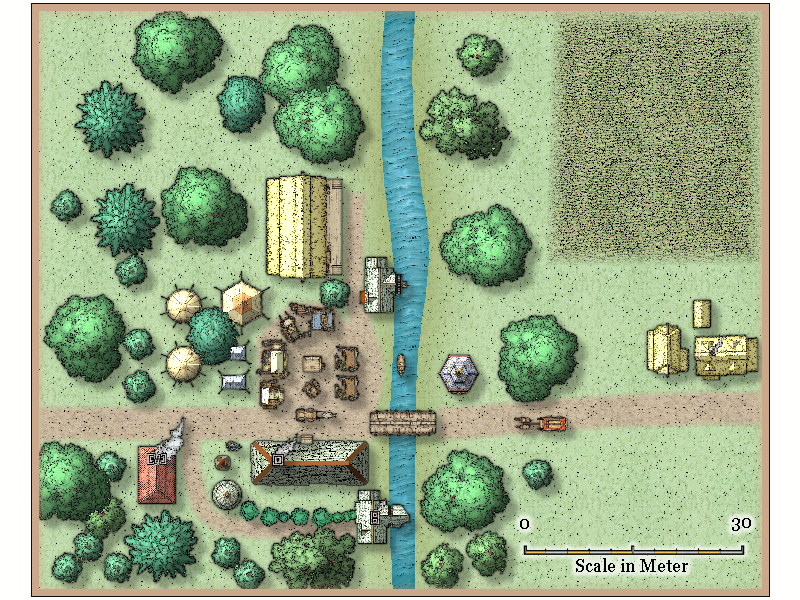
You guessed it: the three maps are really one, though the first lacks a few details and is an initial, unfinished alpha version. What you can see is that these maps can be saved with different sets of effects. One innovation in the new add-on is precisely that it includes multiple effect sets. Another is that it gives us more striking tools for terrain; the set is better thought out, even though the installer is not particularly large. You have probably also noticed the absence of a 5-foot grid. There is none because even this small settlement does not work well with that grid, so tools built around a 5-foot grid would not be particularly useful here.
Obviously, having preordered a tool only now being released, and having encountered a few small bugs, I am not using it particularly well during my first attempts. Fences, hedges, and many other possibilities will be better in the next attempt. There is no instant sense of achievement: I have to discard too many maps before I get one that makes me say, “Okay, now I know the basics.”
There is currently demand for a new campaign whose premise is that all the characters begin with newly acquired noble titles. They received their titles and estates at the same time, in the same region that has been almost razed to the ground, so the location itself provides a series of adventures. I will need maps of many small areas, so acquiring the latest add-on while it was still at RC 1 seemed a good idea. I noticed that its effect settings were not made for metric maps, so “imperial” units or custom settings would be needed.
So far I have encountered only one visual bug, which disappeared after reloading the saved file and refreshing the image. The new add-on is therefore almost perfect. Almost. There are difficulties, and here is an immediate example.
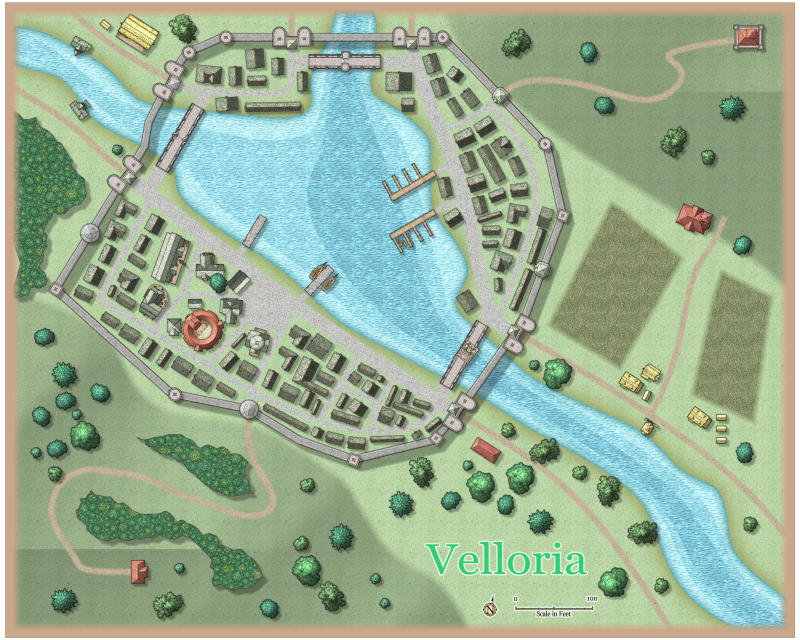
As you can see, the nicely shaded terrain has turned out a little strange. If we do not insist on exporting only the area inside the border, the exported image looks slightly different, but still imperfect. Mainly, the programs being called probably receive different data, in a different way. The remaining option is to try printing the onscreen image to a huge PDF, then save the image from that using a graphics program. Hopefully export bugs like these will be fixed in time; this is still an RC version. We will see what the final release is like.
Great! Except the topic might be whether three mills, the fishermen, and trade provide enough food when the surrounding farms and fields lie on only one riverbank. I think the terrain makes substantial arable fields impractical. The problem is that sufficiently uneven ground is very difficult to plow with human or animal power, and the valley is not wide enough for a decent-sized field. All kinds of details emerge that can be refined through discussion.
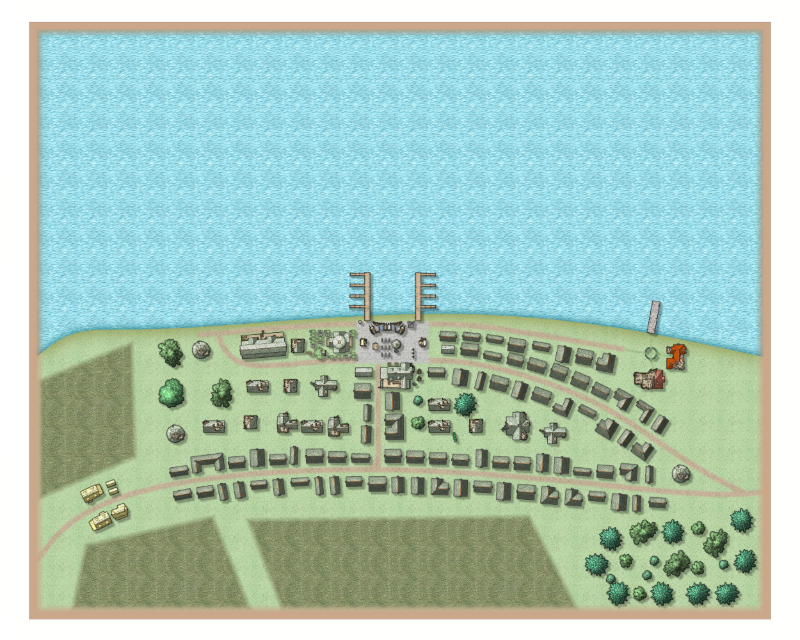
But here the approach of not thinking through the world or system, and simply assigning any task a target number using the basic roll mechanic, will not work. Yet plenty of people argue on the basis of why look up how it works in the world or what the books say, when in D&D I can pull a target number out of thin air? It is a great shame that, despite the assigned target number, the event often would not fit the world and would be prohibited by the system too, taking them ever further from the D&D in the rulebooks. Just as they have no desire to research, they have no desire to weigh distant consequences either. They rely on players not expecting consistency or asking questions. If that assumption fails and produces a mistake, it is obviously not D&D's fault: responsibility lies with the legend of D&D's flexibility and a DM with this attitude.
If you can see the map and infer details from it, you will find it increasingly easy to ask such questions. Yet a hell of a lot of adventures start with “do not ask how a village can exist if...” Because there is no answer; the adventure simply needed it. For that, drawing things that make the relationships immediately visible is not helpful.
We know the story: if a GM verbally describes how feminine an armored woman is, nobody objects. Show a picture, and a million and one questions about the armor arise. A million and one, except that for many magical suits of armor the magic is decisive, as is the way enchanted armor adapts to its wearer's body, following its size and contours by itself. And the fact that others would imitate such armor for psychological reasons, while the expected disaster fails to materialize because there are so few direct, clean hits. Somehow that always causes trouble. A settlement having nothing to eat, creatures not even fitting into the adventure location, or players failing to understand one another because of language barriers never does. Carelessness is great, but there is no need to accept someone else's character or opinion if these self-appointed leaders dislike it.
When you see a map, its errors are jarring too. People have often complained this way about maps of Ynev or other worlds, and explanations did not interest those who wanted to pick a fight before trying to understand. Banning that attitude from a game is a realistic choice for an individual DM, but a publisher cannot afford to turn its back on everyone who behaves that way. On the other hand, a hell of a lot of details can be discussed, and decisions reached by weighing many considerations, even if that takes a little research and a lot of reading. In that case, having new tools to create better city maps, easily map a village and its surroundings, and work with numerous new possibilities is wonderful. It just is not the mainstream anymore.